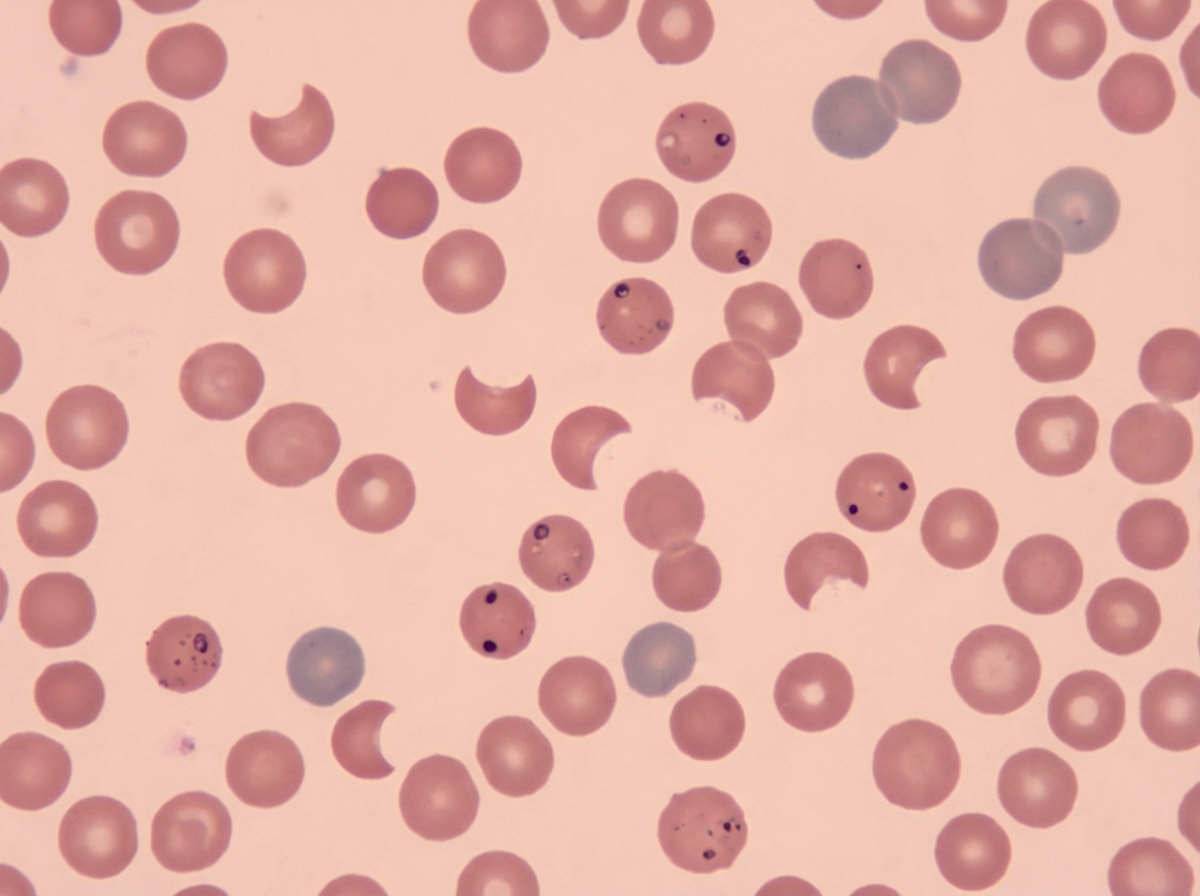
A 36-year-old man from China presents with increasing fatigue. He has a 3-year history of tuberculosis, and CBC shows a mild microcytic anemia. Blood work-up demonstrates low serum iron, low iron-binding capacity, and increased serum ferritin. What is the most likely underlying mechanism for the anemia in this patient?
The Schilling Test is abnormal in which of the following conditions?
What is the primary drug used in the treatment of Acute Promyelocytic Leukemia?
Which of the following statements is incorrect regarding Hemophilia A?
Splenomegaly is a feature of all except:
What is the most effective treatment for the accelerated phase of chronic myeloid leukaemia?
Which of the following features may be used to differentiate hemophilia A from von Willebrand disease?
All of the following statements about the treatment of typical Chronic Lymphocytic Leukemia (CLL) are true, except:
What is the single most important predictor of survival in multiple myeloma?
Which of the following is the first symptom of iron deficiency anemia?
Explanation: ### Explanation The patient presents with **Anemia of Chronic Disease (ACD)**, likely secondary to his chronic tuberculosis infection. The hallmark of ACD is the body’s inability to utilize iron despite having adequate or increased stores [1, 3]. **1. Why Option C is Correct:** In chronic inflammatory states (like TB), the liver produces **Hepcidin** in response to cytokines (primarily IL-6) [1]. Hepcidin degrades **ferroportin** channels on enterocytes and macrophages [1]. This leads to: * **Sequestration of iron** within macrophages (storage sites) [1]. * **Reduced intestinal iron absorption.** The result is "functional iron deficiency"—there is plenty of iron (high Ferritin), but it cannot be transported (low TIBC) to the bone marrow for erythropoiesis, leading to microcytic/normocytic anemia [1, 3]. **2. Why the Other Options are Incorrect:** * **Option A (Clonal stem cell defect):** This describes **Aplastic Anemia** or **Myelodysplastic Syndrome (MDS)**. These typically present with pancytopenia or macrocytosis, not the specific iron profile seen here. * **Option B (Hypoxemia):** Chronic hypoxemia (e.g., in COPD or high altitude) stimulates EPO production, leading to **Polycythemia** (increased RBCs), not anemia [1]. * **Option D (Abnormal globin chains):** This refers to **Hemoglobinopathies** like Thalassemia or Sickle Cell Anemia. While Thalassemia is microcytic, it typically presents with normal/high serum iron and low ferritin is never seen [3]. **NEET-PG High-Yield Pearls:** * **ACD Lab Profile:** Low Serum Iron, **Low TIBC**, **High Ferritin** (Acute phase reactant) [2]. * **Iron Deficiency Anemia (IDA) Profile:** Low Serum Iron, **High TIBC**, **Low Ferritin** [3]. * **Hepcidin** is the "Master Regulator" of iron metabolism; its levels are high in ACD and low in IDA [1]. * **Treatment:** Address the underlying cause (e.g., treat the TB). Erythropoietin may be used in specific cases like CKD.
Explanation: The **Schilling Test** is the classic diagnostic tool used to determine the cause of Vitamin B12 (cobalamin) deficiency by evaluating its absorption at different stages. Blood levels of vitamin B_{12} provide a reasonable indication of tissue stores and are usually diagnostic of deficiency, although stores can last for years [1]. ### **Explanation of the Correct Answer** **A. Intrinsic Factor (IF) Deficiency:** Vitamin B12 absorption requires IF, which is secreted by gastric parietal cells. In conditions like **Pernicious Anemia**, IF is absent [2]. In the Schilling test, if B12 excretion in urine increases only after the administration of oral IF (Stage II), it confirms that the deficiency was due to a lack of Intrinsic Factor. ### **Explanation of Incorrect Options** * **B & C. Amylase and Lipase Deficiency:** These are enzymes involved in the digestion of carbohydrates and fats, respectively [3]. They play no role in the specific binding or transport of Vitamin B12. * **D. Pancreatic Insufficiency:** While pancreatic proteases are required to degrade R-binders (haptocorrin) so that B12 can bind to IF, the Schilling test is primarily associated with identifying IF deficiency or ileal pathology. While Stage IV of the test *can* involve pancreatic enzymes, "Intrinsic Factor deficiency" is the most classic and direct indication for an abnormal Schilling test in the context of megaloblastic anemia. ### **NEET-PG High-Yield Pearls** * **Stages of Schilling Test:** * **Stage I:** Oral B12 + IM B12 (flushing dose). If low urine B12, proceed to Stage II. * **Stage II:** Oral B12 + **Intrinsic Factor**. (Corrects Pernicious Anemia). * **Stage III:** Oral B12 + **Antibiotics**. (Corrects Small Bowel Bacterial Overgrowth/Blind Loop Syndrome) [2]. * **Stage IV:** Oral B12 + **Pancreatic Enzymes**. (Corrects Chronic Pancreatitis) [3]. * **Site of Absorption:** Vitamin B12 is absorbed in the **Terminal Ileum**. * **Modern Practice:** The Schilling test is now largely obsolete due to the availability of anti-parietal cell and anti-IF antibody assays, but it remains a favorite for examiners.
Explanation: Acute Promyelocytic Leukemia (APL), a subtype of AML (M3), is characterized by the chromosomal translocation **t(15;17)**, which results in the **PML-RARα** fusion gene [1]. This fusion protein arrests myeloid differentiation at the promyelocyte stage. **Why Arsenic Trioxide (ATO) is the correct answer:** While both All-trans retinoic acid (ATRA/Tretinoin) and Arsenic Trioxide (ATO) are used, **Arsenic Trioxide** is now considered the primary backbone of therapy, especially in low-to-intermediate risk patients. ATO works by binding directly to the PML moiety of the fusion protein, inducing its degradation and promoting apoptosis of the leukemic cells. When combined with ATRA, it achieves high cure rates without the need for traditional chemotherapy. **Analysis of Incorrect Options:** * **B. Tretinoin (ATRA):** While ATRA is a standard first-line agent that induces differentiation of promyelocytes, modern protocols (like the Lo-Coco regimen) emphasize the ATO-ATRA combination as the primary curative strategy. In many recent clinical guidelines, ATO is highlighted for its potent role in achieving molecular remission. * **C. Gefitinib:** This is a Tyrosine Kinase Inhibitor (TKI) targeting the **EGFR** mutation, primarily used in Non-Small Cell Lung Cancer (NSCLC) [2]. * **D. Dasatinib:** This is a second-generation TKI used for **Chronic Myeloid Leukemia (CML)** and Philadelphia chromosome-positive ALL. **High-Yield Clinical Pearls for NEET-PG:** * **DIC Risk:** APL is a medical emergency due to the high risk of Disseminated Intravascular Coagulation (DIC) triggered by the release of procoagulants from granules. * **Differentiation Syndrome:** A major side effect of ATRA/ATO therapy, characterized by fever, respiratory distress, and pulmonary infiltrates; treated with **Dexamethasone**. * **Monitoring:** ATO can cause **QT prolongation**; baseline and periodic ECGs are mandatory.
Explanation: ### Explanation **1. Why Option A is the Correct (Incorrect Statement):** Hemophilia A is a deficiency of **Factor VIII**, which is a key component of the **intrinsic pathway** of the coagulation cascade. In clinical practice, the **Activated Partial Thromboplastin Time (APTT)** measures the integrity of the intrinsic and common pathways [4]. Therefore, a deficiency in Factor VIII leads to a **prolonged (increased) APTT**, not a decreased one [4]. Bleeding time and PT (Prothrombin Time) remain normal in isolated Hemophilia A. **2. Analysis of Other Options:** * **Option B (Factor VIII is decreased):** This is the hallmark of Hemophilia A (an X-linked recessive disorder) [1]. * **Option C (Factor IX is normal):** Factor IX deficiency characterizes Hemophilia B (Christmas Disease). In Hemophilia A, Factor IX levels are unaffected [2]. * **Option D (VWF is normal):** While Factor VIII circulates bound to Von Willebrand Factor (VWF), Hemophilia A is a primary genetic defect of Factor VIII itself. VWF levels and function (Ristocetin cofactor activity) are normal, which helps distinguish it from Von Willebrand Disease (VWD) [5]. **3. NEET-PG High-Yield Clinical Pearls:** * **Inheritance:** X-linked recessive (affects males; females are typically asymptomatic carriers) [1]. * **Clinical Presentation:** Characterized by deep tissue bleeding, **hemarthrosis** (bleeding into joints, most commonly the knee), and delayed postsurgical bleeding [3]. * **Mixing Study:** If APTT is prolonged, a mixing study is performed. If the APTT **corrects** with normal plasma, it confirms a factor deficiency (like Hemophilia) [4]. If it does not correct, an inhibitor (antibody) is present. * **Treatment:** Recombinant Factor VIII concentrate. Desmopressin (DDAVP) can be used in mild cases to release stored Factor VIII from endothelial cells [2].
Explanation: Explanation: Splenomegaly is a critical clinical sign used to differentiate various types of anemia and hematological disorders [1]. 1. Why Aplastic Anemia is the correct answer: Aplastic anemia is characterized by pancytopenia resulting from bone marrow failure (hypocellular marrow). Since the pathology is a primary failure of production rather than peripheral destruction or infiltration, the spleen is typically not enlarged. In fact, the presence of splenomegaly in a patient with pancytopenia should lead a clinician to look for alternative diagnoses like Aleukemic Leukemia, Myelofibrosis, or Portal Hypertension. 2. Analysis of incorrect options: * CML (Chronic Myeloid Leukemia): This is a myeloproliferative neoplasm where massive splenomegaly is a hallmark feature due to extramedullary hematopoiesis and infiltration by leukemic cells. * Thalassemia: Chronic hemolysis and ineffective erythropoiesis lead to compensatory extramedullary hematopoiesis and iron overload, both of which cause significant splenomegaly. * Hypersplenism: By definition, hypersplenism involves an enlarged spleen that is overactive, leading to the sequestration and destruction of blood cells (causing cytopenias). Clinical Pearls for NEET-PG: * Massive Splenomegaly (Spleen >8cm below costal margin): Remember the mnemonic "C-M-K" — CML, Myelofibrosis, Kala-azar (Visceral Leishmaniasis). Other causes include Malaria and Gaucher’s disease. * Pancytopenia WITHOUT Splenomegaly: Think Aplastic Anemia, PNH, or Vitamin B12 deficiency. * Pancytopenia WITH Splenomegaly: Think Kala-azar, Cirrhosis (Portal HTN), or Myelofibrosis.
Explanation: Chronic Myeloid Leukaemia (CML) typically progresses through three phases: Chronic, Accelerated, and Blast Crisis [1]. The **Accelerated Phase (AP)** signifies clinical instability and an increased risk of transformation into a fatal blast crisis. **Why Allogeneic Bone Marrow Transplantation (BMT) is correct:** While Tyrosine Kinase Inhibitors (TKIs) like Imatinib or Nilotinib are the first-line medical management for CML [1], **Allogeneic BMT** remains the only curative treatment modality. In the accelerated phase, the disease has acquired additional genetic mutations, making it less responsive to TKIs alone. Allogeneic BMT provides a "Graft-versus-Leukemia" effect, where donor T-cells eliminate residual leukemic clones, offering the best chance for long-term survival and cure. **Analysis of Incorrect Options:** * **Autologous BMT:** This involves using the patient’s own stem cells. In CML, the bone marrow is already genetically "contaminated" with the Philadelphia chromosome ($Ph+$); therefore, re-infusing these cells leads to early relapse. * **Chemotherapy:** Drugs like Cytarabine or Daunorubicin may be used to debulk the disease or bridge a patient to transplant, but they are palliative and do not provide a permanent cure in the accelerated phase. * **Hydroxyurea and Interferon:** Hydroxyurea is a cell-cycle specific agent used only for rapid cytoreduction (lowering high WBC counts). Interferon-alpha was the historical standard before TKIs but is now rarely used due to high toxicity and inferior efficacy compared to modern therapies [1]. **High-Yield Clinical Pearls for NEET-PG:** * **Cytogenetic Hallmark:** Translocation $t(9;22)$, forming the *BCR-ABL1* fusion gene (Philadelphia chromosome). * **Drug of Choice (Chronic Phase):** Imatinib (TKI) [1]. * **Accelerated Phase Criteria (WHO):** 10–19% blasts in blood/marrow, persistent thrombocytosis or thrombocytopenia, and increasing splenomegaly. * **Best Prognosis:** Allogeneic BMT performed during the **Chronic Phase** has better outcomes than when performed in the Accelerated Phase.
Explanation: To differentiate between Hemophilia A and von Willebrand Disease (vWD), one must distinguish between a **coagulation factor deficiency** and a **platelet adhesion defect**. [1] ### **Why Bleeding Time is the Correct Answer** * **Bleeding Time (BT)** measures primary hemostasis (platelet plug formation). * In **vWD**, von Willebrand Factor is deficient or defective. Since vWF is essential for anchoring platelets to the subendothelium, the BT is **prolonged**. [2] * In **Hemophilia A**, the defect is strictly in the coagulation cascade (secondary hemostasis). Platelet function is normal; therefore, the BT is **normal**. ### **Why Other Options are Incorrect** * **B. Prothrombin Time (PT):** PT measures the extrinsic and common pathways (Factors VII, X, V, II, I). Both Hemophilia A and vWD involve the intrinsic pathway, so PT is **normal in both**. [1] * **C. Partial Thromboplastin Time (aPTT):** aPTT measures the intrinsic pathway. Since Factor VIII activity is reduced in both Hemophilia A and vWD (vWF stabilizes Factor VIII), the aPTT can be **prolonged in both**. [1][2] * **D. Factor VIII levels:** Factor VIII levels are decreased in Hemophilia A (primary deficiency) and often decreased in vWD (secondary to low vWF). Thus, it cannot reliably differentiate the two without further testing (like vWF Ag or Ristocetin cofactor assay). [2] ### **NEET-PG High-Yield Pearls** * **Inheritance:** Hemophilia A is **X-linked recessive** (mostly males); vWD is **Autosomal Dominant** (most common inherited bleeding disorder). * **Clinical Presentation:** Hemophilia presents with deep tissue bleeds and **hemarthrosis**. vWD presents with **mucocutaneous bleeding** (epistaxis, menorrhagia). [3] * **Ristocetin Cofactor Assay:** The gold standard for diagnosing vWD (measures vWF-induced platelet agglutination). [2] * **Mixing Study:** Both will show correction of aPTT when mixed with normal plasma (indicating a deficiency, not an inhibitor). [1]
Explanation: The management of Chronic Lymphocytic Leukemia (CLL) is unique because it follows a **"Watch and Wait"** strategy for early-stage, asymptomatic disease. [1] **1. Why Option A is the correct answer (The False Statement):** Treatment in CLL is **not** initiated upon diagnosis [1]. Clinical trials have shown that early intervention in asymptomatic patients (Rai Stage 0-II or Binet Stage A-B) does not improve overall survival [1]. Treatment is only indicated when the patient becomes symptomatic or shows evidence of "active disease," such as rapid lymphocyte doubling time (<6 months), progressive marrow failure (anemia/thrombocytopenia), massive splenomegaly, or systemic "B" symptoms. **2. Analysis of other options:** * **Option B & C:** Historically, **Chlorambucil** (an alkylating agent) was the standard for elderly patients due to its low toxicity profile. **Fludarabine** (a purine analog) produces higher response rates and is preferred in younger, fit patients [2]. While targeted therapies (like Ibrutinib) are now first-line, these statements remain classically true in the context of traditional chemotherapy. * **Option D:** Allogeneic Stem Cell Transplantation (SCT) remains the only potentially curative treatment and is considered for younger patients with high-risk genetic features (e.g., 17p deletion or TP53 mutation) who fail primary therapy. **Clinical Pearls for NEET-PG:** * **Most common leukemia** in the Western world; usually affects the elderly. * **Hallmark:** Absolute Lymphocytosis (>5000/µL) with characteristic **"Smudge cells"** (Basket cells) on peripheral smear. * **Immunophenotype:** CD5+, CD19+, CD20+ (weak), and CD23+. * **Richter’s Transformation:** Sudden clinical deterioration where CLL transforms into a High-grade Diffuse Large B-cell Lymphoma (DLBCL).
Explanation: **Explanation:** The prognosis of Multiple Myeloma (MM) is primarily determined by the tumor burden and renal function. **Serum $\beta_2$-microglobulin** is the single most important predictor of survival because it reflects both of these factors [1]. It is a component of the MHC Class I molecule shed by myeloma cells; thus, high levels correlate with a high tumor mass and poor renal clearance. It is the cornerstone of the **International Staging System (ISS)** for MM [1]. **Analysis of Options:** * **A. IL-6 levels:** While IL-6 is the major growth factor for myeloma cells and correlates with disease activity, it is not used as a standardized prognostic marker in clinical practice compared to $\beta_2$-microglobulin. * **B. Bence Jones proteinuria:** This represents free light chains in the urine. While it is a diagnostic hallmark and can lead to renal failure (Myeloma kidney), the absolute quantity of proteinuria is a less reliable independent predictor of overall survival than serum markers [1]. * **C. CD 138 positivity:** Also known as Syndecan-1, this is a highly specific marker used for the **diagnosis** (immunophenotyping) of plasma cells. It does not serve as a primary prognostic indicator for survival. **High-Yield Clinical Pearls for NEET-PG:** * **ISS Staging:** * Stage I: $\beta_2$-microglobulin < 3.5 mg/L and Albumin $\geq$ 3.5 g/dL [1]. * Stage III: $\beta_2$-microglobulin $\geq$ 5.5 mg/L [1]. * **Revised ISS (R-ISS):** Now includes **LDH levels** and **high-risk cytogenetics** [t(4;14), t(14;16), and del(17p)] for more accurate prognosis. * **Most common cause of death:** Infection (due to hypogammaglobulinemia), followed by renal failure.
Explanation: ### Explanation Iron deficiency anemia (IDA) develops in a sequential manner, progressing through three distinct stages [3]. Understanding these stages is crucial for identifying the earliest markers of the disease. **1. Why Reduced Ferritin is Correct:** The first stage of iron deficiency is **Iron Depletion**. In this stage, the body’s iron stores are exhausted to maintain normal serum iron levels for erythropoiesis [3]. **Serum Ferritin** is the most sensitive and earliest laboratory marker because it directly reflects the body's total iron stores. When ferritin levels drop, it indicates that the "reserve tank" is emptying, even though circulating iron and hemoglobin levels remain normal. **2. Why the Other Options are Incorrect:** * **Low iron concentration in blood (Serum Iron):** This occurs during the second stage, **Iron Deficient Erythropoiesis**. Serum iron only drops after the storage iron (ferritin) is significantly depleted [2]. * **Reduced Hemoglobin (Hb):** This is a late manifestation occurring in the third stage, **Iron Deficiency Anemia**. Hb only falls after iron stores are gone and the supply to the bone marrow is insufficient to produce mature red cells [1], [2]. * **Reduced PCV (Packed Cell Volume):** Like hemoglobin, PCV (Hematocrit) decreases only in the final stage of the disease [2]. **Clinical Pearls for NEET-PG:** * **Sequence of Depletion:** Ferritin ↓ → Serum Iron ↓ & TIBC ↑ → Hemoglobin ↓ (Microcytic Hypochromic). * **Best Screening Test:** Serum Ferritin (Note: It is an acute-phase reactant, so it may be falsely normal in inflammation). * **Gold Standard Test:** Bone marrow aspiration with **Prussian Blue staining** (demonstrates absent hemosiderin), though rarely done clinically. * **Earliest Morphological Change:** An increase in **Red Cell Distribution Width (RDW)** often precedes the drop in MCV.
Anemia Evaluation and Management
Practice Questions
Hemoglobinopathies
Practice Questions
Thalassemias
Practice Questions
Platelet Disorders
Practice Questions
Coagulation Disorders
Practice Questions
Thrombotic Disorders
Practice Questions
Leukemias
Practice Questions
Lymphomas
Practice Questions
Multiple Myeloma and Plasma Cell Disorders
Practice Questions
Myeloproliferative Neoplasms
Practice Questions
Transfusion Medicine
Practice Questions
Hematopoietic Stem Cell Transplantation
Practice Questions
Get full access to all questions, explanations, and performance tracking.
Start For Free