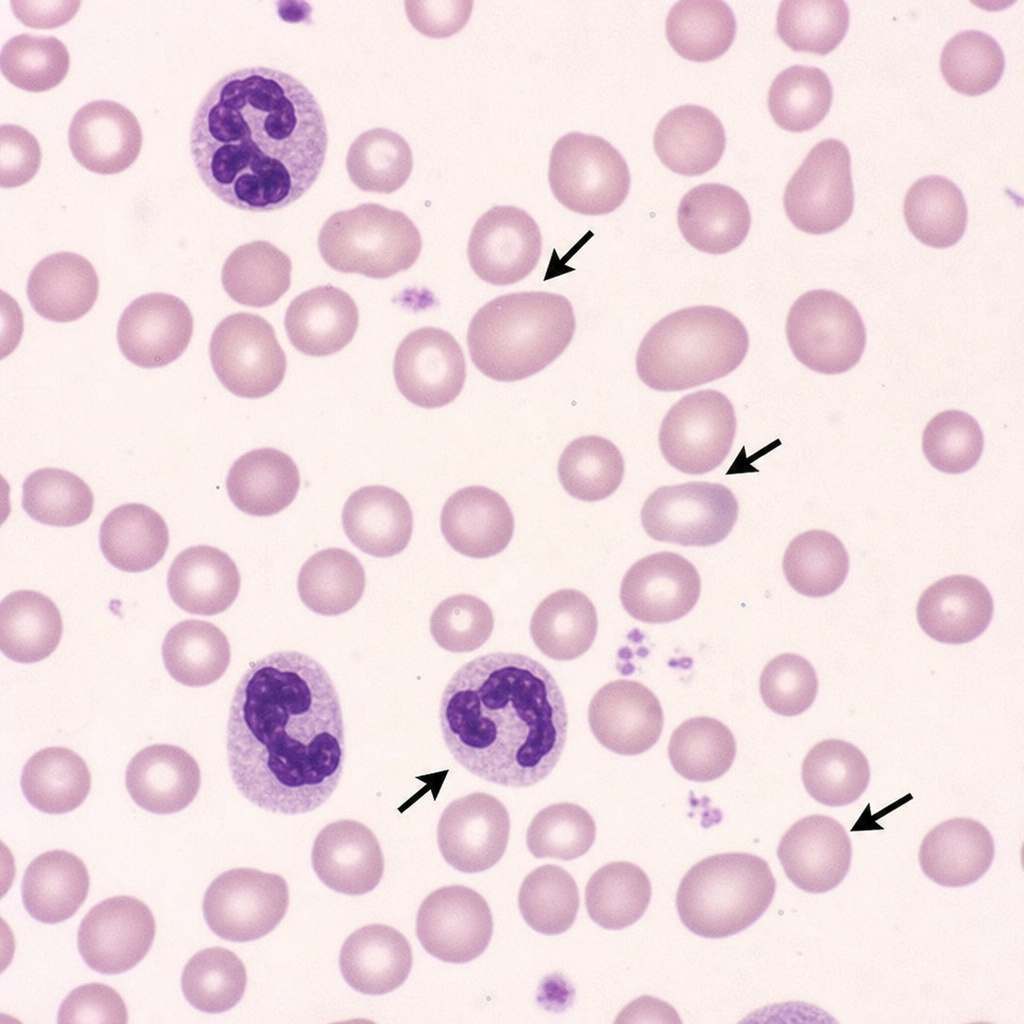
An 18-year-old woman presents with a low hemoglobin value of 10.5 g/dL on routine CBC testing. The red cells are microcytic, but WBC and platelet counts are normal. Her iron intake is adequate, menstrual flow is normal, and there is no other history of blood loss. Physical examination is normal, and iron studies reveal a normal ferritin level. She reports that other family members have also been diagnosed with anemia and alpha-thalassemia. Which of the following hemoglobins is increased in alpha-thalassemia?
Schilling test is performed to assess for what type of deficiency?
A 40-year-old chronic alcoholic is investigated for anemia. Tests reveal increased serum iron and increased transferrin saturation. What is the probable diagnosis?
Which of the following is not a side effect of blood transfusion?
Macrocytosis is seen in all of the following disorders, except?
All of the following are conditions that precipitate hemolysis in G6PD deficiency, except?
What is the positive finding in a patient with anemia due to chronic inflammation?
What type of red blood cells (RBCs) are typically seen in chronic renal failure?
An abnormal Ham test is most likely associated with which of the following?
Hunter's glossitis is a feature of which condition?
Explanation: The clinical presentation of microcytic anemia with normal ferritin levels and a positive family history strongly suggests a thalassemia syndrome. In **Alpha-Thalassemia**, there is a deficiency in the production of alpha-globin chains. Since alpha chains are essential components of all normal adult hemoglobins (HbA, HbA2, and HbF), a deficiency leads to an excess of the remaining non-alpha chains. 1. **Why Hemoglobin H is correct:** In alpha-thalassemia (specifically the 3-gene deletion or HbH disease), the relative excess of beta-globin chains leads them to aggregate into tetramers ($\beta_4$). These tetramers are known as **Hemoglobin H**. In neonates with alpha-thalassemia, excess gamma chains form tetramers ($\gamma_4$) known as **Hb Barts**. 2. **Why other options are incorrect:** * **HbA ($\alpha_2\beta_2$):** This is the major adult hemoglobin. In alpha-thalassemia, its production is decreased, not increased. * **HbF ($\alpha_2\gamma_2$) and HbA2 ($\alpha_2\delta_2$):** Both require alpha chains. Unlike Beta-thalassemia (where HbA2 and HbF increase to compensate for the lack of beta chains), in Alpha-thalassemia, these levels are typically **normal or decreased** because the alpha-chain substrate is the limiting factor. **High-Yield Clinical Pearls for NEET-PG:** * **HbH Disease:** Characterized by a "3-gene deletion" (- - / - $\alpha$). * **Golf Ball Appearance:** On supra-vital staining (Brilliant Cresyl Blue), HbH precipitates as multiple small inclusions, giving RBCs a "golf ball" appearance. * **Mentzer Index:** (MCV/RBC count) < 13 suggests Thalassemia; > 13 suggests Iron Deficiency Anemia. * **Diagnosis:** Hb Electrophoresis is the gold standard, but in alpha-thalassemia trait (1 or 2 gene deletion), electrophoresis may be normal; definitive diagnosis requires genetic testing.
Explanation: The **Schilling test** is a classic diagnostic tool used to determine the cause of low Vitamin B12 (cobalamin) levels and to differentiate between dietary deficiency and various causes of malabsorption [1]. ### **Explanation of the Correct Answer** **Vitamin B12 malabsorption (Option B):** The test involves administering radiolabeled Vitamin B12 orally followed by an intramuscular injection of "cold" (unlabeled) B12 to saturate hepatic receptors. If the radiolabeled B12 is absorbed in the terminal ileum, it will be excreted in the urine [2]. Low urinary excretion indicates malabsorption. The test is performed in stages to pinpoint the etiology: * **Stage I:** Oral B12 alone (checks for general malabsorption). * **Stage II:** Oral B12 + **Intrinsic Factor (IF)** (Corrects Pernicious Anemia). * **Stage III:** Oral B12 + **Antibiotics** (Corrects Small Intestinal Bacterial Overgrowth/SIBO). * **Stage IV:** Oral B12 + **Pancreatic enzymes** (Corrects Chronic Pancreatitis). ### **Explanation of Incorrect Options** * **Option A:** Folic acid levels are measured via serum or RBC folate assays; the Schilling test is specific to the B12 absorption pathway [2]. * **Option C:** While Stage IV of the Schilling test involves pancreatic enzymes, the test's primary purpose is to assess B12 status, not to diagnose pancreatic deficiency itself (which uses tests like fecal elastase). * **Option D:** Coronary artery disease is unrelated to B12 absorption kinetics. ### **NEET-PG High-Yield Pearls** * **Pernicious Anemia:** The most common cause of B12 malabsorption due to lack of Intrinsic Factor (Type II Schilling test correction) [2]. * **Site of Absorption:** Vitamin B12 is absorbed in the **terminal ileum** and requires Intrinsic Factor (secreted by gastric parietal cells). * **Clinical Note:** The Schilling test is largely replaced in modern practice by anti-intrinsic factor antibodies and serum methylmalonic acid (MMA) levels [2], but it remains a frequent "favorite" in exams. * **Classic Triad:** Megaloblastic anemia [3], glossitis (beefy red tongue), and neurological symptoms (Subacute Combined Degeneration of the spinal cord).
Explanation: **Explanation:** The clinical presentation of a chronic alcoholic with **increased serum iron** and **increased transferrin saturation** points toward a state of iron overload. **1. Why Hemosiderosis is correct:** In chronic alcoholism, iron overload (hemosiderosis) occurs through multiple mechanisms: alcohol directly increases intestinal iron absorption, suppresses hepcidin (the iron-regulatory hormone), and many alcoholic beverages (especially certain wines and beers) contain significant amounts of iron. This leads to a systemic increase in iron stores, reflected by high serum iron and high transferrin saturation [3]. **2. Why the other options are incorrect:** * **Iron Deficiency Anemia (IDA):** This is the exact opposite. IDA is characterized by *decreased* serum iron and *decreased* transferrin saturation (usually <15%) [1], [2]. * **Sideroblastic Anemia:** While this can occur in alcoholics (due to mitochondrial toxicity and B6 deficiency) and does show high iron, it is characterized by the presence of **ringed sideroblasts** in the bone marrow. However, in the context of general iron overload in an alcoholic, hemosiderosis is the broader systemic consequence. * **Megaloblastic Anemia:** Common in alcoholics due to folate deficiency, but it typically presents with macrocytosis (high MCV) and does not inherently cause increased serum iron or transferrin saturation unless there is a co-existing iron overload state. **Clinical Pearls for NEET-PG:** * **Transferrin Saturation:** A value >45-50% is a highly sensitive screening marker for iron overload states. * **Alcohol & Hematology:** Alcohol is a direct bone marrow toxin. It can cause Macrocytosis (even without folate deficiency), Sideroblastic anemia, and Thrombocytopenia. * **Hemosiderosis vs. Hemochromatosis:** Hemosiderosis refers to the deposition of iron in tissues (often without initial organ damage), whereas Hemochromatosis implies tissue damage/fibrosis due to that iron [3].
Explanation: ### Explanation The correct answer is **A. Hypokalemia**. In the context of blood transfusion, **Hyperkalemia** (elevated potassium) is the expected side effect, not hypokalemia. #### Why Hypokalemia is the Correct Answer: During storage, the red blood cell (RBC) membrane's Na+/K+-ATPase pump becomes less active due to cold temperatures and ATP depletion. This causes potassium to leak out of the cells into the plasma. Consequently, the older the stored blood, the higher the extracellular potassium concentration. Rapid or massive transfusion of these units can lead to **Hyperkalemia**, which poses a risk of cardiac arrhythmias. #### Analysis of Incorrect Options: * **B. Hypomagnesemia:** Citrate, the anticoagulant used in blood bags, can chelate magnesium ions, leading to a decrease in serum magnesium levels. * **C. Hypocalcemia:** This is a classic complication of massive transfusion. Citrate binds to ionized calcium. Under normal conditions, the liver metabolizes citrate; however, in rapid transfusions or hepatic impairment, citrate accumulation leads to a drop in ionized calcium. * **D. Iron Overload:** Each unit of packed RBCs contains approximately 200–250 mg of iron. Chronic transfusion therapy (e.g., in Thalassemia or Aplastic Anemia) leads to systemic iron accumulation (hemosiderosis) as the body lacks an active excretory mechanism for iron. #### NEET-PG High-Yield Pearls: * **Storage Lesion:** Refers to the biochemical and structural changes in RBCs during storage (decreased 2,3-DPG, decreased pH, increased Potassium). * **Adverse Effects:** Adverse reactions to transfusion can range from minor symptoms like fever or itch to serious complications [1]. * **Hypothermia:** A common complication of massive transfusion due to the infusion of cold blood. * **TRALI vs. TACO:** Transfusion-Related Acute Lung Injury (immune-mediated) is the leading cause of transfusion-related fatalities, while Transfusion-Associated Circulatory Overload is a common non-immune complication.
Explanation: Macrocytosis refers to an increased Mean Corpuscular Volume (MCV > 100 fL). To solve this question, one must distinguish between causes of macrocytic and microcytic anemia. **Why Thalassemia major is the correct answer:** Thalassemia major is a quantitative defect in globin chain synthesis, leading to ineffective erythropoiesis [3]. It is a classic cause of **microcytic hypochromic anemia** (MCV < 80 fL), not macrocytosis. In Thalassemia, the lack of hemoglobin leads to smaller, paler red blood cells. **Analysis of Incorrect Options:** * **Folic acid and Vitamin B12 deficiency:** These are the most common causes of **Megaloblastic Macrocytic Anemia** [1], [2]. Deficiency leads to impaired DNA synthesis while RNA synthesis remains intact, resulting in a "nuclear-cytoplasmic asynchrony" where the nucleus matures slower than the cytoplasm, creating large cells (macro-ovalocytes). * **Hypothyroidism:** This is a common cause of **Non-megaloblastic Macrocytic Anemia**. The exact mechanism is multifactorial, involving a decrease in erythropoietin levels and changes in the RBC lipid membrane. **NEET-PG High-Yield Pearls:** 1. **Megaloblastic vs. Non-megaloblastic:** Megaloblastic causes (B12/Folate deficiency, drugs like Methotrexate) show **hypersegmented neutrophils** (>5 lobes), whereas non-megaloblastic causes (Alcohol, Hypothyroidism, Liver disease) do not. 2. **Mentzer Index:** Used to differentiate Iron Deficiency Anemia (IDA) from Thalassemia. * Index (MCV/RBC count) **< 13** suggests Thalassemia. * Index **> 13** suggests IDA. 3. **Round vs. Oval:** Macrocytes in B12/Folate deficiency are typically **oval** (macro-ovalocytes), while those in liver disease or hypothyroidism are usually **round**.
Explanation: **Explanation:** Glucose-6-Phosphate Dehydrogenase (G6PD) deficiency is an X-linked recessive disorder where the RBCs are unable to regenerate reduced glutathione, making them vulnerable to oxidative stress [3][4]. When exposed to oxidizing agents, hemoglobin denatures into **Heinz bodies**, leading to episodic hemolysis [1][3]. **Why Option D is Correct:** Acetaminophen and Aspirin (at standard therapeutic doses) are considered **safe** in G6PD deficiency. While high-dose aspirin was historically debated, current hematological guidelines list these as non-oxidizing agents that do not precipitate clinically significant hemolysis. **Why Other Options are Incorrect:** * **A. Ingestion of fava beans:** This causes "Favism." Fava beans contain vicine and covicine, which produce free radicals that overwhelm the limited antioxidant capacity of G6PD-deficient cells [1]. * **B. Viral hepatitis:** Infection is the **most common trigger** for hemolysis in G6PD deficiency [1]. Inflammatory responses generate reactive oxygen species (ROS) from polymorphonuclear leukocytes, causing oxidative damage to RBCs. * **C. Antimalarials:** Primaquine is the classic "textbook" trigger [1]. It undergoes redox cycling, generating superoxide anions that cause rapid hemolysis in deficient individuals [2]. **NEET-PG High-Yield Pearls:** * **Inheritance:** X-linked Recessive (Common in Mediterranean and African populations) [1][3]. * **Peripheral Smear:** Look for **Heinz Bodies** (denatured Hb) and **Bite Cells/Degmacytes** (formed when splenic macrophages pluck out Heinz bodies) [3]. * **Diagnosis:** Be careful! G6PD levels may be **falsely normal** during an acute hemolytic episode because the most deficient (older) cells have already lysed [1]. Re-testing should be done 6–8 weeks later. * **Key Contraindicated Drugs:** Primaquine, Dapsone, Nitrofurantoin, Rasburicase, and Sulfonamides [1].
Explanation: Anemia of Chronic Disease (ACD), or Anemia of Inflammation, is driven by the cytokine **Interleukin-6 (IL-6)**, which stimulates the liver to produce **Hepcidin** [1]. Hepcidin acts as the master regulator of iron homeostasis by degrading ferroportin channels [1]. This prevents iron release from macrophages (reticuloendothelial system) and inhibits intestinal iron absorption. **Analysis of Options:** * **Correct Option (C): Total iron-binding capacity (TIBC) is decreased.** In chronic inflammation, the body attempts to sequester iron away from potential pathogens. Since TIBC is a surrogate measure of Transferrin, and Transferrin is a **negative acute-phase reactant**, its levels fall during inflammation. Thus, a low TIBC is a hallmark of ACD. * **Option A (Serum Iron):** This is **decreased** (Hypoferremia) because iron is trapped inside macrophages and cannot be utilized for erythropoiesis [1]. * **Option B (Serum Ferritin):** This is **increased** or normal. Ferritin is a **positive acute-phase reactant** and reflects the trapped iron stores in macrophages. * **Option D (Iron in Blasts):** In ACD, Prussian blue staining of bone marrow shows increased iron in macrophages but **decreased/absent iron in erythroid precursors (sideroblasts)**, as the iron cannot be transferred to the developing red cells. **NEET-PG High-Yield Pearls:** 1. **Gold Standard Diagnosis:** Bone marrow aspiration showing increased iron in macrophages but absent iron in erythroblasts. 2. **Soluble Transferrin Receptor (sTfR):** This is **normal** in ACD but **elevated** in Iron Deficiency Anemia (IDA). It is the best marker to differentiate the two. 3. **Mentzer Index:** Usually >13 in both ACD and IDA (unlike Thalassemia where it is <13). 4. **Treatment:** Treat the underlying inflammatory condition; Erythropoietin (EPO) may be used in specific cases like CKD or malignancy. *(Note: The prompt indicated Option A as correct in the text, but medically, TIBC is decreased and Serum Iron is decreased in ACD. The explanation follows the standard medical pathophysiology where C is the classic positive finding.)*
Explanation: ### Explanation **Correct Option: C. Normocytic** The anemia associated with **Chronic Renal Failure (CRF)** is typically **Normocytic Normochromic Anemia**. **Why it is correct:** The primary pathophysiology in CRF is the **deficiency of Erythropoietin (EPO)** [1]. EPO is a glycoprotein hormone produced by the peritubular interstitial cells of the kidney in response to hypoxia [1], [2]. In chronic kidney disease, the functional renal mass decreases, leading to inadequate EPO production [1]. Since the bone marrow is healthy but lacks the hormonal signal to produce more cells, the RBCs produced are normal in size (normocytic) and color (normochromic), but their absolute number is decreased. Other contributing factors include the accumulation of uremic toxins (which shorten RBC lifespan) and chronic inflammation (Anemia of Chronic Disease). **Why other options are incorrect:** * **A. Microcytic:** This is characteristic of Iron Deficiency Anemia (IDA) or Thalassemia. While CRF patients can develop IDA due to hemodialysis blood loss or poor absorption, the *primary* anemia of renal failure itself is normocytic. * **B. Macrocytic:** This is seen in Vitamin B12 or Folic acid deficiency. While some drugs used in renal patients might interfere with folate metabolism, it is not the classic presentation of renal anemia. **High-Yield Clinical Pearls for NEET-PG:** * **Target Hemoglobin:** In patients on Erythropoiesis-Stimulating Agents (ESAs), the target Hb is usually **10–11.5 g/dL**. Aiming for normal levels (>13 g/dL) increases the risk of stroke and cardiovascular events (CHOIR and CREATE trials). * **Burr Cells (Echinocytes):** These are small, spiked RBCs often seen on the peripheral smear of patients with uremia/CRF. * **First step in management:** Before starting EPO therapy, always ensure **iron stores are adequate** (Transferrin saturation >20% and Ferritin >100 ng/mL).
Explanation: **Explanation:** The **Ham test** (Acidified Serum Lysis test) is a classic diagnostic test for **Paroxysmal Nocturnal Hemoglobinuria (PNH)**. **1. Why the Correct Answer is Right:** PNH is an acquired clonal hematopoietic stem cell disorder caused by a somatic mutation in the **PIGA gene**. This mutation leads to a deficiency of **Glycosylphosphatidylinositol (GPI) anchors**. These anchors are essential for attaching protective proteins, such as **CD55** (Decay Accelerating Factor) and **CD59** (Membrane Inhibitor of Reactive Lysis), to the red blood cell membrane. Without these GPI-anchored proteins, RBCs become hypersensitive to complement-mediated lysis. The Ham test works by acidifying serum to activate the alternative complement pathway; PNH cells, lacking GPI-anchored protectors, will undergo lysis. **2. Why Other Options are Incorrect:** * **Option A (Defect in spectrin):** This is the hallmark of **Hereditary Spherocytosis**. It leads to osmotic fragility, not complement-mediated lysis. * **Option C (Defect in complement):** In PNH, the complement system itself is normal; the defect lies in the RBC's inability to *regulate* complement on its surface. * **Option D (Mannose-binding residue defect):** This refers to Mannose-Binding Lectin (MBL) deficiency, which is associated with increased susceptibility to infections, not PNH. **High-Yield Clinical Pearls for NEET-PG:** * **Gold Standard Diagnosis:** While the Ham test is historically significant, **Flow Cytometry** (detecting absence of CD55/CD59) is now the gold standard. * **FLAER (Fluorescently Labeled Aerolysin):** A highly sensitive flow cytometry-based test used to detect the absence of GPI anchors. * **Triad of PNH:** Hemolytic anemia, Pancytopenia, and Venous Thrombosis (often in unusual sites like the Budd-Chiari syndrome). * **Treatment:** **Eculizumab**, a monoclonal antibody against C5, is the drug of choice.
Explanation: **Explanation:** **Hunter’s glossitis** (also known as Moeller’s glossitis) is a classic clinical sign of **Pernicious anemia**, which results from Vitamin B12 deficiency due to a lack of intrinsic factor. 1. **Why Pernicious Anemia is correct:** Vitamin B12 is essential for DNA synthesis and the rapid turnover of mucosal cells [3]. In its absence, the lingual papillae undergo atrophy. This results in a characteristic **"beefy red," smooth, and shiny appearance** of the tongue, often accompanied by a burning sensation or soreness [1]. 2. **Why other options are incorrect:** * **Leukemia:** Typically presents with gingival hypertrophy (especially in AML-M5) [1], oral candidiasis, or petechiae due to thrombocytopenia, rather than isolated atrophic glossitis. * **Sickle cell anemia:** Oral manifestations are usually related to bone changes (e.g., "crew-cut" appearance on X-ray) or mucosal pallor due to chronic hemolysis [4], not specific glossitis. * **HIV infection:** Common oral findings include Hairy Leukoplakia (caused by EBV), Kaposi sarcoma, or Oral Candidiasis, but not Hunter’s glossitis. **High-Yield Clinical Pearls for NEET-PG:** * **Triad of Vitamin B12 Deficiency:** Megaloblastic anemia, Hunter’s glossitis, and Neurological symptoms (Subacute Combined Degeneration of the Spinal Cord). * **Peripheral Smear:** Look for **Hypersegmented neutrophils** (earliest sign) and Macro-ovalocytes. * **Schilling Test:** Historically used to differentiate B12 malabsorption causes (now largely replaced by antibody testing for Anti-Intrinsic Factor and Anti-Parietal Cell antibodies) [2]. * **Other causes of Atrophic Glossitis:** Iron deficiency anemia (Plummer-Vinson Syndrome), sprue, and other B-complex deficiencies [1].
Anemia Evaluation and Management
Practice Questions
Hemoglobinopathies
Practice Questions
Thalassemias
Practice Questions
Platelet Disorders
Practice Questions
Coagulation Disorders
Practice Questions
Thrombotic Disorders
Practice Questions
Leukemias
Practice Questions
Lymphomas
Practice Questions
Multiple Myeloma and Plasma Cell Disorders
Practice Questions
Myeloproliferative Neoplasms
Practice Questions
Transfusion Medicine
Practice Questions
Hematopoietic Stem Cell Transplantation
Practice Questions
Get full access to all questions, explanations, and performance tracking.
Start For Free