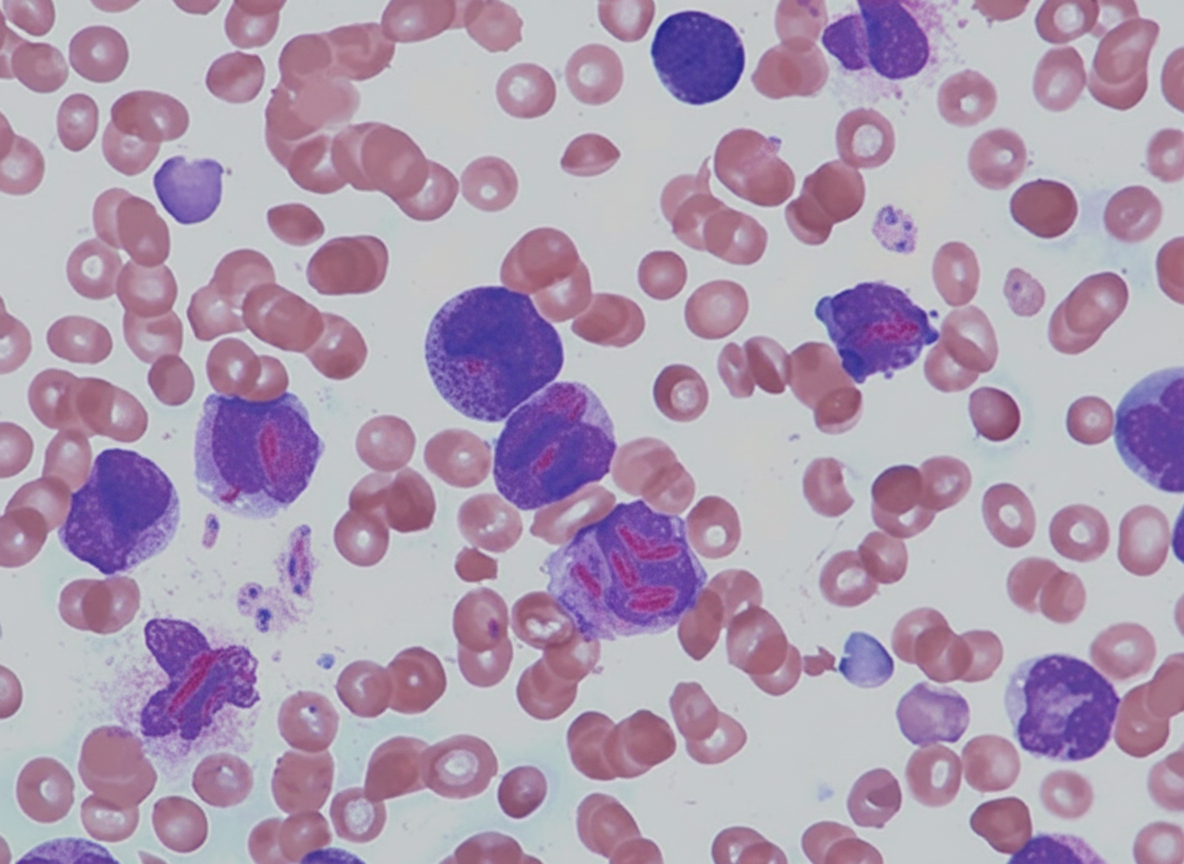
All of the following are features of thrombotic thrombocytopenic purpura, EXCEPT:
Splenomegaly is least likely associated with which of the following conditions?
For what procedure is the instrument depicted in the diagram used?

A 20-year-old male presents with weakness, jaundice, and hematuria. He has a history of similar, self-limiting episodes and unusual substance consumption. Examination reveals mild jaundice and splenomegaly. Lab findings include increased indirect bilirubin, hemoglobinemia, hemoglobinuria, absent haptoglobin, raised LDH, hemosiderinuria, and reticulocytosis. Which peripheral blood smear finding is most likely associated with this condition?
Which condition is associated with Coomb's positive hemolytic anemia?
Which of the following will NOT show a dismal prognosis?
Elevated serum ferritin, decreased serum iron, and decreased % transferrin saturation are most consistent with which diagnosis?
A 30-year-old male, undergoing platelet apheresis for the first time, experiences tingling around the mouth and numbness in his arm. An ECG shows ST segment elevation. What is the most likely cause of these symptoms?
What is the most common subtype of adult acute lymphoblastic leukemia (ALL)?
A 58-year-old woman presents with a gastric ulcer, achlorhydria, loss of vibration sense in her lower extremities, and megaloblastic anemia. What diagnostic test would best support a diagnosis of pernicious anemia?
Explanation: Thrombotic Thrombocytopenic Purpura (TTP) is a life-threatening microangiopathy caused by a deficiency in the **ADAMTS13** enzyme (a von Willebrand factor-cleaving protease). This deficiency leads to large vWF multimers that cause spontaneous platelet aggregation and microthrombi formation. **Why Splenomegaly is the Correct Answer:** Splenomegaly is **not** a characteristic feature of TTP [1]. While TTP involves significant platelet consumption and red cell destruction, the pathology occurs within the microvasculature (systemic microthrombi) rather than via splenic sequestration or congestion. If a patient presents with thrombocytopenia and a significantly enlarged spleen, alternative diagnoses like hypersplenism, portal hypertension, or certain hematologic malignancies should be considered [1]. **Analysis of Incorrect Options:** * **Microangiopathic Hemolytic Anemia (MAHA):** A hallmark of TTP. Fragmentation of RBCs as they pass through fibrin/platelet meshworks results in **schistocytes** on peripheral smear [2]. * **Neurologic findings:** Common due to microthrombi in the cerebral vasculature. Symptoms range from fluctuating headaches and confusion to seizures and coma. * **Fever:** Part of the classic pentad, likely due to tissue ischemia and inflammation, though it is present in only about 25% of cases. **Clinical Pearls for NEET-PG:** * **The Classic Pentad (FAT RN):** **F**ever, **A**nemia (MAHA), **T**hrombocytopenia, **R**enal failure, and **N**eurological deficits [2]. * **Diagnosis:** Decreased ADAMTS13 activity (<10%). * **Treatment:** **Emergency Plasmapheresis (Plasma Exchange)** is the gold standard. Never delay treatment for lab confirmation. * **Contraindication:** Platelet transfusion is generally contraindicated as it may "fuel the fire" by promoting further thrombosis.
Explanation: **Explanation:** The correct answer is **Primary Thrombocytosis** (also known as Essential Thrombocythemia). **1. Why Primary Thrombocytosis is the correct answer:** In the spectrum of Chronic Myeloproliferative Neoplasms (MPNs), **Essential Thrombocythemia (ET)** is the condition least likely to present with significant splenomegaly. In ET, the primary pathology is the overproduction of platelets. While mild splenomegaly can occur in about 25–40% of cases, it is often absent. If a patient with suspected ET has massive splenomegaly, clinicians should look for an alternative diagnosis like Myelofibrosis or CML. **2. Analysis of Incorrect Options:** * **Chronic Myeloid Leukemia (CML):** Splenomegaly is a hallmark feature, present in over 50–70% of cases. It occurs due to the massive infiltration of the spleen by leukemic cells. * **Polycythemia Rubra Vera (PRV):** Splenomegaly is common (approx. 70% of patients) due to extramedullary hematopoiesis and increased red cell mass. * **Idiopathic Myelofibrosis (Primary Myelofibrosis):** This condition is associated with the **most massive splenomegaly** among all MPNs [1]. As the bone marrow becomes fibrotic, the spleen takes over hematopoiesis (extramedullary hematopoiesis), leading to giant enlargement [1]. **3. NEET-PG High-Yield Pearls:** * **Massive Splenomegaly (Spleen crossing midline/reaching iliac fossa):** Remember the mnemonic **"M-C-I"** — **M**yelofibrosis, **C**hronic Myeloid Leukemia, and **I**ndian Kala-azar (Visceral Leishmaniasis). Other causes include Malaria and Gaucher’s disease. * **Essential Thrombocythemia:** The most common clinical presentation is actually vasomotor symptoms (headaches, erythromelalgia) or thrombohemorrhagic events, rather than organomegaly. * **Diagnostic Clue:** If a question mentions "Tear-drop RBCs" (Dacrocytes) and massive splenomegaly, always think of Myelofibrosis [1].
Explanation: ***Bone marrow biopsy*** - The **Jamshidi needle** depicted has a distinctive **tapered bore** that is wider at the tip with a **cutting edge**, specifically designed to obtain bone marrow core samples from the **iliac crest** or sternum. - Features a **removable stylet** and sturdy construction to penetrate cortical bone and extract intact marrow specimens for histological examination. *Pleural biopsy* - Requires specialized needles like the **Abrams needle** or **Cope needle** with a **notched cutting mechanism** to sample pleural tissue. - These instruments have a **hook-like design** with a cutting chamber, completely different from the straight, tapered Jamshidi needle. *Kidney biopsy* - Utilizes **Tru-Cut needles** or **automated core biopsy guns** with spring-loaded mechanisms for precise tissue sampling. - These needles have **smaller gauge** (14-18G) and **automated firing systems**, unlike the manual, larger-bore Jamshidi needle. *Liver biopsy* - Performed with **Menghini needles** or **Vim-Silverman needles** that have **suction capability** and thinner profiles. - These instruments feature **aspiration mechanisms** and are designed for softer tissue penetration, not the bone-cutting capability of the Jamshidi needle.
Explanation: ### Explanation The clinical presentation of weakness, jaundice, and hemoglobinuria, combined with lab findings of increased indirect bilirubin, absent haptoglobin, and raised LDH, points toward **intravascular hemolysis** [2]. The presence of **hemosiderinuria** is a pathognomonic marker of chronic or recurrent intravascular hemolysis [1]. **Why Option D is Correct:** In conditions of chronic intravascular hemolysis (such as G6PD deficiency, PNH, or certain drug-induced anemias), hemoglobin is filtered by the kidneys [3]. The renal tubular cells reabsorb iron and store it as ferritin and hemosiderin. When these cells are eventually sloughed into the urine, it results in **hemosiderinuria** [1]. On a peripheral smear, **Pappenheimer bodies** (siderotic granules) represent red cells containing granules of iron. While typically associated with sideroblastic anemia, they can also be seen in hemolytic anemias and post-splenectomy states due to iron overload in the RBCs. **Analysis of Incorrect Options:** * **Option A (Bite cells):** While bite cells are seen in G6PD deficiency (oxidative stress), the question specifically highlights **hemosiderinuria**, which is the hallmark of the renal handling of free hemoglobin [1]. * **Option B (Schistocytes):** These are characteristic of Microangiopathic Hemolytic Anemia (MAHA), such as TTP or HUS. While these cause intravascular hemolysis, the "unusual substance consumption" and "self-limiting episodes" in a young male more strongly suggest a metabolic or oxidative trigger [3], [4]. * **Option C (Rouleaux):** This is seen in Multiple Myeloma or chronic inflammatory states due to high plasma protein levels, not acute hemolysis. **NEET-PG High-Yield Pearls:** * **Intravascular Hemolysis Markers:** Low Haptoglobin, High LDH, Hemoglobinuria, and **Hemosiderinuria** (occurs 3–5 days after the hemolytic event) [1], [2]. * **Prussian Blue Stain:** Used to confirm hemosiderin in urine sediment or Pappenheimer bodies on a smear. * **G6PD Deficiency:** Often triggered by "unusual substances" like fava beans (favism) or drugs (Primaquine, Sulfa drugs) [3], [5]. It manifests as episodic intravascular hemolysis [4].
Explanation: ### Explanation The correct answer is **Systemic lupus erythematosus (SLE)**. **1. Why SLE is correct:** SLE is a multisystem autoimmune disorder characterized by the production of various autoantibodies. In SLE, patients can develop **Warm Autoimmune Hemolytic Anemia (WAIHA)** [1]. This occurs because IgG autoantibodies are directed against antigens on the red blood cell (RBC) surface. The **Direct Coombs Test (Direct Antiglobulin Test)** detects these antibodies or complement proteins attached to the RBCs, making it the hallmark diagnostic test for this condition [1]. Hematologic involvement is a key diagnostic criterion for SLE. **2. Why the other options are incorrect:** * **TTP and HUS (Options A & D):** Both are types of **Microangiopathic Hemolytic Anemia (MAHA)**. In these conditions, hemolysis is mechanical (fragmentation of RBCs as they pass through fibrin mesh in small vessels), not immune-mediated. Therefore, they are characteristically **Coombs negative** and show **schistocytes** on a peripheral smear. * **Polyarteritis nodosa (Option B):** PAN is a systemic necrotizing vasculitis of medium-sized arteries. While it causes significant systemic symptoms and organ damage (like renal failure or mononeuritis multiplex), it is not typically associated with autoimmune hemolytic anemia or a positive Coombs test. **3. NEET-PG High-Yield Pearls:** * **Evans Syndrome:** The clinical triad/combination of Autoimmune Hemolytic Anemia (Coombs positive) and Immune Thrombocytopenia (ITP). It is frequently associated with SLE. * **Drug-induced Coombs positive anemia:** Common culprits include **Methyldopa** (true autoantibodies) and **Penicillin** (hapten mechanism). * **False Positive Coombs:** Can be seen in patients receiving intravenous immunoglobulin (IVIG) or certain cephalosporins. * **SLE Hematology:** The most common hematological abnormality in SLE is **Anemia of Chronic Disease**, but Coombs-positive hemolytic anemia is the most specific "autoimmune" hemolytic finding.
Explanation: This question pertains to the prognostic factors of **Acute Lymphoblastic Leukemia (ALL)**, the most common childhood malignancy. Prognosis in ALL is determined by clinical, laboratory, and cytogenetic features. [1] ### **Explanation of Options** * **A. Age between 1-10 years (Correct):** This is the "Golden Age" for ALL. Children diagnosed between the ages of 1 and 10 years have the best prognosis and highest cure rates (often >90%). Conversely, infants (<1 year) and adolescents/adults (>10 years) carry a much poorer prognosis. * **B. Total Leucocyte Count (TLC) > 1 lac:** A high initial white cell count (Hyperleukocytosis) is a major poor prognostic indicator. In B-ALL, a TLC >50,000/µL is considered high risk; a count >100,000 (1 lac) signifies a very high tumor burden and increased risk of CNS involvement. [1] * **C. Petechiae:** While petechiae are a common presenting symptom due to thrombocytopenia, their presence (along with hepatosplenomegaly or lymphadenopathy) at the time of diagnosis is traditionally associated with a higher disease burden and a more aggressive clinical course compared to patients without these findings. * **D. t(9;22) translocation:** Also known as the **Philadelphia Chromosome (Ph+)**, this translocation creates the *BCR-ABL1* fusion gene. It is the single most important **poor cytogenetic prognostic factor** in both pediatric and adult ALL, associated with resistance to standard chemotherapy. [1] ### **High-Yield Clinical Pearls for NEET-PG** | **Feature** | **Good Prognosis** | **Poor Prognosis** | | :--- | :--- | :--- | | **Age** | 1–10 years | <1 year or >10 years | | **WBC Count** | <50,000/µL | >50,000/µL | | **Cytogenetics** | Hyperdiploidy (>50), t(12;21) | Hypodiploidy, t(9;22), t(4;11) | | **Immunotype** | Early Pre-B cell | Mature B-cell or T-cell ALL | | **Response** | Rapid (Remission by Day 14) | Slow (Minimal Residual Disease +) | **Note:** The **t(12;21)** translocation (TEL-AML1) is the most common translocation in childhood ALL and carries an **excellent** prognosis.
Explanation: **Explanation:** The laboratory profile described is the classic presentation of **Anemia of Chronic Disease (ACD)**, also known as Anemia of Inflammation [1]. **1. Why Anemia of Chronic Disease is Correct:** The pathophysiology of ACD is driven by **Hepcidin**, an acute-phase reactant [1]. In chronic inflammatory states (infections, malignancy, autoimmune diseases), cytokines like IL-6 stimulate the liver to produce hepcidin. Hepcidin degrades **ferroportin** (the iron export channel), leading to [2]: * **Sequestration of iron** within macrophages and hepatocytes (reflected by **elevated serum ferritin**) [2]. * **Decreased serum iron** because iron cannot be released into the plasma [2]. * **Decreased % Transferrin Saturation** because there is less iron available to bind to transferrin. **2. Why the other options are incorrect:** * **Iron Deficiency Anemia (IDA):** Characterized by **decreased ferritin** (the most sensitive marker) and increased Total Iron Binding Capacity (TIBC) [3]. * **Thalassemia:** Typically presents with **normal to elevated serum iron and ferritin** because the defect is in globin chain synthesis, not iron metabolism. * **Sideroblastic Anemia:** Characterized by iron overload. You would see **elevated serum iron, elevated ferritin,** and increased transferrin saturation, along with ringed sideroblasts in the bone marrow. **High-Yield Clinical Pearls for NEET-PG:** * **Ferritin** is the key differentiator: It is **low** in IDA and **normal/high** in ACD [3]. * **TIBC** (Total Iron Binding Capacity) is **increased** in IDA but **decreased** in ACD [3]. * **Soluble Transferrin Receptor (sTfR) assay:** This is the most reliable test to distinguish IDA from ACD when both coexist; sTfR is **elevated in IDA** but **normal in ACD** [3].
Explanation: The correct answer is **Citrate toxicity**. During platelet apheresis, **sodium citrate** is used as an anticoagulant. When returned to the donor's circulation, citrate chelates free ionized calcium, leading to **hypocalcemia**. The classic presentation of hypocalcemia includes neuromuscular irritability, such as perioral tingling (paresthesia) and numbness [1]. Crucially, hypocalcemia affects cardiac conduction. While it typically causes QT interval prolongation, severe electrolyte imbalances during apheresis can lead to coronary vasospasm or conduction abnormalities that manifest as **ST-segment changes** on an ECG. **Analysis of Incorrect Options:** * **A & B (Blood phobia/Anxiety):** While common in first-time donors, these typically present with vasovagal symptoms (bradycardia, hypotension, syncope) or hyperventilation. While hyperventilation can cause tingling due to respiratory alkalosis, it does not typically cause the specific ECG changes associated with electrolyte shifts. * **D (Hypothermia):** Though large volume exchanges can lower body temperature, the primary symptoms would be shivering and "J" waves (Osborn waves) on ECG, not acute perioral numbness. **High-Yield Clinical Pearls for NEET-PG:** * **Mechanism:** Citrate binds to ionized Calcium ($Ca^{2+}$) $\rightarrow$ Hypocalcemia. * **Management:** Slowing the infusion rate or administering oral/IV calcium gluconate. * **ECG Hallmark:** The most common ECG finding in hypocalcemia is **prolonged QT interval** (specifically the ST segment). * **Apheresis vs. Whole Blood:** Citrate toxicity is significantly more common in apheresis and massive blood transfusions because of the high volume of citrate-anticoagulated plasma involved.
Explanation: **Explanation:** Acute Lymphoblastic Leukemia (ALL) is a malignant transformation of lymphoid progenitor cells. In adults, the distribution of subtypes differs slightly from children, but the overall predominance remains the same [1]. **1. Why B-cell lineage ALL is correct:** Approximately **75-80% of adult ALL cases** are of B-cell lineage [1]. This category encompasses the entire spectrum of B-cell development, from early pro-B to mature B-cells. Because it represents the vast majority of cases, it is classified as the most common subtype. **2. Why the other options are incorrect:** * **Pre-B-cell ALL:** While this is a specific stage within the B-cell lineage (characterized by cytoplasmic mu chains), it is a *subset* of B-cell ALL. The question asks for the broader lineage subtype. * **T-cell lineage ALL:** This accounts for only about **20-25%** of adult ALL cases [1]. It typically presents in younger males with a high white cell count and a mediastinal mass. * **Cortical T-ALL:** This is a specific immunophenotypic subcategory of T-ALL. While it often carries a slightly better prognosis than other T-cell subtypes, it is far less common than B-cell lineage ALL. **High-Yield Clinical Pearls for NEET-PG:** * **Cytogenetics:** The most common translocation in **adult B-ALL** is **t(9;22)**, the Philadelphia chromosome (BCR-ABL1), which carries a poor prognosis [1]. In contrast, children more commonly show t(12;21). * **Markers:** B-ALL typically expresses **CD19, CD20, and CD22** [1]. T-ALL expresses **CD2, CD3, CD5, and CD7**. * **Commonality:** ALL is the most common cancer in children, but in adults, it is less common than AML (Acute Myeloid Leukemia). * **Prognosis:** Adult ALL generally has a poorer prognosis compared to pediatric ALL [1].
Explanation: **Explanation:** The clinical presentation of **megaloblastic anemia**, **achlorhydria** (lack of gastric acid), and **loss of vibration sense** (subacute combined degeneration of the spinal cord) strongly suggests **Pernicious Anemia**. This condition is caused by an autoimmune destruction of gastric parietal cells, leading to a deficiency of **Intrinsic Factor (IF)**, which is essential for Vitamin B12 absorption in the terminal ileum. [1] **Why Option D is correct:** The **Schilling Test** (historically the gold standard) involves the **oral administration of radiolabeled Vitamin B12**. In Pernicious Anemia, the radiolabeled B12 is not absorbed due to the lack of IF and is subsequently excreted in the feces rather than the urine. If the absorption defect is corrected by co-administering oral IF, the diagnosis of Pernicious Anemia is confirmed. [1] **Why other options are incorrect:** * **Option A:** Injection of radioactive B12 is not used for diagnosis; intramuscular "flushing doses" of non-labeled B12 are used in the Schilling test to saturate liver receptors, ensuring that any absorbed radiolabeled B12 is excreted in the urine. * **Option B:** ERCP is used to visualize bile and pancreatic ducts; it has no role in diagnosing megaloblastic anemia. * **Option C:** Prothrombin Time (PT) assesses the extrinsic coagulation pathway (Vitamin K dependent factors) and is unrelated to Vitamin B12 metabolism. **NEET-PG High-Yield Pearls:** * **Pernicious Anemia** is associated with **Type A Gastritis** (Atrophic, Autoimmune, affecting the Body/Fundus) and an increased risk of **Gastric Carcinoma**. * **Antibodies:** Anti-parietal cell antibodies (sensitive) and Anti-intrinsic factor antibodies (specific). * **Neurological symptoms:** B12 deficiency affects the **posterior columns** (vibration/proprioception) and **lateral corticospinal tracts** (spasticity). *Note: Folate deficiency does NOT cause neurological deficits.* * **MCV:** Typically >100 fL; Peripheral smear shows **hypersegmented neutrophils** (>5 lobes). [1]
Anemia Evaluation and Management
Practice Questions
Hemoglobinopathies
Practice Questions
Thalassemias
Practice Questions
Platelet Disorders
Practice Questions
Coagulation Disorders
Practice Questions
Thrombotic Disorders
Practice Questions
Leukemias
Practice Questions
Lymphomas
Practice Questions
Multiple Myeloma and Plasma Cell Disorders
Practice Questions
Myeloproliferative Neoplasms
Practice Questions
Transfusion Medicine
Practice Questions
Hematopoietic Stem Cell Transplantation
Practice Questions
Get full access to all questions, explanations, and performance tracking.
Start For Free