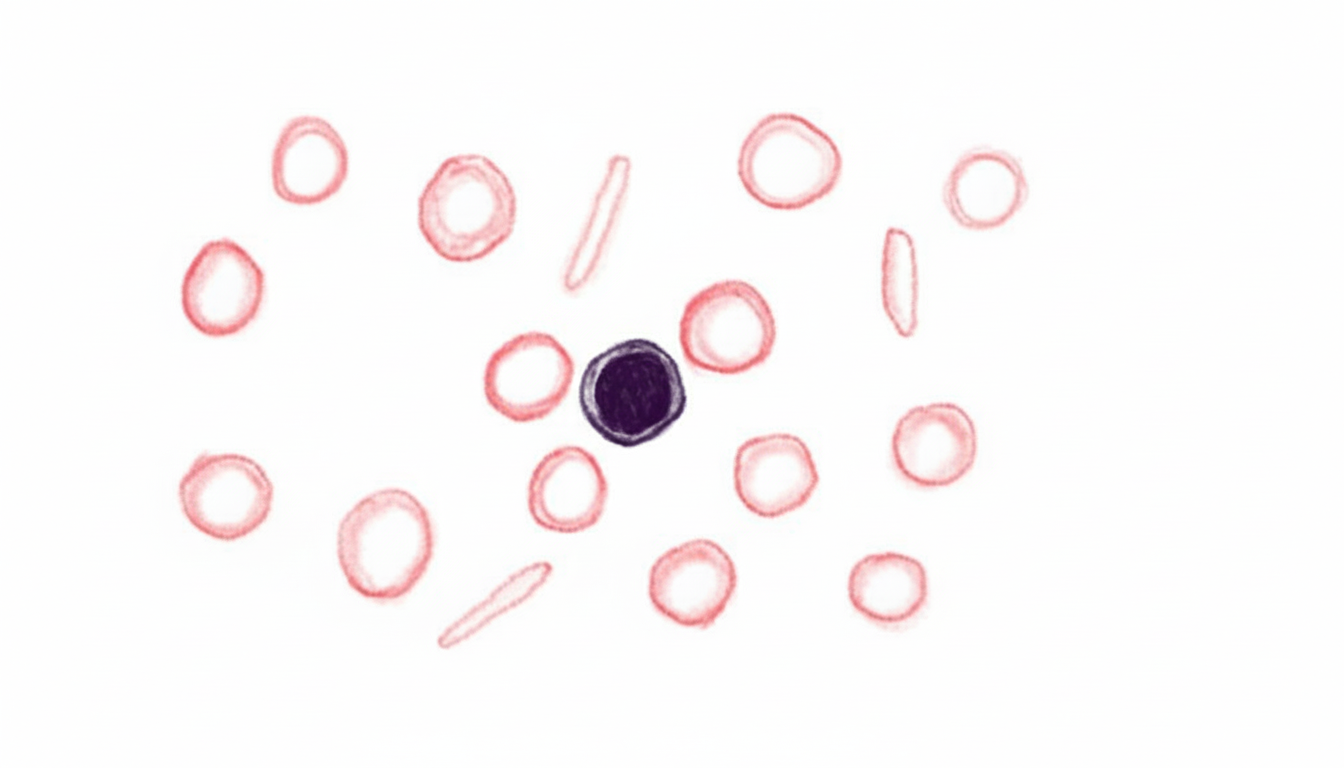
Leukocytosis is seen in all conditions except?
Which antibody is commonly elevated in Waldenstrom macroglobulinemia?
Which disorder is most likely associated with erythroid hyperplasia in the bone marrow?
Macrocytic anemia occurs in all except?
A 72-year-old woman is admitted to the hospital with an acute illness. Her platelet count is incidentally noted to be 800,000/mL. For this patient with a blood-count anomaly, select the corresponding clinical situation and/or laboratory finding.
Which of the following is NOT a feature of Chronic Myeloid Leukemia (CML)?
Which blood indices most accurately reflect iron deficiency?
Which of the following is NOT true about multiple myeloma?
Which of the following patients would LEAST likely require a bone marrow examination?
All of the following are inherited thrombocytopenia syndromes, EXCEPT:
Explanation: The correct answer is **Typhoid Fever (Option C)**. In clinical medicine, most acute bacterial infections trigger a "shift to the left" and **leukocytosis** (elevated white blood cell count). However, certain specific infections are classic exceptions that present with **leukopenia** (decreased WBC count) or a normal count. **1. Why Typhoid Fever is the correct answer:** Enteric fever (Typhoid), caused by *Salmonella Typhi*, is a classic cause of **leukopenia** with a relative lymphocytosis. The mechanism involves the suppression of bone marrow and the sequestration of leukocytes in the enlarged spleen and inflamed Peyer's patches [1]. Finding leukocytosis in a suspected typhoid patient usually suggests a complication like intestinal perforation [1]. **2. Analysis of Incorrect Options:** * **Acute Myocardial Infarction (AMI):** Tissue necrosis (infarction) triggers a systemic inflammatory response. This leads to a reactive neutrophilic leukocytosis, typically appearing within 24 hours of the event. * **Diphtheria:** As an acute bacterial infection caused by *Corynebacterium diphtheriae*, it induces a standard inflammatory response resulting in leukocytosis. * **Brucellosis:** While Brucellosis can sometimes present with a normal WBC count or mild leukopenia in chronic stages, it is frequently associated with mild **leukocytosis** or lymphocytosis during acute febrile phases. Compared to Typhoid, which is a "textbook" cause of leukopenia, it is not the best fit for this "except" question. **High-Yield Clinical Pearls for NEET-PG:** * **Infections causing Leukopenia:** Typhoid, Kala-azar (Leishmaniasis), Brucellosis (variable), Malaria, and viral infections like Dengue or HIV [2]. * **Eosinopenia in Typhoid:** The disappearance of eosinophils from the peripheral blood film is a highly sensitive diagnostic marker for the early stages of Typhoid fever. * **Leukemoid Reaction:** An extreme leukocytosis (WBC >50,000/mm³) mimicking leukemia, often seen in severe sepsis, C. difficile, or miliary TB.
Explanation: **Explanation:** **Waldenström Macroglobulinemia (WM)** is a low-grade B-cell lymphoma characterized by the infiltration of the bone marrow by **lymphoplasmacytic cells** that secrete a monoclonal **IgM** protein [1]. 1. **Why IgM is Correct:** The defining feature of WM is the presence of a monoclonal IgM paraprotein (M-spike) in the serum [1]. Because IgM is the largest immunoglobulin (a pentamer), its elevation significantly increases blood viscosity, leading to the classic **Hyperviscosity Syndrome** (headache, visual disturbances, and mucosal bleeding) [1]. 2. **Why Other Options are Incorrect:** * **IgG and IgA:** These are typically elevated in **Multiple Myeloma (MM)**. While MM involves plasma cells, WM involves lymphoplasmacytoid cells. IgG is the most common subtype in MM, followed by IgA. * **IgD:** This is a very rare subtype of Multiple Myeloma and is not associated with Waldenström Macroglobulinemia. **High-Yield Clinical Pearls for NEET-PG:** * **Genetic Marker:** Over 90% of patients with WM harbor the **MYD88 L265P mutation**, which is a crucial diagnostic marker. * **Clinical Triad:** Anemia, hepatosplenomegaly/lymphadenopathy (unlike Multiple Myeloma), and hyperviscosity symptoms [1]. * **Diagnosis:** Bone marrow biopsy showing >10% infiltration by lymphoplasmacytic cells + IgM monoclonal protein (any size). * **Fundoscopy:** May show "sausage-link" or "box-car" appearance of retinal veins due to hyperviscosity. * **Treatment:** Plasmapheresis is the immediate treatment for symptomatic hyperviscosity; Rituximab-based regimens are used for definitive therapy [1].
Explanation: ### Explanation **Correct Option: C (7 to 10 days after a gastrointestinal bleed)** The fundamental concept here is the bone marrow's response to **erythropoietin (EPO)**. Following an acute gastrointestinal bleed, the resulting anemia and hypoxia trigger the kidneys to release EPO [1]. This hormone stimulates the bone marrow to increase red cell production, leading to **erythroid hyperplasia**. It takes approximately 5–7 days for this proliferation to manifest significantly, peaking around 10 days. This is a physiological compensatory mechanism in a marrow that has adequate nutritional building blocks (Iron, B12, Folate). **Why the other options are incorrect:** * **A. Anemia of Chronic Disease (ACD):** This is characterized by high levels of hepcidin and inflammatory cytokines (like IL-6), which **suppress** erythropoiesis and inhibit EPO release [1]. The marrow typically shows normal or decreased erythroid precursors. * **B. Thalassemia Minor:** While Thalassemia *Major* shows marked erythroid hyperplasia due to ineffective erythropoiesis, Thalassemia *Minor* is usually a mild, asymptomatic carrier state. The bone marrow in minor forms is typically near-normal or shows only very mild changes. * **D. Iron Deficiency Anemia (IDA):** In IDA, the marrow lacks the essential "raw material" (iron) to produce new cells. Consequently, the marrow is often **hypocellular** for the erythroid lineage or shows "ragged" cytoplasm in normoblasts, rather than hyperplasia. **NEET-PG Clinical Pearls:** * **Erythroid Hyperplasia** is a hallmark of **Hemolytic Anemias** (e.g., Hereditary Spherocytosis, Sickle Cell) and **Ineffective Erythropoiesis** (e.g., Megaloblastic Anemia, Thalassemia Major). * The **M:E Ratio (Myeloid to Erythroid)**: Normal is 3:1 to 4:1. In erythroid hyperplasia, this ratio decreases (e.g., 1:1 or reversal). * A sudden drop in reticulocytes in a patient with chronic erythroid hyperplasia (like Sickle Cell) suggests an **Aplastic Crisis**, often triggered by **Parvovirus B19**.
Explanation: **Explanation:** The correct answer is **Copper deficiency**. In hematology, macrocytic anemia (MCV >100 fL) is broadly divided into megaloblastic and non-megaloblastic causes. **1. Why Copper Deficiency is the correct answer:** Copper is an essential cofactor for **hephaestin** and **ceruloplasmin**, which are required for iron transport and utilization. Copper deficiency typically presents as **Microcytic Hypochromic Anemia** (due to defective iron mobilization) or **Normocytic Anemia**. A classic high-yield finding in copper deficiency is **sideroblastic changes** and **neutropenia**, often mimicking Myelodysplastic Syndrome (MDS). **2. Analysis of Incorrect Options:** * **Thiamine (B1) Deficiency:** Specifically, **Thiamine-Responsive Megaloblastic Anemia (TRMA)** or Rogers Syndrome is a rare genetic disorder characterized by megaloblastic anemia, non-type 1 diabetes, and sensorineural deafness. * **Liver Disease:** This is a classic cause of **non-megaloblastic macrocytosis**. Increased cholesterol deposition on the RBC membrane leads to increased surface area (target cells) and macrocytosis. * **Orotic Aciduria:** This is an autosomal recessive disorder of pyrimidine synthesis. It presents with **megaloblastic anemia** [1] that does not respond to B12 or Folate [2], along with failure to thrive and orotic acid crystals in the urine. **Clinical Pearls for NEET-PG:** * **Megaloblastic Macrocytosis:** B12/Folate deficiency [2], Drugs (Methotrexate, Phenytoin, Hydroxyurea), Orotic aciduria. * **Non-Megaloblastic Macrocytosis:** Alcoholism (most common), Liver disease, Hypothyroidism, Pregnancy, and Reticulocytosis. * **Copper Deficiency Clue:** Look for a history of gastric bypass surgery or excessive zinc ingestion (zinc induces metallothionein which sequesters copper).
Explanation: The patient presents with **thrombocytosis** (platelet count >450,000/µL). In clinical practice, this is most commonly **Reactive (Secondary) Thrombocytosis**, an elevation in platelets driven by high levels of cytokines (specifically IL-6) in response to inflammation, infection, or tissue injury [2]. **1. Why Acute Hemorrhage is Correct:** Acute hemorrhage is a classic cause of reactive thrombocytosis. Following blood loss, the body increases the production of various hematopoietic lineages. The physiological stress and the subsequent rise in endogenous erythropoietin (which has structural homology with thrombopoietin) stimulate megakaryopoiesis, leading to a transient but significant rise in platelet counts. **2. Analysis of Incorrect Options:** * **A. Post-splenectomy:** While splenectomy *does* cause thrombocytosis (as the spleen normally sequesters 1/3rd of platelets), it is typically associated with specific peripheral smear findings like **Howell-Jolly bodies**. In the context of an "acute illness" admission, hemorrhage or infection is a more common reactive trigger. * **B. Increased numbers of reticulocytes:** While often seen alongside thrombocytosis in hemorrhage, reticulocytosis itself is a sign of erythroid marrow activity, not a cause of thrombocytosis [1]. * **C. Thiamine deficiency:** This is typically associated with Beriberi or Wernicke-Korsakoff syndrome and does not cause thrombocytosis. Conversely, **Vitamin B12 or Folate deficiency** usually causes *thrombocytopenia* due to ineffective hematopoiesis. **NEET-PG High-Yield Pearls:** * **Reactive vs. Essential:** Reactive thrombocytosis (Infection, Iron deficiency, Hemorrhage, Malignancy) rarely exceeds 1 million/µL and carries a **low risk of thrombosis**. Essential Thrombocythemia (ET) often exceeds 1 million/µL and is associated with the **JAK2 V617F mutation** [1]. * **Iron Deficiency:** This is the most common cause of "unexplained" reactive thrombocytosis in outpatients [3]. * **Acute Phase Reactant:** Platelets act as acute-phase reactants; therefore, look for elevated ESR/CRP in reactive cases [2].
Explanation: **Explanation:** Chronic Myeloid Leukemia (CML) is a myeloproliferative neoplasm characterized by the uncontrolled proliferation of the myeloid lineage, driven by the **Philadelphia chromosome t(9;22)** and the resulting **BCR-ABL1** fusion gene [1]. **Why Option D is the Correct Answer:** **Autoimmune Hemolytic Anemia (AIHA)** is a classic feature of **Chronic Lymphocytic Leukemia (CLL)**, not CML [2]. In CML, anemia is typically normocytic normochromic due to bone marrow overcrowding (myelophthisis) or splenic sequestration, rather than immune-mediated destruction. **Analysis of Incorrect Options:** * **A. Pruritus:** This is a common feature in myeloproliferative neoplasms. It occurs due to **basophilia** and the subsequent release of histamine. * **B. Infections:** While CML presents with a high white cell count, these cells are often dysfunctional [1]. Furthermore, as the disease progresses to the Accelerated Phase or Blast Crisis, neutropenia can occur, leading to opportunistic infections. * **C. Shift to left:** This is a hallmark of CML. The peripheral blood smear shows the entire spectrum of myeloid differentiation, including myeloblasts, promyelocytes, myelocytes (the "myelocyte bulge"), and metamyelocytes. **High-Yield Clinical Pearls for NEET-PG:** * **Leukocyte Alkaline Phosphatase (LAP) Score:** Characteristically **decreased** in CML (helps differentiate it from a Leukemoid Reaction, where LAP is increased). * **Splenomegaly:** The most common physical finding; often "massive" [2]. * **Drug of Choice:** Imatinib (a Tyrosine Kinase Inhibitor) [1]. * **Cytogenetics:** Presence of t(9;22) is essential for diagnosis [1].
Explanation: ### Explanation In iron deficiency anemia (IDA), the synthesis of hemoglobin is impaired. The **Mean Corpuscular Hemoglobin Concentration (MCHC)** is the most accurate index for reflecting iron deficiency because it measures the average concentration of hemoglobin in a given volume of packed red blood cells. **1. Why MCHC is the correct answer:** Iron is the central component of heme. When iron is deficient, hemoglobin synthesis falls significantly more than the reduction in cell size [1]. This leads to **hypochromia** (pale cells). MCHC is the mathematical expression of this hypochromia. While other indices change, a low MCHC is the hallmark of true iron deficiency, distinguishing it from conditions like early anemia of chronic disease where cells may be small but still normochromic [1]. **2. Analysis of Incorrect Options:** * **MCV (Mean Corpuscular Volume):** This measures the average size of RBCs. While IDA causes microcytosis (low MCV), it is not as specific as MCHC. MCV can also be low in Thalassemia, Sideroblastic anemia, and Lead poisoning. * **MCH (Mean Corpuscular Hemoglobin):** This measures the average *amount* (weight) of hemoglobin per RBC. Because MCH is dependent on the size of the cell (MCV), it often mirrors MCV and is considered less specific than the concentration-based MCHC. * **PCV (Packed Cell Volume/Hematocrit):** This measures the percentage of whole blood occupied by RBCs. It is a marker of general anemia severity but does not provide information about the morphological type or etiology of the anemia. **3. NEET-PG High-Yield Pearls:** * **Earliest Sign of Iron Deficiency:** The very first laboratory sign is a **decrease in Serum Ferritin**. * **Earliest Peripheral Blood Change:** An increase in **RDW (Red Cell Distribution Width)**, indicating anisocytosis, often precedes the drop in MCV. * **Mentzer Index:** (MCV/RBC count) — If **>13**, it suggests Iron Deficiency; if **<13**, it suggests Thalassemia Trait. * **Gold Standard:** Bone marrow aspiration showing absent **hemosiderin** (Prussian Blue stain) is the definitive gold standard, though rarely performed clinically.
Explanation: In Multiple Myeloma (MM), the characteristic bone lesions are purely **osteolytic**. This is due to the activation of osteoclasts (via RANKL) and the simultaneous inhibition of osteoblasts [1]. Since **Alkaline Phosphatase (ALP)** is a marker of osteoblastic activity (bone formation), its levels typically remain **normal** in MM, despite extensive bone destruction [1]. This is a classic "trap" in NEET-PG questions, as most other bone-destroying pathologies (like bony metastases or Paget’s disease) show elevated ALP. **Explanation of Options:** * **Option D (Correct):** ALP is not increased because there is no compensatory osteoblastic activity in MM. If ALP is elevated in a myeloma patient, one should suspect a pathological fracture or an alternative diagnosis. * **Option A (Incorrect):** Hyperuricemia is common due to high cell turnover and increased nucleic acid breakdown, especially during treatment (Tumor Lysis Syndrome). * **Option B (Incorrect):** Increased urea (Azotemia) occurs due to **Myeloma Kidney**. Renal failure is caused by Bence-Jones proteinuria (cast nephropathy), hypercalcemia, and amyloidosis [1]. * **Option C (Incorrect):** Hypercalcemia is a hallmark of MM (part of the **CRAB** criteria), resulting from massive osteoclast-mediated bone resorption. **High-Yield Clinical Pearls for NEET-PG:** 1. **CRAB Criteria:** **C**alcium (↑), **R**enal failure, **A**nemia, **B**one lesions [1]. 2. **Radiology:** "Punched-out" lytic lesions on a skeletal survey; **Technetium-99m bone scans are often negative** (as they detect osteoblastic activity) [1]. 3. **Diagnosis:** M-spike on Serum Protein Electrophoresis (SPEP) and >10% clonal plasma cells on bone marrow biopsy [1]. 4. **Blood Film:** Rouleaux formation due to high globulin levels [1].
Explanation: Bone marrow examination (aspiration and biopsy) is indicated when peripheral blood findings cannot be explained by non-invasive tests or when a primary hematological malignancy is suspected [1]. **Why Option D is the Correct Answer:** A WBC count of 20,000 cells/µl with a **"left shift"** (presence of immature neutrophils like bands and metamyelocytes) in the context of fever is a classic presentation of a **Leukemoid Reaction** or a severe bacterial infection. This is a reactive process occurring in the peripheral blood, and the diagnosis is clinical and microbiological. Bone marrow is not indicated unless the counts fail to normalize after the infection resolves or if features of leukemia (e.g., blasts >20%) are present [1]. **Why the other options are incorrect:** * **Option A (Pancytopenia):** Pancytopenia with a normal MCV necessitates a bone marrow study to differentiate between **Aplastic Anemia**, myelodysplastic syndromes (MDS), or marrow infiltration (myelophthisis) [1]. * **Option B (Myeloproliferative Disease):** Conditions like Polycythemia Vera, Essential Thrombocythemia, or Primary Myelofibrosis require marrow examination for **histopathological staging**, assessing cellularity, and checking for fibrosis (reticulin staining) [1]. * **Option C (Monoclonal Spike):** An M-spike on SPEP suggests **Multiple Myeloma** or MGUS. A bone marrow biopsy is mandatory to quantify plasma cell percentage (≥10% for Myeloma diagnosis) and for cytogenetic studies [1]. **NEET-PG High-Yield Pearls:** * **Leukemoid Reaction vs. CML:** Leukemoid reactions show high **Leukocyte Alkaline Phosphatase (LAP) scores**, whereas CML shows a low LAP score. * **Dry Tap:** Commonly seen in Myelofibrosis and Hairy Cell Leukemia; requires a trephine biopsy. * **M-Spike:** If found, always check for **CRAB** features (Calcium elevation, Renal failure, Anemia, Bone lesions) [1].
Explanation: **Explanation:** The correct answer is **D. Pelger-Huet anomaly**. The core medical concept here is distinguishing between **disorders of platelet number/size** and **disorders of leukocyte morphology**. 1. **Why Pelger-Huet anomaly is the correct answer:** Pelger-Huet anomaly is an autosomal dominant condition characterized by a failure of normal neutrophil segmentation. This results in "pince-nez" nuclei (bilobed) or non-segmented nuclei. Crucially, it is a **benign white blood cell morphology variant** and does not involve thrombocytopenia or platelet abnormalities. 2. **Why the other options are incorrect:** Options A, B, and C are all part of the **MYH9-related disorders (MYH9-RD)** spectrum. These are inherited as autosomal dominant conditions caused by mutations in the *MYH9* gene, which encodes the non-muscle myosin heavy chain IIA. * **May-Hegglin Anomaly:** Characterized by the triad of macrothrombocytopenia (large platelets), thrombocytopenia, and blue-staining cytoplasmic inclusions in neutrophils (Döhle-like bodies). * **Epstein’s Syndrome:** Features macrothrombocytopenia along with hereditary nephritis and sensorineural hearing loss. * **Fechtner Syndrome:** Includes all features of Epstein’s syndrome plus the presence of leukocyte inclusions (similar to May-Hegglin). **High-Yield Clinical Pearls for NEET-PG:** * **MYH9-RD Triad:** Macrothrombocytopenia + Leukocyte inclusions + Variable systemic involvement (renal/hearing). * **Wiskott-Aldrich Syndrome:** Another high-yield inherited thrombocytopenia, but unlike MYH9-RD, it features **microthrombocytes** (very small platelets). * **Pseudo-Pelger-Huet:** If seen in an older patient, it is often an acquired sign of **Myelodysplastic Syndrome (MDS)** or acute myeloid leukemia, rather than the benign inherited form.
Anemia Evaluation and Management
Practice Questions
Hemoglobinopathies
Practice Questions
Thalassemias
Practice Questions
Platelet Disorders
Practice Questions
Coagulation Disorders
Practice Questions
Thrombotic Disorders
Practice Questions
Leukemias
Practice Questions
Lymphomas
Practice Questions
Multiple Myeloma and Plasma Cell Disorders
Practice Questions
Myeloproliferative Neoplasms
Practice Questions
Transfusion Medicine
Practice Questions
Hematopoietic Stem Cell Transplantation
Practice Questions
Get full access to all questions, explanations, and performance tracking.
Start For Free