A 60-year-old male with a history of diabetes and hypertension is found unconscious. On examination, his pulse rate is 120/min and BP is 160/100 mm Hg. What is the next step in management?
Obesity is associated with decreased risk of:
Which is the first center activated before skilled voluntary movements?
Which is the function of the tube mentioned below?
Which of the following statements about hemoptysis is false?
Which of the following is NOT true about chronic fatigue syndrome?
What is the temperature range considered hyperpyrexia?
Internal jugular vein pressure directly reflects the pressure of which cardiac chamber?
What is the investigation of choice for interstitial lung disease?
Smoking is not a risk factor for which of the following conditions?
Explanation: **Explanation:** In any patient presenting with an altered sensorium or unconsciousness, the immediate priority is to address the **"ABC" (Airway, Breathing, Circulation)** followed by identifying reversible metabolic causes. **1. Why "Check blood glucose" is the correct answer:** Hypoglycemia is a common, life-threatening, yet rapidly reversible cause of unconsciousness, especially in patients with a history of diabetes who may be on insulin or oral hypoglycemic agents. It is often referred to as a "medical chameleon" because it can mimic stroke or other neurological emergencies. Checking capillary blood glucose (CBG) is a bedside test that provides immediate results, allowing for life-saving intervention (IV Dextrose) before irreversible brain damage occurs. **2. Why the other options are incorrect:** * **Order CT scan:** While a CT scan is essential to rule out an intracranial hemorrhage or infarct, it should only be performed *after* metabolic causes like hypoglycemia have been excluded. * **Administer intravenous mannitol:** Mannitol is used to reduce intracranial pressure (ICP). Administering it without a diagnosis of cerebral edema or mass effect is premature and potentially harmful. * **Immediately reduce BP:** In the acute setting of a possible stroke or metabolic crisis, the elevated BP (160/100 mmHg) may be a compensatory response (Cushing’s reflex) or a result of sympathetic overactivity. Rapidly lowering BP can compromise cerebral perfusion pressure. **High-Yield Clinical Pearls for NEET-PG:** * **Whipple’s Triad:** Symptoms of hypoglycemia, low plasma glucose, and relief of symptoms after glucose administration. * **Rule of Thumb:** In any "Coma" case, always think of **DON'T** (Dextrose, Oxygen, Naloxone, Thiamine) as part of the initial assessment. * **Hypertension in Unconscious Patients:** Never treat blood pressure aggressively in the initial minutes unless it exceeds 220/120 mmHg or there is evidence of end-organ damage (e.g., aortic dissection).
Explanation: The correct answer is **Osteoporosis**. While obesity is a major risk factor for numerous metabolic and cardiovascular disorders, it paradoxically exerts a protective effect against bone loss and osteoporosis. **Why Osteoporosis is the correct answer:** The relationship between obesity and increased bone mineral density (BMD) is mediated by several mechanisms: 1. **Mechanical Loading:** Increased body weight places greater mechanical stress on bone-bearing joints, stimulating osteoblast activity and bone formation (Wolff’s Law). 2. **Hormonal Factors:** Adipose tissue contains the enzyme **aromatase**, which converts androgens into **estrogens** [1]. Higher circulating estrogen levels in obese individuals inhibit osteoclast activity, thereby reducing bone resorption. 3. **Hyperinsulinemia:** Obesity is often associated with insulin resistance; high insulin levels can directly promote bone formation. **Why the other options are incorrect:** * **Hypertension:** Obesity leads to increased sympathetic nervous system activity, activation of the Renin-Angiotensin-Aldosterone System (RAAS), and physical compression of the kidneys by visceral fat, all of which elevate blood pressure. * **Hyperuricemia:** Adiposity is strongly linked to increased production and decreased renal excretion of uric acid, often leading to gout. * **Heart Disease:** Obesity is a core component of Metabolic Syndrome, contributing to dyslipidemia, systemic inflammation, and atherosclerosis, significantly increasing the risk of Coronary Artery Disease (CAD) [2]. **NEET-PG High-Yield Pearls:** * **The Obesity Paradox:** Although obesity protects against osteoporosis, it significantly increases the risk of **Osteoarthritis** (especially of the knees) due to chronic mechanical wear. * **Adiponectin:** In obesity, levels of Adiponectin (an anti-inflammatory adipokine) are actually **decreased**, while Leptin levels are increased [2]. * **Pickwickian Syndrome:** Also known as Obesity Hypoventilation Syndrome, characterized by the triad of Obesity (BMI >30), sleep-disordered breathing, and daytime hypercapnia (PaCO2 >45 mmHg).
Explanation: The execution of a skilled voluntary movement follows a specific hierarchical sequence. The **Neocortex** (specifically the association areas, premotor cortex, and supplementary motor area) is the first center activated [1]. This is where the "idea" or "plan" for movement originates [1]. Before the primary motor cortex (M1) sends the final signal down the corticospinal tract, these higher cortical areas integrate sensory information and motor memory to program the complex sequence of muscle contractions required for skilled tasks [1]. **Analysis of Options:** * **A. Neocortex (Correct):** The prefrontal cortex and motor association areas are responsible for the higher-order planning and initiation of voluntary actions [1]. Electrophysiological studies (like the "readiness potential") show cortical activity occurs hundreds of milliseconds before the actual movement. * **B. Hypothalamus:** This is the primary center for visceral and endocrine control (homeostasis). It regulates temperature, hunger, and thirst, but does not initiate voluntary motor planning. * **C. Pons:** Acts as a relay station between the cortex and cerebellum and contains nuclei for cranial nerves [1]. While it facilitates motor pathways, it is not the site of initiation. * **D. Medulla:** Contains vital centers (respiratory, cardiovascular) and the decussation of pyramids [1]. It is an execution pathway, not a planning center. **High-Yield Clinical Pearls for NEET-PG:** * **Sequence of Activation:** Association Cortex → Basal Ganglia/Cerebellum → Premotor/Supplementary Motor Cortex → Primary Motor Cortex [2]. * **Supplementary Motor Area (SMA):** Specifically involved in planning *complex* sequences (e.g., playing a piano) [1]. * **Readiness Potential (Bereitschaftspotential):** An EEG finding recorded over the precentral and parietal cortical areas that precedes voluntary movement.
Explanation: The question refers to the **Ewald tube** or a large-bore **Boas tube**, which are specifically designed for **Gastric Lavage**. ### Why Gastric Lavage is Correct Gastric lavage involves the evacuation of stomach contents. The tube used is typically a large-bore orogastric tube (36–40 French for adults). The large diameter is essential to allow the passage of intact tablets, pill fragments, and debris that would otherwise clog a standard nasogastric tube. It is primarily indicated in life-threatening oral drug overdoses if the patient presents within 1 hour of ingestion ("the golden hour"). ### Why Other Options are Incorrect * **Barium/Soap Water Enema:** These procedures require a rectal tube or a Foley-type catheter with an inflatable balloon to be inserted into the anal canal to deliver contrast or laxative solutions into the colon, not the stomach. * **Nasogastric (NG) Feeding:** This utilizes a **Ryle’s tube**, which is much thinner (usually 12–16 French) and longer. It is designed for nasal insertion to provide enteral nutrition or low-pressure suction, making it unsuitable for rapid evacuation of large particulate matter. ### High-Yield Clinical Pearls for NEET-PG * **Positioning:** For gastric lavage, the patient should be placed in the **Left Lateral Decubitus position** with the head tilted down (Trendelenburg) to prevent the contents from passing through the pylorus. * **Contraindications:** Lavage is contraindicated in the ingestion of **corrosives** (risk of perforation) and **hydrocarbons** (high aspiration risk). * **Complications:** The most serious complication is **aspiration pneumonia**; hence, airway protection (intubation) is mandatory if the patient has a decreased GCS. * **Size Tip:** Remember, for lavage, "the bigger, the better" to prevent clogging.
Explanation: The correct answer is **C**. While CT angiography is highly sensitive for identifying the site of bleeding, the **initial investigation** for any patient presenting with hemoptysis is a **Chest X-ray (CXR)**. CXR is quick, cost-effective, and can identify common causes like pneumonia, masses, or cavitation [1]. If the CXR is negative and clinical suspicion remains high, a CT scan follows. **Analysis of other options:** * **Option A:** Massive hemoptysis is traditionally defined as **>600 ml of blood in 24 hours** (or >100-150 ml/hr). However, the clinical definition often focuses on the threat to the airway and hemodynamic stability rather than exact volume. * **Option B:** The lungs have a dual blood supply. While the pulmonary arteries handle 99% of blood flow (low pressure), **90% of hemoptysis cases originate from the bronchial arteries**, which are under high systemic pressure [3]. * **Option D:** In hemodynamically unstable patients with massive bleeding, **rigid bronchoscopy** is the procedure of choice. It allows for better airway control, superior suctioning of large clots, and the ability to perform therapeutic interventions (e.g., balloon tamponade). **Clinical Pearls for NEET-PG:** * **Most common cause of hemoptysis (Worldwide):** Tuberculosis [1]. * **Most common cause (Developed countries):** Bronchitis/Bronchiectasis [2]. * **Management Priority:** Always secure the airway first. Position the patient with the **bleeding lung in the dependent (downward) position** to prevent aspiration into the healthy lung. * **Gold Standard for localization:** Multi-detector CT (MDCT) angiography. * **Definitive non-surgical treatment:** Bronchial Artery Embolization (BAE) [3].
Explanation: Chronic Fatigue Syndrome (CFS), also known as Myalgic Encephalomyelitis (ME), is a complex, multisystem disorder characterized by profound fatigue and cognitive dysfunction. **Why Option C is the correct answer (False statement):** The hallmark of CFS is that the fatigue is **not relieved by rest**. In fact, patients often experience **Post-Exertional Malaise (PEM)**, where symptoms worsen significantly after even minor physical or mental exertion. This lack of recovery after rest is a key clinical differentiator from ordinary tiredness or overwork. **Analysis of other options:** * **Option A:** According to the CDC and Fukuda criteria, the fatigue must be persistent or relapsing for at least **6 months** to establish a diagnosis. * **Option B:** Cognitive impairment, often described by patients as **"brain fog,"** is a core symptom. This includes difficulties with short-term memory, concentration, and word-finding. * **Option C:** Physical examination in CFS patients is **typically unremarkable** [1]. There are no specific pathognomonic physical signs (like rashes or joint swelling), which often makes the diagnosis one of exclusion. **High-Yield Clinical Pearls for NEET-PG:** * **Diagnosis:** It is primarily a clinical diagnosis. Other causes (hypothyroidism, anemia, depression, sleep apnea) must be ruled out first. * **Associated Symptoms:** Patients often report unrefreshing sleep, muscle pain (myalgia), and multi-joint pain without swelling. * **Demographics:** It is more common in women, typically between the ages of 20 and 50. * **Treatment:** Management is supportive, focusing on **Cognitive Behavioral Therapy (CBT)** and **Graded Exercise Therapy (GET)**, though the latter must be approached cautiously due to PEM.
Explanation: Hyperpyrexia is defined as an extraordinary elevation of body temperature, typically exceeding **41.5°C (106.7°F)**. This condition is a medical emergency and differs from simple fever (pyrexia) because the hypothalamic set-point is either overwhelmed by external heat or severely dysfunctional due to central nervous system pathology [1]. **Analysis of Options:** * **Option A (31.5°C):** This represents **Hypothermia** (specifically moderate to severe), where the core body temperature falls below 35°C (95°F). * **Option B (37°C):** This is the **normal physiological core body temperature** (98.6°F), maintained by the thermoregulatory center in the hypothalamus [2]. * **Option C (38.5°C):** This is classified as **Pyrexia** (fever). While it indicates an inflammatory or infectious process, it does not reach the threshold of hyperpyrexia. * **Option D (41.5°C):** This is the **correct threshold**. At this temperature, there is a high risk of permanent brain damage, multi-organ failure, and rhabdomyolysis [1]. **High-Yield Clinical Pearls for NEET-PG:** 1. **Common Causes:** Sepsis, intracranial hemorrhage (pontine hemorrhage), Heat Stroke, Neuroleptic Malignant Syndrome (NMS), and Malignant Hyperthermia [4]. 2. **Fever vs. Hyperthermia:** In fever, the hypothalamic set-point is elevated (responsive to antipyretics). In hyperthermia (like heat stroke), the set-point is normal, but heat dissipation fails (unresponsive to antipyretics; requires physical cooling) [3]. 3. **Treatment:** Immediate aggressive physical cooling (ice-water immersion or evaporative cooling) is the mainstay of management for hyperpyrexia [1].
Explanation: ### Explanation **Why Right Atrium (RA) is Correct:** The Internal Jugular Vein (IJV) is anatomically continuous with the Superior Vena Cava (SVC) and the Right Atrium [1]. Because there are **no valves** between the IJV and the RA, the IJV acts as a "manometer," directly reflecting the hydrostatic pressure within the Right Atrium. This is why Jugular Venous Pressure (JVP) is clinically used as a reliable surrogate for **Central Venous Pressure (CVP)** and right-sided heart function [2]. **Why Other Options are Incorrect:** * **Right Ventricle (RV):** While RA pressure influences RV filling, the **Tricuspid Valve** separates these two chambers [3]. During systole, the valve is closed, meaning IJV pressure does not directly reflect RV systolic pressure. * **Left Atrium (LA) & Left Ventricle (LV):** These are chambers of the left heart. They are separated from the right heart by the pulmonary circulation. Pressures in these chambers are reflected by the **Pulmonary Capillary Wedge Pressure (PCWP)**, which provides an indirect measure of left atrial pressure [4], not the JVP. **High-Yield Clinical Pearls for NEET-PG:** * **Measurement:** JVP is measured as the vertical distance between the **Angle of Louis** (sternal angle) and the highest point of pulsation. Add 5 cm to this value to estimate total CVP (as the RA is roughly 5 cm below the sternal angle). * **Kussmaul’s Sign:** A paradoxical rise in JVP during inspiration (normally it should fall). Seen in **Constrictive Pericarditis** and Restrictive Cardiomyopathy. * **Cannon 'a' waves:** Seen in **AV dissociation** (e.g., Complete Heart Block, Ventricular Tachycardia) when the atrium contracts against a closed tricuspid valve. * **Giant 'v' waves:** Characteristic of **Tricuspid Regurgitation**.
Explanation: **Explanation:** **Interstitial Lung Disease (ILD)** refers to a diverse group of disorders characterized by inflammation and fibrosis of the pulmonary interstitium [1]. **Why HRCT is the Investigation of Choice:** High-Resolution Computed Tomography (HRCT) is the gold standard for diagnosing ILD [1]. Unlike conventional CT, HRCT uses thin collimation (1–2 mm slices) and high-spatial-frequency reconstruction algorithms. This allows for superior visualization of the lung parenchyma, enabling the identification of specific patterns such as **honeycombing, ground-glass opacities, reticular patterns, and traction bronchiectasis** [1]. HRCT is often sufficient to make a definitive diagnosis (e.g., Usual Interstitial Pneumonia/UIP pattern) without the need for an invasive lung biopsy [2]. **Analysis of Other Options:** * **Chest X-ray:** While often the first-line screening tool, it is insensitive. Up to 10% of patients with biopsy-proven ILD may have a normal chest radiograph [1]. It lacks the detail to differentiate between various types of ILD. * **Gallium-67 DTPA Scan:** Historically used to assess active inflammation (alveolitis), it is non-specific and has been largely replaced by HRCT and clinical monitoring. It is not used for primary diagnosis. * **MRI:** Due to low proton density in the lungs and motion artifacts from breathing, MRI is inferior to CT for evaluating lung parenchyma and is not used in the routine workup of ILD. **Clinical Pearls for NEET-PG:** * **PFT Pattern:** ILD typically shows a **Restrictive pattern** (Reduced TLC, Reduced FVC, and a Normal or Increased FEV1/FVC ratio) with a **Reduced DLCO** [1]. * **Honeycombing on HRCT:** This is the hallmark of advanced fibrosis and is most characteristic of **Idiopathic Pulmonary Fibrosis (IPF)** [1]. * **Drug-induced ILD:** Always remember **Amiodarone, Methotrexate, and Bleomycin** as common pharmacological causes [2].
Explanation: **Explanation:** The correct answer is **Alzheimer’s disease**. While historical, industry-funded studies once suggested a "protective" effect of smoking on neurodegeneration, modern high-quality evidence confirms that smoking is actually a significant **risk factor** for dementia, including Alzheimer’s. However, in the context of standard medical examinations and classic epidemiology, smoking is famously **not** a risk factor for (and may even be inversely associated with) **Ulcerative Colitis** and **Endometrial Cancer**. In this specific question, Alzheimer’s is the best fit as it does not share the direct pathophysiological link to smoking that the other options do. **Why the other options are incorrect:** * **Lung Carcinoma:** Smoking is the primary risk factor, responsible for approximately 85-90% of cases due to direct exposure to carcinogens (e.g., polycyclic aromatic hydrocarbons) [1]. * **Osteoporosis:** Smoking decreases calcium absorption, lowers estrogen levels (anti-estrogenic effect), and is directly toxic to osteoblasts, leading to decreased bone mineral density. * **Nonunion of Bones:** Nicotine is a potent vasoconstrictor that reduces peripheral blood flow. It impairs revascularization and osteoblast function at the fracture site, significantly increasing the risk of delayed union or nonunion. **High-Yield Clinical Pearls for NEET-PG:** * **Protective effect of smoking:** Classically associated with **Ulcerative Colitis** (nicotine patches are sometimes used in refractory cases), **Endometrial Cancer** (due to decreased estrogen), and **Sarcoidosis**. * **Smoking and Surgery:** Patients are advised to stop smoking at least **4–8 weeks** before surgery to reduce pulmonary complications and improve wound healing. * **Buerger’s Disease (Thromboangiitis Obliterans):** Smoking is the absolute prerequisite for diagnosis and progression.
Explanation: The correct answer is **Allodynia**. This phenomenon is defined as the perception of pain resulting from a stimulus that does not normally provoke pain (non-noxious stimuli) [1], [2]. **1. Why Allodynia is Correct:** Allodynia occurs due to central sensitization or structural remodeling of the nervous system [1], [2]. In this state, low-threshold mechanoreceptors (Aβ fibers), which normally signal light touch, begin to activate the pain pathways in the spinal cord. A classic clinical example is a patient with post-herpetic neuralgia or fibromyalgia who experiences intense pain from the light touch of clothing or a gentle breeze [2]. **2. Analysis of Incorrect Options:** * **Hyperalgesia:** This is an **increased response** to a stimulus that is *normally* painful [1]. The stimulus is noxious, but the perceived intensity of pain is exaggerated. * **Paresthesia:** This refers to abnormal sensations (such as "pins and needles," tingling, or numbness) that occur **spontaneously** in the absence of an external stimulus. It is usually not described as painful. * **Hyperpathia:** This is a clinical symptom wherein a painful syndrome is characterized by an abnormally exaggerated subjective response to a stimulus, especially a **repetitive** stimulus, often with an increased threshold (the stimulus must be stronger to be felt, but once felt, it is excruciating). **High-Yield Clinical Pearls for NEET-PG:** * **Dysesthesia:** An unpleasant, abnormal sensation (painful paresthesia), whether spontaneous or evoked. * **Mechanism:** Allodynia involves **Aβ fibers** (touch), whereas Hyperalgesia involves sensitized **C-fibers** and **Aδ fibers** (nociceptors). * **Clinical Context:** These terms are frequently tested in the context of **Neuropathic Pain** (e.g., Diabetic Neuropathy, Trigeminal Neuralgia).
Explanation: **Explanation:** The partial pressure of oxygen in the alveoli ($PAO_2$) is determined by the balance between the delivery of oxygen via ventilation and its removal by pulmonary capillary blood [1]. At sea level, atmospheric air has a $PO_2$ of approximately 160 mmHg. As this air is inhaled, it is humidified in the upper airways, adding water vapor pressure (47 mmHg), which reduces the $PO_2$ to ~149 mmHg. Once it reaches the alveoli, it mixes with residual carbon dioxide ($CO_2$) diffusing out of the blood. According to the **Alveolar Gas Equation**, the final $PAO_2$ is approximately **103–104 mmHg**. **Analysis of Options:** * **A (60 mmHg):** This is the threshold below which significant hypoxemia occurs and is often the target $PaO_2$ in clinical respiratory failure management. * **B (103 mmHg):** **Correct.** This represents the standard alveolar oxygen tension under normal physiological conditions at sea level [1]. * **C (136 mmHg):** This value does not correspond to standard physiological oxygen pressures in the respiratory cycle. * **D (160 mmHg):** This is the $PO_2$ of **dry atmospheric air** at sea level (21% of 760 mmHg) before it enters the respiratory tract. **NEET-PG High-Yield Pearls:** 1. **Alveolar Gas Equation:** $PAO_2 = FiO_2(P_{atm} - PH_2O) - (PaCO_2 / R)$. 2. **A-a Gradient:** The difference between alveolar ($PAO_2$) and arterial ($PaO_2$) oxygen. A normal gradient is <15 mmHg (increases with age). An increased gradient suggests shunting, V/Q mismatch, or diffusion defects. 3. **Venous $PO_2$:** The partial pressure of oxygen in mixed venous blood is typically **40 mmHg**.
Explanation: **Explanation:** The complement system is a vital component of innate immunity. The correct answer is **C5** because it is the first component of the **Membrane Attack Complex (MAC)**, which consists of components **C5b, C6, C7, C8, and C9**. The MAC is specifically required for the lysis of thin-walled bacteria, most notably the **Neisseria species** (*N. meningitidis* and *N. gonorrhoeae*). Patients with deficiencies in these late-acting complement components (C5–C9) cannot form the MAC and are therefore uniquely predisposed to recurrent, disseminated Neisserial infections. **Analysis of Options:** * **C2 Deficiency (Option A):** This is the most common complement deficiency in humans. It is strongly associated with **Systemic Lupus Erythematosus (SLE)** and other autoimmune connective tissue diseases, rather than specific Neisserial susceptibility. * **C3 Deficiency (Option B):** C3 is the central hub of all complement pathways. Deficiency is severe and leads to recurrent infections with **encapsulated bacteria** (e.g., *S. pneumoniae*, *H. influenzae*) due to impaired opsonization. * **C4 Deficiency (Option C):** Similar to C2, C4 deficiency is primarily associated with an increased risk of **SLE-like syndromes** due to failure in clearing immune complexes. **High-Yield Clinical Pearls for NEET-PG:** * **C1, C2, C4 deficiency:** Associated with SLE and pyogenic infections. * **C1 Esterase Inhibitor deficiency:** Causes **Hereditary Angioedema** (characterized by low C4 levels). * **C3 deficiency:** Most severe; predisposes to pyogenic infections and Type II Membranoproliferative Glomerulonephritis (MPGN). * **C5–C9 deficiency:** Classic association with **recurrent Neisserial meningitis**. * **DAF (CD55) & MIRL (CD59) deficiency:** Leads to **Paroxysmal Nocturnal Hemoglobinuria (PNH)**.
Explanation: Explanation: Chronic Fatigue Syndrome (CFS), also known as Myalgic Encephalomyelitis (ME), is a complex, multisystem disorder characterized by profound fatigue and cognitive dysfunction. Why Option B is the Correct Answer (The Exception): Chronic Fatigue Syndrome is significantly more common in women than in men (ratio approximately 3:1 or 4:1). It typically affects young to middle-aged adults (20–50 years). Therefore, the statement that it is more common in men is incorrect. Analysis of Other Options: * Option A (Joint Pain): Multijoint pain (arthralgia) is a common clinical feature. Crucially, this occurs without objective signs of inflammation like swelling or redness, which helps distinguish it from inflammatory arthritides like Rheumatoid Arthritis. * Option C (Lymphadenopathy): Patients frequently report tender cervical or axillary lymph nodes. This is part of the "flu-like" prodrome often associated with the onset of the syndrome. * Option D (Rest): A hallmark of CFS is that the fatigue is not relieved by rest and is worsened by physical or mental exertion (Post-Exertional Malaise - PEM). High-Yield Clinical Pearls for NEET-PG: * Diagnostic Criteria (IOM/NAM): Requires 6 months of profound fatigue, Post-Exertional Malaise (PEM), and unrefreshing sleep, plus either cognitive impairment ("brain fog") or orthostatic intolerance. * Etiology: Often follows a viral infection (e.g., EBV, Ross River virus), though no single causative agent is proven. * Treatment: Primarily symptomatic; includes Cognitive Behavioral Therapy (CBT) and pacing (energy management). [1] * Exclusion: CFS is a diagnosis of exclusion; always rule out hypothyroidism, sleep apnea, and major depression first. [2]
Explanation: ### Explanation **Core Concept:** Cyanosis is the bluish discoloration of the skin and mucous membranes caused by an excessive amount of **reduced hemoglobin** (deoxygenated hemoglobin) in the capillaries [1]. For central cyanosis to become clinically apparent, the absolute concentration of reduced hemoglobin must exceed **5 g/dL** [1]. **Why Option B is Correct:** In a patient with normal hemoglobin levels (approx. 15 g/dL), central cyanosis typically manifests when the arterial oxygen saturation ($SaO_2$) falls below **85%**. At this saturation level, the amount of deoxygenated hemoglobin reaches the critical threshold of 5 g/dL required to produce the visible blue hue in highly vascular areas like the tongue and lips. **Analysis of Incorrect Options:** * **Option A:** Methemoglobinemia causes "pseudocyanosis" or a slate-grey appearance [2]. However, it requires a concentration of **>1.5 g/dL** (not 0.5 g/dL) to be clinically visible. * **Option C:** $SaO_2 < 94\%$ indicates mild hypoxia but is generally insufficient to produce the 5 g/dL of reduced hemoglobin needed for visible cyanosis in a person with normal Hb. * **Option D:** Hemoglobin of 4 gm% represents severe anemia [3]. In such patients, even if all the hemoglobin is deoxygenated, they cannot reach the 5 g/dL threshold. Therefore, **severely anemic patients may never manifest cyanosis** despite life-threatening hypoxia [3]. **NEET-PG High-Yield Pearls:** 1. **Site of Detection:** Central cyanosis is best seen on the **tongue** and soft palate (highly vascular, warm areas). Peripheral cyanosis is seen in nail beds and tips of fingers. 2. **Polycythemia vs. Anemia:** Patients with polycythemia develop cyanosis at higher $SaO_2$ levels, while anemic patients develop it at much lower $SaO_2$ levels [3]. 3. **Differential Cyanosis:** Seen in PDA with reversal of shunt (Eisenmenger syndrome); cyanosis is present in the lower limbs but absent in the upper limbs [4]. 4. **Clubbing:** Often accompanies central cyanosis due to chronic congenital cyanotic heart disease or suppurative lung diseases.
Explanation: Human Albumin is a natural colloid derived from pooled human plasma. In clinical practice, its use is highly restricted primarily due to its **high cost** and limited availability compared to crystalloids (like Normal Saline) and synthetic colloids [2]. **1. Why Option A is Correct:** Albumin production involves complex processes of plasma collection, fractionation, and heat treatment (to ensure viral safety). This makes it significantly more expensive than alternative fluids [2]. Large-scale clinical trials (e.g., the SAFE study) have shown that for most patients requiring volume resuscitation, albumin offers no survival benefit over cheaper crystalloids, making its routine use cost-ineffective. **2. Why Other Options are Incorrect:** * **Option B (Carcinogenic):** Albumin is a naturally occurring protein in human blood. It is not carcinogenic. It is heat-treated (pasteurized) to eliminate the risk of transmitting viruses like HIV or Hepatitis, making it safe for infusion. * **Option C (Does not raise oncotic pressure):** This is physiologically incorrect. Albumin is the primary protein responsible for **75–80% of the plasma oncotic pressure** [1, 4]. Infusing exogenous albumin is highly effective at drawing fluid from the intravascular compartment into the interstitial space [1]. **Clinical Pearls for NEET-PG:** * **Indications for Albumin:** Despite the cost, it is specifically indicated in: 1. **Large-volume paracentesis** (>5 liters removed) to prevent circulatory dysfunction [2]. 2. **Spontaneous Bacterial Peritonitis (SBP)** to prevent renal failure [2]. 3. **Hepatorenal Syndrome (HRS)** in combination with vasoconstrictors (Terlipressin) [2]. * **Contraindication:** It should be avoided in patients with **Traumatic Brain Injury (TBI)** as it has been associated with increased mortality in these cases.
Explanation: **Explanation:** **Mael’s sign** is a clinical finding associated with **Gout**. It refers to the presence of a **white, chalky discharge** from a ruptured tophus [2]. This discharge consists of monosodium urate (MSU) crystals, which have a characteristic toothpaste-like consistency. In chronic tophaceous gout, these deposits can ulcerate the overlying skin, leading to the drainage of this material [2]. **Analysis of Options:** * **A. Gout (Correct):** As described, Mael’s sign is the extrusion of urate crystals from a tophus [2]. Under polarized microscopy, these crystals would show strong negative birefringence and a needle-shaped morphology [3]. * **B. Systemic Lupus Erythematosus (SLE):** SLE is characterized by various mucocutaneous signs like the malar (butterfly) rash, discoid rash, and photosensitivity, but it does not feature Mael’s sign. * **C. Takayasu Arteritis:** This is a large-vessel vasculitis ("pulseless disease"). Clinical signs include absent peripheral pulses, bruits, and limb claudication, rather than crystal-induced skin signs. * **D. Kawasaki Disease:** This is a medium-vessel vasculitis seen in children. Key signs include "strawberry tongue," conjunctival injection, and desquamation of the skin on the fingertips, but not Mael’s sign. **NEET-PG High-Yield Pearls:** * **Martel’s Sign (G-sign):** Often confused with Mael's sign, this is a **radiological** finding in gout characterized by "punched-out" erosions with overhanging bony edges. * **Tophi Locations:** Most common in the helix of the ear, olecranon bursa, and Achilles tendon [2]. * **Definitive Diagnosis of Gout:** Identification of needle-shaped, negatively birefringent MSU crystals from joint aspirate or tophi [1].
Explanation: This patient presents with severe **euvolemic hyponatremia** (Na: 110 mEq/L), which is most consistent with the **Syndrome of Inappropriate Antidiuretic Hormone (SIADH)** [1]. ### **1. Why SIADH is the Correct Diagnosis** The diagnosis is reached through a process of elimination and clinical markers: * **Euvolemic Status:** The patient has a normal BP (110/70) and no orthostatic changes, ruling out significant volume depletion [1]. * **Low BUN and Creatinine:** A BUN of 5 mg/dL is characteristic of SIADH due to urea dilution and increased urea clearance. * **Urine Concentration:** A urine specific gravity of 1.016 indicates that the urine is not maximally dilute (it should be <1.003 in the presence of hyponatremia). This signifies inappropriate ADH activity despite low plasma osmolality [2]. * **Risk Factors:** Alcoholism and smoking are associated with pulmonary pathologies (like Small Cell Lung Cancer) or CNS disturbances, which are common triggers for SIADH. ### **2. Why Other Options are Incorrect** * **A. Volume Depletion:** This would typically present with clinical signs of dehydration (tachycardia, orthostatic hypotension) and an **elevated BUN/Creatinine ratio** (prerenal azotemia), which are absent here [1]. * **C. Psychogenic Polydipsia:** In this condition, ADH is suppressed [2]. The kidneys would excrete maximally dilute urine (Specific Gravity <1.003 or Urine Osmolality <100 mOsm/kg). * **D. Cirrhosis:** While common in alcoholics, cirrhosis causes **hypervolemic hyponatremia** (edema, ascites) due to effective arterial blood volume depletion, which is not described in this patient [1]. ### **3. NEET-PG High-Yield Pearls** * **SIADH Criteria:** Hyponatremia + Euvolemia + High Urine Osmolality (>100 mOsm/kg) + High Urine Sodium (>40 mEq/L) + Low Serum Uric Acid/BUN. * **Treatment:** Fluid restriction is the first-line treatment [3]. For severe symptomatic hyponatremia, use 3% hypertonic saline. * **Danger Zone:** Rapid correction of chronic hyponatremia (>8-10 mEq/L in 24h) can lead to **Osmotic Demyelination Syndrome (Central Pontine Myelinolysis).** [3]
Explanation: **Explanation:** Chronic Fatigue Syndrome (CFS), also known as Myalgic Encephalomyelitis (ME), is a complex, multisystem disorder characterized by profound fatigue and cognitive dysfunction. The diagnosis is primarily clinical, based on the **Fukuda Criteria** or the **IOM (Institute of Medicine) Criteria**. **Why Option C is the correct answer:** By definition, Chronic Fatigue Syndrome is a diagnosis of exclusion. A key diagnostic criterion is that the fatigue **must not be explained by an underlying medical or major psychiatric condition** (such as clinical depression, schizophrenia, or bipolar disorder). While patients with CFS may develop secondary reactive depression due to the chronic nature of their illness, the presence of a primary major psychiatric disorder actually excludes the diagnosis of CFS. **Analysis of Incorrect Options:** * **Option A (New onset fatigue):** The fatigue must be of new or definite onset; it is not lifelong. * **Option B (Fatigue not improved by rest):** A hallmark of CFS is that the exhaustion is not significantly alleviated by rest and is often exacerbated by physical or mental exertion (Post-Exertional Malaise). * **Option D (Fatigue lasting >6 months):** To meet the diagnostic criteria, the fatigue must be persistent or relapsing for at least 6 consecutive months. **High-Yield Clinical Pearls for NEET-PG:** * **Post-Exertional Malaise (PEM):** This is the most specific symptom of CFS; symptoms worsen 12–48 hours after activity. * **Treatment:** There is no cure. Management is symptomatic, focusing on **Cognitive Behavioral Therapy (CBT)** and **Graded Exercise Therapy (GET)**, though the latter is now controversial and should be tailored to individual limits. * **Demographics:** It is more common in women (ages 20–50). * **Rule out:** Always check TSH (Hypothyroidism), CBC (Anemia), and Sleep studies (Sleep Apnea) before diagnosing CFS.
Explanation: The correct answer is **Chronic bronchitis**. Clubbing is characterized by the focal enlargement of the connective tissue in the terminal phalanges. The underlying pathophysiology usually involves chronic hypoxia, increased vascularity, or the release of growth factors (like PDGF and VEGF) from megakaryocytes that bypass the pulmonary capillary bed. 1. **Why Chronic Bronchitis is the correct answer:** Simple chronic bronchitis is a disease of the large airways and is **not** typically associated with clubbing. Finger clubbing is not a feature of COPD and should trigger further investigation for lung cancer or fibrosis [2]. If clubbing is found in a patient with chronic bronchitis, a clinician must investigate for underlying complications such as bronchiectasis or lung malignancy. 2. **Why the other options are incorrect:** * **Cryptogenic fibrosing alveolitis (Idiopathic Pulmonary Fibrosis):** This is a classic cause of "late-stage" clubbing due to chronic interstitial inflammation and hypoxia [1]. * **Central bronchiectasis:** Suppurative lung diseases (bronchiectasis, lung abscess, empyema) are high-yield causes of clubbing due to chronic infection and increased local blood flow. * **Primary biliary cirrhosis:** This is a well-recognized extra-pulmonary cause of clubbing. It is thought to be related to bile acid metabolism or hepatopulmonary shunting. **High-Yield Clinical Pearls for NEET-PG:** * **Grading of Clubbing:** Grade 1 (Softening of nail bed), Grade 2 (Obliteration of Lovibond’s angle), Grade 3 (Parrot beak appearance), Grade 4 (Drumstick appearance/Hypertrophic Osteoarthropathy). * **Common Causes (Mnemonic: ABCDEF):** **A**bscess (Lung), **B**ronchiectasis, **C**yanotic Heart Disease/CF, **D**on't forget Neoplasia (Bronchogenic Carcinoma), **E**mpyema, **F**ibrosing Alveolitis. * **Unilateral Clubbing:** Think of Axillary artery aneurysm or Brachial plexus injury. * **Differential:** COPD (Emphysema/Bronchitis) does **not** cause clubbing unless there is co-existing malignancy or bronchiectasis [2].
Explanation: The risk of developing smoking-related complications, particularly **Lung Carcinoma** and **Chronic Obstructive Pulmonary Disease (COPD)**, is most significantly influenced by the **duration of smoking** rather than the intensity (number of cigarettes per day) [1] [2]. According to the **Peto’s Law** and various epidemiological studies, the risk of lung cancer increases proportionally to the intensity of smoking, but it increases to the **fourth or fifth power of the duration** of smoking. For example, doubling the number of cigarettes per day doubles the risk, but doubling the duration of smoking increases the risk approximately 20 to 30 times. Therefore, the chronicity of exposure is the primary determinant of cumulative genetic damage and carcinogenesis. **Analysis of Incorrect Options:** * **B. Number of cigarettes smoked daily:** While this contributes to the "Pack Year" calculation (Packs per day × Years smoked), it is a less potent predictor of malignancy than the total number of years smoked [2]. * **C & D. Brand and Filter:** While "light" cigarettes or filters may slightly alter the concentration of certain tars or nicotine, they do not significantly reduce the risk of major diseases like COPD, MI, or Lung Cancer, as smokers often compensate by inhaling more deeply. **High-Yield Clinical Pearls for NEET-PG:** * **Pack Year Calculation:** (Number of cigarettes smoked per day / 20) × Number of years smoked [2]. * **Smoking Cessation:** The risk of Stroke returns to that of a non-smoker within 5–15 years of quitting. However, the risk for Lung Cancer remains elevated compared to never-smokers for decades, though it halves within 10 years of cessation. * **Most Common Cancer:** Smoking is the leading cause of Small Cell and Squamous Cell Carcinoma of the lung [1].
Explanation: The Jugular Venous Pulse (JVP) reflects pressure changes in the right atrium. Understanding its waveform is a high-yield topic for NEET-PG. ### **Explanation of the Correct Answer** The **'c' wave** occurs during **early ventricular systole**. As the right ventricle begins to contract (isovolumetric contraction), the intraventricular pressure rises sharply. This causes the **tricuspid valve to bulge backward into the right atrium**, leading to a transient increase in atrial pressure, which is reflected in the JVP. Additionally, the nearby carotid artery pulsation may contribute to this wave. ### **Analysis of Incorrect Options** * **A. Atrial contraction:** This produces the **'a' wave**. It occurs at the end of diastole and is the first positive deflection. * **C. Right atrial filling:** This occurs while the tricuspid valve is closed during ventricular systole, leading to the **'v' wave**. It represents venous return filling the atrium against a closed valve. * **D. Rapid ventricular filling:** This corresponds to the **'y' descent**. Once the tricuspid valve opens, blood flows rapidly into the ventricle, causing atrial pressure to drop. ### **Clinical Pearls for NEET-PG** * **Giant 'a' waves:** Seen in Tricuspid Stenosis, Pulmonary Hypertension, and Pulmonary Stenosis. * **Cannon 'a' waves:** Seen in AV dissociation (e.g., Complete Heart Block, VT) when the atrium contracts against a closed tricuspid valve. * **Absent 'a' wave:** Pathognomonic for **Atrial Fibrillation**. * **Prominent 'v' wave:** Characteristic of **Tricuspid Regurgitation** (Lancisi’s sign). * **Friedreich’s Sign:** A steep 'y' descent seen in Constrictive Pericarditis.
Explanation: **Explanation:** The correct answer is **Sickle Cell Disease (SCD)**. While many hematological and infectious conditions cause enlargement of both the liver and spleen, SCD is unique due to the phenomenon of **autosplenectomy** [1]. **1. Why Sickle Cell Disease is the correct answer:** In SCD, repeated episodes of sickling lead to microvascular occlusion and splenic infarction [1]. Over time, the spleen undergoes progressive fibrosis and shrinkage, a process known as autosplenectomy, which is usually complete by late childhood/adolescence [1]. Therefore, while a young child with SCD may have splenomegaly, an adult patient typically has a non-palpable, shrunken spleen. While hepatomegaly may persist, the classic "hepatosplenomegaly" complex is absent. **2. Why the other options are incorrect:** * **Malaria:** Causes massive splenomegaly and moderate hepatomegaly due to chronic hemolysis and hypertrophy of the reticuloendothelial system [2]. * **Lymphoma:** Both Hodgkin and Non-Hodgkin lymphomas frequently involve the liver and spleen through direct infiltration by malignant lymphocytes [3]. * **Kala-azar (Visceral Leishmaniasis):** Characterized by the classic triad of fever, massive splenomegaly, and hepatomegaly due to the proliferation of *Leishmania* amastigotes within the reticuloendothelial cells. **Clinical Pearls for NEET-PG:** * **Massive Splenomegaly (Spleen >8cm):** Remember the mnemonic **"M-C-K"** — **M**yelofibrosis, **C**hronic Myeloid Leukemia (CML), and **K**ala-azar. * **Autosplenectomy:** Howell-Jolly bodies on a peripheral smear are a hallmark sign of functional asplenia/autosplenectomy in SCD [1]. * **SCD Exception:** Splenomegaly *can* be seen in **Sickle-Thalassemia** or **HbSC disease**, where sickling is less severe, preventing early infarction.
Explanation: ### Explanation **Correct Option: A. Metabolic Alkalosis** The administration of Potassium Chloride (KCl) is the cornerstone of treatment for **Chloride-Responsive Metabolic Alkalosis** (e.g., due to vomiting or diuretic use) [1]. * **The Mechanism:** In metabolic alkalosis, the body often faces a "triple deficit" of fluid, chloride, and potassium. Hypokalemia maintains alkalosis because the kidneys prioritize excreting H+ ions to reabsorb K+ (via H+/K+ ATPase) [1]. Furthermore, chloride depletion forces the kidneys to reabsorb bicarbonate to maintain electrical neutrality. * **The Solution:** Providing KCl (in a carrier like 5% Dextrose or Normal Saline) corrects the chloride deficit, allowing the kidneys to excrete excess bicarbonate, and corrects the potassium deficit, shifting H+ ions back into the extracellular space [1]. **Why the other options are incorrect:** * **B & D (Respiratory Alkalosis/Acidosis):** These are primary disorders of ventilation ($CO_2$ imbalance). Treatment focuses on addressing the underlying pulmonary cause or adjusting ventilator settings, not electrolyte replacement. * **C (Metabolic Acidosis):** This condition is characterized by a low pH. Adding KCl does not address the acid-base imbalance; in fact, severe acidosis often causes *hyperkalemia* (as H+ moves intracellularly and K+ moves out), making potassium administration potentially dangerous. **High-Yield NEET-PG Pearls:** * **Saline-Responsive Alkalosis:** Defined by Urinary Chloride **< 20 mEq/L**. It responds to NaCl or KCl [1]. * **Saline-Resistant Alkalosis:** Defined by Urinary Chloride **> 20 mEq/L** (e.g., Conn’s syndrome, Bartter’s). It does not respond to simple saline/KCl infusion. * **Infusion Rate:** Never exceed **10–20 mEq/hour** of peripheral IV potassium to avoid cardiotoxicity. * **Paradoxical Aciduria:** Seen in metabolic alkalosis where the kidney excretes H+ despite systemic alkalosis due to volume/K+ depletion. KCl corrects this [1].
Explanation: **Explanation:** Lactate Dehydrogenase (LDH) is a non-specific intracellular enzyme found in almost all body tissues. It serves as a marker of **high cell turnover, tissue destruction, or metabolic activity** [1]. **Why "Bulky Disease" is the most appropriate answer:** In the context of oncology, "Bulky disease" refers to a large tumor mass (typically >10 cm in diameter). High LDH levels in these patients are a direct reflection of the **total tumor burden** [3]. Large tumors often have areas of central necrosis and rapid cellular proliferation, leading to the massive release of LDH into the bloodstream. In clinical practice, LDH is used as a crucial prognostic marker in the **IPI (International Prognostic Index)** for lymphomas, where it correlates specifically with the extent (bulk) of the disease [2]. **Analysis of Other Options:** * **B, C, and D (Lymphoma, Liver, and Lung Metastasis):** While LDH can indeed be elevated in these conditions, they are specific manifestations or sites of disease. The question asks for the condition most fundamentally *associated* with the increase. "Bulky disease" is the overarching clinical concept that explains *why* LDH rises in lymphoma or metastatic states—it signifies the volume of the pathology rather than just its location [3]. **NEET-PG High-Yield Pearls:** * **Tumor Marker:** LDH is a key marker for **Germ Cell Tumors** (especially Dysgerminoma) and **Ewing’s Sarcoma** [3]. * **Pneumocystis jirovecii (PJP):** Elevated LDH in an HIV-positive patient with respiratory distress is a classic diagnostic clue for PJP pneumonia. * **Hemolysis:** LDH is a sensitive marker for intravascular hemolysis (e.g., HUS, TTP, or Megaloblastic anemia). * **Megaloblastic Anemia:** Characterized by the highest levels of LDH (often >3000 U/L) due to ineffective erythropoiesis.
Explanation: ### Explanation **Correct Option: C** The World Health Organization (WHO) classifies weight status based on Body Mass Index (BMI), calculated as weight in kilograms divided by the square of height in meters ($kg/m^2$) [1]. According to these criteria: * **Overweight:** BMI $\geq$ 25 * **Obesity:** BMI $\geq$ 30 * **Underweight:** BMI < 18.5 *(Note: For the Asian-Indian population, the cutoff for overweight is lower, at $\geq$ 23 $kg/m^2$.)* **Analysis of Incorrect Options:** * **Option A:** **Dexfenfluramine** is no longer the drug of choice; it was withdrawn from the market globally due to its association with valvular heart disease and pulmonary hypertension. * **Option B:** **Sibutramine** is a combined norepinephrine, serotonin, and dopamine reuptake inhibitor (SNRI), not just an epinephrine uptake inhibitor. However, it was also withdrawn due to increased risks of cardiovascular events (SCOUT trial). * **Option D:** While **Orlistat** (a gastric and pancreatic lipase inhibitor) is FDA-approved for long-term use, the statement is generally considered false in a clinical exam context because "well-known long-term effects" often implies safety [2]. However, Orlistat is frequently limited by GI side effects (steatorrhea) and potential malabsorption of fat-soluble vitamins. **High-Yield Clinical Pearls for NEET-PG:** * **Drug of Choice:** Currently, **Liraglutide** (GLP-1 agonist) or **Semaglutide** are highly preferred for pharmacological management. * **Bariatric Surgery Indications:** BMI $\geq$ 40 or BMI $\geq$ 35 with comorbidities (e.g., Type 2 DM, OSA) [2]. * **Pickwickian Syndrome:** Also known as Obesity Hypoventilation Syndrome, characterized by the triad of obesity, sleep apnea, and hypercapnia. * **Waist Circumference:** A better predictor of visceral fat and metabolic risk than BMI (High risk: $>102$ cm in men, $>88$ cm in women).
Explanation: ### Explanation The **second heart sound (S2)** is produced by the closure of the semilunar valves (Aortic and Pulmonary) at the beginning of ventricular diastole [1]. **Why Option A is Correct:** While the aortic component (A2) is traditionally heard at the 2nd right intercostal space and the pulmonary component (P2) at the 2nd left intercostal space, the **Third left intercostal space (Erb’s point)** is the location where S2 is best appreciated as a whole. At this site, the sounds from both semilunar valves converge, making it the optimal area to evaluate the intensity and splitting (physiologic or pathologic) of S2. **Analysis of Incorrect Options:** * **Option B (Second right intercostal space):** This is the **Aortic area** [2]. While A2 is loud here, it is not the best place to hear the combined S2 or to appreciate the splitting between A2 and P2. * **Option C (Fourth left intercostal space):** This is the **Tricuspid area**, where the first heart sound (S1) and right-sided murmurs (e.g., Tricuspid Regurgitation) are better heard. * **Option D (Fifth left intercostal space):** This is the **Mitral area (Apex)**. It is the best site for hearing S1 and murmurs like Mitral Stenosis or Regurgitation [2]. **High-Yield Clinical Pearls for NEET-PG:** * **Physiologic Splitting:** S2 splits during inspiration (increased venous return delays P2) and fuses during expiration. * **Wide Fixed Splitting:** Pathognomonic for **Atrial Septal Defect (ASD)**. * **Paradoxical Splitting:** Occurs when P2 precedes A2; seen in **Left Bundle Branch Block (LBBB)** and **Aortic Stenosis**. * **Loud P2:** A classic sign of **Pulmonary Hypertension** [2].
Explanation: **Explanation:** Zinc is an essential trace element required for the function of over 300 enzymes, including DNA polymerase and alkaline phosphatase [1]. It plays a critical role in protein synthesis, cell division, and immune function. **Why Pigmentation is the Correct Answer:** Zinc deficiency is typically associated with **hypopigmentation** (loss of pigment) rather than hyperpigmentation. In conditions like **Acrodermatitis Enteropathica**, patients present with erythematous, vesiculobullous, and eczematous lesions, often accompanied by alopecia [1]. Pigmentation (hyperpigmentation) is more characteristic of other nutritional deficiencies, such as Vitamin B12 or Niacin (Pellagra) [2]. **Analysis of Incorrect Options:** * **Delayed wound healing:** Zinc is a cofactor for enzymes involved in collagen synthesis and cell proliferation. Deficiency impairs the inflammatory phase and epithelialization, leading to poor wound healing [1]. * **Loss of libido and Sexual infantilism:** Zinc is vital for the development and function of the reproductive system. It is necessary for testosterone synthesis and spermatogenesis. Severe deficiency leads to hypogonadism, delayed puberty (sexual infantilism), and decreased libido [1]. **High-Yield Clinical Pearls for NEET-PG:** * **Acrodermatitis Enteropathica:** An autosomal recessive disorder causing zinc malabsorption. Classic triad: **Dermatitis** (periorificial and acral), **Alopecia**, and **Diarrhea** [1]. * **Immune Impact:** Zinc deficiency causes thymic atrophy and impaired T-cell function, leading to increased susceptibility to infections [1]. * **Other Features:** Dysgeusia (distorted sense of taste), anosmia, and night blindness (zinc is required for Retinol Binding Protein synthesis). * **Diagnosis:** Low serum zinc levels (though clinical response to supplementation is often the gold standard).
Explanation: The **second heart sound (S2)** is produced by the closure of the semilunar valves (Aortic and Pulmonary) at the onset of ventricular diastole [1, 2]. While S2 has two components—A2 (Aortic) and P2 (Pulmonary)—the sound as a whole is best appreciated at the **base of the heart**. 1. **Why Option A is correct:** The **third left intercostal space (Erb’s point)** is the traditional site where both components of S2 (A2 and P2) are heard with equal intensity. It is the optimal location to appreciate the physiological splitting of S2 and to hear murmurs of aortic regurgitation. 2. **Why Option B is incorrect:** The **second right intercostal space** is the classic "Aortic area." While A2 is loud here, P2 is often not well-heard, making it less ideal for evaluating the total S2 sound compared to the third left space. 3. **Why Option C is incorrect:** The **fourth left intercostal space** is typically associated with the tricuspid area. S2 is audible here, but it is not the site of maximum intensity. 4. **Why Option D is incorrect:** The **fifth left intercostal space (mid-clavicular line)** is the "Mitral area" or apex. This is the site where the **first heart sound (S1)** is best appreciated, not S2. **Clinical Pearls for NEET-PG:** * **S2 Splitting:** Best heard in the 2nd or 3rd left intercostal space during inspiration (Physiological split). * **Wide Fixed Split S2:** Pathognomonic for **Atrial Septal Defect (ASD)**. * **Reverse (Paradoxical) Splitting:** Seen in conditions that delay aortic closure, such as **Left Bundle Branch Block (LBBB)** or **Aortic Stenosis**. * **Loud P2:** A classic sign of **Pulmonary Hypertension** [1].
Explanation: **Explanation:** The second heart sound (S2) is produced by the closure of the semilunar valves (Aortic and Pulmonary) at the onset of ventricular diastole [1]. While the aortic component (A2) is loudest at the right second intercostal space and the pulmonary component (P2) is loudest at the left second intercostal space, the **total S2 (the combination of A2 and P2) is best appreciated at the Third Left Intercostal Space**, also known as **Erb’s point**. This area is centrally located between the two semilunar valves, making it the ideal site to hear the physiological splitting of S2. **Analysis of Options:** * **Option A (Correct):** Erb’s point is the traditional "auscultatory center" of the heart where S2 components are most balanced and murmurs of aortic/pulmonary regurgitation are best heard. * **Option B (Incorrect):** This is the **Aortic area**. While A2 is loud here, the P2 component is often faint or absent, making it suboptimal for evaluating the complete S2. * **Option C (Incorrect):** This is the **Tricuspid area** (lower left sternal border), where the first heart sound (S1) and right-sided gallops are better appreciated. * **Option D (Incorrect):** This is the **Mitral area (Apex)**. This is the landmark for the first heart sound (S1) and mitral valve pathologies. **Clinical Pearls for NEET-PG:** * **Physiological Splitting:** S2 normally splits during inspiration (increased venous return delays P2) and fuses during expiration. * **Wide Fixed Splitting:** Pathognomonic for **Atrial Septal Defect (ASD)**. * **Paradoxical Splitting:** Seen in conditions that delay Aortic closure (e.g., Left Bundle Branch Block, Severe Aortic Stenosis); the split narrows during inspiration. * **Loud P2:** A classic sign of **Pulmonary Hypertension** [2].
Explanation: ***1, 3, 4 are correct*** - This option cannot be properly evaluated as the question lacks the actual **numbered statements** that need to be assessed for correctness. - Without the specific content of statements 1, 2, 3, and 4, it is impossible to provide meaningful medical reasoning for this selection. *1, 2, 3 are correct* - This combination cannot be validated without access to the **actual statements** referenced in the question stem. - The correctness of this option depends entirely on the medical accuracy of the missing numbered statements. *1, 2, 3, 4 are correct* - This selection suggests that **all statements** would be medically accurate, but verification requires the actual statement content. - Without the numbered statements, no determination can be made about whether this comprehensive selection is appropriate. *1, 4 are correct* - This partial combination cannot be evaluated for medical accuracy without the **specific content** of the referenced statements. - The validity of selecting only statements 1 and 4 depends on the actual medical information contained in those missing statements.
Explanation: ***1 and 3 only*** - The placenta typically implants in the **upper uterine segment** and often extends to the **fundus**, providing a robust blood supply and optimal conditions for fetal growth. - An implantation in the **upper uterine segment** or **fundus** ensures that as the uterus grows, the placenta moves away from the cervix, reducing the risk of placenta previa. *1, 3 and 4* - While the placenta can be located in the **anterior uterine wall**, this is not a universal characteristic as it can also be posterior, lateral, or even fundal. - The core locations for healthy placental implantation are the **upper uterine segment** and **fundus**, which are accurately captured in statements 1 and 3. *1, 2 and 3* - The statement that the placenta is usually located in the **lower uterine segment** (statement 2) is incorrect; this location is associated with **placenta previa**, a complication [1]. - Healthy placental implantation avoids the **lower uterine segment** to prevent issues during labour and delivery. *2 and 3 only* - This option incorrectly states that the placenta is usually located in the **lower uterine segment** (statement 2), which is generally considered abnormal. - While location in the **fundus** (statement 3) is correct, combining it with an incorrect primary location makes this option invalid.
Explanation: ***Tamoxifen therapy*** - **Tamoxifen** is a selective estrogen receptor modulator (SERM) primarily used in **breast cancer** treatment and is not typically associated with causing hypokalemia. - Its main side effects are related to its estrogenic/antiestrogenic actions, such as **hot flashes**, **endometrial hyperplasia**, and **thromboembolic events**, not electrolyte disturbances. *Non-bilious vomiting* - **Non-bilious vomiting** can lead to significant loss of gastric acid (HCl), causing **metabolic alkalosis** [1]. - In response to alkalosis, the kidneys excrete bicarbonate and retain hydrogen ions, often leading to increased potassium excretion to maintain electroneutrality, resulting in **hypokalemia** [1]. *Diabetic ketoacidosis* - In **diabetic ketoacidosis (DKA)**, severe **insulin deficiency** and **hyperglycemia** lead to an osmotic diuresis, causing significant fluid and electrolyte losses, including potassium. - Despite total body potassium depletion, initial serum potassium levels may be normal or elevated due to extracellular shift, but aggressive fluid and insulin therapy will unmask severe **hypokalemia**. *ACTH producing tumors* - **ACTH-producing tumors** (e.g., in Cushing's disease or ectopic ACTH syndrome) cause increased cortisol production, which has mineralocorticoid effects [2]. - This leads to increased activity of the **renin-angiotensin-aldosterone system** and enhanced potassium excretion in the renal tubules, resulting in **hypokalemia** [1], [2].
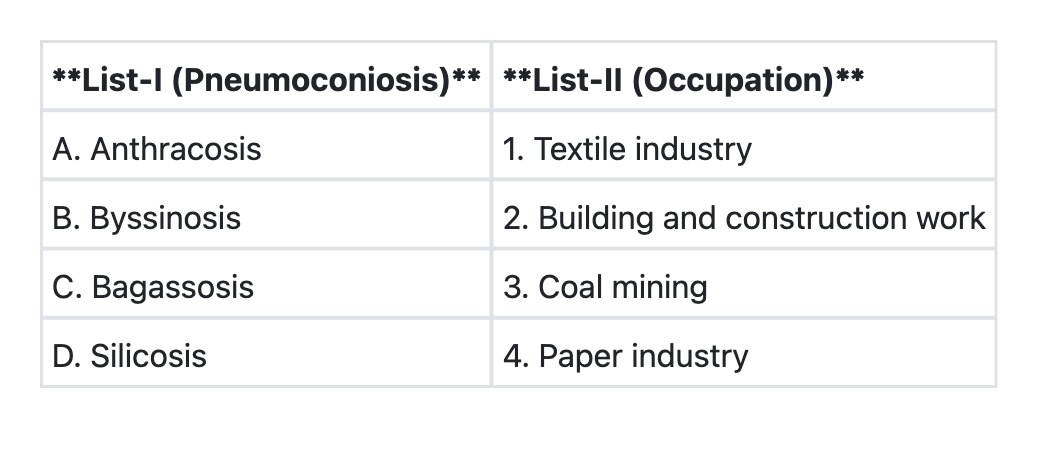
Explanation: ***A→3 B→1 C→2 D→4*** - This option correctly matches each pneumoconiosis with its associated occupation. - **Anthracosis** is linked to coal mining, **Byssinosis** to the textile industry, **Bagassosis** to the paper industry, and **Silicosis** to building and construction work. *A→3 B→2 C→1 D→4* - This option incorrectly matches **Byssinosis** with building and construction work and **Bagassosis** with the textile industry. - Byssinosis is caused by cotton dust in the textile industry, and Bagassosis is caused by bagasse dust, commonly from the sugar cane or paper industry. *A→1 B→4 C→2 D→3* - This option contains multiple incorrect matches, including linking Anthracosis to the textile industry and Silicosis to coal mining. - Anthracosis is specifically tied to **coal dust exposure**, and Silicosis results from **silica dust inhalation**. *A→4 B→2 C→1 D→3* - This option is incorrect because it mismatches Anthracosis with the paper industry and Bagassosis with the textile industry, among others. - Each pneumoconiosis has a distinct occupational exposure source.
Explanation: ***Hyperphosphataemia*** - **Hypophosphatemia** is a common complication of prolonged parenteral hyperalimentation (TPN), particularly during refeeding syndrome, due to increased cellular uptake of phosphate for ATP synthesis [1]. - **Hyperphosphatemia** is rare in TPN unless there is significant renal impairment or excessive phosphate administration, which is usually avoided. *Hyperosmolar acidosis* - This can occur with total parenteral nutrition (TPN) if the **glucose load is too high** or if the patient has underlying impaired glucose tolerance [1]. - The high glucose acts as an **osmotic diuretic**, leading to dehydration and metabolic acidosis [1]. *Hyperammonaemia* - This is a potential complication, especially with **excessive amino acid administration** in patients with liver dysfunction or immature liver enzymes (e.g., neonates). - The inability to adequately metabolize ammonia can lead to **encephalopathy**. *Cholestatic jaundice* - Prolonged TPN is a recognized cause of **TPN-associated liver disease**, which can manifest as cholestatic jaundice. - The etiology is multifactorial, involving factors such as **lack of enteral stimulation**, hepatotoxic components in TPN solutions, and altered bile flow.
Explanation: ***Vitamin A*** - **Vitamin A deficiency** is a common cause of **xerophthalmia**, characterized by **dry eyes** (**xerosis conjunctivae**) and roughening of the **cornea** due to impaired mucin production [1]. In vitamin A deficiency, mucus-secreting cells are replaced by keratin-producing cells [2]. - Progression of ocular epithelial keratinization can lead to **Bitot's spots**, corneal ulceration, and ultimately **blindness** [1], [2]. *Iron* - **Iron deficiency** primarily leads to **iron-deficiency anemia**, causing fatigue, pallor, and weakness, but not directly ocular manifestations like dry eyes or rough cornea. - While severe anemia can cause some visual disturbances, it does not typically present with the specific **xerophthalmic** changes seen here. *Protein* - **Protein deficiency** can lead to conditions like **kwashiorkor** (edema, muscle wasting) or **marasmus** (severe wasting), which broadly impair health and immunity. - However, it does not directly cause the specific ocular signs of **dryness** and **corneal roughening** as a primary deficiency, though it can exacerbate other nutritional deficiencies. *Niacin* - **Niacin (Vitamin B3) deficiency** causes **pellagra**, characterized by the "3 Ds": **dermatitis**, **diarrhea**, and **dementia**. - Ocular symptoms are not a common or primary feature of niacin deficiency; it does not cause **dry eyes** or **corneal roughening**.
Explanation: Vitamin A deficiency - **Dry eyes** with a **gritty sensation (xerophthalmia)** and **corneal softening (keratomalacia)** are classic signs of severe vitamin A deficiency [1], [2]. - This condition can lead to blindness if not treated promptly, as vitamin A is crucial for the health of the **cornea** and **retina** [1], [2]. *Follicular conjunctivitis* - Characterized by the presence of **lymphoid follicles** on the conjunctiva, often due to viral infections like **adenovirus** or **chlamydia**. - While it can cause dryness, it does not typically lead to **corneal softening** or the severe vision-threatening complications seen with vitamin A deficiency. *Viral Keratitis* - Involves inflammation of the **cornea** due to a viral infection, commonly by **herpes simplex virus**. - Symptoms include pain, redness, blurred vision, and sensitivity to light, but **generalized dryness** and **corneal softening** as the primary presentation are less characteristic. *Riboflavin Deficiency* - Also known as **ariboflavinosis**, this deficiency can cause ocular symptoms like **photophobia**, **corneal vascularization**, and **conjunctivitis**. - However, it typically does not present with **severe dry eyes** or **corneal softening (keratomalacia)** as seen in vitamin A deficiency.
Explanation: ***Smoking*** - **Smoking** is a well-established risk factor for **osteoporosis** and **osteopenia** due to its negative effects on bone formation and density [1]. - It impairs osteoblast activity, increases osteoclast activity, and can lead to lower estrogen levels, all contributing to bone loss. *NSAID use* - **NSAIDs (nonsteroidal anti-inflammatory drugs)** are not typically associated with a risk of osteopenia or osteoporosis. - While prolonged high-dose use can have side effects, bone density reduction is not one of them. *Type 2 diabetes mellitus* - The relationship between **Type 2 diabetes mellitus** and bone health is complex; while some studies suggest an increased fracture risk, largely due to falls and poorer bone quality, it's not consistently associated with lower bone mineral density (osteopenia) itself, particularly in younger individuals, and can even be associated with higher bone density. - The primary mechanism for increased fracture risk in diabetes often relates to microvascular complications, neuropathy leading to falls, and altered bone microarchitecture rather than directly causing osteopenia. *Hypoparathyroidism* - **Hypoparathyroidism** leads to **low parathyroid hormone (PTH) levels**, which can result in increased bone mineral density rather than decreased density (osteopenia). - PTH is crucial for maintaining calcium homeostasis and bone remodeling, and its deficiency slows bone turnover, potentially making bones denser but also more brittle. *Obesity* - **Obesity** is generally considered protective against osteopenia or osteoporosis due to the increased mechanical loading on bones, which stimulates bone formation. - Adipose tissue also produces estrogen, which can help maintain bone density, particularly in postmenopausal women [2].
Explanation: ***Low serum angiotensin-converting enzyme levels*** - This patient's presentation with **shortness of breath, nonproductive cough, constipation, fatigue, injected conjunctivae, tender erythematous nodules (erythema nodosum)**, and bilateral hilar lymphadenopathy on chest X-ray is highly suggestive of **sarcoidosis**. - **Elevated serum angiotensin-converting enzyme (ACE) levels** are a classic finding in sarcoidosis due to granuloma production, not low levels. The question asks for the most likely additional finding, and given the classic presentation of sarcoidosis, an elevated ACE level would be expected, which means low ACE levels are incorrect. *Elevated serum parathyroid hormone levels* - This would suggest primary **hyperparathyroidism**, which is not directly indicated by the patient's symptoms or imaging. - While sarcoidosis can cause **hypercalcemia** due to increased vitamin D production, it typically leads to **suppressed PTH levels**, not elevated ones. *Positive interferon-gamma release assay* - A positive IGRA indicates **tuberculosis infection**, which would present differently (e.g., typically productive cough, fever, night sweats, cavitary lesions or upper lobe infiltrates). - While TB can cause hilar lymphadenopathy, the constellation of symptoms (erythema nodosum, conjunctivitis, constipation) is less typical for TB and more for sarcoidosis. *Positive anti-dsDNA antibody testing* - Positive anti-dsDNA antibodies are characteristic of **systemic lupus erythematosus (SLE)**. - While SLE can cause pulmonary symptoms and fatigue, the presence of **erythema nodosum** and **bilateral hilar lymphadenopathy** is not typical for SLE. *Low serum CD4+ T-cell count* - A low CD4+ T-cell count is characteristic of **HIV infection**, which can lead to opportunistic infections, but the constellation of symptoms and imaging findings points away from HIV as the primary diagnosis. - In sarcoidosis, while there can be **anergy** (decreased T-cell reactivity to skin antigens), the peripheral CD4+ T-cell count is often normal or slightly elevated.
Explanation: ***Metabolic acidosis*** - Diarrhea leads to a loss of **bicarbonate** from the gastrointestinal tract, causing a decrease in blood pH [1]. - **Deep and rapid respirations** (Kussmaul breathing) are a compensatory mechanism to blow off CO2 and raise the blood pH [1], [2]. *Respiratory acidosis* - This condition results from **hypoventilation**, leading to CO2 retention and a reduced pH [2]. - Deep and rapid breathing would actually improve respiratory acidosis by expelling CO2. *Metabolic alkalosis* - Characterized by an **excess of bicarbonate** and an elevated blood pH [3]. - Compensatory mechanisms would involve decreased respiration to retain CO2, not increased [3]. *Respiratory alkalosis* - This is caused by **hyperventilation**, which leads to excessive CO2 expulsion and an elevated pH [2]. - While hyperventilation causes deep and rapid breathing, it leads to alkalosis, not acidosis (which is indicated by compensatory breathing in this scenario).
Explanation: ***Drug induced*** - In men under 40, **medication side effects** are a significant and often overlooked cause of erectile dysfunction [4]. - Common culprits include **antidepressants** (especially SSRIs), **antihypertensives** (like beta-blockers and thiazide diuretics), and some **antihistamines** [2]. *Vascular* - While vascular issues are the **most common cause overall** in older men, they are less prevalent in younger men unless associated with severe underlying conditions like **uncontrolled hypertension** or **dyslipidemia** [2]. - **Atherosclerosis** and reduced blood flow to the penis are the primary mechanisms, which typically manifest later in life [2]. *Diabetes* - **Diabetes** can cause erectile dysfunction through **peripheral neuropathy** and **vascular damage**, leading to impaired nerve function and blood flow [3]. - Although it can occur at any age, its prevalence as a cause of ED generally **increases with the duration and poor control** of the disease, making it less likely to be the *most common* cause in men under 40. *Psychological* - **Psychological factors** such as stress, anxiety, depression, and relationship problems are **very common** contributors to erectile dysfunction in young men [1]. - However, direct **drug-induced ED** is often a primary or exacerbating factor that should be carefully considered, especially given the widespread use of various medications in this age group [2].
Explanation: ***Urethral syndrome*** - The patient presents with classic symptoms of **urethral syndrome**, including chronic pelvic pain, frequency, urgency, and incomplete evacuation despite negative urine cultures and normal cystoscopy [1]. - This diagnosis is also supported by the absence of significant findings on ultrasound, urine examination, and vaginal cultures, ruling out common infectious or structural causes [1]. *Asymptomatic bacteriuria* - This condition involves the presence of bacteria in the urine without any associated symptoms and would not explain the patient's **chronic pelvic pain**, frequency, and urgency. - While urine cultures would be positive, the absence of symptoms differentiates it from the patient's presentation. *Cystitis* - **Cystitis**, or bladder inflammation, typically presents with similar symptoms to the patient, but would usually show signs of inflammation or infection in urine analysis (e.g., pyuria) or cystoscopy, which are absent here. - Her negative urine cultures also effectively rule out **bacterial cystitis**. *Vulvovaginitis* - **Vulvovaginitis** is an inflammation of the vulva and vagina, usually presenting with vaginal discharge, itching, or irritation, which is conspicuously absent in this patient [2]. - The patient's symptoms are primarily urinary and pain-related, not genitally localized to the vulva or vagina.
Explanation: ***Ringer lactate*** - **Ringer's lactate** is the preferred solution for severe dehydration, especially in cases with significant fluid and electrolyte loss. - Its composition is similar to that of **extracellular fluid**, containing sodium, potassium, calcium, chloride, and lactate, which is metabolized to bicarbonate, helping to correct metabolic acidosis. *Normal saline* - While **normal saline (0.9% NaCl)** is an isotonic solution, its high chloride content can lead to **hyperchloremic metabolic acidosis** with large volumes [1]. - It does not contain **potassium** or **calcium**, which are essential electrolytes lost during severe dehydration [2]. *DNS 5%* - **Dextrose 5% in normal saline (DNS 5%)** contains free water and sodium, but the dextrose is quickly metabolized, leaving primarily free water. - This can be problematic in severe dehydration as it doesn't effectively restore **plasma volume** and can worsen electrolyte imbalances. *DNS 10%* - **Dextrose 10% in normal saline (DNS 10%)** has a higher dextrose concentration, which further contributes to free water administration once metabolized. - It is generally used when there's a need for significant **caloric intake** and fluid with a high sodium content, which is not the primary goal in severe dehydration management.
Explanation: ***Osteoporosis*** - While osteoporosis can cause **vertebral collapse**, it typically results in a **wedging deformity** or uniform compression, usually without significantly affecting the intervertebral disc space [1]. - The patient's age (38 years old), while not precluding osteoporosis, makes it less likely to be the primary cause of a severe D12 collapse with normal disc space compared to other destructive processes. *Tuberculosis* - **Tuberculous spondylitis (Pott's disease)** commonly affects the vertebral body, often leading to its collapse (gibbus deformity) and subsequent **destruction of the intervertebral disc space** in later stages due to infection spread [2]. - The initial presentation with vertebral collapse and normal disc space followed by disc involvement is characteristic of tuberculous infection, making it a likely consideration. *Metastasis* - **Vertebral metastases** frequently cause osteolytic lesions that weaken the vertebral body, leading to collapse while often **sparing the intervertebral discs** initially due to their avascular nature [3]. - This presentation directly matches the description of D12 collapse with a normal disc space. *Multiple myeloma* - **Multiple myeloma** is a plasma cell malignancy that commonly causes **osteolytic lesions** in the spine, resulting in vertebral body collapse without significant involvement of the intervertebral discs. - This is a highly characteristic presentation for multiple myeloma, making it a strong differential for the given clinical and radiological findings.
Explanation: ***Lisinopril for hypertension*** - **ACE inhibitors** (like lisinopril) are generally recommended as **first-line antihypertensive agents** in diabetic patients due to their **renoprotective effects** and ability to reduce cardiovascular risk [1]. - They *slow the progression of diabetic nephropathy* by reducing intraglomerular pressure and proteinuria [1]. *Metformin for type 2 diabetes mellitus* - While metformin is the **first-line medication for type 2 diabetes**, the question specifically asks for an **antihypertensive medication** [2]. - Metformin's primary role is and *glucose control*, not blood pressure management [2]. *Atorvastatin for hyperlipidemia* - **Statins** like atorvastatin are crucial for **lipid management** in diabetic patients to reduce cardiovascular risk [3]. - However, they do not *lower blood pressure* and therefore are not an *antihypertensive medication*. *Aspirin for cardiovascular protection* - **Aspirin** is used for **cardiovascular protection** in diabetic patients with increased risk, but it is not an *antihypertensive medication*. - Its mechanism involves *antiplatelet effects*, not blood pressure reduction.
Explanation: ***Peptic ulcer disease*** - **Obesity** is generally **not considered a direct risk factor** for peptic ulcer disease; instead, factors like *H. pylori* infection and NSAID use are primary causes. - While comorbidities associated with obesity might indirectly influence gastric health, obesity itself doesn't directly predispose to ulcer formation. *Diabetes* - **Obesity**, particularly **abdominal obesity**, greatly increases the risk of **insulin resistance** and **Type 2 Diabetes Mellitus**. - Excess adipose tissue contributes to systemic inflammation and alters glucose metabolism. *Breast cancer* - **Obesity** is a significant risk factor for **postmenopausal breast cancer** due to increased estrogen production in adipose tissue. - It also promotes chronic inflammation, which can contribute to cancer development and progression. *Colon cancer* - **Obesity** is linked to an increased risk of **colorectal cancer** due to associated **insulin resistance**, chronic inflammation, and altered hormone levels. - These factors can stimulate cell proliferation and inhibit apoptosis in the colon.
Explanation: ***Hypocalcemia*** - While hypocalcemia can cause symptoms like **tetany**, muscle cramps, and paresthesias, it typically does not manifest as **episodic generalized weakness** in the same way that other electrolyte disturbances do. - Its neuromuscular effects are primarily due to increased neuromuscular excitability rather than generalized muscle weakness. *Hypophosphatemia* - Severe hypophosphatemia can lead to **generalized muscle weakness** due to impaired ATP production and cellular energy. - This weakness can be profound and include **rhabdomyolysis** in severe cases, making it a cause of acute generalized weakness. *Hypokalemia* - Low potassium levels can cause **muscle weakness** ranging from mild to severe, including paralysis, due to its critical role in muscle cell membrane potential and neuromuscular function. - This can be episodic, especially in conditions like **hypokalemic periodic paralysis**. *Hyponatremia* - Acute hyponatremia can cause rapid fluid shifts into cells, including muscle cells, leading to **generalized weakness**, lethargy, and altered mental status. - This can be episodic depending on the cause of the acute drop in sodium levels.
Explanation: ***95 to 109degF*** - Clinical thermometers are designed to measure the range of human body temperatures, which typically spans from **hypothermia** to severe fever. - This specific range of **95°F to 109°F** (approximately 35°C to 42.8°C) covers the critical temperatures for accurate diagnosis and monitoring of most common febrile and hypothermic states. *94 to 108degF* - This range is slightly off, as the lower limit of measurement for human body temperature typically starts closer to **95°F** for clinical accuracy. - While it covers the normal and some febrile states, it might miss some severe **hyperthermic** conditions that can push temperatures up to 109°F. *95 to 104degF* - This range is too narrow and would not be sufficient for a clinical thermometer. It would fail to accurately measure **high fevers** (above 104°F). - Many serious medical conditions involve temperatures exceeding **104°F**, making this range impractical for comprehensive clinical use. *95 to 108degF* - While this range is largely adequate for most routine uses, it still falls short of capturing the most extreme but clinically relevant high temperatures. - In certain severe medical emergencies like **heat stroke** or critical infections, body temperatures can reach **109°F**, which this range would not cover.
Explanation: ***More common in males than females*** - Fibromyalgia is significantly **more prevalent in females** than in males, with a female-to-male ratio ranging from 2:1 to 7:1 in various studies. - The exact reasons for this gender disparity are still under investigation, but hormonal, genetic, and psychosocial factors are thought to play a role. *Associated with EEG abnormalities* - Patients with fibromyalgia often exhibit **abnormal EEG patterns**, particularly during sleep, characterized by an alpha rhythm intrusion into non-REM sleep [1]. - These EEG abnormalities are thought to contribute to the characteristic **non-restorative sleep** experienced by many fibromyalgia patients [1]. *Associated with decreased blood flow to the brain* - Studies using imaging techniques like **SPECT** and **fMRI** have shown areas of **reduced cerebral blood flow** in patients with fibromyalgia, particularly in regions involved in pain processing [1]. - This decreased blood flow may contribute to the cognitive symptoms, such as **"fibro fog"**, and altered pain perception [1]. *Associated with low free cortisol levels* - Fibromyalgia is often associated with dysregulation of the **hypothalamic-pituitary-adrenal (HPA) axis**, leading to abnormalities in cortisol secretion [1]. - While total cortisol levels can be variable, many studies report **lower free cortisol levels**, particularly during daytime hours, reflecting a blunted stress response [1].
Explanation: Hypomagnesemia - **Weakness, vertigo, and convulsions** in a patient on **total parenteral nutrition (TPN)** for 20 days are classic signs of magnesium deficiency. - TPN without adequate magnesium supplementation can lead to this condition, as magnesium is crucial for **neuromuscular function**. *Hypercalcemia* - Symptoms of hypercalcemia typically include **bone pain, kidney stones (nephrolithiasis) [1], abdominal groans (constipation, nausea, vomiting)**, and **psychiatric overtones (depression, lethargy)**. - It does not typically cause vertigo or convulsions as primary symptoms, especially not after TPN. *Hypermagnesemia* - Hypermagnesemia is usually associated with **renal failure** or excessive magnesium intake (e.g., antacids, laxatives). - Symptoms often include **hypotension, bradycardia, respiratory depression**, and **loss of deep tendon reflexes**, which are not described here. *Hypocalcemia* - Hypocalcemia can cause neuromuscular irritability, leading to **tetany, muscle cramps**, and **paresthesias**. - While it can manifest with seizures, the combination of **vertigo** and the context of TPN makes hypomagnesemia a more direct and often co-occurring cause.
Explanation: ***Glucosamine-chondroitin*** - While widely used and marketed for osteoarthritis, numerous **large, well-designed clinical trials** have consistently shown that **glucosamine-chondroitin supplements** are **not more effective than placebo** in alleviating pain or improving function in osteoarthritis. - The American College of Rheumatology (ACR) and other major medical organizations **do not recommend** its use due to a lack of evidence of efficacy. *Glucocorticoid steroid intra-articular injections* - **Intra-articular corticosteroid injections** provide **short-term pain relief** [1] and reduce inflammation in patients with osteoarthritis, especially during flares. - They are a commonly used and effective treatment for **symptomatic knee osteoarthritis** [1], although repeated injections have potential risks and may not alter long-term disease progression. *Acetaminophen* - **Acetaminophen (paracetamol)** is often recommended as a **first-line oral analgesic** for mild to moderate pain in osteoarthritis due to its relatively favorable side effect profile compared to NSAIDs for long-term use. - It works by **inhibiting prostaglandin synthesis** primarily in the central nervous system, reducing pain perception. *Total joint arthroplasty* - **Total joint arthroplasty (TJA)**, particularly **total knee replacement**, is a highly effective surgical treatment for patients with **severe, end-stage osteoarthritis** [1] who have failed conservative therapies. - It significantly **reduces pain and improves functional outcomes** [1] and quality of life for the vast majority of patients.
Explanation: ***Sir William Osler*** - This quote is widely attributed to **Sir William Osler**, a renowned physician and one of the four founding professors of Johns Hopkins Hospital. - He is known for his influential contributions to medical education and clinical practice. *Joseph Lister* - **Joseph Lister** was a British surgeon and a pioneer of **antiseptic surgery**, known for promoting the idea of sterile surgical fields. - While significant, this particular quote is not associated with his work. *William Harvey* - **William Harvey** was an English physician who made seminal contributions to **cardiology**, being the first to describe completely the systemic circulation and properties of blood being pumped by the heart. - His work was focused on the circulatory system, not general observations on diseases like fever. *Ronald Ross* - **Ronald Ross** was a British medical doctor who received the **Nobel Prize for his work on malaria**, specifically demonstrating that mosquitoes transmit the disease. - His contributions were centered on parasitic diseases, and this quote is not part of his known writings.
Explanation: ***i.v. NaHCO3*** - **Intravenous sodium bicarbonate (NaHCO3)** is the primary treatment for severe metabolic acidosis to directly correct the acid-base imbalance by providing bicarbonate ions [3]. - It works to **neutralize excess acid** in the bloodstream, raising the pH [4]. *Dextrose* - **Dextrose** (glucose) is used to provide calories and prevent hypoglycemia, but it does not directly treat acidosis [1]. - While sometimes given in critically ill patients, it does not have an immediate or direct effect on **acid-base balance** [2]. *Ringers lactate* - **Ringer's lactate solution** contains lactate, which is metabolized to bicarbonate in the liver; however, in severe acidosis, particularly **lactic acidosis**, the liver's ability to metabolize lactate might be impaired. - Although it contains some electrolytes and can help with volume expansion, its bicarbonate-generating effect is slower and less reliable than direct bicarbonate administration in **severe acidosis**. *None of the options* - This option is incorrect because **i.v. NaHCO3** is a well-established and effective treatment for severe acidosis.
Explanation: ***Epididymitis*** - The patient's history of **benign prostatic hyperplasia (BPH)** and **recurrent cystitis** increases the risk for ascending infections [2, 5], which are the most common cause of epididymitis in older men. - The presentation of **scrotal pain**, **fever**, and a **tender nodule attached to the testis** (most likely the epididymis) is classic for epididymitis [1, 2]. *Urethritis* - While urethritis can cause dysuria and urethral discharge, it typically does not present with a **tender scrotal nodule or fever** in this manner. - It could be a precursor to epididymitis [2], but the primary scrotal findings point elsewhere. *Orchitis* - **Orchitis** primarily involves inflammation of the **testis itself** and is often associated with mumps or viral infections. - While it can cause testicular pain and swelling, the description of a **small, tender nodule attached to the testis** is more indicative of epididymal involvement. *Spermatocele* - A **spermatocele** is a benign cyst that typically presents as a **painless, smooth mass** above the testis. - It does not cause acute pain, fever, or signs of inflammation.
Explanation: ***All of the options*** - **Thiamine (vitamin B1)** is critical for nervous system, heart, and muscle function, as it is a coenzyme in carbohydrate metabolism [1], [2]. - Deficiency can manifest as **Wernicke-Korsakoff syndrome** (affecting the central nervous system), **beriberi** (affecting cardiovascular and peripheral nervous systems), or both [1]. *Peripheral neuropathy* - This is a hallmark of **dry beriberi**, leading to **symmetrical peripheral neuropathy** with muscle weakness and sensory loss [1]. - It results from the impaired function of peripheral nerves due to thiamine's role in myelin maintenance and nerve signal transmission [1]. *Ophthalmoplegia* - This symptom is characteristic of **Wernicke encephalopathy**, a severe neurological manifestation of thiamine deficiency. - It involves paralysis or weakness of the eye muscles, often accompanied by **nystagmus** and ataxia. *Cardiomyopathy* - This is a characteristic feature of **wet beriberi**, where thiamine deficiency impacts cardiac function due to decreased cellular energy production [1]. - It can lead to **high-output cardiac failure**, manifesting as edema and shortness of breath [1].
Explanation: ***40*** - **Morbid obesity** is defined as a Body Mass Index (BMI) of **40 or higher**, or a BMI of 35 or higher with significant obesity-related health conditions. - This level of obesity is associated with a significantly increased risk of severe health complications and reduced life expectancy. *25* - A BMI of **25 or greater** is considered **overweight**, not morbidly obese [1]. - Normal weight is classified as a BMI between 18.5 and 24.9 [1]. *30* - A BMI of **30 or greater** is classified as **obese (Class I)**, but not yet morbidly obese. - Morbid obesity (Class III) starts at a BMI of 40. *18.5* - A BMI **below 18.5** is generally classified as **underweight** [1]. - This range indicates insufficient body fat and can also be associated with health risks.
Explanation: ***Increased number of FFA*** - In **hypothermia**, the body's **metabolic rate** slows down significantly, leading to reduced lipolysis and thus a **decreased** number of **free fatty acids (FFA)**, not an increased number. - This reduction in FFA contributes to the overall energy conservation mechanisms observed during cold exposure. *Lactic acidosis* - **Lactic acidosis** is a common feature of severe hypothermia due to **tissue hypoperfusion** and **anaerobic metabolism** [2]. - Reduced blood flow in cold conditions impairs oxygen delivery, leading to increased lactate production. *Bradycardia* - **Bradycardia** is a classic cardiovascular response to hypothermia, as the heart rate slows down in proportion to the decrease in core body temperature [1]. - The reduced metabolic demand in colder temperatures necessitates a slower heart rate to maintain cardiac output efficiency. *Hypoglycemia* - **Hypoglycemia** is frequently observed in accidental hypothermia, as the body's **glucose metabolism** is profoundly affected by cold temperatures. - Reduced endogenous glucose production and impaired hormonal responses contribute to low blood sugar levels.
Explanation: ***Tetany*** - Magnesium deficiency can lead to increased neuronal excitability and **neuromuscular irritability**, manifesting as **tetany**. - This is often seen in conjunction with **hypocalcemia** because magnesium is essential for normal parathyroid hormone function and calcium homeostasis. *Hyperreflexia* - While magnesium deficiency can cause increased neuromuscular excitability, **hyperreflexia** is not the primary or most characteristic manifestation. - Instead, tetany, which involves more generalized muscle spasms and cramps, is a more specific sign of severe deficiency. *Hyporeflexia* - **Hyporeflexia** is more commonly associated with **hypermagnesemia**, where high magnesium levels depress neuromuscular transmission. - Magnesium deficiency, in contrast, tends to enhance muscle and nerve activity, leading to symptoms like tetany. *All of the options* - While some forms of increased neuromuscular excitability like hyperreflexia might be present, **tetany** is the most direct and classic manifestation of significant magnesium deficiency due to its critical role in regulating muscle and nerve function. - Hyporeflexia is characteristic of excess magnesium, not deficiency.
Explanation: ***Antibiotics*** - Allergic rhinitis is an **inflammatory response to allergens**, not a bacterial infection. - Antibiotics are ineffective against allergic reactions and are associated with risks like **antibiotic resistance** and adverse drug reactions. *Corticosteroids* - **Intranasal corticosteroids** are a first-line treatment for allergic rhinitis due to their potent anti-inflammatory effects [1]. - They effectively reduce symptoms like **nasal congestion**, sneezing, itching, and rhinorrhea [1]. *Surgery* - In certain severe cases, surgery may be considered for allergic rhinitis, particularly to address **structural abnormalities** like nasal polyps or turbinate hypertrophy that contribute to symptoms. - Procedures like **turbinate reduction** can improve nasal airflow and symptom control. *Avoiding allergen* - **Allergen avoidance** is a fundamental and often primary strategy in managing allergic rhinitis. - Identifying and minimizing exposure to specific allergens (e.g., pollen, dust mites, pet dander) can significantly **prevent symptom exacerbations** [1].
Explanation: ***Enalapril*** - As an **ACE inhibitor**, enalapril is the **antihypertensive of choice** for patients with diabetes and proteinuria due to its **renoprotective effects** [2], [3]. - It reduces **glomerular hydrostatic pressure** and decreases proteinuria by dilating the efferent arteriole of the glomerulus [2], [3]. *Propranolol* - **Beta-blockers** like propranolol are generally not first-line for hypertension in diabetic patients because they can mask symptoms of **hypoglycemia** and may worsen **insulin resistance**. - While effective for hypertension, they don't offer the specific **renoprotective benefits** of ACE inhibitors in the presence of proteinuria. *Methyldopa* - **Methyldopa** is primarily used for hypertension in **pregnancy** due to its favorable safety profile in this population. - It is not a preferred agent for general hypertension management, particularly in patients with diabetes and proteinuria, as it lacks the **renoprotective effects** of ACE inhibitors. *Furosemide* - **Furosemide** is a loop diuretic primarily used to manage **fluid overload** and severe hypertension, especially in patients with **renal impairment** or heart failure [4]. - While it lowers blood pressure, it does not offer the same **renoprotective advantages** in reducing proteinuria as ACE inhibitors and may not be suitable as a monotherapy for chronic hypertension with diabetes [1].
Explanation: ***Vertigo*** - **Hyperbaric oxygen therapy (HBOT)** is not a recognized treatment for **isolated vertigo**. Vertigo is primarily a balance disorder often related to inner ear issues or central nervous system dysfunction, not typically amenable to increased oxygen delivery. - While HBOT has been explored for some forms of sudden sensorineural hearing loss, its direct application for general vertigo is not supported by current evidence. *CO poisoning* - HBOT is critical in treating **carbon monoxide (CO) poisoning** as it rapidly displaces CO from hemoglobin and myoglobin, reducing its toxic effects [2]. - It also enhances oxygen delivery to tissues, crucial for preventing neurological damage [1]. *Gas gangrene* - **Gas gangrene**, caused by **Clostridium perfringens**, is an anaerobic infection. HBOT significantly increases tissue oxygen levels, which is directly toxic to the bacteria and inhibits their growth. - It also helps in wound healing and reduces the systemic effects of the bacterial toxins. *Compartment syndrome* - HBOT can be beneficial in **compartment syndrome** by improving oxygenation to ischemic tissues and reducing inflammation and edema. - This can help to preserve muscle viability and reduce the need for fasciotomy, especially when surgical intervention is delayed or incomplete.
Explanation: ***Visual scale*** - The **Visual Analog Scale (VAS)** is a psychometric response scale used to measure subjective characteristics, like pain intensity, that cannot be directly measured. - Patients mark a point on a **10-cm line** between "no pain" and "worst pain imaginable," allowing for continuous comparison. *Face's scale* - The **Wong-Baker FACES Pain Rating Scale** is primarily used in children or adults with communication difficulties. - It uses **facial expressions** to depict different levels of pain intensity, making it easier for individuals to express their pain. *CHEOPS* - **CHEOPS** stands for the Children's Hospital of Eastern Ontario Pain Scale and is specifically designed for assessing **postoperative pain in infants and young children**. - It observes **behavioral indicators** such as crying, facial expression, and verbal cues, rather than direct self-reporting [1]. *Numerical charts* - **Numerical Rating Scales (NRS)** ask patients to rate their pain intensity on a scale from 0 (no pain) to 10 (worst pain possible). - While commonly used, NRS provides discrete values rather than a continuous visual representation for comparison like the VAS.
Explanation: ***Urge incontinence*** - **Urge incontinence**, characterized by an **involuntary leakage of urine accompanied or immediately preceded by urgency**, is the most common form of urinary incontinence after stress urinary incontinence, especially in older women [1]. - It results from **detrusor overactivity**, leading to sudden, strong urges to void that are difficult to defer. *Vesico vaginal fistula* - A **vesicovaginal fistula** involves an abnormal connection between the bladder and the vagina, leading to continuous and spontaneous leakage of urine into the vagina, which would present differently from typical urge symptoms [1]. - While it causes leakage, it's a relatively rare cause compared to urge incontinence and is often associated with prior surgery or radiation. *Overflow incontinence* - **Overflow incontinence** occurs when the bladder is overfilled and unable to empty properly, leading to continuous leakage of small amounts of urine due to retention [1]. - This is often caused by **bladder outlet obstruction** or **neurogenic bladder**, and the patient might report difficulty voiding or a sensation of incomplete emptying [1]. *Detrusor dyssynergia* - **Detrusor dyssynergia** describes a lack of coordination between the detrusor muscle contraction and external urethral sphincter relaxation, typically seen in neurological disorders [2]. - This condition is a specific type of voiding dysfunction that can lead to incontinence but is not the most common cause of leakage after stress incontinence in the general population.
Explanation: ***Thyrotoxicosis*** - **Thyrotoxicosis** is characterized by an **exaggerated physiological tremor**, which is typically fine and rapid, and differs from the slow, irregular flapping tremor (asterixis). - The tremor in thyrotoxicosis is primarily due to increased metabolic rate and enhanced sympathetic activity, not impaired motor control secondary to metabolic encephalopathy. *CO2 narcosis* - **CO2 narcosis**, a severe complication of hypercapnia, can lead to asterixis due to the depressive effects of high CO2 levels on the central nervous system. - The elevated **pCO2** results in cerebral vasodilation and increased intracranial pressure, contributing to impaired neurological function. *Hepatic encephalopathy* - **Hepatic encephalopathy** is a classic cause of **asterixis (flapping tremor)**, due to the liver's inability to detoxify ammonia and other neurotoxins. - These neurotoxins interfere with neurotransmission and neuronal activity, particularly in the motor cortex and basal ganglia. *Uremia* - **Uremia**, a manifestation of severe kidney failure, can cause **asterixis** due to the accumulation of uremic toxins that impair central nervous system function. - These toxins disrupt normal neuronal excitability and metabolism, leading to a variety of neurological symptoms.
Explanation: ***Extracellular dehydration with hyponatremia*** - Diarrhea and vomiting primarily lead to a loss of **isotonic fluid** from the **extracellular space**, resulting in **extracellular dehydration** (hypovolemia) [1]. - While both water and sodium are lost, the replacement with inadequate water intake or plain water can dilute the remaining extracellular fluid, leading to relatively more water than sodium, thus causing **hyponatremia** [1]. *Extracellular dehydration with hypernatremia* - Although there is **extracellular dehydration** due to fluid loss, **hypernatremia** would occur if water loss significantly exceeded sodium loss, or if the water deficit was not adequately replaced, leading to a concentration of existing sodium. - In this scenario, the combination of fluid loss and insufficient water intake is more likely to cause a relative decrease in sodium concentration or an isotonic loss leading to subsequent hyponatremia [1]. *Intracellular dehydration with hyponatremia* - **Intracellular dehydration** occurs primarily due to a shift of water out of cells into the extracellular space, often as a result of **hypernatremia** in the extracellular fluid. - **Hyponatremia** would typically cause water to shift *into* cells, leading to cellular swelling, not intracellular dehydration [1]. *Intracellular dehydration with hypernatremia* - **Intracellular dehydration** is indeed often associated with **hypernatremia** in the extracellular fluid, as the increased extracellular osmolarity pulls water out of the cells [1]. - However, the primary effect of diarrhea and vomiting is directly on the **extracellular fluid volume**, and the subsequent alterations in sodium concentration are more complex than simple intracellular dehydration with hypernatremia.
Explanation: ***Darrow's solution*** - **Darrow's solution** is specifically formulated for patients with significant **potassium and fluid deficits**, often seen in conditions like severe diarrhea. - It contains a high concentration of potassium (typically around **35 mEq/L**) along with sodium and lactate, making it suitable for aggressive repletion. *Ringer lactate* - **Ringer lactate** (also known as Hartmann's solution) is an **isotonic crystalloid** used for fluid resuscitation and maintenance [1]. - While it contains potassium, its concentration is relatively low (typically around **4-5 mEq/L**), similar to physiological plasma levels, to prevent hyperkalemia during large-volume infusions [1]. *Isotonic saline* - **Isotonic saline** (0.9% NaCl) is a basic crystalloid solution primarily used for **volume expansion** and does not contain any potassium [1]. - It provides sodium and chloride, making it useful for extracellular fluid replacement but offers no potassium supplementation. *Plasma* - **Plasma** is the liquid component of blood and has a physiological potassium concentration that is tightly regulated, typically ranging from **3.5 to 5.0 mEq/L** [2]. - This concentration is maintained within a narrow range by renal excretion and cellular shifts to prevent cardiac arrhythmias and other electrolyte disturbances [2].
Explanation: **Intranasal corticosteroids** - **Intranasal corticosteroids** are considered the **first-line treatment** for allergic rhinitis due to their broad anti-inflammatory effects on nasal mucosa [1]. - They effectively reduce symptoms such as **nasal congestion**, **rhinorrhea**, **sneezing**, and **itching** [1]. *Nasal saline irrigation* - **Nasal saline irrigation** can help clear irritants and mucus from the nasal passages, providing symptomatic relief. - However, it is primarily an **adjunctive therapy** and not the most potent first-line treatment for managing moderate to severe allergic rhinitis symptoms alone. *Antibiotics* - **Antibiotics** are used to treat bacterial infections, which are not indicated in this case as the symptoms (watery discharge, itchy eyes) are classic for **allergic rhinitis**, not a bacterial infection. - Unnecessary antibiotic use contributes to **antibiotic resistance** and provides no benefit for allergic conditions. *Oral antihistamine* - **Oral antihistamines** are effective for relieving sneezing, itching, and rhinorrhea in allergic rhinitis [1]. - While useful, intranasal corticosteroids generally offer **superior efficacy**, particularly for nasal congestion, and are often preferred as initial monotherapy for persistent symptoms [1].
Explanation: ***IV potassium replacement*** - The presence of **fatigue, muscle weakness, hypokalemia**, and **U waves on EKG** indicates profound potassium depletion which requires urgent intravenous replacement to prevent life-threatening **cardiac arrhythmias**. [1] - **U waves** are pathognomonic for severe hypokalemia, and immediate intervention is crucial. *Administer oral potassium supplements* - While oral potassium is appropriate for mild to moderate hypokalemia, it is **too slow** and insufficient for severe or symptomatic hypokalemia with EKG changes. - The patient's symptoms and EKG findings suggest a more acute and severe deficiency requiring rapid correction. *Initiate intravenous fluids with dextrose* - Dextrose solutions alone do not address the primary issue of **potassium depletion** and can potentially worsen hypokalemia by stimulating insulin release, which drives potassium into cells. [2] - While intravenous fluids may be needed for hydration, they must be combined with potassium replacement. [1] *Start refeeding protocol* - Refeeding syndrome is a concern in patients with eating disorders, but it is not the immediate priority for a patient with **symptomatic hypokalemia** and EKG changes. - Addressing the critical electrolyte imbalance takes precedence over starting a refeeding protocol, which should be initiated cautiously later.
Explanation: ***Diabetic ketoacidosis*** - In **diabetic ketoacidosis (DKA)**, the body produces **ketoacids** (ketones) due to insulin deficiency, which are unmeasured anions causing a **high anion gap metabolic acidosis** [2]. - The accumulation of these organic acids lowers the **bicarbonate** level and pH, increasing the calculated anion gap. *Renal tubular acidosis* - **Renal tubular acidosis (RTA)** typically causes a **normal anion gap metabolic acidosis**, as the kidney's inability to excrete acid or reabsorb bicarbonate does not involve the accumulation of unmeasured anions [1]. - It results from specific defects in acid-base handling by the renal tubules, leading to hyperchloremic metabolic acidosis [1]. *Severe diarrhea* - Severe diarrhea causes **metabolic acidosis** due to the loss of **bicarbonate** in the stool. - This loss of bicarbonate without a corresponding increase in unmeasured anions results in a **normal anion gap (hyperchloremic) metabolic acidosis**. *Salicylate intoxication* - Salicylate intoxication is complex and often causes a **mixed acid-base disorder**, initially stimulating the respiratory center leading to **respiratory alkalosis** [1]. - As the intoxication progresses, it can cause **high anion gap metabolic acidosis** due to uncoupling of oxidative phosphorylation and impaired renal function, but DKA remains a more classic and distinct cause of solely high anion gap metabolic acidosis.
Explanation: ***Optimize glucose, start systemic abx*** - **Poorly controlled diabetes** compromises the immune system and is a significant risk factor for recurrent **bacterial skin infections** like carbuncles [2], necessitating immediate glycemic optimization [1]. - **Carbuncles** are deeper, more extensive infections than furuncles [3], often requiring **systemic antibiotics** in addition to incision and drainage, especially in immunocompromised individuals [1]. *Immediate drainage w/o abx* - While **drainage** is a crucial step for carbuncles to remove pus and relieve pressure, it is insufficient alone for a patient with diabetes and recurrent infections [1]. - **Systemic antibiotics** are typically required to treat the extensive infection and prevent further spread or recurrence in immunocompromised patients [1]. *Topical abx, daily wound care* - **Topical antibiotics** are generally not effective for **carbuncles**, which are deep-seated infections extending into the subcutaneous tissue and often accompanied by systemic symptoms [3]. - While **daily wound care** is important, it cannot address the underlying systemic infection or the predisposing factor of poorly controlled diabetes. *Observation, follow-up* - **Observation** is an inappropriate management strategy for a diabetic patient with **recurrent carbuncles** and **poor glycemic control**. - Such a presentation indicates a severe, ongoing infection requiring prompt medical intervention to prevent complications like **sepsis** or spread of infection.
Explanation: ***Alcohol cessation programs*** - **Abstinence from alcohol** is the most effective primary prevention strategy, as it directly addresses the cause of alcohol-related liver damage [1]. - Participating in **alcohol cessation programs** helps individuals stop drinking, thereby preventing the progression to cirrhosis [1]. *Liver function tests* - **Liver function tests (LFTs)** are diagnostic tools used to assess liver damage or dysfunction, not preventive measures [1]. - While LFTs can monitor liver health, they do not prevent the initial development of **cirrhosis** itself. *Treatment of cirrhosis* - This option refers to **tertiary prevention**, which involves managing an existing disease to prevent complications or slow its progression. - The question asks for **primary prevention**, which aims to prevent the disease from occurring in the first place. *Liver transplant* - A **liver transplant** is a treatment for end-stage liver disease, including severe cirrhosis, and is a last resort [2]. - This is a **tertiary prevention** or treatment strategy, not a primary prevention method to stop the onset of cirrhosis [2].
Explanation: ***Prostate*** - In a 70-year-old male presenting with **difficulty urinating** and a pelvic mass, an enlarged prostate is the most likely cause. This is indicative of **benign prostatic hyperplasia (BPH)**, a common condition in older men. - The enlarged prostate can compress the **urethra**, leading to symptoms like **urinary hesitancy, weak stream, nocturia, and incomplete bladder emptying** [1]. *Bladder* - While bladder distension can occur secondary to **urinary outflow obstruction**, the bladder itself is not typically the structure that *enlarges* as the primary cause of the obstruction in this scenario. - A palpable bladder mass would usually indicate a **distended bladder** due to urinary retention rather than a primary bladder enlargement causing the obstruction. *Seminal vesicle* - Enlargement of the seminal vesicles is generally **not associated with urinary obstruction** and is usually asymptomatic unless there is inflammation or a rare malignancy. - The seminal vesicles are located posterior to the bladder and do not typically exert pressure on the urethra in a way that causes significant urinary symptoms or a palpable pelvic mass in the context of voiding difficulty. *Urethra* - The urethra is a **tube-like structure**; it does not "enlarge" to form a mass in the pelvis. - Instead, the urethra can be **compressed or strictured**, leading to obstruction, but its anatomical structure prevents it from forming a palpable mass.
Explanation: ***Transitional zone*** - **Benign prostatic hyperplasia (BPH)**, which commonly causes symptoms like difficulty urinating and weak stream [1], originates primarily in the **transitional zone**. - Enlargement of this zone compresses the **urethra**, leading to outflow obstruction symptoms. *Peripheral zone* - The **peripheral zone** is the most common site for **prostate cancer**, not typically BPH. - While a DRE can detect abnormalities in this zone, symptoms of urinary obstruction in this age group are less likely to stem primarily from isolated peripheral zone enlargement. *Central zone* - The **central zone** surrounds the ejaculatory ducts and is rarely involved in BPH or carcinoma. - It is more resistant to hyperplasia compared to the transitional zone. *Anterior zone* - The **anterior zone** is largely glandular and is typically non-pathologic and minimally involved in BPH or prostate cancer. - It is composed mainly of fibromuscular tissue.
Explanation: Sickle cell disease - Sickle cell disease can lead to **splenic autoinfarction**, which results in a shrunken or non-palpable spleen due to repeated vaso-occlusive crises. - Unlike other conditions, it often features **functional asplenia**, making splenomegaly less common. *Infectious mononucleosis* - Typically causes **acute splenomegaly** due to viral infection, specifically from **Epstein-Barr virus**. - Patients often present with **lymphadenopathy** and significant fatigue, along with a palpable spleen. *Hemolytic anemia* - Can lead to splenomegaly due to increased **red blood cell destruction**, causing the spleen to enlarge as it filters out damaged cells [1][2]. - Conditions like **autoimmune hemolytic anemia** are particularly known for causing this enlargement. *Portal hypertension* - Causes **splenomegaly** due to increased pressure in the portal venous system, often resulting from liver disease [1]. - The spleen enlarges as it becomes congested, and is commonly palpable in these cases [1].
Explanation: Intravenous rehydration and electrolyte replacement - This patient exhibits signs of **refeeding syndrome**, characterized by severe **electrolyte imbalances** (low potassium, magnesium, phosphate) and **cardiovascular instability** (tachycardia, hypotension), precipitated by aggressive refeeding in malnourished individuals. - Initial management prioritizes correcting these **life-threatening electrolyte derangements** and addressing **hemodynamic instability** [1] before gradual nutritional support to prevent further complications. *Nutritional rehabilitation* - While critical for long-term recovery in anorexia nervosa, immediate, aggressive nutritional rehabilitation without prior electrolyte correction can worsen **refeeding syndrome**, leading to further cardiac and neurologic decompensation [1]. - Nutritional support should be initiated **slowly and cautiously** after stabilizing the patient's acute medical status and correcting severe electrolyte abnormalities. *Cognitive Behavioral Therapy (CBT)* - **CBT is a cornerstone of long-term psychological treatment** for anorexia nervosa, addressing distorted thoughts and behaviors related to eating, weight, and body image [1]. - However, it is not an acute intervention for immediate medical stabilization in a patient presenting with life-threatening complications like **confusion, tachycardia, and severe electrolyte imbalances**. *Antidepressant medication* - **Antidepressants**, particularly SSRIs, can be part of the long-term management of anorexia nervosa, especially if comorbid depression or anxiety is present. - These medications are **not indicated for acute medical stabilization** in the context of confusion, hemodynamic instability, and severe electrolyte abnormalities, and their effects are not immediate.
Explanation: ***Exercise-associated hyponatremia*** - This condition occurs during or after prolonged physical exertion, like a marathon, and is characterized by a serum **sodium concentration below 135 mmol/L**. - The combination of **confusion and seizures** in a marathon runner with hyponatremia is a classic presentation of exercise-associated hyponatremia due to **excessive fluid consumption** and impaired renal water excretion [2]. *Excessive fluid intake* - While **excessive fluid intake** is a contributing factor to exercise-associated hyponatremia, it is not the diagnosis itself. - Hyponatremia leads to **cerebral edema**, causing neurological symptoms like confusion and seizures [3]. *Inappropriate fluid replacement strategy* - An **inappropriate fluid replacement strategy**, such as drinking too much hypotonic fluid, can certainly cause hyponatremia during prolonged exercise. - However, this option describes the **cause** of the hyponatremia rather than the clinical diagnosis. *Heat stroke with electrolyte imbalance* - **Heat stroke** is characterized by a core body temperature above 40°C with central nervous system dysfunction, but hyponatremia is not a primary diagnostic criterion [1]. - While **electrolyte imbalances** can occur in heat stroke, hyponatremia as the leading cause of such severe neurological symptoms is more suggestive of EAH.
Explanation: ***Metabolic acidosis*** - Severe diarrhea leads to excessive loss of **bicarbonate (HCO3-)** from the gastrointestinal tract, primarily from the small intestine and colon [1], [2]. - The loss of this principal buffer results in a decrease in blood pH, causing **metabolic acidosis** [1], [2]. *Metabolic alkalosis* - This condition is characterized by an increase in blood pH due to an excess of bicarbonate or a loss of hydrogen ions [3]. - It is typically caused by conditions like **vomiting** (loss of gastric acid) or diuretic use, not diarrhea [2], [3]. *Respiratory alkalosis* - This occurs when there is a decrease in the partial pressure of carbon dioxide (PCO2) due to **hyperventilation**. - While diarrhea can lead to compensatory hyperventilation, the primary disturbance is metabolic, not respiratory [1]. *Respiratory acidosis* - This is characterized by an increase in PCO2 due to **hypoventilation** or impaired gas exchange in the lungs. - Diarrhea does not directly cause respiratory acidosis; in fact, the body might try to compensate for metabolic acidosis by increasing ventilation [2].
Explanation: ***Hypotension*** - Severe dehydration leads to a significant reduction in **intravascular volume**, which directly decreases cardiac preload and **blood pressure** [2]. - **Hypotension** is a critical sign indicating that the body's compensatory mechanisms are failing to maintain adequate circulatory function [2]. *Oliguria* - **Oliguria** (reduced urine output) is a common sign of dehydration because the body attempts to conserve fluid [3]. - While concerning, it is generally an early to moderate sign of dehydration and less specific to **severe dehydration** than profound hemodynamic changes. *Increased thirst* - **Increased thirst** is an early and prominent symptom of dehydration, indicating the body's physiological response to fluid deficit [1]. - However, thirst alone does not signify **severe dehydration**, as it can be present even with mild fluid losses [1]. *Tachycardia* - **Tachycardia** (increased heart rate) is a common compensatory mechanism in dehydration, as the heart tries to maintain cardiac output despite reduced blood volume. - While present in moderate to severe dehydration, **hypotension** indicates a more critical stage where compensation is no longer sufficient [2].
Explanation: ***Prednisolone*** - **Corticosteroids** like prednisolone are the first-line treatment for acute sarcoidosis due to their potent **anti-inflammatory** and **immunosuppressive** effects. - They effectively reduce granuloma formation and inflammation, alleviating symptoms and preventing organ damage [1]. *Cyclosporin* - Cyclosporine is an **immunosuppressant** used in some autoimmune diseases and organ transplantation but is not the primary treatment for acute sarcoidosis. - It carries significant side effects, including **nephrotoxicity** and increased infection risk. *Infliximab* - Infliximab is a **TNF-alpha inhibitor** used for chronic, refractory sarcoidosis or in cases where steroids are contraindicated or ineffective. - It is considered a second-line or third-line agent, not the treatment of choice for acute presentation. *IV immunoglobulins* - IV immunoglobulins (IVIG) are used for various **immune deficiencies** and certain autoimmune disorders. - They are not indicated for the initial management of acute sarcoidosis.
Explanation: ***Congenital urethral malformation*** - While often requiring surgical correction, **congenital urethral malformations** (e.g., hypospadias) primarily affect the **urinary stream** and **ejaculatory function**, rather than directly impacting erectile physiology [2]. - Many individuals with corrected or even uncorrected urethral malformations retain the capacity for **erection**. *Double penis (diphallia)* - This rare congenital condition involves the presence of two penises, which often have **structural abnormalities**, including **vascular** and **neural deficits**. - These associated defects commonly lead to **erectile dysfunction** due to impaired blood flow or nerve supply to one or both penile shafts. *Bilateral castration* - This procedure removes both testicles, leading to a profound and immediate drop in **testosterone levels** [1]. - **Testosterone** is crucial for libido, erectile function, and maintaining penile structure, making **impotence** a near-certain outcome [1]. *Penile amputation* - The surgical removal of the penis directly eliminates the organ necessary for **erection** and intercourse. - This results in a complete and irreversible **loss of erectile function** and sexual penetrative capacity.
Explanation: Vitamin B1 - The constellation of **edema**, **hypertension**, **ocular disturbances**, and **mental status changes** in an **alcoholic** patient with **high-output cardiac failure** (Wet Beri Beri) is a classic presentation of **thiamine (Vitamin B1) deficiency** [2], [3]. - **Thiamine** is crucial for **carbohydrate metabolism** and **neurological function**, and a deficiency can lead to severe cardiovascular and neurological dysfunction, especially in chronic alcoholics due to poor absorption and increased metabolic demand [1], [3]. Vitamin B3 - Deficiency of Vitamin B3 (niacin) causes **pellagra**, characterized by the "4 D's": **dermatitis**, **diarrhea**, **dementia**, and death. - While it can cause psychiatric symptoms (dementia), it does not directly lead to the specific cardiovascular manifestations of high-output cardiac failure as seen in Wet Beri Beri. Vitamin B6 - Deficiency of Vitamin B6 (pyridoxine) can result in **peripheral neuropathy**, **anemia**, and **seizures**. - It is not directly linked to the cardiac and edematous symptoms characteristic of Wet Beri Beri. Vitamin B9 - Deficiency of Vitamin B9 (folate) primarily causes **megaloblastic anemia** and can lead to **neural tube defects** in developing fetuses. - While it can manifest with fatigue and weakness due to anemia, it does not typically present with the acute cardiovascular and neurological syndrome described.
Explanation: ***Lactate*** - The **reduced osmolarity ORS** formulation replaced **bicarbonate** with **citrate** and does not contain lactate. - **Citrate** is preferred over lactate / bicarbonate due to its stability, longer shelf life, and ease of dissolution. *Sodium* - **Sodium** is a crucial component of ORS, as it is co-transported with glucose into enterocytes, facilitating water absorption through **solvent drag**. - Reduced osmolarity ORS has a **lower sodium concentration** (75 mEq/L) compared to standard ORS (90 mEq/L) to minimize hypernatremia risk and enhance water absorption. *Potassium* - **Potassium** is included in ORS to replace intestinal losses, as **diarrhea** leads to significant potassium depletion. - Maintaining adequate **potassium levels** is essential for normal cellular function and preventing hypokalemia-related complications. *Citrate* - **Citrate** is a component of ORS that serves as an **alkalinizing agent** to correct metabolic acidosis often associated with dehydration in diarrheal diseases. - It also enhances the absorption of sodium and water in the intestine.
Explanation: ***Pellagra*** - Pellagra is a **nutritional deficiency disease** caused by a lack of **niacin (vitamin B3)**, characterized by symptoms affecting the **skin, gastrointestinal tract, and nervous system** (dermatitis, diarrhea, dementia, and death if untreated) [1]. - It does **not typically cause subconjunctival hemorrhages** as it primarily affects other organ systems and isn't associated with vascular fragility in the conjunctiva like the other conditions listed [2]. *Whooping cough* - **Violent coughing paroxysms** in whooping cough (pertussis) can significantly increase **venous pressure in the head and neck**. - This elevated pressure can rupture small conjunctival blood vessels, leading to **subconjunctival hemorrhages**. *Scurvy* - Scurvy is caused by **vitamin C deficiency**, which is essential for collagen synthesis and maintaining **blood vessel integrity**. - Lack of vitamin C leads to **fragile capillaries**, making patients prone to bleeding, including **subconjunctival hemorrhages**. *Purpura* - Purpura refers to **purple-colored spots on the skin caused by bleeding underneath the skin**. It is a general term for various conditions characterized by **small vessel bleeding**. - These conditions often involve **vascular fragility or platelet abnormalities**, making individuals susceptible to bleeding in different sites, including the conjunctiva, resulting in **subconjunctival hemorrhages**.
Explanation: ***Food obstruction*** - **Food obstruction** is the most frequent cause of choking in adults, often due to large, poorly chewed pieces of food becoming lodged in the airway [1]. - This typically happens during meals, especially when talking or laughing while eating, or consuming alcohol which impairs coordination [1], [2]. *Laryngospasm* - **Laryngospasm** is an involuntary spasm of the vocal cords that temporarily closes the airway, but it typically resolves spontaneously and is not usually the primary cause of sustained choking in adults from foreign body obstruction [1]. - While it can cause transient difficulty breathing, it's often a protective reflex or a complication of intubation/anesthesia, rather than a common choking event. *Anaphylaxis* - **Anaphylaxis** is a severe allergic reaction that can cause airway swelling (angioedema and bronchospasm), leading to difficulty breathing and a sensation of choking. - However, it is a systemic allergic response with other symptoms like rash, hypotension, and gastrointestinal distress, not a direct mechanical obstruction of the airway by a foreign body. *Aspiration of liquids* - **Aspiration of liquids** occurs when fluids enter the trachea and lungs, which can cause coughing, gagging, and lead to aspiration pneumonia. - While it can be a serious event, it rarely causes complete and sudden airway obstruction that is characteristic of choking on a solid object.
Explanation: ***Nephritic syndrome*** - In nephritic syndrome, the **glomerular filtration is often preserved**, allowing for the maintenance of A:G ratio despite the presence of hematuria and proteinuria [1]. - The condition typically leads to a **moderate degree of proteinuria**, retaining a relatively normal serum albumin level [1]. *Multiple myeloma* - In multiple myeloma, there is often a **high level of paraproteins** leading to a significant drop in albumin, affecting the A:G ratio. - Patients frequently exhibit **renal impairment**, resulting in a disrupted A:G ratio due to increased urinary protein loss. *Protein losing enteropathy* - This condition causes **loss of proteins** like albumin through the gastrointestinal tract, leading to **hypoalbuminemia** and altered A:G ratio. - It is characterized by **diarrhea** and fluid accumulation, further impacting the protein status in circulation. *Cirrhosis* - Cirrhosis leads to **decreased albumin synthesis**, resulting in a low serum albumin and an altered A:G ratio. - The condition is associated with **portal hypertension** and ascites, complicating the biochemical status.
Explanation: ***25-29.9*** - A **Body Mass Index (BMI)** between 25 and 29.9 kg/m² is classified as **overweight** [1] or **preobesity**. - This range indicates an increased risk of developing various health problems associated with higher body weight [1]. *18.5-24.9* - This BMI range is considered **normal weight**, which is generally ideal for health [1]. - Individuals within this range typically have the lowest risk of weight-related health complications [1]. *30-34.9* - A BMI in this range is classified as **obesity class I** [1]. - This category indicates a significantly increased risk of developing co-morbidities such as type 2 diabetes and cardiovascular disease [1]. *35-39.9* - This BMI range represents **obesity class II** (severe obesity) [1]. - Individuals in this category face a high risk of serious health issues and often require more aggressive intervention strategies [1].
Explanation: There is no genetic predisposition to obesity. - This statement is false because genetic factors play a significant role in an individual's susceptibility to obesity, influencing metabolism, appetite, and fat storage [1]. - While environment and lifestyle are crucial, polygenic influences and certain single-gene disorders can heavily predispose individuals to weight gain [1]. *Smoking is associated with weight loss* - Smoking can lead to appetite suppression and an increased metabolic rate, which may result in weight loss or lower body weight compared to non-smokers. - However, this is not a healthy or recommended method for weight control due to the numerous severe health risks associated with smoking. *Obesity affects only females.* - This statement is false; obesity affects both males and females across all age groups and demographics [2]. - Although there can be differences in fat distribution and associated health risks between sexes, obesity is a global health issue impacting everyone [2]. *The prevalence of obesity decreases with age.* - This statement is generally false; the prevalence of obesity tends to increase with age through middle adulthood before possibly leveling off or slightly declining in older age. - Factors like decreased physical activity, changes in metabolism, and chronic disease accumulation contribute to weight gain later in life [3].
Explanation: ***Sodium*** - The primary electrolyte in **Oral Rehydration Salts (ORS)** is **sodium**, which is crucial for replacing losses due to diarrhea and facilitating water absorption in the intestines [1]. - The standard ORS formulation, recommended by the WHO, contains **75 mEq/L of sodium** to effectively rehydrate individuals with acute watery diarrhea [1]. *Potassium* - While **potassium** is an essential electrolyte found in ORS, its concentration is typically lower than sodium, usually around **20 mEq/L**. - Potassium helps replenish intracellular losses and supports normal cellular function, but it is not the primary electrolyte at the 75 mEq/L concentration. *Glucose* - **Glucose** is a crucial component of ORS, but it is a sugar, not an electrolyte. - Its role is to facilitate the co-transport of **sodium and water** across the intestinal wall, enhancing fluid absorption, but it does not contribute to the electrolyte concentration in mEq/L [1]. *Chloride* - **Chloride** is an electrolyte present in ORS, primarily to balance the charge of **sodium** and prevent hyynatremia. - Its concentration is typically around **65 mEq/L**, making it slightly less concentrated than sodium but still vital for maintaining electrolyte balance.
Explanation: ***Change imipramine and haloperidol to fluoxetine and risperidone and add bisacodyl for constipation*** - The patient's presentation with **severe constipation** and **orthostatic hypotension** (supine BP 90/60 mmHg from 157/98 mmHg) strongly suggests drug-induced side effects. Older people are especially sensitive to drugs that can cause postural hypotension, and for any presenting problem in old age, the possibility that medication is a contributory factor should be considered [1]. Both **imipramine** (a tricyclic antidepressant) and **haloperidol** (an antipsychotic) have significant **anticholinergic effects**, which can cause severe constipation and worsen orthostatic hypotension. - Switching to **fluoxetine** (an SSRI with fewer anticholinergic effects) and **risperidone** (an atypical antipsychotic with less anticholinergic burden than haloperidol) would mitigate these side effects. Postural hypotension in older adults is defined as a drop in blood pressure of >20 mmHg systolic or >10 mmHg diastolic upon standing [2]. Adding **bisacodyl**, a stimulant laxative, directly addresses her severe constipation. *Change atenolol and thiazide to calcium channel blocker and ACE inhibitor and add bisacodyl for constipation* - While atenolol and thiazide can contribute to orthostatic hypotension, the primary drivers of her severe constipation and marked anticholinergic side effects are likely **imipramine** and **haloperidol**. - Changing the antihypertensive medications alone would not adequately address the severe constipation or the underlying pharmacological cause of her symptoms. *Only add bisacodyl for constipation and continue rest of the medications* - Simply adding a **laxative** without addressing the underlying drug-induced issues would not resolve the root cause of her severe constipation and orthostatic hypotension. Failure to recognise ADRs may lead to the use of further drugs to treat the problem, making matters worse [1]. - Continuing **imipramine** and **haloperidol** would perpetuate the significant anticholinergic side effects, leading to ongoing symptoms and potential complications. *Discontinue all her medications and start her on steroids* - **Discontinuing all medications** without a clear rationale is generally unsafe, especially in an elderly patient with multiple comorbidities like hypertension and depression. - **Steroids** are not indicated for constipation or orthostatic hypotension in this context and could introduce a new set of serious side effects.
Explanation: ***HALE*** - This acronym stands for **Heart-failure Associated Lung Edema**. The symptoms of **progressive dyspnea**, **orthopnea**, **bilateral pedal edema**, **elevated JVP**, **S3 gallop**, and **hepatomegaly** are classic signs of **congestive heart failure** leading to fluid overload and pulmonary congestion [1]. - The pathophysiology involves the heart's inability to pump blood effectively, causing a buildup of pressure in the pulmonary and systemic circulations, leading to the observed symptoms [1]. *DALEY* - This is not a recognized acronym in medical pathophysiology. The symptoms presented are strongly indicative of a specific cardiovascular condition. - There is no clinical scenario where "DALEY" would accurately describe the underlying pathophysiology of dyspnea, edema, and heart failure signs. *OALY* - This is not a recognized acronym in medical pathophysiology. The presented clinical picture requires a well-established and specific pathophysiological explanation. - Using an unrecognized term would not provide an accurate or helpful description of the patient's condition. *None of the options* - The acronym HALE (Heart-failure Associated Lung Edema) accurately captures the core pathophysiology evident from the patient's symptoms and signs. - Given the strong clinical presentation of congestive heart failure with pulmonary and systemic congestion, one of the provided options *does* accurately describe the situation.
Explanation: ***Mastitis*** - **Mastitis** is an **inflammatory condition** of the breast, often caused by bacterial infection, particularly common during **lactation** [1]. - It is an **acquired condition** as it develops after birth due to external or internal factors, not present at birth. *Polymastia (supernumerary breasts)* - **Polymastia** is a **congenital condition** where additional breast tissue develops along the **milk line**. - This condition is present at birth and results from *embryological development anomalies*, not acquired later in life. *Polythelia (extra nipples)* - **Polythelia** refers to the presence of **accessory nipples** along the embryonic milk line and is a **congenital anomaly**. - Like polymastia, it is present from birth due to *developmental errors* and is not an acquired condition. *Amastia (absence of breast tissue)* - **Amastia** is a rare **congenital anomaly** characterized by the complete absence of breast tissue, nipple, and areola. - It is a **birth defect**, meaning it is present from birth and not an acquired condition.
Explanation: ***20*** - The Body Mass Index (BMI) is calculated using the formula: **weight (kg) / [height (m)]²**. - In this case, 45 kg / (1.5 m * 1.5 m) = 45 / 2.25 = **20**. *19* - This answer would result from an incorrect calculation, possibly dividing 45 by 2.36 or using a slightly different height value. - A BMI of 19 would fall within the **normal weight range (18.5-24.9)** but is not the precise calculation for the given metrics. *21* - This answer would result if the denominator was smaller, for example, if the height squared was approximately 2.14, which is not 1.5 times 1.5. - A BMI of 21 still falls within the **normal weight range** but deviates from the accurate calculation. *22* - This answer indicates an error in the calculation, where a smaller denominator was used or a larger numerator was applied. - A BMI of 22 is within the **normal weight range** but does not match the provided weight and height.
Explanation: In which of the following conditions is serum alkaline phosphatase typically not elevated? ***Hyperparathyroidism*** - In hyperparathyroidism, serum alkaline phosphatase levels can be normal or only mildly elevated, depending on bone metabolism changes. - This condition primarily elevates **serum calcium** and affects the bones rather than significantly affecting alkaline phosphatase levels [1]. *Primary biliary cirrhosis* - This condition is associated with **cholestasis**, leading to significantly elevated alkaline phosphatase levels due to liver involvement [1]. - Typically, patients also have other markers such as **AMA (anti-mitochondrial antibodies)** indicating liver-specific pathology. *Hepatitis* - Hepatitis can cause a rise in serum alkaline phosphatase levels, especially if there is associated cholestasis or liver injury. - It often accompanies elevated transaminases, indicating liver inflammation. *Multiple myeloma* - Multiple myeloma may show elevated alkaline phosphatase levels due to bone lesions and increased osteoclastic activity [2]. - The condition is primarily characterized by **monoclonal protein** detection and associated with various bone complications. **References:** [1] Cross SS. Underwood's Pathology: A Clinical Approach. 6th ed. Common Clinical Problems From Liver And Biliary System Disease, pp. 392-393.
Explanation: ***Elevation of testis reduces pain in epididymitis.*** - A **positive Prehn's sign** is characterized by the **alleviation of testicular pain** when the scrotum and testis are elevated, which is typical for epididymitis. - This maneuver is thought to relieve pressure on the inflamed epididymis by reducing traction on the **spermatic cord**. *No change in pain with elevation of testis in epididymitis* - A situation where elevation causes no change in pain, particularly a complete absence of relief, would suggest a **negative Prehn's sign**. - This finding would point away from epididymitis and more towards conditions like **testicular torsion**, where pain is often constant regardless of position. *Pain is referred to the groin in epididymitis* - **Referred pain to the groin** can indeed occur in epididymitis due to shared nerve pathways, but it is not what is solely indicated by a positive Prehn's sign itself. - Prehn's sign specifically assesses the effect of **scrotal elevation** on testicular pain, not the location to which the pain radiates primarily. *Elevation of testis increases pain in epididymitis.* - An increase in pain upon testicular elevation is **not consistent** with epididymitis and a positive Prehn's sign. - This response would be more indicative of conditions where movement or position exacerbates the pathology, such as **testicular appendage torsion** or other acute scrotal issues.
Explanation: ***Amyloidosis*** - Amyloidosis is typically characterized by the deposition of **amyloid protein** in tissues, which does not specifically cause **depapillation of the tongue**. - The **tongue changes** in amyloidosis are often related to macroglossia rather than depapillation. *Luetic glossitis* - Associated with **syphilis**, leading to glossitis and often results in **depapillation** due to inflammation and ulceration of the tongue. - Characterized by **painful, smooth tongue** with loss of papillae, fitting the condition of depapillation. *Pernicious anemia* - Results in **atrophic glossitis**, which is linked to vitamin B12 deficiency and causes **depapillation** of the tongue. - This condition often presents with a smooth, red tongue due to the loss of filiform papillae. *Plummer-Vinson syndrome* - This syndrome is associated with **iron deficiency anemia**, leading to **atrophic glossitis** and **depapillation** of the tongue. - Patients commonly exhibit a smooth and painful tongue, indicative of true depapillation.
Explanation: ***Hypercalcaemia*** - Bronchiogenic carcinoma can lead to **paraneoplastic hypercalcaemia**, often due to osteolytic metastasis or secretion of parathyroid hormone-related peptide (PTHrP) [2]. - Symptoms such as **polyuria, nausea, vomiting**, and **altered sensorium** are common manifestations of elevated calcium levels in the blood [1], [2]. *Hypocalcaemia* - Usually presents with **muscle cramps**, **tetany**, or **neuromuscular irritability**, unlike the symptoms described here. - Contrary to the patient's case, it does not typically result from bronchiogenic carcinoma. *Hyperkalemia* - Often causes **muscle weakness**, **arrhythmias**, and **ECG changes**, which are not aligned with the patient's presentation. - More commonly associated with conditions like **renal failure** or **adrenal insufficiency**, rather than bronchiogenic carcinoma. *Hypokalemia* - Typically results from conditions causing **excessive fluid loss**, such as **vomiting**, but leads to **muscle weakness** rather than altered sensorium [3]. - Rather unlikely in the context of a cancer patient showing signs that suggest an **elevated calcium level** instead.
Explanation: ***Diarrhea*** - Profuse **diarrhea** leads to a significant loss of **bicarbonate** from the gastrointestinal (GI) tract, resulting in **metabolic acidosis**. - The loss of potassium-rich fluid from the GI tract also directly causes **hypokalemia** [1]. *Vomiting* - **Vomiting** leads to the loss of gastric acid (HCl), causing **metabolic alkalosis**, not acidosis [1]. - While it can cause **hypokalemia** due to renal compensation and direct loss, the acid-base disturbance is opposite to what is asked [1]. *Chronic kidney disease* - **Chronic kidney disease** often leads to impaired acid excretion, causing **metabolic acidosis**, but typically causes **hyperkalemia** due to reduced potassium excretion, especially in advanced stages [2]. - In earlier stages, potassium levels might be normal, but hypokalemia is not a characteristic feature. *Nasogastric suction* - **Nasogastric suction** removes gastric acid and fluids, similar to vomiting, leading to a loss of hydrogen ions and chloride. - This typically results in **metabolic alkalosis** and can cause **hypokalemia**, which is inconsistent with metabolic acidosis [1].
Explanation: Loss of deep tendon reflexes (DTR) - Loss of deep tendon reflexes (DTRs) is one of the earliest and most reliable signs of increasing magnesium toxicity, often occurring when serum magnesium levels are between 4-6 mEq/L. - This symptom reflects the neuromuscular blocking effects of magnesium, which reduces acetylcholine release at the neuromuscular junction [1]. *Hypotension* - Hypotension is a later and more severe symptom of hypermagnesemia, typically occurring at higher magnesium levels (e.g., above 6 mEq/L). - It results from the vasodilating effects of magnesium on smooth muscle, leading to decreased peripheral vascular resistance. *Diarrhea* - Diarrhea is actually a common side effect of oral magnesium supplementation, as magnesium acts as an osmotic laxative. - It is generally *not* an early symptom of systemic hypermagnesemia resulting from impaired excretion or excessive parenteral administration. *Arrhythmias* - Arrhythmias, particularly bradycardia and heart block, are significant and *late-stage* cardiac complications of severe hypermagnesemia (often above 8-10 mEq/L). - These are caused by magnesium's interference with myocardial conduction and are more dangerous than early DTR changes.
Explanation: ***ACE inhibitors*** - **ACE inhibitors** are considered first-line therapy for hypertension in patients with diabetes mellitus due to their **renoprotective effects**, which help prevent or slow the progression of diabetic nephropathy [1]. - They reduce **glomerular pressure** and proteinuria [1], which are crucial benefits in diabetic patients [2]. *Some beta blockers* - While beta blockers can lower blood pressure, some **non-selective beta blockers** can mask the symptoms of **hypoglycemia** and may worsen glycemic control in diabetic patients. - They are generally reserved for specific indications such as coexisting angina or heart failure, and preferred agents are those with **cardioselective** properties. *Thiazide diuretics* - **Thiazide diuretics** can increase blood glucose levels and may exacerbate **insulin resistance**, making them less ideal as a first-line treatment for hypertension in diabetic patients. - They can also worsen **dyslipidemia**, which is often a comorbidity for diabetic patients. *Calcium channel blockers* - **Calcium channel blockers** are effective in lowering blood pressure but do not offer the same **renoprotective benefits** as ACE inhibitors in diabetic patients. - They are often used as an alternative or add-on therapy if ACE inhibitors are not tolerated or insufficient [2].
Explanation: ***Stress incontinence*** - This is characterized by the involuntary leakage of urine with activities that increase **intra-abdominal pressure**, such as **coughing, sneezing, laughing, bending, or exercising**. - It commonly results from **weakness of the pelvic floor muscles** or dysfunction of the urethral sphincter, often due to childbirth or aging. *Urge incontinence* - This involves a sudden, **intense urge to urinate** followed by involuntary loss of urine, often without any precipitating activity. - It is typically caused by **detrusor overactivity**, where the bladder muscles contract involuntarily. *Overflow incontinence* - This occurs when the bladder is **overfilled** and urine leaks out, often in small amounts, because the bladder cannot empty properly. [1] - It can be caused by **bladder outlet obstruction** (e.g., enlarged prostate in men) or impaired detrusor contractility (e.g., neurological conditions). [1] *Functional incontinence* - This refers to urine leakage that occurs because of **physical or cognitive impairments** that prevent a person from reaching the toilet in time. [1] - The urinary tract itself may be normal, but external factors limit effective toileting. [1]
Explanation: **Intravenous injection of 20 ml 10% calcium gluconate solution** - Repeated vomiting leads to loss of **hydrochloric acid**, causing **metabolic alkalosis** [1] and subsequent **hypocalcemia**, which manifests as carpopedal spasms. - Administering **intravenous calcium gluconate** directly addresses the low ionized calcium responsible for the spasms. *Intravenous infusion of isotonic saline* - While fluid replacement might be necessary to correct dehydration, isotonic saline alone does not directly address the underlying **hypocalcemia** or metabolic alkalosis causing the spasms [1]. - It would not immediately relieve the **carpopedal spasms**. *5% CO2 inhalation* - Inhaling CO2 would increase blood pCO2, causing **respiratory acidosis**, which could theoretically counteract metabolic alkalosis to some extent [1]. - However, this is not the primary or most effective treatment for acute **hypocalcemic tetany** and does not directly provide calcium. *Oral ammonium chloride 1g four times a day* - Oral ammonium chloride works as an **acidifying agent**, which could help correct **metabolic alkalosis**. - However, it works too slowly to provide immediate relief for acute, symptomatic **carpopedal spasms** and does not directly treat the hypocalcemia.
Explanation: The patient's presentation with **poor wound healing**, **ecchymoses**, **perifollicular hemorrhages**, and **splinter hemorrhages**, in an **edentulous alcoholic male** (indicating poor nutrition), are classic signs and symptoms of **scurvy** caused by **vitamin C deficiency** [1]. **Vitamin C (ascorbic acid)** is essential for **collagen synthesis** (wound healing, blood vessel integrity) and iron absorption, explaining the observed symptoms [1]. A dose of 250 mg vitamin C 3 times daily by mouth should saturate the tissues quickly [1].
Explanation: ***Myopia*** - **Myopia**, or nearsightedness, is primarily caused by an abnormally long eyeball or excessive curvature of the cornea, leading to distant objects appearing blurry. - It is a **refractive error** and is not directly linked to nutritional deficiencies like vitamin A deficiency. *Night blindness* - **Night blindness** (**nyctalopia**) is one of the earliest and most common symptoms of vitamin A deficiency, occurring because vitamin A is a crucial component of **rhodopsin**, a photopigment in the retina vital for low-light vision [1], [2]. - Impaired rhodopsin regeneration leads to difficulty seeing in dim light [2]. *Corneal dryness* - **Corneal dryness** (**xerophthalmia**) is a severe manifestation of vitamin A deficiency, resulting from the impaired differentiation of goblet cells and squamous metaplasia in the conjunctiva and cornea [1], [3]. - This leads to a lack of mucus production and tears, causing the cornea to dry out and become vulnerable to damage [1], [3]. *Bitot's spots* - **Bitot's spots** are foamy, triangular patches of keratinized epithelium on the conjunctiva, specifically on the temporal side, which are characteristic signs of **vitamin A deficiency** [3]. - These spots are a result of squamous metaplasia and keratinization due to the lack of vitamin A, which is essential for normal epithelial cell differentiation [3].
Explanation: ***Tamoxifen therapy*** - **Tamoxifen**, an estrogen receptor modulator, can cause electrolyte imbalances, but **hypokalemia is not a typical side effect**. - It is more commonly associated with an increased risk of **thromboembolic events** and **endometrial cancer**. *ACTH producing tumors* - **ACTH-producing tumors** lead to increased cortisol production (**Cushing's syndrome**), which can cause **mineralocorticoid effects** [1]. - This results in increased renal potassium excretion, leading to **hypokalemia** [1]. *Diabetic ketoacidosis* - In **diabetic ketoacidosis (DKA)**, potassium shifts from the intracellular to the extracellular space due to **acidosis** and **insulin deficiency**. - Despite elevated serum potassium initially, patients often have significant **total body potassium depletion** and are at risk for **severe hypokalemia** upon insulin and fluid administration. *Non-bilious vomiting* - **Non-bilious vomiting** leads to the loss of **gastric acid (HCl)** [1]. - This causes **metabolic alkalosis**, which promotes potassium shift into cells and increased renal excretion of potassium to conserve hydrogen ions, leading to **hypokalemia** [1].
Explanation: ***Verapamil*** - **Verapamil**, a **calcium channel blocker**, is a suitable choice for this patient as it effectively lowers blood pressure without adversely affecting renal function in the presence of **bilateral renal artery stenosis**. - It also does not worsen **diabetes mellitus** or interfere with glucose metabolism, making it a safer option for this specific patient profile. *Enalapril* - **Enalapril**, an **ACE inhibitor**, is contraindicated in patients with **bilateral renal artery stenosis** because it can severely impair renal function and lead to acute kidney injury by reducing glomerular filtration pressure [1]. - While generally good for hypertension and diabetes, the presence of **bilateral renal artery stenosis** overrides these benefits due to the high risk of renal compromise [1], [2]. *Beta blockers* - **Beta blockers** can be used in hypertension, but they can **mask symptoms of hypoglycemia** in diabetic patients and may negatively affect lipid profiles and glucose control. - While not strictly contraindicated by renal artery stenosis, their potential metabolic side effects in a diabetic patient make them less ideal than **calcium channel blockers**. *Thiazides* - **Thiazide diuretics** can cause **glucose intolerance** and worsen glycemic control in patients with diabetes, which is a significant concern for this patient. - Although effective for hypertension, their use in patients with **renal artery stenosis** can sometimes lead to reduced renal blood flow due to volume depletion, potentially compromising kidney function.
Explanation: ***Myoglobinuria*** - Myoglobinuria is the most probable cause of red-colored urine following strenuous exercise, as **myoglobin** is released into the bloodstream from damaged muscle fibers and then excreted in the urine. - This condition is often associated with **rhabdomyolysis**, which can occur after intense physical exertion. *Hemoglobinuria* - Hemoglobinuria occurs due to hemolysis, often from **intravascular destruction of red blood cells**, not directly from muscle damage due to exercise [2]. - While strenuous exercise can sometimes cause minor hemolysis, it is less likely to be the primary cause of significant red urine compared to myoglobinuria. *Hemosiderinuria* - Hemosiderinuria is the presence of **hemosiderin** in the urine, which is a breakdown product of hemoglobin, observed in chronic hemolytic states. - It does not typically present as acute red-colored urine after exercise but rather reflects ongoing iron excretion and is identified microscopically. *Hematuria* - Hematuria involves the presence of **intact red blood cells** in the urine, usually indicating damage to the urinary tract (kidneys, bladder, etc.) [1]. - While exercise can occasionally lead to transient hematuria, the history of severe exercise and the typical presentation of rhabdomyolysis make myoglobinuria a more likely cause for the specific red-colored urine described [1].
Explanation: **≥30** - A **Body Mass Index (BMI)** of **30 kg/m² or greater** is the widely accepted classification for obesity in adults [1]. - This threshold is used globally by health organizations like the **World Health Organization (WHO)** to define and categorize obesity [1]. *≥20* - A BMI of 20 kg/m² typically falls within the **normal weight range** (18.5 to 24.9 kg/m²) [1]. - This value is significantly below the threshold for classifying obesity [2]. *≥40* - A BMI of **40 kg/m² or greater** is classified as **Class III obesity** (also known as severe or morbid obesity) [1]. - While it indicates obesity, it's a specific sub-classification and not the general threshold for obesity. *≥50* - A BMI of 50 kg/m² categorizes an individual into an even more severe subclass of **Class III obesity**. - It represents an extreme level of obesity, far exceeding the general threshold.
Explanation: ***Iron deficiency anemia*** - **Iron deficiency** is a well-established and the most common reversible secondary cause of **restless leg syndrome (RLS)**, affecting dopamine synthesis and function in the brain [1]. - Correcting iron levels, often with oral iron supplements, can significantly improve RLS symptoms. *Chronic kidney disease* - While **chronic kidney disease (CKD)** is a known cause of secondary RLS, it is less common than iron deficiency anemia. [1] - RLS in CKD is often associated with **uremia** and electrolyte imbalances [1]. *Hyperthyroidism* - **Hyperthyroidism** is not typically associated with restless leg syndrome. - Symptoms of hyperthyroidism usually include **tremor**, anxiety, weight loss, and heat intolerance. *Peripheral neuropathy* - **Peripheral neuropathy** can cause leg discomfort and sensory symptoms, but these are generally described as burning, tingling, or numbness rather than the irresistible urge to move associated with RLS [1]. - While some neuropathies may coexist with RLS, it is not the most common direct cause of RLS itself [1].
Explanation: ***Alkalosis*** - **Alkalosis** causes an **intracellular shift of potassium** in exchange for hydrogen ions [1], typically leading to **hypokalemia**, not hyperkalemia [1]. - This shift helps to buffer the alkaline state by moving hydrogen ions out of cells. *Acute renal failure* - In **acute renal failure**, the kidneys lose their ability to excrete potassium, leading to its accumulation in the blood. - This impaired **potassium excretion** is a common cause of **hyperkalemia** in these patients. *Addison's disease* - **Addison's disease** (primary adrenal insufficiency) results in decreased production of **aldosterone**, a hormone that promotes potassium excretion [1]. - Reduced **aldosterone** activity leads to reduced potassium secretion in the renal tubules, causing **hyperkalemia** [1]. *Excess hemolysis* - **Hemolysis** refers to the breakdown of red blood cells, which contain a high concentration of **intracellular potassium** [1]. - When red blood cells lyse, they release their intracellular potassium into the bloodstream, directly causing **hyperkalemia**.
Approach to the Medical Patient
Practice Questions
Differential Diagnosis Development
Practice Questions
Rational Diagnostic Testing
Practice Questions
Medical Decision Making
Practice Questions
Cost-effective Care
Practice Questions
Patient-centered Communication
Practice Questions
Interprofessional Collaboration
Practice Questions
Systems-based Practice
Practice Questions
High-value Care
Practice Questions
Transitions of Care
Practice Questions
Chronic Disease Management
Practice Questions
Medical Uncertainty Management
Practice Questions
Get full access to all questions, explanations, and performance tracking.
Start For Free