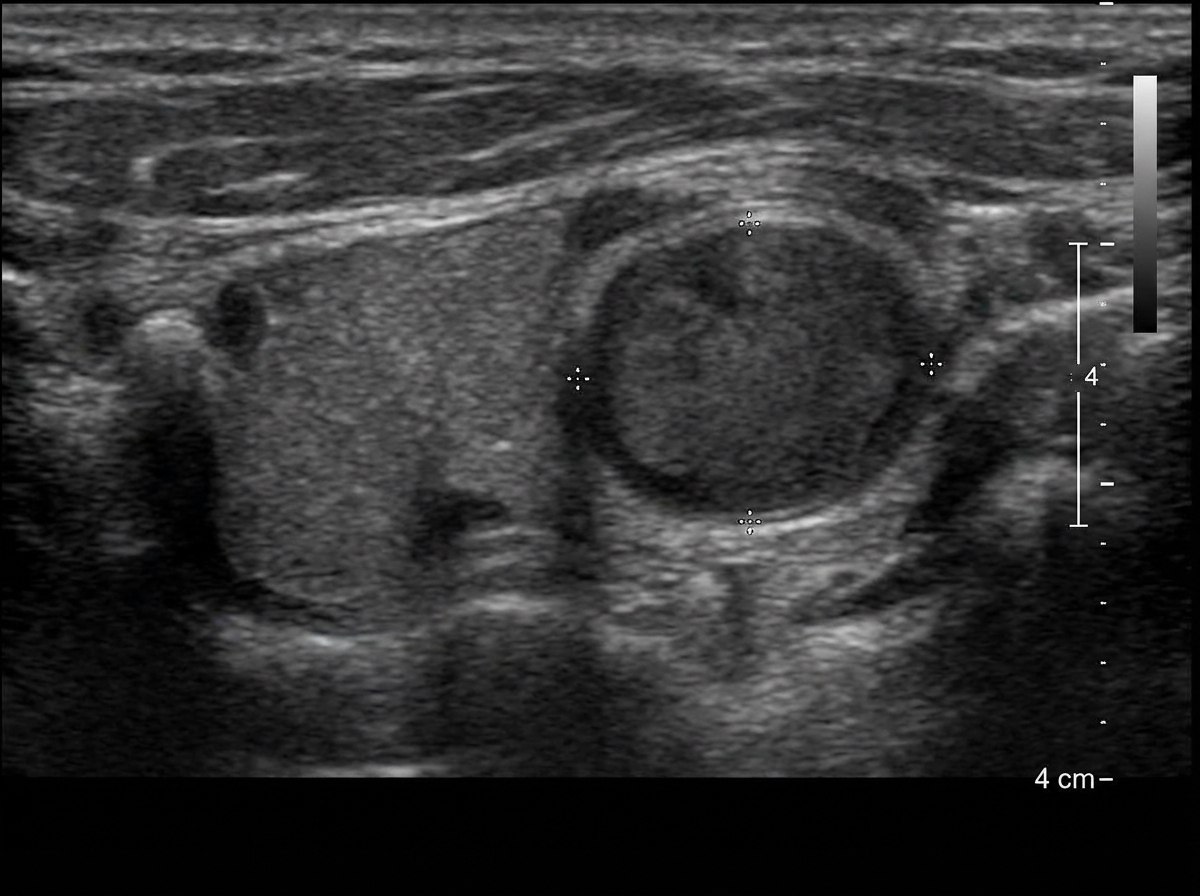
What is the treatment of choice for a 52-year-old male with toxic adenoma?
A 55-year-old extremely obese man reports weakness, sweating, tachycardia, confusion, and headache whenever he fasts for more than a few hours. He has prompt relief of symptoms when he eats. These symptoms are most suggestive of which of the following disorders?
What is the most common hormone, other than gastrin, found in a gastric secreting islet cell tumor?
Which of the following is true regarding cretinism?
All of the following are true about Graves disease, except?
Which of the following does not occur in Addison's disease?
Which of the following are causes of hyperparathyroidism?
Which of the following statements about Diabetic Ketoacidosis is true?
Which of the following is true about pseudohypoparathyroidism?
Which of the following is NOT a feature of thyrotoxicosis?
Explanation: **Explanation:** **Toxic Adenoma (Plummer’s Disease)** is characterized by a solitary, autonomously functioning thyroid nodule that overproduces thyroid hormones, leading to the suppression of TSH and subsequent "shut down" of the surrounding normal thyroid tissue. **Why Radioactive Iodine (RAI) is the Correct Choice:** RAI ($I^{131}$) is the treatment of choice for most adults with toxic adenoma [1]. Because the surrounding normal thyroid tissue is suppressed (due to low TSH), it does not take up the isotope. The RAI is selectively concentrated only in the "hot" autonomous nodule, leading to its localized destruction while sparing the rest of the gland. This results in a high cure rate with a very low risk of post-treatment hypothyroidism compared to Grave's disease. **Analysis of Incorrect Options:** * **A. Surgical removal (Hemithyroidectomy):** While effective and preferred in children, adolescents, or patients with very large compressive nodules, it is generally considered second-line to RAI in a 52-year-old due to surgical risks. * **B. Radiotherapy:** External beam radiation has no role in the management of benign hyperthyroidism; it is reserved for thyroid malignancies. * **D. Medical treatment (Antithyroid drugs):** Thionamides (Methimazole/PTU) are used to achieve euthyroidism before definitive therapy (RAI or surgery) [1] but are **not curative**. Toxic nodules never undergo spontaneous remission, unlike Graves' disease. **High-Yield Clinical Pearls for NEET-PG:** * **Diagnosis:** Radionuclide scan shows a **"Hot Nodule"** with complete suppression of the contralateral lobe. * **Toxic Multinodular Goiter (TMNG):** Also treated definitively with RAI, though higher doses are often required compared to a solitary adenoma. * **Amiodarone-Induced Thyrotoxicosis (Type 1):** Occurs in patients with underlying multinodular goiter; treated with antithyroid drugs, not RAI (due to low iodine uptake) [2].
Explanation: ### Explanation The clinical presentation described is a classic manifestation of **Whipple’s Triad**, which is the hallmark of an **Insulinoma**. **1. Why Insulinoma is Correct:** An insulinoma is a rare neuroendocrine tumor of the pancreatic beta cells that secretes insulin autonomously, regardless of blood glucose levels. The patient exhibits the three components of Whipple’s Triad: * **Symptoms of hypoglycemia:** Neuroglycopenic (confusion, headache, weakness) and autonomic (sweating, tachycardia) symptoms triggered by fasting [1]. * **Low plasma glucose:** Occurring during these episodes. * **Relief of symptoms:** Prompt recovery upon administration of glucose/eating. The association with obesity is common, as patients often eat frequently to avoid unpleasant hypoglycemic episodes. **2. Why the Other Options are Incorrect:** * **A. Diabetes Mellitus:** Typically presents with hyperglycemia (polyuria, polydipsia). While hypoglycemia can occur in diabetics, it is almost always a side effect of medication (insulin or sulfonylureas), not the disease itself [3]. * **C. Zollinger-Ellison Syndrome:** A gastrin-secreting tumor (Gastrinoma) leading to severe peptic ulcers and diarrhea, not hypoglycemia. * **D. Carcinoid Syndrome:** Characterized by flushing, diarrhea, and wheezing due to serotonin release; it does not cause fasting hypoglycemia [2]. **3. NEET-PG High-Yield Pearls:** * **Diagnosis:** The gold standard is the **72-hour supervised fast**. * **Biochemical Profile:** High Insulin, High C-peptide, and High Pro-insulin levels during hypoglycemia. (Note: Exogenous insulin intake would show high insulin but *low* C-peptide) [1]. * **Localization:** Most insulinomas are small, benign, and solitary. Endoscopic ultrasound (EUS) is highly sensitive for localization. * **Rule of 10s:** Approximately 10% are malignant, 10% are multiple, and 10% are associated with **MEN-1 syndrome**.
Explanation: Explanation: Gastrinomas (Zollinger-Ellison Syndrome) are neuroendocrine tumors (NETs) that primarily secrete gastrin. However, these tumors are frequently plurihormonal, meaning they can synthesize and secrete multiple peptide hormones simultaneously. Why ACTH is correct: Among the non-gastrin hormones produced by pancreatic or duodenal islet cell tumors, ACTH (Adrenocorticotropic Hormone) is the most common [2]. When a gastrinoma secretes ACTH, it can lead to ectopic Cushing syndrome [1]. This is a high-yield association, particularly in the context of Multiple Endocrine Neoplasia type 1 (MEN1), where gastrinomas are the most common functional pancreatic NET. Analysis of Incorrect Options: * B. Glucagon: While glucagon is secreted by alpha-cell tumors (glucagonomas), it is less frequently co-secreted by gastrin-secreting tumors compared to ACTH. * C. Melanocyte Stimulating Hormone (MSH): MSH can be elevated as a byproduct of ACTH synthesis (both derived from POMC), but ACTH itself is the primary hormone identified in these clinical scenarios. * D. Growth Hormone Releasing Factor (GHRF): GHRF secretion can occur in pancreatic NETs (leading to acromegaly), but it is statistically rarer than ACTH co-secretion. NEET-PG High-Yield Pearls: * Most common site for Gastrinoma: The Gastrinoma Triangle (Passaro’s Triangle)—bounded by the junction of the cystic/common bile duct, the junction of the 2nd and 3rd parts of the duodenum, and the neck of the pancreas. * MEN1 Association: 25% of gastrinomas are associated with MEN1 (3 Ps: Pituitary, Parathyroid, Pancreas). * Clinical Clue: If a patient with ZES develops hypokalemia and hypertension, suspect ectopic ACTH secretion.
Explanation: Cretinism, now medically referred to as **Congenital Hypothyroidism**, is a condition resulting from a deficiency of thyroid hormones during fetal or neonatal life [1]. Thyroid hormones are essential for linear bone growth and skeletal maturation. **Why Option C is Correct:** In cretinism, there is a profound failure of endochondral ossification and epiphyseal growth. This leads to **disproportionate dwarfism**, characterized by **short limbs and short stature**. Unlike growth hormone deficiency (which causes proportionate growth failure), thyroid deficiency specifically impairs the maturation of the skeleton more than the growth in length, resulting in a low upper-to-lower segment ratio and a "stocky" appearance. **Analysis of Incorrect Options:** * **Option A & B:** These are incorrect because cretinism is characterized by **disproportionate** growth failure. Proportionate shortening is typically seen in Pituitary Dwarfism (Growth Hormone deficiency). * **Option D:** Short limbs and tall stature is a physiological contradiction in the context of growth disorders and does not occur in cretinism. **High-Yield Clinical Pearls for NEET-PG:** * **Most common cause:** Thyroid dysgenesis (Aplasia, hypoplasia, or ectopic gland) [1]. * **Clinical Features:** Macroglossia (large tongue), umbilical hernia, prolonged neonatal jaundice, hoarse cry, and mental retardation (if untreated) [1]. * **Radiological Hallmark:** Epiphyseal dysgenesis (stippled epiphysis), most commonly seen at the knee. * **Screening:** Best performed between **2–4 days of life** by measuring TSH levels [1]. Early thyroxine (T4) replacement is critical to prevent permanent intellectual disability.
Explanation: **Explanation:** **1. Why Option A is the correct answer (The Exception):** Graves' disease, like most autoimmune conditions, shows a strong female predilection. It is approximately **7 to 10 times more common in women** than in men [1], [2]. The peak incidence typically occurs between the ages of 20 and 50 [1]. Therefore, the statement that it is "more common in males" is factually incorrect. **2. Why the other options are incorrect (True statements):** * **Option B (Autoimmune etiology):** This is true. The disease is caused by **TSH-receptor antibodies (TRAb)** [1], specifically Thyroid Stimulating Immunoglobulins (TSI), which bind to and activate the TSH receptor, mimicking the action of TSH [2]. * **Option C (Hyperthyroidism):** This is true. Graves' disease is the most common cause of thyrotoxicosis/hyperthyroidism worldwide [2]. The continuous stimulation of the thyroid gland leads to excessive synthesis and release of T3 and T4. * **Option D (Non-thyroid manifestations):** This is true. Graves' is a multisystem disorder. Key extrathyroidal features include **Graves' Ophthalmopathy** (exophthalmos due to retro-orbital inflammation) and **Pretibial Myxedema** (localized dermopathy) [1]. **High-Yield Clinical Pearls for NEET-PG:** * **Triad of Graves:** Hyperthyroidism + Diffuse Goiter + Ophthalmopathy. * **Diagnosis:** Low TSH, High Free T4/T3, and diffuse uptake on Radioiodine (RAIU) scan [2]. * **Specific Marker:** TSH-receptor antibody (TRAb) is the most specific test [1]. * **Histology:** Shows tall columnar epithelium with **"scalloping"** of the colloid. * **Associated HLA:** Strongly linked with **HLA-DR3** and HLA-B8.
Explanation: Addison’s disease (Primary Adrenocortical Insufficiency) is characterized by the destruction of the adrenal cortex, leading to a deficiency of both **cortisol** (glucocorticoid) and **aldosterone** (mineralocorticoid) [1]. **Why Hyperglycemia is the correct answer:** Cortisol is a "stress hormone" and a potent gluconeogenic agent. It increases blood glucose by stimulating gluconeogenesis and decreasing peripheral glucose utilization. In Addison’s disease, the lack of cortisol leads to **hypoglycemia**, not hyperglycemia. Therefore, hyperglycemia is not a feature of this condition. **Analysis of Incorrect Options:** * **Hyperpigmentation:** In primary adrenal insufficiency, low cortisol triggers a compensatory increase in **ACTH** (Adrenocorticotropic Hormone) from the pituitary. ACTH is derived from POMC, which also produces **MSH** (Melanocyte-Stimulating Hormone). High levels of ACTH/MSH lead to characteristic hyperpigmentation of skin creases, buccal mucosa, and scars [2]. * **Weight loss:** Cortisol deficiency leads to anorexia, nausea, and vomiting, while aldosterone deficiency causes chronic dehydration [2]. Together, these result in significant weight loss. * **Hypotension:** Aldosterone deficiency leads to renal sodium wasting and potassium retention [1]. This causes volume depletion, decreased cardiac output, and orthostatic hypotension. **NEET-PG High-Yield Pearls:** * **Electrolyte Triad:** Hyponatremia, Hyperkalemia, and Metabolic Acidosis. * **Most common cause:** Autoimmune adrenalitis (developed countries); Tuberculosis (developing countries like India) [3]. * **Cosyntropin Test:** The gold standard for diagnosis (failure of cortisol to rise after ACTH administration) [2]. * **Secondary Adrenal Insufficiency:** Unlike Addison’s, there is **no hyperpigmentation** (low ACTH) and **no hyperkalemia** (aldosterone is regulated by the RAAS, not ACTH).
Explanation: **Explanation:** The question asks for the manifestations of hyperparathyroidism. The correct answer is **D (All of the above)** because all listed options are classic skeletal manifestations of **Osteitis Fibrosa Cystica**, the hallmark of advanced primary hyperparathyroidism (PHPT). **Underlying Concept:** Hyperparathyroidism leads to an overproduction of Parathyroid Hormone (PTH) [1]. PTH increases osteoclast activity to mobilize calcium from the bones into the blood [1]. Chronic, excessive bone resorption results in the replacement of marrow elements with fibrous tissue and the formation of characteristic cystic lesions. * **Subperiosteal bone resorption:** This is the **most specific** radiological sign of hyperparathyroidism. It is most commonly seen on the radial aspect of the middle phalanges of the 2nd and 3rd fingers. * **Multiple bone cysts:** As bone is replaced by fibrous tissue, localized areas of decalcification form cysts (often called "salt and pepper" appearance when occurring in the skull). * **Brown’s Tumor (Osteoclastoma):** These are not true neoplasms but focal lytic lesions caused by rapid bone resorption. The "brown" color is due to vascular congestion and hemosiderin deposition from micro-hemorrhages within the cysts. **Clinical Pearls for NEET-PG:** * **Classic Triad of PHPT:** "Stones (renal calculi), Bones (osteitis fibrosa cystica), Groans (abdominal pain/peptic ulcers), and Psychic overtones (depression/confusion)." * **Rugger-Jersey Spine:** Characterized by bands of increased bone density at the upper and lower vertebral endplates; typically seen in secondary hyperparathyroidism (Chronic Kidney Disease) [2]. * **Biochemical Profile:** High Serum Calcium, Low Serum Phosphate, and High PTH. (In secondary HPT, Calcium is low/normal) [2].
Explanation: **Explanation:** **Diabetic Ketoacidosis (DKA)** is a life-threatening complication of diabetes characterized by the triad of hyperglycemia, ketosis, and metabolic acidosis [1], [2]. **1. Why Decreased Bicarbonate is Correct:** In DKA, an absolute or relative insulin deficiency leads to increased lipolysis and the production of ketoacids (acetoacetate and $\beta$-hydroxybutyrate) [4]. These are strong organic acids that dissociate, releasing hydrogen ions ($H^+$). To maintain physiological pH, the body’s primary buffer, **Bicarbonate ($HCO_3^-$)**, reacts with these excess $H^+$ ions. This consumption leads to a significant **decrease in serum bicarbonate levels** (typically $<18$ mEq/L), resulting in a high anion gap metabolic acidosis. **2. Why the other options are incorrect:** * **Increased Lactate:** While DKA can coexist with lactic acidosis (due to dehydration/sepsis), the primary pathology is the accumulation of **ketoacids**, not lactate. * **Normal Anion Gap:** DKA is a classic cause of **High Anion Gap Metabolic Acidosis (HAGMA)**. The "unmeasured anions" are the ketoacids. * **Glucose < 250 mg/dl:** By definition, DKA usually presents with blood glucose **$>250$ mg/dl**. **High Yield Clinical Pearls for NEET-PG:** * **The "Gap":** Anion Gap $= Na^+ - (Cl^- + HCO_3^-)$. Normal is $12 \pm 2$. * **Potassium Paradox:** Total body potassium is **depleted**, but serum potassium may appear **normal or high** due to the extracellular shift caused by acidosis and insulin deficiency [3]. * **Management Priority:** The first step in management is aggressive **Normal Saline (0.9% NaCl)** rehydration, followed by an insulin infusion [1]. * **Monitoring:** The best indicator of resolution is the **closure of the anion gap**, not just the normalization of blood glucose.
Explanation: **Explanation:** **Pseudohypoparathyroidism (PHP)** is a group of rare endocrine disorders characterized by **target organ resistance to Parathyroid Hormone (PTH)**, primarily due to mutations in the *GNAS1* gene [1]. 1. **Why Option A is correct:** Heterotopic calcification (subcutaneous ossification) is a hallmark feature of **Albright Hereditary Osteodystrophy (AHO)**, the phenotypic expression often seen in PHP Type 1a [1]. This occurs due to the underlying genetic defect affecting mesenchymal stem cells, leading to bone formation in soft tissues. 2. **Why Options B, C, and D are incorrect:** While these biochemical abnormalities (low calcium, high phosphate, and high PTH) are indeed characteristic of PHP, the question asks for the **"true"** statement in a context where multiple options might seem correct. In NEET-PG patterns, when biochemical markers and a specific physical sign are both listed, the physical sign (Heterotopic calcification) is often the "defining" clinical feature of the AHO phenotype associated with PHP. However, technically, B, C, and D are also biochemical features of PHP. If this were a "Multiple True" type, all would be correct; as a single best answer, heterotopic calcification is the specific clinical differentiator. **High-Yield Clinical Pearls for NEET-PG:** * **Albright Hereditary Osteodystrophy (AHO) Phenotype:** Characterized by short stature, round face, **short 4th and 5th metacarpals** (Archibald’s sign), and heterotopic calcification [1]. * **PHP Type 1a:** Shows AHO phenotype + PTH resistance (Low Ca, High PO4, High PTH) [1]. * **Pseudopseudohypoparathyroidism (PPHP):** Shows AHO phenotype but **normal** biochemistry (Normal Ca, PO4, and PTH) because the resistance is absent [1]. * **Biochemical Hallmark:** The key to PHP is **High PTH** (the body tries to compensate for resistance), which distinguishes it from true Hypoparathyroidism (Low PTH) [1].
Explanation: Thyrotoxicosis represents a hypermetabolic state caused by excess circulating thyroid hormones ($T_{3}$ and $T_{4}$). These hormones increase the expression of $\beta$-adrenergic receptors and exert direct chronotropic and inotropic effects on the myocardium. [3] **Why "Diastolic Murmur" is the Correct Answer:** Thyrotoxicosis is a classic **high-output state**. The increased stroke volume and rapid blood flow across the heart valves typically result in a **systolic flow murmur** (ejection systolic). Diastolic murmurs are generally associated with structural valvular disease (like Mitral Stenosis or Aortic Regurgitation) and are **not** a feature of thyrotoxicosis. **Analysis of Incorrect Options:** * **Tremors:** Excess thyroid hormone increases $\beta$-adrenergic activity. This manifests as a characteristic **fine, rapid, distal tremor** (best seen when the patient extends their hands). [3] * **Irregularly Irregular Pulse:** Thyrotoxicosis is a leading cause of **Atrial Fibrillation (AF)**, especially in elderly patients. [1] AF presents clinically as an irregularly irregular pulse. * **Osteoporosis:** Thyroid hormones directly stimulate osteoclast activity. Chronic thyrotoxicosis leads to increased bone resorption, hypercalciuria, and a reduction in bone mineral density, eventually causing osteoporosis. [2] **NEET-PG High-Yield Pearls:** * **Means-Lerman Scratch:** A mid-systolic scratching sound heard at the left second intercostal space during expiration, caused by the rubbing of the hyperdynamic heart against the pleura. * **Pulse Pressure:** Thyrotoxicosis causes **widened pulse pressure** (increased systolic BP due to stroke volume and decreased diastolic BP due to peripheral vasodilation). [3] * **Apathetic Hyperthyroidism:** In the elderly, typical signs like tremors may be absent; they may present only with AF or weight loss.
Diabetes Mellitus
Practice Questions
Thyroid Disorders
Practice Questions
Adrenal Gland Disorders
Practice Questions
Pituitary Disorders
Practice Questions
Calcium and Bone Metabolism
Practice Questions
Reproductive Endocrinology
Practice Questions
Lipid Disorders
Practice Questions
Endocrine Hypertension
Practice Questions
Multiple Endocrine Neoplasia
Practice Questions
Obesity and Metabolic Syndrome
Practice Questions
Neuroendocrine Tumors
Practice Questions
Endocrine Emergencies
Practice Questions
Get full access to all questions, explanations, and performance tracking.
Start For Free