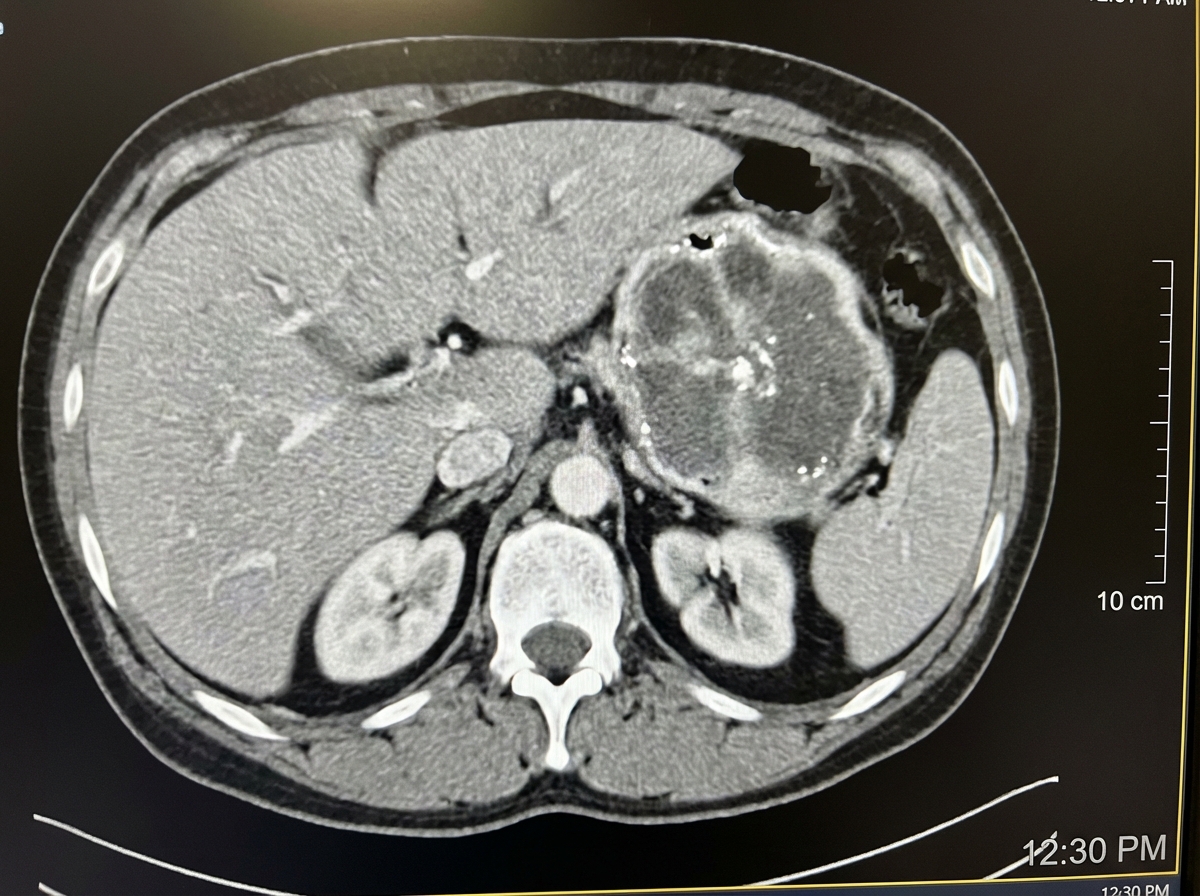
A 25-year-old young lady presented with a complaint of acute hirsutism and hoarseness of voice. Which of the following is the best investigation for diagnosis?
SIADH secretion is seen in all except:
11-hydroxylase deficiency leads to which of the following?
Which of the following conditions is associated with pituitary adenoma?
Which of the following could develop with a mucosal neuroma on the lower lip, a family history of medullary thyroid carcinoma, and recent introduction of severe headaches, perspiration, palpitations, and hypertension?
Which of the following is NOT associated with adrenal insufficiency?
Brown tumors, compression syndromes, and erythropoietin resistance are seen in which condition?
Which of the following is NOT a cause of Gynaecomastia?
A 20-year-old male presents with chronic constipation, headache, and palpitations. On examination, he has Marfanoid habitus, neuromas of the tongue, medullated corneal nerve fibers, and a 2 x 2 cm nodule in the right lobe of the thyroid. This patient is a case of -
What are the causes of primary hyperparathyroidism?
Explanation: ### Explanation The clinical presentation of **acute-onset hirsutism** accompanied by **virilization** (hoarseness of voice, clitoromegaly, or male-pattern baldness) in a young female is a red flag. It strongly suggests a **virilizing tumor** rather than a functional disorder like PCOS, which typically has a slow, peripubertal onset. **1. Why Blood DHEA levels is the correct answer:** In cases of rapid virilization, the primary goal is to differentiate between an ovarian and an adrenal source of excess androgens. **DHEA-S (Dehydroepiandrosterone sulfate)** is a specific marker for the adrenal glands (95% originates from the adrenals). Markedly elevated levels (typically >700 µg/dL) are highly suggestive of an **Adrenal Carcinoma** or an androgen-secreting adrenal adenoma. While the option says "DHEA," in clinical practice, DHEA-S is preferred due to its longer half-life and stable serum levels. **2. Why other options are incorrect:** * **Blood Pregnenolone:** This is a precursor hormone. While elevated in certain rare congenital adrenal hyperplasias (CAH), it is not a standard diagnostic marker for acute virilization or adrenal tumors. * **17-ketosteroids:** This is a 24-hour urine test that measures metabolites of androgens. It is largely obsolete in modern practice because serum assays (DHEA-S and Testosterone) are more accurate, convenient, and specific. * **LH and FSH levels:** These are used to diagnose PCOS (where LH:FSH ratio may be >2:1) or primary ovarian failure. They do not help in identifying the source of a virilizing tumor. **Clinical Pearls for NEET-PG:** * **Rule of Thumb:** If Testosterone is >200 ng/dL, suspect an **Ovarian tumor** (e.g., Sertoli-Leydig cell tumor). If DHEA-S is >700 µg/dL, suspect an **Adrenal tumor**. * **PCOS** is the most common cause of hirsutism, but it **never** causes rapid virilization or voice deepening. * **Initial Step:** Always measure Total Testosterone and DHEA-S to localize the pathology.
Explanation: **Explanation:** The Syndrome of Inappropriate Antidiuretic Hormone (SIADH) is characterized by the excessive release of ADH, leading to water retention and dilutional hyponatremia [1], [2]. **Why Interstitial Nephritis is the correct answer:** Interstitial nephritis is a cause of **Nephrogenic Diabetes Insipidus (NDI)**, not SIADH [3]. In NDI, the renal tubules become resistant to the action of ADH [3]. This results in the inability to concentrate urine, leading to polyuria and hypernatremia—the physiological opposite of SIADH. **Analysis of Incorrect Options:** * **Lung Abscess:** Pulmonary pathologies (pneumonia, abscess, tuberculosis) are classic triggers for SIADH. * **Vinca Alkaloids:** Drugs like Vincristine and Vinblastine are well-known causes of SIADH. They exert a direct neurotoxic effect on the hypothalamus and neurohypophyseal tract, leading to unregulated ADH release. * **Bronchial Adenoma:** Ectopic ADH production is a hallmark of certain tumors. While Small Cell Lung Cancer (SCLC) is the most common, bronchial adenomas (carcinoid tumors) can also secrete ADH autonomously. **NEET-PG High-Yield Pearls:** 1. **Diagnosis:** SIADH is a diagnosis of exclusion. Key features: Euvolemic hyponatremia, low serum osmolality (<275 mOsm/kg), and inappropriately high urine osmolality (>100 mOsm/kg) [1]. 2. **Drug Causes (Mnemonic: "S-C-V"):** **S**SRIs, **C**arbamazepine/Cyclophosphamide, and **V**inca alkaloids. 3. **Treatment:** Fluid restriction is the first-line treatment. For severe symptoms, use hypertonic saline (3%). **Vaptans** (Tolvaptan) are vasopressin receptor antagonists used in chronic cases. 4. **Caution:** Rapid correction of hyponatremia can lead to **Osmotic Demyelination Syndrome** (Central Pontine Myelinolysis). Keep correction <8–10 mmol/L in 24 hours.
Explanation: **Explanation:** Congenital Adrenal Hyperplasia (CAH) due to **11β-hydroxylase deficiency** is the second most common cause of CAH. Understanding the steroid biosynthesis pathway is key to solving this [1]: 1. **Why Hypertension is Correct:** 11β-hydroxylase is responsible for converting **11-deoxycorticosterone (DOC)** to corticosterone and **11-deoxycortisol** to cortisol. When this enzyme is deficient, there is a buildup of 11-deoxycorticosterone (DOC) [1]. DOC is a potent mineralocorticoid [2]. Its accumulation leads to sodium and water retention and potassium excretion, resulting in **hypertension** and hypokalemia. This distinguishes it from 21-hydroxylase deficiency, which presents with hypotension (salt-wasting). 2. **Why other options are incorrect:** * **Hypotension:** This occurs in 21-hydroxylase deficiency due to the lack of mineralocorticoids (aldosterone). In 11β-hydroxylase deficiency, the excess DOC prevents hypotension. * **Hypoglycemia:** While cortisol (a glucocorticoid) is low, the clinical hallmark of 11β-hydroxylase deficiency is the mineralocorticoid excess effect (hypertension) and androgen excess. * **Normal Puberty:** This is incorrect because the "shunting" of precursors leads to **excess adrenal androgens**. This causes virilization in females (ambiguous genitalia) and precocious pseudopoterty in males. **High-Yield Clinical Pearls for NEET-PG:** * **The "Rule of 1s":** If the enzyme starts with **1** (11β-hydroxylase, 17α-hydroxylase), it causes **Hypertension**. * **Virilization:** Both 21 and 11β-hydroxylase deficiencies cause virilization (increased androgens), whereas 17α-hydroxylase deficiency causes delayed puberty/sexual infantilism. * **Biochemical Marker:** Elevated levels of **11-deoxycortisol** and **S-androstenedione** are diagnostic for 11β-hydroxylase deficiency.
Explanation: **Explanation:** The correct answer is **Multiple Endocrine Neoplasia type 4 (MEN4)**. **1. Why MEN4 is correct:** MEN4 is a rare autosomal dominant syndrome caused by a germline mutation in the **CDKN1B gene** (encoding the p27 protein), which acts as a cyclin-dependent kinase inhibitor. Clinically, MEN4 presents very similarly to MEN1. It is characterized by a "3P" pattern, though with lower penetrance: **Pituitary adenomas**, **Parathyroid adenomas**, and **Pancreatic neuroendocrine tumors**. Therefore, pituitary adenoma is a hallmark feature of this condition. **2. Why the other options are incorrect:** * **MEN2A:** Caused by **RET proto-oncogene** mutations. It is characterized by the "MPH" triad: Medullary thyroid carcinoma (MTC), Pheochromocytoma, and Hyperparathyroidism. It does **not** involve the pituitary gland. * **MEN2B (formerly MEN3):** Also caused by RET mutations. It presents with MTC, Pheochromocytoma, and mucosal neuromas/Marfanoid habitus. Pituitary adenomas are not part of this syndrome. * **MEN3:** This is an older nomenclature for MEN2B and is no longer used as a separate category in modern classification. **3. NEET-PG High-Yield Pearls:** * **MEN1 (Wermer Syndrome):** The classic "3Ps" (Pituitary, Parathyroid, Pancreas). Caused by the *MEN1* gene (Menin). * **MEN4:** Think of it as "MEN1-like" but caused by *CDKN1B*. * **Pituitary involvement:** Only seen in **MEN1** and **MEN4**. * **Medullary Thyroid Carcinoma:** Present in 100% of MEN2A and 2B cases; prophylactic thyroidectomy is often indicated. * **Most common pituitary tumor in MEN1/4:** Prolactinoma.
Explanation: ### Explanation The clinical presentation described is classic for **Multiple Endocrine Neoplasia Type 2B (MEN 2B)**. This autosomal dominant syndrome, caused by a mutation in the **RET proto-oncogene**, is characterized by a triad of: 1. **Medullary Thyroid Carcinoma (MTC):** Often aggressive and occurs early in life (explaining the family history). 2. **Pheochromocytoma:** Occurs in approximately 50% of cases. 3. **Mucosal Neuromas:** Typically found on the tongue, lips (as seen here), and eyelids, often accompanied by a **Marfanoid habitus**. The patient’s "recent introduction" of severe headaches, perspiration, palpitations, and hypertension forms the classic **"PHE" triad** (Palpitations, Headache, Episodic sweating), which is pathognomonic for a **Pheochromocytoma** (Option D). #### Analysis of Incorrect Options: * **A & B (Gastrinoma/Insulinoma):** These are Pancreatic Neuroendocrine Tumors (NETs) [1], which are components of **MEN 1** (the "3 Ps": Pituitary, Parathyroid, Pancreas), not MEN 2B. Insulinomas are confirmed as a pancreatic NET associated with hormone excess syndromes [3]. * **C (Parathyroid Adenoma):** While parathyroid hyperplasia/adenoma is a key feature of **MEN 1** and **MEN 2A**, it is characteristically **characteristically absent** in MEN 2B. #### NEET-PG High-Yield Pearls: * **MEN 2A (Sipple Syndrome):** MTC + Pheochromocytoma + Parathyroid Hyperplasia. * **MEN 2B (Wagenmann–Froboese Syndrome):** MTC + Pheochromocytoma + Mucosal Neuromas/Marfanoid habitus. * **Rule of 10s for Pheochromocytoma:** 10% bilateral, 10% malignant, 10% extra-adrenal, 10% pediatric, and 10% familial [2]. * **Clinical Priority:** In any MEN 2 patient, always screen for and surgically remove a Pheochromocytoma **before** addressing the thyroid to prevent a lethal hypertensive crisis during anesthesia [2].
Explanation: **Explanation:** Adrenal insufficiency (specifically primary adrenal insufficiency or Addison’s disease) results from the deficiency of adrenal cortical hormones: **Aldosterone, Cortisol, and Androgens.** [1] **Why Metabolic Alkalosis is the Correct Answer:** Adrenal insufficiency is characterized by **Metabolic Acidosis** (specifically Normal Anion Gap Metabolic Acidosis), not alkalosis. Aldosterone normally acts on the distal convoluted tubules to reabsorb sodium and excrete potassium and hydrogen ions ($H^+$). [1] In its absence, $H^+$ ions are retained in the blood, leading to acidosis. Metabolic alkalosis is instead associated with conditions of mineralocorticoid excess like Conn's syndrome. [2] **Analysis of Incorrect Options:** * **A. Hyponatremia:** Aldosterone deficiency leads to "salt wasting" (loss of $Na^+$ in urine). Additionally, cortisol deficiency increases ADH secretion, causing water retention and dilutional hyponatremia. * **B. Hyperkalemia:** Without aldosterone, the kidneys cannot effectively secrete potassium into the urine, leading to elevated serum potassium levels. [1] * **C. Hypoglycemia:** Cortisol is a counter-regulatory hormone that promotes gluconeogenesis and antagonizes insulin. Its absence leads to impaired glucose production and increased insulin sensitivity. **High-Yield Clinical Pearls for NEET-PG:** * **Primary vs. Secondary:** Hyponatremia occurs in both, but **Hyperkalemia** is seen *only* in Primary Adrenal Insufficiency (because aldosterone is regulated by the RAAS, which remains intact in secondary/pituitary causes). * **Hyperpigmentation:** Seen only in Primary Adrenal Insufficiency due to increased ACTH and POMC levels (stimulating melanocytes). * **Cosyntropin Stimulation Test:** The gold standard for diagnosis. * **Acute Crisis Management:** Immediate IV fluids (Normal Saline) and IV Hydrocortisone. Do not wait for lab confirmation if a crisis is suspected.
Explanation: ### Explanation **Correct Answer: C. Hyperparathyroidism** The clinical triad of brown tumors, compression syndromes, and erythropoietin (EPO) resistance is characteristic of **Hyperparathyroidism (HPT)**, particularly in the context of chronic kidney disease (Secondary/Tertiary HPT) or severe Primary HPT [1]. * **Brown Tumors (Osteitis Fibrosa Cystica):** Excess Parathyroid Hormone (PTH) stimulates intense osteoclastic activity [1]. This leads to bone resorption and the formation of cystic lesions filled with fibrous tissue and vascularized hemorrhage. The breakdown of hemoglobin into hemosiderin gives these lesions a "brown" appearance. * **Compression Syndromes:** Extensive bone remodeling and brown tumors (especially in the vertebrae or skull) can lead to nerve root or spinal cord compression. * **Erythropoietin Resistance:** High levels of PTH have a direct toxic effect on erythropoiesis and promote bone marrow fibrosis (myelofibrosis). This reduces the marrow's responsiveness to EPO, leading to refractory anemia. **Why Incorrect Options are Wrong:** * **Hypothyroidism:** Characterized by systemic slowing (bradycardia, constipation, weight gain) and myxedema, but does not cause focal lytic bone lesions or EPO resistance. * **Hyperthyroidism:** While it can cause increased bone turnover and osteoporosis, it does not typically result in brown tumors or marrow fibrosis leading to EPO resistance. * **Osteoporosis:** This is a quantitative decrease in bone density. While it increases fracture risk, it is not associated with the fibro-cystic changes or the hematologic complications seen in HPT. **NEET-PG High-Yield Pearls:** * **Radiology:** Look for "Salt and pepper" skull and subperiosteal resorption (most common on the radial aspect of the middle phalanx). * **Biochemistry:** Primary HPT shows ↑Ca²⁺, ↓PO₄³⁻, and ↑PTH [1]. Secondary HPT (CKD) shows ↓Ca²⁺, ↑PO₄³⁻, and ↑PTH [1]. * **Rugger-Jersey Spine:** A classic radiological sign of the vertebral changes in secondary hyperparathyroidism.
Explanation: Gynaecomastia is the benign proliferation of glandular breast tissue in males, primarily caused by an imbalance between estrogen and androgen action. **Why Hypothyroidism is the correct answer:** While **Hyperthyroidism** is a well-known cause of gynaecomastia (due to increased Sex Hormone Binding Globulin (SHBG) levels which lower free testosterone and increase peripheral aromatization), **Hypothyroidism** is generally not associated with it. In fact, primary hypothyroidism in prepubertal boys may cause precocious puberty, but it does not typically cause gynaecomastia in adults. **Analysis of Incorrect Options:** * **Kallmann Syndrome:** This is a form of hypogonadotropic hypogonadism (GnRH deficiency). Low levels of testosterone lead to an increased estrogen-to-androgen ratio, resulting in gynaecomastia. * **Obesity:** Adipose tissue contains the enzyme **aromatase**, which converts androgens (androstenedione and testosterone) into estrogens (estrone and estradiol) [1]. Increased fat mass leads to higher systemic estrogen levels. * **Klinefelter Syndrome (47, XXY):** This is the most common genetic cause of male hypogonadism [2]. It features primary testicular failure (low testosterone) and elevated gonadotropins (LH/FSH). The high LH stimulates Leydig cell aromatase, significantly increasing estrogen production. **NEET-PG High-Yield Pearls:** * **Physiological Gynaecomastia:** Occurs in three peaks: Neonatal (maternal estrogens), Pubertal (transient imbalance), and Senile (declining testosterone) [1]. * **Drug-induced Gynaecomastia (Mnemonic: DISCO):** **D**igoxin, **I**soniazid, **S**pironolactone (most common), **C**imetidine, **O**estrogens/Ketoconazole. * **Clinical Distinction:** True gynaecomastia (glandular tissue) must be differentiated from **pseudogynaecomastia** (fat deposition seen in obesity) by palpation [1].
Explanation: ### Explanation The patient presents with a classic constellation of symptoms diagnostic of **Multiple Endocrine Neoplasia Type 2B (MEN 2B)**. **Why Option D is Correct:** MEN 2B is characterized by the triad of **Medullary Thyroid Carcinoma (MTC)**, **Pheochromocytoma**, and **Mucosal Neuromas**. * **Marfanoid Habitus:** Unlike MEN 2A, patients with MEN 2B often exhibit a thin body habitus with long limbs and joint laxity. * **Mucosal Neuromas:** The "neuromas of the tongue" and "medullated corneal nerve fibers" are pathognomonic features of MEN 2B. * **Pheochromocytoma:** The symptoms of headache and palpitations suggest an underlying catecholamine-secreting tumor. * **MTC:** The thyroid nodule represents MTC, which is more aggressive and occurs earlier in MEN 2B than in other forms. **Why Other Options are Incorrect:** * **Option A & B:** While MTC is present, these options do not account for the extra-thyroidal manifestations like mucosal neuromas and Marfanoid habitus. * **Option C (MEN 2A):** While MEN 2A also features MTC and Pheochromocytoma, it is associated with **Primary Hyperparathyroidism** rather than mucosal neuromas or Marfanoid habitus. **High-Yield Clinical Pearls for NEET-PG:** 1. **Genetics:** Both MEN 2A and 2B are caused by germline mutations in the **RET proto-oncogene** (Chromosome 10). 2. **MTC Screening:** In MEN 2B, MTC is highly aggressive; prophylactic thyroidectomy is often recommended within the **first year of life**. 3. **Gastrointestinal Involvement:** Chronic constipation in these patients can be due to **intestinal ganglioneuromatosis**, a common feature of MEN 2B. 4. **Rule of Thumb:** If you see "Mucosal Neuromas" or "Marfanoid Habitus" in a thyroid case, think **MEN 2B**.
Explanation: **Explanation:** Primary Hyperparathyroidism (PHPT) is characterized by the autonomous overproduction of parathyroid hormone (PTH), leading to hypercalcemia [2]. **Why Option A is Correct:** The most common cause of PHPT is a solitary **parathyroid adenoma** (~85%) [4], followed by four-gland hyperplasia (~15%). **Parathyroid carcinoma** is a rare but recognized cause (<1%). In all these conditions, the pathology lies within the parathyroid gland itself, resulting in elevated PTH despite high serum calcium levels [3]. **Why Other Options are Incorrect:** * **Renal Failure (B):** Chronic Kidney Disease (CKD) leads to **Secondary Hyperparathyroidism**. In CKD, there is phosphate retention and decreased Vitamin D activation, leading to hypocalcemia [1]. The parathyroid glands hyperfunction as a *compensatory* response to low calcium [2]. * **Rickets (C) and Malabsorption (D):** These conditions cause Vitamin D deficiency, leading to poor intestinal calcium absorption [1]. The resulting hypocalcemia triggers a secondary increase in PTH to maintain calcium homeostasis [2]. These are classic causes of **Secondary Hyperparathyroidism**. **High-Yield Clinical Pearls for NEET-PG:** * **Biochemical Hallmark:** Elevated Serum Calcium + Elevated (or inappropriately normal) PTH + Low Serum Phosphate [2]. * **Clinical Presentation:** Often asymptomatic but can present as "stones, bones, abdominal groans, and psychic overtones" [3]. * **Hungry Bone Syndrome:** A common post-operative complication after parathyroidectomy where rapid bone remineralization causes profound hypocalcemia. * **MEN Syndromes:** Always screen for MEN 1 and MEN 2A if PHPT is associated with multiglandular hyperplasia [3].
Diabetes Mellitus
Practice Questions
Thyroid Disorders
Practice Questions
Adrenal Gland Disorders
Practice Questions
Pituitary Disorders
Practice Questions
Calcium and Bone Metabolism
Practice Questions
Reproductive Endocrinology
Practice Questions
Lipid Disorders
Practice Questions
Endocrine Hypertension
Practice Questions
Multiple Endocrine Neoplasia
Practice Questions
Obesity and Metabolic Syndrome
Practice Questions
Neuroendocrine Tumors
Practice Questions
Endocrine Emergencies
Practice Questions
Get full access to all questions, explanations, and performance tracking.
Start For Free