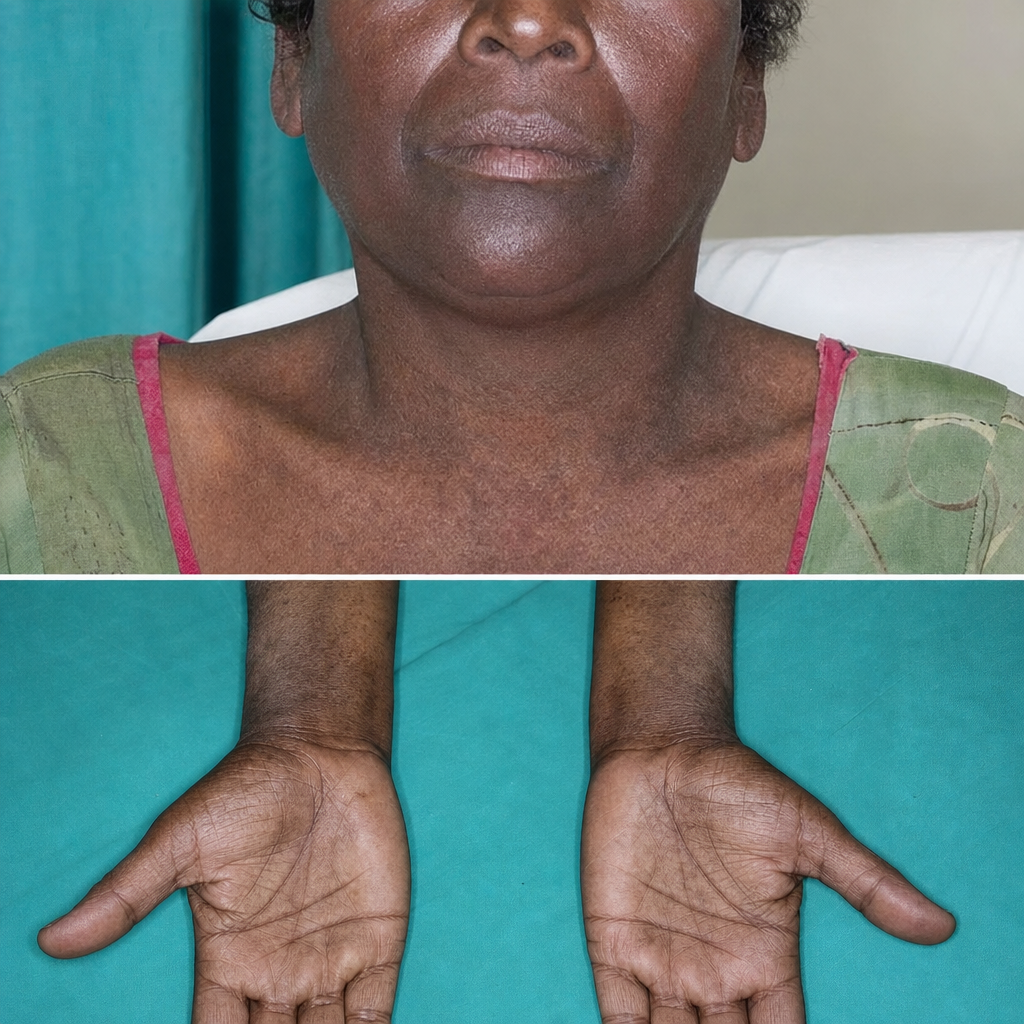
A 60-year-old woman presents to the emergency room in a coma with a temperature of 32.2°C (90°F), bradycardia, an enlarged thyroid gland, diffuse hyporeflexia, and a BP of 100/60. Which of the following is the best next step in management?
The formation of 25-hydroxycholecalciferol takes place in the:
All of the following are true for Graves' disease except:
What is the primary treatment for acute hypercalcemia?
Which genetic locus is most strongly associated with Type 1 Diabetes Mellitus?
All of the following are seen in rickets, except?
Which of the following is the most characteristic finding for hypertriglyceridemia?
Which of the following is a corticosteroid used in the management of adrenal insufficiency?
All of the following are important in the development of Type I diabetes mellitus except?
What is the most common cause of a hypersecreting pituitary tumor?
Explanation: ### Explanation **Diagnosis: Myxedema Coma** This patient presents with the classic triad of **hypothermia, altered mental status (coma), and precipitating factors/signs of hypothyroidism** (bradycardia, goiter, hyporeflexia). Myxedema coma is a medical emergency with high mortality; therefore, treatment must be initiated based on clinical suspicion without waiting for laboratory confirmation. **1. Why Option B is Correct:** * **Immediate Treatment:** Once blood is drawn for TSH and free T4, intravenous levothyroxine (T4) or liothyronine (T3) must be started immediately. * **Glucocorticoids:** High-dose intravenous glucocorticoids (e.g., hydrocortisone) are **mandatory** before or concurrent with thyroid hormone replacement. This is to treat potential coexisting adrenal insufficiency or to prevent an adrenal crisis, as thyroid hormone increases the metabolic clearance of cortisol. **2. Why Other Options are Incorrect:** * **Option A:** Delaying treatment to await lab results is dangerous. The diagnosis is clinical, and mortality increases with every hour of delay. * **Option C:** Rapid rewarming (e.g., immersion in hot water) is contraindicated as it causes peripheral vasodilation, which can lead to circulatory collapse and worsening hypotension. Only **passive rewarming** (blankets) is recommended. * **Option D:** While a CT scan may eventually be needed to rule out other causes of coma, it is not the priority over life-saving endocrine stabilization. **3. NEET-PG High-Yield Pearls:** * **Hallmark:** Hypothermia is the most common finding (often <35.5°C) [1]. * **Electrolyte Clue:** Hyponatremia (due to SIADH) is frequently seen. * **Precipitants:** Sepsis, cold exposure, MI, or sedative drugs [1]. * **Management Priority:** IV Thyroid hormone + IV Hydrocortisone + Supportive care (Passive rewarming).
Explanation: ### Explanation The synthesis of active Vitamin D is a multi-step process involving the skin, liver, and kidneys. **1. Why the Liver is Correct:** Vitamin D (either $D_3$ from the skin/diet or $D_2$ from diet) is biologically inactive. The first step of activation occurs in the **liver**, where the enzyme **25-hydroxylase** (CYP2R1) adds a hydroxyl group to the 25th carbon [1]. This converts Cholecalciferol into **25-hydroxycholecalciferol** [25(OH)D], also known as **Calcidiol** [1], [3]. This is the major circulating form of Vitamin D and the standard marker used to measure a patient's Vitamin D status [3]. **2. Why the Other Options are Incorrect:** * **Kidney:** The second hydroxylation step occurs here. The enzyme **1-alpha-hydroxylase** converts 25(OH)D into **1,25-dihydroxycholecalciferol (Calcitriol)**, which is the most potent, biologically active form [1], [3]. * **Intestines:** This is the primary site for Vitamin D-mediated **calcium absorption**, but it does not perform the hydroxylation required to form 25-hydroxycholecalciferol [2]. * **Pancreas:** The pancreas is not involved in the primary metabolic pathway of Vitamin D activation. **3. High-Yield Clinical Pearls for NEET-PG:** * **Best Marker for Vitamin D deficiency:** Serum 25(OH)D (Calcidiol) because it has a longer half-life (2-3 weeks) compared to Calcitriol (4-6 hours). * **Rate-limiting step:** The renal 1-alpha-hydroxylation is the most tightly regulated step, stimulated by **PTH** and low serum phosphate. * **Chronic Kidney Disease (CKD):** Patients with CKD fail to convert 25(OH)D to 1,25(OH)$_2$D, leading to secondary hyperparathyroidism and renal osteodystrophy. * **Anticonvulsants (e.g., Phenytoin):** These drugs induce hepatic P450 enzymes, which can accelerate the catabolism of 25(OH)D, leading to drug-induced osteomalacia.
Explanation: **Explanation:** The correct answer is **A (Commoner in males)** because it is a false statement. Graves' disease, like most autoimmune thyroid disorders, shows a strong female predilection. It typically affects women 7 to 10 times more frequently than men, with a peak incidence between the ages of 20 and 50 [1], [2]. **Analysis of Options:** * **Option A (False):** Graves' disease is significantly more common in **females** [2]. Any statement suggesting a male predominance in autoimmune thyroiditis is incorrect. * **Option B (True):** Thyroid-associated ophthalmopathy (eye signs like exophthalmos, lid lag, and proptosis) occurs in approximately 25–50% of patients [1]. It is caused by inflammation and accumulation of glycosaminoglycans in the extraocular muscles. * **Option C (True):** There is a strong genetic predisposition. Patients often have a family history of Graves' or other autoimmune conditions like Type 1 Diabetes, Vitiligo, or Pernicious Anemia (associated with HLA-DR3 and CTLA-4 genes). * **Option D (True):** The hallmark of Graves' is the presence of **TSH-receptor antibodies (TRAb)**, specifically Thyroid Stimulating Immunoglobulins (TSI), which mimic TSH and cause hyperthyroidism [1], [2]. **High-Yield Clinical Pearls for NEET-PG:** * **Triad of Graves':** Hyperthyroidism with diffuse goiter, Ophthalmopathy, and Dermopathy (Pretibial Myxedema) [1]. * **Pathophysiology:** Type II Hypersensitivity reaction. * **Diagnosis:** Low TSH, High T3/T4, and **diffuse increased uptake** on Radionuclide (Technetium-99m) scan [2]. * **Smoking:** The most significant modifiable risk factor for the worsening of Graves' ophthalmopathy.
Explanation: **Explanation:** The management of acute hypercalcemia focuses on rapid volume expansion and inhibiting bone resorption. **Mithramycin (Plicamycin)** is a potent cytotoxic antibiotic that inhibits osteoclast activity, effectively lowering serum calcium levels. While not the first-line treatment in modern clinical practice (due to the preference for Bisphosphonates and Calcitonin), it remains a classic "textbook" answer for severe, refractory hypercalcemia, especially when associated with malignancy. **Analysis of Options:** * **A. Normal saline with forced diuresis with chlorothiazide:** This is incorrect because **Thiazides** actually increase renal calcium reabsorption and would worsen hypercalcemia. While Normal Saline is the initial step for volume expansion, it should be paired with **Loop diuretics (Furosemide)**, not Thiazides. * **B & C. Plicamycin and Gallium nitrate:** While Plicamycin (Mithramycin) is the correct mechanism, the question specifically lists Mithramycin as the designated answer. Gallium nitrate is an alternative that inhibits bone resorption but is slower-acting and nephrotoxic, making it less ideal for "acute" management compared to the rapid action of Mithramycin. **NEET-PG High-Yield Pearls:** 1. **First-line Initial Step:** Aggressive hydration with **0.9% Normal Saline** (restores GFR and promotes calciuresis). Occasionally, primary hyperparathyroidism presents with severe life-threatening hypercalcaemia which should be managed medically with intravenous fluids and bisphosphonates [1]. 2. **Drug of Choice (Modern):** **IV Bisphosphonates** (Zoledronic acid/Pamidronate) are preferred for long-term control, but take 48–72 hours to work. 3. **Fastest Acting:** **Calcitonin** works within hours (tachyphylaxis is a limitation). 4. **Avoid Thiazides:** Always remember "Thiazides *thrive* on calcium" (increase it), while "Loop diuretics *lose* calcium" (decrease it).
Explanation: **Explanation:** Type 1 Diabetes Mellitus (T1DM) is a T-cell-mediated autoimmune destruction of pancreatic beta cells. While the HLA region (MHC) provides the strongest overall genetic risk, the **CTLA4 (Cytotoxic T-Lymphocyte Associated Protein 4)** gene on chromosome 2q33 is a critical non-HLA locus associated with susceptibility. CTLA4 acts as a "brake" on the immune system by downregulating T-cell activation. Polymorphisms in this gene lead to reduced inhibitory control, promoting the autoimmune process seen in T1DM, Graves' disease, and Addison's disease. **Analysis of Options:** * **MHC (Option A):** While HLA-DR3 and DR4 are the strongest genetic determinants of T1DM risk (found in >90% of patients), in the context of specific non-HLA regulatory proteins, CTLA4 is a high-yield focus for its role in immune checkpoints. * **VHL (Option B):** The Von Hippel-Lindau gene is a tumor suppressor gene on chromosome 3. Mutations lead to VHL syndrome (hemangioblastomas, pheochromocytomas, and RCC), not T1DM. * **PDGF-R (Option C):** Platelet-Derived Growth Factor Receptor is a tyrosine kinase receptor involved in cell growth and angiogenesis. It is associated with various malignancies (e.g., GIST, dermatofibrosarcoma protuberans) but has no primary role in T1DM pathogenesis. **High-Yield Clinical Pearls for NEET-PG:** * **HLA Association:** HLA-DR3-DQ2 and HLA-DR4-DQ8 carry the highest risk for T1DM [1]. * **Protective Allele:** HLA-DQB1*0602 is strongly protective against T1DM. * **Autoantibodies:** Anti-GAD65 (most persistent), IA-2, and Zinc Transporter 8 (ZnT8) are key diagnostic markers. * **Other Genes:** PTPN22 (lymphoid-specific phosphatase) is another significant non-HLA gene associated with T1DM [1].
Explanation: **Explanation:** The correct answer is **Gunstock deformity (Cubitus varus)**. This deformity is a classic complication of a **supracondylar fracture of the humerus** (malunion), not a metabolic bone disease. In this condition, the normal carrying angle of the elbow is lost, resulting in a medial deviation of the forearm. **Analysis of Options:** * **Bow legs (Genu varum):** This is a hallmark clinical feature of rickets. Due to vitamin D deficiency, there is a failure of mineralization of the osteoid matrix. When a child starts weight-bearing, the "soft" bones of the lower limbs bend under the body's weight, leading to bowing. * **Pot belly:** This occurs in rickets due to **hypotonia** of the abdominal muscles and the presence of hepatosplenomegaly (often associated with underlying nutritional deficiencies or compensatory mechanisms). * **Craniotabes:** This is often the **earliest sign** of rickets (seen in infants <6 months). It is characterized by the softening of the skull bones (occipital and parietal), which give a "ping-pong ball" sensation when pressed. **NEET-PG High-Yield Pearls:** 1. **Rachitic Rosary:** Palpable enlargement of the costochondral junctions (rounded, unlike the sharp "scorbutic rosary" seen in Scurvy). 2. **Harrison’s Sulcus:** A horizontal groove along the lower border of the thorax corresponding to the insertion of the diaphragm. 3. **Radiological Sign:** The earliest radiological sign of rickets is the **fading/loss of the provisional zone of calcification** at the metaphysis, followed by cupping, splaying, and fraying. 4. **Biochemical Profile:** Low/Normal Calcium, Low Phosphate, and **Elevated Alkaline Phosphatase (ALP)**—the latter is the most sensitive marker for disease activity.
Explanation: The hallmark of severe hypertriglyceridemia is a significant elevation in serum triglyceride (TG) levels, typically exceeding **1000 mg/dL** [1]. While mild elevations are common, levels above 1000 mg/dL are clinically significant as they pose a high risk for **acute pancreatitis** and are associated with the presence of chylomicrons in the plasma [1]. **Analysis of Options:** * **Option B (Correct):** Severe hypertriglyceridemia is defined by TG levels >1000 mg/dL. At these levels, physical signs like **eruptive xanthomas** (small, yellow-orange papules on the trunk and extremities) and **lipemia retinalis** (milky appearance of retinal vessels) may occur. * **Option A (Incorrect):** **Palmar plane xanthomas** (yellowish deposits in the creases of the palms) are the pathognomonic finding for **Type III Hyperlipoproteinemia** (Dysbetalipoproteinemia) [1], characterized by an accumulation of IDL and remnants. * **Option C (Incorrect):** **Tendon xanthomas** (specifically on the Achilles or extensor tendons of the hands) are characteristic of **Familial Hypercholesterolemia (Type IIa)** [1], where LDL cholesterol is markedly elevated, not necessarily triglycerides. * **Option D (Incorrect):** In hypertriglyceridemia, serum cholesterol is often **elevated or normal**, but rarely low. Very high VLDL or chylomicron levels contribute to the total cholesterol measurement [1]. **NEET-PG High-Yield Pearls:** * **Acute Pancreatitis Risk:** The risk increases significantly when TG >500 mg/dL and becomes critical when >1000 mg/dL. * **Lipemia Retinalis:** Seen only when TG levels exceed 2000–2500 mg/dL. * **Management:** The primary goal for TG >500 mg/dL is preventing pancreatitis using **Fibrates** (first-line) [2] and Omega-3 fatty acids. * **Pseudohyponatremia:** Severe hypertriglyceridemia can cause a falsely low sodium reading on lab reports.
Explanation: The management of adrenal insufficiency (AI) requires the replacement of glucocorticoids and, in primary AI, mineralocorticoids [1]. **Dexamethasone** is a potent, long-acting synthetic glucocorticoid. It is particularly useful in the acute management of adrenal crisis because it does not interfere with the measurement of serum cortisol levels, allowing for a definitive diagnosis via the ACTH stimulation test while treatment is being initiated. **Analysis of Options:** * **Dexamethasone (Correct):** A pure glucocorticoid with high potency. While Hydrocortisone is the preferred maintenance therapy due to its shorter half-life, Dexamethasone is the drug of choice during diagnostic workups. * **Norepinephrine & Adrenaline (Incorrect):** These are catecholamines produced by the adrenal medulla (and sympathetic nerves). They are used in the management of shock and anaphylaxis but do not treat the underlying steroid deficiency in adrenal insufficiency. * **Fludrocortisone (Incorrect):** While Fludrocortisone is used in primary adrenal insufficiency (Addison’s disease), it is a **mineralocorticoid** used to replace aldosterone, not a primary corticosteroid used for glucocorticoid replacement or acute crisis stabilization [1]. **High-Yield Clinical Pearls for NEET-PG:** * **Drug of Choice (Maintenance):** Hydrocortisone (divided doses to mimic circadian rhythm). * **Drug of Choice (Acute Crisis):** IV Hydrocortisone (due to combined glucocorticoid and mineralocorticoid activity at high doses). * **Diagnostic Advantage:** Dexamethasone is the only steroid that does not cross-react with cortisol immunoassays [2]. * **Secondary AI:** Only glucocorticoid replacement is needed; mineralocorticoid (Fludrocortisone) is unnecessary as the Renin-Angiotensin-Aldosterone System (RAAS) remains intact [1].
Explanation: **Explanation:** Type 1 Diabetes Mellitus (T1DM) is an **autoimmune disorder** characterized by the destruction of pancreatic beta cells in genetically susceptible individuals. The pathogenesis involves a complex interplay between genetic predisposition (HLA-DR3/DR4) and environmental triggers that initiate or accelerate the autoimmune process. **Why "High sugar intake" is the correct answer:** High dietary sugar intake is a risk factor for **Type 2 Diabetes Mellitus**, where it contributes to obesity and insulin resistance. It does not trigger the autoimmune destruction of beta cells and is therefore not a causative factor in the development of Type 1 Diabetes. **Analysis of other options (Environmental Triggers for T1DM):** * **Cow’s Milk (Option D):** Early exposure to cow’s milk proteins (specifically bovine serum albumin) is a classic high-yield trigger. It is thought to involve "molecular mimicry," where antibodies against milk proteins cross-react with islet cell antigens. * **Gluten (Option B):** There is a strong association between T1DM and Celiac disease. Early introduction of cereals/gluten can influence gut permeability and trigger immune-mediated beta-cell damage. * **Smoked and Red Meat (Option C):** These contain **Nitrosamines** (N-nitroso compounds), which are known to be toxic to pancreatic beta cells and have been linked to an increased risk of T1DM in epidemiological studies. **NEET-PG Clinical Pearls:** * **HLA Association:** Strongest link is with **HLA-DR3 and HLA-DR4**. HLA-DQ8 is also highly specific. * **Autoantibodies:** Glutamic Acid Decarboxylase (**GAD-65**) is the most common antibody found in T1DM. Others include IA-2 and Zinc Transporter 8 (ZnT8). * **Viral Triggers:** **Coxsackie B virus** is the most frequently implicated viral trigger for T1DM. * **The "Hygiene Hypothesis":** Suggests that decreased childhood exposure to infections may lead to an imbalanced immune system, increasing T1DM risk.
Explanation: **Explanation:** **1. Why Pituitary Adenoma is Correct:** Pituitary adenomas are benign neoplasms of the anterior pituitary gland and represent the most common cause of pituitary hormone hypersecretion [1]. These tumors are classified based on size (microadenomas <10mm; macroadenomas >10mm) and hormone production [1]. The most common hyperfunctioning adenoma is a **Prolactinoma** [3], followed by Growth Hormone-secreting adenomas (causing Acromegaly) [2] and ACTH-secreting adenomas (causing Cushing’s Disease) [4]. **2. Why the Other Options are Incorrect:** * **B. Pituitary Carcinoma:** These are extremely rare. The diagnosis of a pituitary carcinoma requires the presence of systemic or cerebrospinal metastases, not just local invasion. * **C. Autoimmune disease:** Conditions like Lymphocytic Hypophysitis typically lead to **hypopituitarism** (hormone deficiency) due to the destruction of pituitary tissue, rather than hypersecretion. * **D. Transection of the pituitary stalk:** This results in the "Stalk Effect." While it causes a mild rise in Prolactin (due to loss of inhibitory dopamine from the hypothalamus), it causes a **deficiency** of all other anterior pituitary hormones and leads to Diabetes Insipidus (loss of ADH) [3]. It is not a cause of a hypersecreting tumor. **High-Yield Clinical Pearls for NEET-PG:** * **Most common secretory adenoma:** Prolactinoma [3]. * **Most common symptom of any macroadenoma:** Bitemporal hemianopia (due to compression of the optic chiasm) [1]. * **MEN 1 Syndrome:** Remember the "3 Ps"—Pituitary, Parathyroid, and Pancreatic tumors. * **Treatment of choice:** Transsphenoidal surgery is the gold standard for most [2], **except Prolactinomas**, where medical management with Dopamine agonists (Cabergoline/Bromocriptine) is the first-line treatment.
Diabetes Mellitus
Practice Questions
Thyroid Disorders
Practice Questions
Adrenal Gland Disorders
Practice Questions
Pituitary Disorders
Practice Questions
Calcium and Bone Metabolism
Practice Questions
Reproductive Endocrinology
Practice Questions
Lipid Disorders
Practice Questions
Endocrine Hypertension
Practice Questions
Multiple Endocrine Neoplasia
Practice Questions
Obesity and Metabolic Syndrome
Practice Questions
Neuroendocrine Tumors
Practice Questions
Endocrine Emergencies
Practice Questions
Get full access to all questions, explanations, and performance tracking.
Start For Free