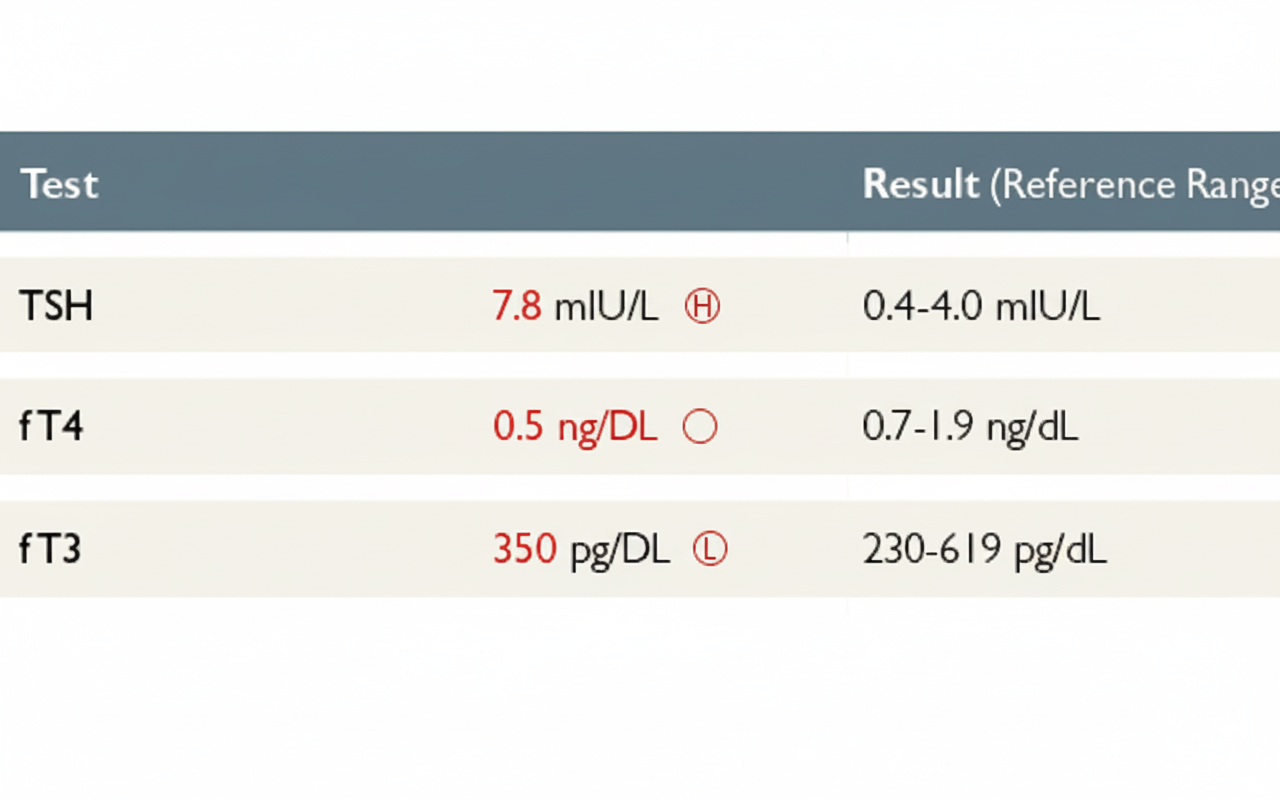
Enlargement of the thyroid gland with tenderness is most commonly seen in:
Which of the following endocrine disorders is a result of molecular mimicry?
All of the following statements about Maturity Onset Diabetes of the young (MODY) are true, except?
Absence of lamina dura is seen in which of the following conditions?
A 24-year-old woman presents 6 months after delivery for evaluation of fatigue. She notes cold intolerance and mild constipation. She recalls having a tremor and mild palpitations for a few weeks, beginning 3 months after delivery. On examination, her BP is 126/84 and her pulse rate is 56. The thyroid gland is two times normal in size and nontender. Laboratory studies reveal a free T4 level of 0.7 ng/mL (normal 0.9-2.4) and an elevated thyroid-stimulating hormone (TSH) at 22 microU/mL (normal 0.4-4). What is the likely course of her illness?
Which tumor follows the "rule of 10"?
A 40-year-old woman is found to have a 15-mm nontender thyroid nodule on the right lobe during routine evaluation. She has no prior history of thyroid disease, feels well, and has normal thyroid function tests. There is no associated lymphadenopathy. What is the most appropriate next step in management?
Which of the following is not associated with myxedema?
A male patient presents with gynaecomastia, galactorrhoea, and hypogonadism. What is the likely diagnosis?
What is the greatest degree of association with the severity of diabetic nephropathy in a 30-year-old diabetic?
Explanation: The correct answer is **Hashimoto’s Thyroiditis (B)**. While traditionally taught as a painless goiter, Hashimoto’s thyroiditis is the **most common cause** of thyroid enlargement (goiter) globally. In clinical practice and recent NEET-PG patterns, it is recognized that during the acute inflammatory phase or due to rapid glandular enlargement, patients frequently experience mild to moderate thyroid tenderness. **Why the other options are incorrect:** * **De Quervain’s Thyroiditis (Subacute Granulomatous):** This is characterized by **exquisite, severe pain** and tenderness, often following a viral prodrome. While it is the "classic" answer for a painful thyroid, it is less common overall than Hashimoto’s. * **Graves’ Disease:** Presents with a diffuse, smooth, **painless** goiter associated with hyperthyroidism and ophthalmopathy. [1] * **Riedel’s Thyroiditis:** Characterized by a "stony hard," fixed, **painless** thyroid due to extensive fibrosis. **NEET-PG High-Yield Pearls:** 1. **Hashimoto’s Thyroiditis:** Most common cause of hypothyroidism in iodine-sufficient areas. Look for **Anti-TPO** and **Anti-Tg** antibodies. Histology shows **Hurthle cells** and lymphocytic infiltration with germinal centers. 2. **Painful Thyroid Conditions (Mnemonic: "D-A-S-H"):** **D**e Quervain’s, **A**cute suppurative thyroiditis (bacterial), **S**ubacute thyroiditis, and occasionally **H**ashimoto’s (during "Hashitoxicosis"). 3. **De Quervain’s:** Associated with **HLA-B35**; features a high ESR and low radioactive iodine uptake (RAIU). 4. **Riedel’s:** Associated with **IgG4-related systemic diseases** (e.g., retroperitoneal fibrosis).
Explanation: **Explanation:** **Hashimoto’s Thyroiditis (Correct Answer):** Molecular mimicry is a mechanism where foreign antigens (usually from viruses or bacteria) share structural similarities with self-antigens. This leads to a cross-reactive immune response where the body’s T-cells and antibodies mistakenly attack its own tissues [1]. In Hashimoto’s thyroiditis, certain pathogens (such as *Yersinia enterocolitica*, Hepatitis C, or *H. pylori*) are thought to trigger an immune response that cross-reacts with thyroid proteins like **Thyroid Peroxidase (TPO)** and **Thyroglobulin (Tg)**, leading to chronic lymphocytic infiltration and follicular destruction. **Analysis of Incorrect Options:** * **Addison’s Disease:** While primarily autoimmune (anti-21-hydroxylase antibodies), it is generally characterized by direct autoimmune destruction or genetic susceptibility rather than a classic molecular mimicry trigger [2]. * **Diabetes Mellitus (Type 1):** Although some studies suggest viruses (like Coxsackie B) may trigger T1DM via mimicry with GAD65, the primary pathophysiology is complex T-cell mediated destruction [3]. Hashimoto’s is the more classic textbook example cited for mimicry in endocrine exams. * **Hypoparathyroidism:** Most commonly occurs iatrogenically (post-surgical). Autoimmune forms (APS Type 1) are due to mutations in the **AIRE gene**, leading to a failure of central tolerance rather than molecular mimicry. **High-Yield Clinical Pearls for NEET-PG:** * **Most common cause** of hypothyroidism in iodine-sufficient areas: Hashimoto’s. * **Antibody Profile:** Anti-TPO (most sensitive) and Anti-Tg. * **Histology:** Hurthle cells (Askanazy cells) and prominent germinal centers. * **Risk:** Increased risk of **B-cell (Marginal zone) Lymphoma** of the thyroid. * **Other Mimicry Examples:** Rheumatic Heart Disease (*S. pyogenes* M-protein vs. cardiac myosin) and Guillain-Barré Syndrome (*C. jejuni* vs. gangliosides).
Explanation: Maturity-Onset Diabetes of the Young (MODY) is a group of monogenic disorders characterized by **non-insulin-dependent** diabetes [1]. The correct answer is **D** because MODY is fundamentally a defect in insulin secretion, not an absolute insulin deficiency (like Type 1 DM) or primary insulin resistance (like Type 2 DM). * **Why Option D is the Exception:** Patients with MODY typically have residual beta-cell function. While some may eventually require insulin as the disease progresses, they are **not typically insulin-dependent** at onset and do not usually develop ketoacidosis [1]. * **Why Option A is True:** MODY is defined by an early onset, usually before age 25, occurring in children, adolescents, or young adults. * **Why Option B is True:** The underlying pathophysiology is a primary **beta-cell dysfunction** caused by genetic mutations (e.g., *HNF1A, GCK, HNF4A*) that impair glucose sensing or insulin secretion. * **Why Option C is True:** Most common subtypes, specifically **MODY 3** (*HNF1A*) and **MODY 1** (*HNF4A*), are exquisitely sensitive to low-dose **sulfonylureas**, which often serve as the first-line treatment. **High-Yield Clinical Pearls for NEET-PG:** * **Inheritance:** Autosomal Dominant (look for a strong family history across 3 generations) [1]. * **Most Common Type:** **MODY 3** (*HNF1A* mutation). * **MODY 2 (GCK mutation):** Presents as mild, stable fasting hyperglycemia; usually requires no treatment (except during pregnancy). * **Differentiating Feature:** Absence of obesity (unlike Type 2 DM) and absence of pancreatic autoantibodies (unlike Type 1 DM).
Explanation: The **lamina dura** is the thin layer of compact bone that lines the tooth socket (alveolus), appearing as a continuous radiopaque (white) line on dental X-rays. Its integrity is a sensitive indicator of systemic bone metabolism. **1. Why Hyperparathyroidism is correct:** In **Hyperparathyroidism** (specifically primary and secondary), excess Parathyroid Hormone (PTH) stimulates osteoclastic activity. This leads to subperiosteal bone resorption. The lamina dura is one of the earliest sites to undergo resorption because it has a high turnover rate. Its absence is a classic radiographic hallmark of the disease, often accompanied by a "salt and pepper" appearance of the skull. **2. Why the other options are incorrect:** * **Rickets:** While Rickets/Osteomalacia involves defective mineralization, the lamina dura is usually preserved or may appear blurred, but its frank absence is not a characteristic diagnostic feature compared to hyperparathyroidism. * **Multiple Myeloma:** This condition typically presents with discrete, "punched-out" lytic lesions. While it causes bone destruction, it does not specifically target the lamina dura in a generalized manner. * **Rheumatoid Arthritis:** This is primarily an inflammatory joint disease. While it can cause periarticular osteopenia and marginal erosions of small joints, it does not typically affect the alveolar bone of the teeth. **Clinical Pearls for NEET-PG:** * **Most sensitive site for resorption in Hyperparathyroidism:** Subperiosteal bone of the radial aspect of the middle phalanges. * **Brown Tumor:** A giant cell focal lesion found in advanced hyperparathyroidism (Osteitis Fibrosa Cystica). * **Differential for loss of Lamina Dura:** Hyperparathyroidism (most common), Paget’s disease, and Scleroderma (though Scleroderma more commonly causes *widening* of the periodontal ligament space).
Explanation: ### Explanation The clinical presentation is classic for **Postpartum Thyroiditis (PPT)**, a variant of silent (painless) lymphocytic thyroiditis occurring within one year of delivery. **1. Why Option C is Correct:** Postpartum thyroiditis typically follows a **triphasic course**: * **Thyrotoxic phase (2–4 months postpartum):** Caused by the release of preformed thyroid hormone (destructive thyroiditis). This explains the patient's initial tremors and palpitations [1]. * **Hypothyroid phase (3–8 months postpartum):** As hormone stores are depleted, the patient develops symptoms like fatigue, cold intolerance, and constipation, with labs showing low T4 and high TSH (as seen in this patient) [1]. * **Recovery phase:** In **70–80% of cases**, thyroid function returns to **euthyroidism** spontaneously within a few months. **2. Why the Other Options are Incorrect:** * **Option A:** While 20–30% of patients may develop permanent hypothyroidism, the majority recover. Permanent replacement is not the "likely" course unless high titers of anti-TPO antibodies persist [1]. * **Option B:** Methimazole is ineffective in PPT because the hyperthyroidism is due to "leakage" of hormone, not increased synthesis [1]. * **Option D:** PPT does not cause permanent infertility, though the hypothyroid phase may cause temporary menstrual irregularities. **Clinical Pearls for NEET-PG:** * **Hallmark:** PPT is **nontender** (distinguishing it from De Quervain’s/Subacute thyroiditis). * **Diagnosis:** Low radioactive iodine uptake (RAIU) during the thyrotoxic phase [1]. * **Antibodies:** Anti-TPO antibodies are present in 60–80% of cases. * **Management:** Propanolol for the thyrotoxic phase; Levothyroxine for the hypothyroid phase (usually for 6–12 months, then tapered to check for recovery) [1].
Explanation: **Explanation:** **Pheochromocytoma** is a catecholamine-secreting tumor arising from the chromaffin cells of the adrenal medulla. It is classically associated with the **"Rule of 10,"** which serves as a high-yield clinical mnemonic for its epidemiological characteristics: * **10% Extra-adrenal:** Occur in the Paraganglia (Organ of Zuckerkandl). * **10% Bilateral:** Often associated with familial syndromes. * **10% Malignant:** Most are benign; malignancy is defined by metastasis, not histology. * **10% Pediatric:** Though primarily an adult diagnosis. * **10% Familial:** (Note: Modern genetics suggests this is now closer to 30-40% involving RET, VHL, and NF1 genes). * **10% Normotensive:** While most present with paroxysmal hypertension. **Analysis of Incorrect Options:** * **B. Oncocytoma:** A benign renal tumor characterized by a "central stellate scar" on imaging. It does not follow a specific "rule of 10." * **C. Lymphoma:** A hematological malignancy of the lymphoid system. Its classification (Hodgkin vs. Non-Hodgkin) and staging (Ann Arbor) are key, but it lacks this specific numerical rule. * **D. Renal Cell Carcinoma (RCC):** Known for the "classic triad" (hematuria, flank pain, palpable mass) and its association with VHL syndrome, but it does not follow the rule of 10. **Clinical Pearls for NEET-PG:** * **Diagnosis:** Best initial screening test is **24-hour urinary fractionated metanephrines** or plasma free metanephrines. * **Management:** Always give **Alpha-blockers first** (e.g., Phenoxybenzamine) followed by Beta-blockers to avoid a hypertensive crisis (unopposed alpha stimulation). * **Histology:** Look for the **"Zellballen" pattern** (nested clusters of cells).
Explanation: ### Explanation The management of a thyroid nodule is a high-yield topic for NEET-PG, focusing on the systematic exclusion of malignancy. **Why Option B is Correct:** The initial step in evaluating a thyroid nodule is checking the **Serum TSH** [1]. In this patient, thyroid function tests are normal (euthyroid). According to the American Thyroid Association (ATA) guidelines, any solid thyroid nodule **>1 cm (10 mm)** with normal TSH should undergo **Fine Needle Aspiration (FNA) biopsy** to rule out malignancy. FNA is the gold standard and the most cost-effective diagnostic tool for differentiating benign from malignant lesions. **Why Other Options are Incorrect:** * **Option A (Thyroid Scan):** Radionuclide scanning is only indicated if the TSH is **low (suppressed)** to identify a "hot" (functioning) nodule, which is rarely malignant [1]. It has no role in a euthyroid patient. In such cases, scintigraphy is not routinely used when TSH is normal [1]. * **Option C (Repeat assessment):** Observation is only appropriate for nodules <1 cm that do not have high-risk ultrasound features. A 15-mm nodule requires immediate pathological evaluation. * **Option D (Partial thyroidectomy):** Surgery is a definitive treatment, not a diagnostic step. It is only considered after FNA results suggest malignancy (Bethesda Category V or VI) or follicular neoplasm. **Clinical Pearls for NEET-PG:** * **Size Cut-off:** Generally, FNA is indicated for nodules ≥1 cm if solid/hypoechoic, or ≥1.5 cm if iso/hyperechoic. * **TSH First:** Always check TSH first [1]. If TSH is low $\rightarrow$ Scan; if TSH is normal/high $\rightarrow$ FNA. * **Bethesda System:** FNA results are reported via the Bethesda Classification (I-VI). * **Risk Factors:** History of childhood neck irradiation or a family history of Medullary Thyroid Carcinoma increases the suspicion of malignancy regardless of size.
Explanation: **Explanation:** The term **myxedema** refers to severe, long-standing hypothyroidism. This condition significantly impacts lipid metabolism and the cardiovascular system. **Why Option B is the correct answer:** Hypothyroidism is classically associated with **Type IIa or Type IIb hyperlipoproteinemia**. The underlying mechanism is a decrease in the expression and activity of **LDL receptors** in the liver [1], leading to elevated levels of LDL cholesterol. While hypothyroidism can cause hypertriglyceridemia (by decreasing lipoprotein lipase activity), it is **not** typically associated with **Type III hyperlipoproteinemia** (Dysbetalipoproteinemia), which is a genetic defect involving Apolipoprotein E. **Analysis of Incorrect Options:** * **Option A (Coronary atherosclerosis):** Hypothyroidism leads to hypercholesterolemia and hypertension, both of which are major risk factors that accelerate coronary atherosclerosis [2]. * **Option C (Massive pericardial effusion):** Myxedema often causes pericardial effusions due to increased capillary permeability and decreased lymphatic drainage. These effusions can be "massive" in volume. * **Option D (Absence of pulsus paradoxus):** Despite the presence of large pericardial effusions in myxedema, **cardiac tamponade is rare**. This is because the fluid accumulates very slowly, allowing the pericardium to stretch. Therefore, clinical signs of tamponade, such as *pulsus paradoxus*, are typically absent. **High-Yield Clinical Pearls for NEET-PG:** * **Lipid Profile in Hypothyroidism:** Increased Total Cholesterol, increased LDL (most common), and variable increases in Triglycerides [1]. * **Cardiovascular Signs:** Bradycardia, low voltage ECG, and "Water-bottle" heart on CXR (due to effusion). * **Myxedema Coma:** The most severe form, characterized by hypothermia, bradycardia, and altered mental status; treated with IV Levothyroxine and Hydrocortisone.
Explanation: ### Explanation **Correct Answer: D. Prolactinoma** **Mechanism:** The clinical triad of **gynaecomastia, galactorrhoea, and hypogonadism** in a male is the classic presentation of hyperprolactinaemia, most commonly caused by a **Prolactinoma** (a prolactin-secreting pituitary adenoma). * **Galactorrhoea:** Excess prolactin directly stimulates milk production in breast tissue. * **Hypogonadism:** High prolactin levels exert a negative feedback effect on the hypothalamus, inhibiting the pulsatile release of **GnRH**. This leads to decreased LH and FSH, resulting in secondary hypogonadism (low testosterone), which manifests as decreased libido, erectile dysfunction, and gynaecomastia. **Analysis of Incorrect Options:** * **A. Empty Sella Syndrome:** This is often an incidental radiological finding where the pituitary gland is flattened. While it can occasionally cause mild hyperprolactinaemia (due to stalking effect), it typically presents as asymptomatic or with non-specific headaches. * **B. Meningioma:** These are benign tumors arising from the meninges. While a suprasellar meningioma could compress the pituitary stalk (causing "stalk effect" hyperprolactinaemia), it is a much less common cause of this specific hormonal triad than a primary prolactinoma. * **C. Acromegaly:** Caused by excess Growth Hormone (GH). While some GH-secreting tumors co-secrete prolactin, the primary presentation would involve acral enlargement, coarse facial features, and glucose intolerance rather than isolated hypogonadism and galactorrhoea. **NEET-PG High-Yield Pearls:** 1. **Drug-induced hyperprolactinaemia:** Always rule out dopamine antagonists (e.g., Metoclopramide, Risperidone, Haloperidol) as they are common causes. 2. **Hook Effect:** In extremely large macroprolactinomas, very high prolactin levels can cause a false-low lab reading; serial dilution is required for diagnosis. 3. **Treatment of Choice:** Unlike most pituitary tumors, the first-line treatment for Prolactinoma is **Medical Management** with Dopamine agonists (**Cabergoline** > Bromocriptine). Surgery is reserved for refractory cases.
Explanation: ### Explanation **1. Why "Duration of Disease" is Correct:** The development and progression of diabetic nephropathy (DN) are primarily time-dependent [1]. Hyperglycemia-induced metabolic pathways (such as the formation of Advanced Glycation End-products or AGEs) and hemodynamic changes (hyperfiltration) require years of chronic exposure to cause structural damage like Kimmelstiel-Wilson nodules. In clinical practice, DN rarely occurs within the first 5 years of Type 1 DM and typically peaks after 15–20 years of disease duration [1]. Therefore, the length of time a patient has been diabetic is the strongest predictor of the severity of renal involvement. **2. Why Other Options are Incorrect:** * **Type of Diabetes:** While the timing of presentation differs (Type 1 often presents with microalbuminuria 5 years post-diagnosis, whereas Type 2 may have it at diagnosis due to unknown duration), the pathological severity and risk of progression to End-Stage Renal Disease (ESRD) are similar across both types once the disease is established. * **Retinal Involvement:** While there is a strong *correlation* between diabetic retinopathy and nephropathy (especially in Type 1 DM), retinopathy is a co-manifestation of microvascular damage rather than the primary driver or the greatest association for the *severity* of renal damage itself. **3. Clinical Pearls for NEET-PG:** * **Earliest Sign:** The earliest clinical sign of DN is **Microalbuminuria** (30–300 mg/day). * **Earliest Pathological Change:** Thickening of the **Glomerular Basement Membrane (GBM)** [1]. * **Most Specific Finding:** **Kimmelstiel-Wilson (KW) nodules** (nodular glomerulosclerosis) are pathognomonic for DN [1]. * **Natural History:** DN is characterized by an initial increase in GFR (hyperfiltration) followed by a progressive decline. * **Rule of Thumb:** In Type 1 DM, if nephropathy is present, retinopathy is almost always present (>90%). If a Type 1 patient has nephropathy without retinopathy, consider alternative renal diagnoses.
Diabetes Mellitus
Practice Questions
Thyroid Disorders
Practice Questions
Adrenal Gland Disorders
Practice Questions
Pituitary Disorders
Practice Questions
Calcium and Bone Metabolism
Practice Questions
Reproductive Endocrinology
Practice Questions
Lipid Disorders
Practice Questions
Endocrine Hypertension
Practice Questions
Multiple Endocrine Neoplasia
Practice Questions
Obesity and Metabolic Syndrome
Practice Questions
Neuroendocrine Tumors
Practice Questions
Endocrine Emergencies
Practice Questions
Get full access to all questions, explanations, and performance tracking.
Start For Free