Commonest cause of hypothyroidism is
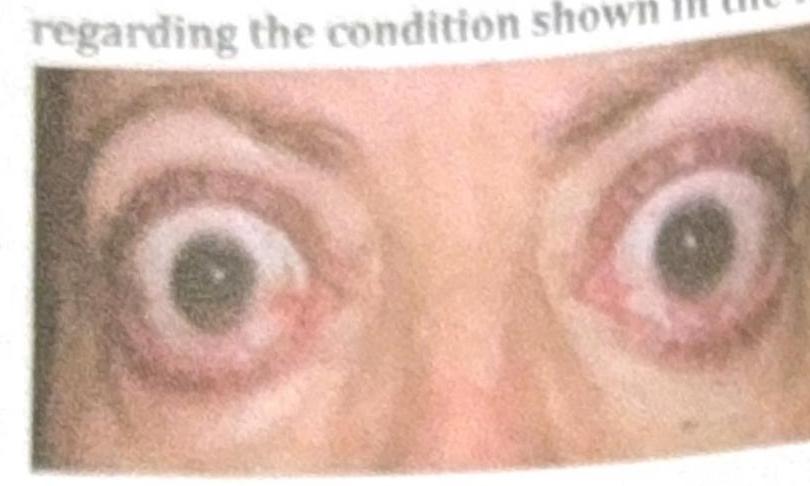
Which of the following statements about thyroid eye disease is false?
A 30-year-old woman presents with a history of amenorrhea and impaired vision of six months' duration. Physical examination shows normal findings except for pale optic discs and diminished visual acuity. The most likely diagnosis is -
The tumor which is more commonly located in the tail of the pancreas is:
In Osteoporosis which of these is seen?
Pendred's syndrome is:
Slow relaxation of tendon reflexes may be a manifestation of:
Osteomalacia is due to -
Prevention or treatment of osteoporosis in post- menopausal women may be achieved by all EXCEPT
A 40 year old lady with temporal field defects and galactorrhoea is most likely to have-
Explanation: **Thyroid dysgenesis** - **Thyroid dysgenesis** refers to congenital defects in thyroid gland development (e.g., aplasia, hypoplasia, ectopia) and is the most frequent cause worldwide of **congenital hypothyroidism** [1]. - Early detection and treatment with thyroid hormone replacement are crucial to prevent **intellectual disability** and developmental delays [1]. *Defect of iodide transport* - This is a rare genetic disorder affecting the **sodium-iodide symporter (NIS)**, leading to impaired iodide uptake by the thyroid gland. - While it causes hypothyroidism, it is significantly less common than thyroid dysgenesis. *Defective synthesis of thyroxine* - This refers to various inherited defects in the enzymes involved in thyroid hormone synthesis (e.g., peroxidase deficiency, organification defects). - These are collectively known as **dyshormonogenesis**, and although they cause congenital hypothyroidism, their incidence is lower than that of thyroid dysgenesis [1]. *Hashimoto's thyroiditis* - **Hashimoto's thyroiditis** is the most common cause of **acquired hypothyroidism** in adults, an autoimmune condition leading to thyroid gland destruction. - It is not the most common cause of hypothyroidism in general, especially when considering congenital forms.
Explanation: ***The management corresponds to improvement in thyrotoxic state*** - Thyroid eye disease (TED) is an **autoimmune condition** that runs independently of the thyroid's hormonal status [1]. While hyperthyroidism can trigger or worsen TED, treating the hyperthyroidism does not necessarily resolve or improve the eye symptoms [2]. - The disease course of TED is often **biphasic**, with an active inflammatory phase followed by a quiescent phase. Treatment decisions for TED are based on the severity and activity of the eye disease itself, not solely on the thyroid hormone levels. *NOSPECS score is used to classify thyroid eye disease* - The **NOSPECS classification system** is a well-established method for grading the severity of thyroid eye disease. - This acronym stands for **N**o signs or symptoms, **O**nly signs (e.g., lid retraction) no symptoms, **S**oft tissue involvement, **P**roptosis, **E**xtraocular muscle involvement, **C**orneal involvement, and **S**ight loss (optic neuropathy). *Can lead to visual loss* - Thyroid eye disease can cause **optic nerve compression** due to enlarged extraocular muscles or increased orbital fat, leading to **compressive optic neuropathy** and potentially irreversible visual loss. - Severe **corneal exposure** from proptosis and lid retraction can also lead to corneal ulceration, infection, and scaring, affecting vision. *Seen in more than 10% of patients with hyperthyroidism* - Thyroid eye disease is the **most common extrathyroidal manifestation** of Graves' disease, occurring in approximately 25-50% of patients with Graves' hyperthyroidism [1]. - While it is less common in other forms of hyperthyroidism or euthyroid individuals, the prevalence in Graves' disease alone is significantly higher than 10%.
Explanation: ***Pituitary adenoma*** - Pituitary adenomas, particularly **macroadenomas**, can cause **bitemporal hemianopsia** due to compression of the **optic chiasm**, leading to impaired vision and pale optic discs [1]. - They also frequently secrete hormones, with **prolactinomas** being a common type, leading to **amenorrhea** in women due to inhibition of GnRH. *Benign intracranial hypertension* - This condition is primarily characterized by **increased intracranial pressure** leading to headache, pulsatile tinnitus, and **papilledema**, which presents as a swollen optic disc, not pale. - While it can cause visual field defects, **amenorrhea** is not a typical associated symptom. *Hypothalamic glioma* - Hypothalamic gliomas can cause visual field defects and endocrine dysfunction due to their location near the **optic chiasm** and **hypothalamus**. - However, they are more common in children and usually present with symptoms like **diabetes insipidus**, growth abnormalities, or precocious puberty, rather than isolated amenorrhea and optic disc pallor. *Craniopharyngioma* - Craniopharyngiomas are **suprasellar tumors** that can compress the optic chiasm, causing visual disturbances, and impact the pituitary stalk and hypothalamus, leading to endocrine dysfunction. - They often present with symptoms of **hydrocephalus**, **growth retardation**, or **diabetes insipidus**, and are more frequently diagnosed in childhood or adolescence, although they can occur in adults.
Explanation: ***Glucagonoma*** - **Glucagonomas** are most commonly found in the **tail of the pancreas**. - They are associated with a distinct clinical syndrome including **necrolytic migratory erythema**, diabetes, weight loss, and anemia. *Somatostatinoma* - **Somatostatinomas** are typically located in the **head of the pancreas** or duodenum. - Their classical presentation involves diabetes, cholelithiasis, steatorrhea, and weight loss. *Insulinoma* - **Insulinomas** are usually small and evenly distributed throughout the **pancreas**, without a predilection for the tail. - They cause symptoms of hypoglycemia due to excessive insulin secretion, such as **whipple's triad**. *Gastrinoma* - **Gastrinomas** are most frequently found in the **"gastrinoma triangle"**, which includes the head of the pancreas, duodenum, and peripancreatic lymph nodes. [1] - They cause **Zollinger-Ellison syndrome**, characterized by severe peptic ulcer disease and diarrhea due to hypersecretion of gastrin. [1]
Explanation: ***Normal calcium, normal ALP*** - In **osteoporosis**, the primary defect is a reduction in **bone mass** due to imbalanced bone remodeling, but the remaining bone tissue is normally mineralized [1]. - Therefore, **serum calcium** and **alkaline phosphatase (ALP)**, which reflect bone turnover and mineralization, typically remain within normal ranges [3]. *Normal calcium, decreased ALP* - While **serum calcium** is usually normal in osteoporosis, **decreased ALP** is not a characteristic finding. - Decreased ALP might indicate conditions like **hypophosphatasia** or certain nutritional deficiencies, which are distinct from osteoporosis. *Decreased calcium, increased ALP* - **Decreased serum calcium** (hypocalcemia) combined with **increased ALP** is often seen in conditions like **osteomalacia** or **rickets**, where there is defective bone mineralization [2]. - This pattern is not typical of osteoporosis, where the problem is a quantitative reduction in bone, not qualitative mineralization defect [3]. *Decreased calcium, decreased ALP* - A combination of **decreased calcium** and **decreased ALP** is an unusual biochemical profile in bone disorders. - It could potentially be seen in severe malnutrition leading to multiple deficiencies, but it is not indicative of osteoporosis.
Explanation: ***Deaf and goitrous patient since infancy*** - **Pendred's syndrome** is an autosomal recessive disorder characterized by **sensorineural hearing loss** and a **goiter** due to a defect in iodine organification [1]. - The symptoms typically manifest from **infancy** or early childhood, with profound deafness being one of the earliest signs [1]. *Thyroiditis extending into adjacent structures* - This describes an inflammatory process of the thyroid gland that has spread, which is not characteristic of **Pendred's syndrome**. - **Pendred's syndrome** is a genetic developmental disorder, not primarily an inflammatory condition causing direct tissue invasion. *None* - This option is incorrect because there is a correct description of Pendred's syndrome provided. - **Pendred's syndrome** is a well-defined genetic condition with specific clinical manifestations. *Autoimmune thyroiditis* - **Autoimmune thyroiditis** (e.g., Hashimoto's thyroiditis) involves the immune system attacking the thyroid gland, leading to hypothyroidism and goiter. - While it can cause a goiter, it does not typically present with congenital **sensorineural deafness** as a primary feature.
Explanation: ***Hypothyroidism*** - **Slow relaxation of tendon reflexes**, often described as a "hung-up" reflex, is a classic sign of **hypothyroidism**. [1] - This is due to slowed muscle contraction and relaxation phases, reflecting the generalized metabolic slowing in the body. *Hypoparathyroidism* - This condition is primarily characterized by **hypocalcemia** and can lead to increased neuromuscular excitability, manifesting as **tetany**, muscle cramps, and seizures. - It does not typically cause slow relaxation of tendon reflexes; instead, reflexes may be hyperactive due to lower calcium levels. *Hyperparathyroidism* - This condition leads to **hypercalcemia**, which can cause generalized muscle weakness, fatigue, and bone pain. - While it affects muscle function, it does not typically present with the characteristic slow relaxation of tendon reflexes. *Hyperthyroidism* - **Hyperthyroidism** typically leads to **brisk reflexes** (hyperreflexia) and may even manifest with a fast-relaxing or quickly exhausted reflex. - This is due to the increased metabolic rate and heightened neuromuscular excitability.
Explanation: ***Vitamin D deficiency*** - **Osteomalacia** is characterized by defective **bone mineralization** in adults, primarily due to insufficient **calcium** and **phosphate** availability for deposition into the bone matrix [1]. - The most common cause of impaired mineralization is severe and prolonged **vitamin D deficiency**, which leads to reduced absorption of calcium and phosphate from the gut [1]. [2]. *Vitamin E deficiency* - **Vitamin E** is an important **antioxidant** that protects cells from damage, but its deficiency is not directly linked to osteomalacia. - Deficiency can lead to **neurological symptoms** like ataxia, peripheral neuropathy, and muscle weakness. *Vitamin C deficiency* - **Vitamin C** is crucial for **collagen synthesis**, and its deficiency causes **scurvy**, characterized by weakened blood vessels, bleeding gums, and impaired wound healing. - It does not directly affect the mineralization of bone, which is the hallmark of osteomalacia. *None of the options* - This option is incorrect because **Vitamin D deficiency** is a well-established cause of osteomalacia [2].
Explanation: ***Multivitamins*** - While multivitamins may contain some **calcium** and **vitamin D**, the dosages are generally insufficient to effectively prevent or treat osteoporosis, which requires targeted, higher doses of these specific nutrients. - Multivitamins provide a broad range of vitamins and minerals, many of which are not directly involved in **bone metabolism** or have a significant impact on **bone mineral density**. *Calcium and vitamin D supplementation* - **Calcium** is a fundamental component of bone, and adequate intake is crucial for maintaining **bone mineral density** and strength, especially in postmenopausal women who are at higher risk of osteoporosis [1, 4]. - **Vitamin D** is essential for the absorption of calcium in the gut and plays a key role in regulating **calcium and phosphate homeostasis**, directly impacting bone health [3]. *Bisphosphonates* - **Bisphosphonates** are potent **antiresorptive agents** that inhibit **osteoclast activity**, thereby reducing bone turnover and preventing bone loss, making them a cornerstone of osteoporosis treatment. - They effectively increase **bone mineral density** and significantly reduce the risk of **vertebral and non-vertebral fractures** in postmenopausal women. *Estrogen and progesterone hormone replacement therapy* - **Estrogen deficiency** after menopause is a primary cause of accelerated bone loss; **estrogen replacement therapy** helps to maintain bone density by reducing **bone resorption** [2]. - While effective, HRT is typically reserved for women with significant menopausal symptoms or those who cannot tolerate other osteoporosis treatments, due to potential risks like increased risk of **breast cancer** and **cardiovascular events** [2].
Explanation: ***Pituitary macroadenoma*** - **Temporal field defects** (bitemporal hemianopsia) are a classic symptom of a pituitary macroadenoma due to compression of the **optic chiasm** by the expanding tumor [1]. - **Galactorrhoea** is often caused by hyperprolactinemia, which is frequently associated with **prolactinomas**, a type of pituitary adenoma [1]. *Lactational failure* - Lactational failure would present with the **absence** of milk production or poor milk supply, not galactorrhoea (milk production outside of breastfeeding). - This condition does not cause **temporal field defects**, which are indicative of a mass effect on vision. *Pregnancy* - While pregnancy can cause galactorrhoea due to hormonal changes, it does not typically lead to **temporal field defects**. - **Visual field defects** in pregnancy would suggest a more serious underlying neurological issue, not a normal physiological response to pregnancy. *Craniopharyngioma* - Craniopharyngiomas are typically **suprasellar tumors** that can cause visual field defects due to optic chiasm compression, similar to pituitary adenomas. - However, craniopharyngiomas are not typically associated with **galactorrhoea**; they are more often linked to hypothalamic-pituitary dysfunction leading to hormone deficiencies, not hyperprolactinemia [1].
Diabetes Mellitus
Practice Questions
Thyroid Disorders
Practice Questions
Adrenal Gland Disorders
Practice Questions
Pituitary Disorders
Practice Questions
Calcium and Bone Metabolism
Practice Questions
Reproductive Endocrinology
Practice Questions
Lipid Disorders
Practice Questions
Endocrine Hypertension
Practice Questions
Multiple Endocrine Neoplasia
Practice Questions
Obesity and Metabolic Syndrome
Practice Questions
Neuroendocrine Tumors
Practice Questions
Endocrine Emergencies
Practice Questions
Get full access to all questions, explanations, and performance tracking.
Start For Free