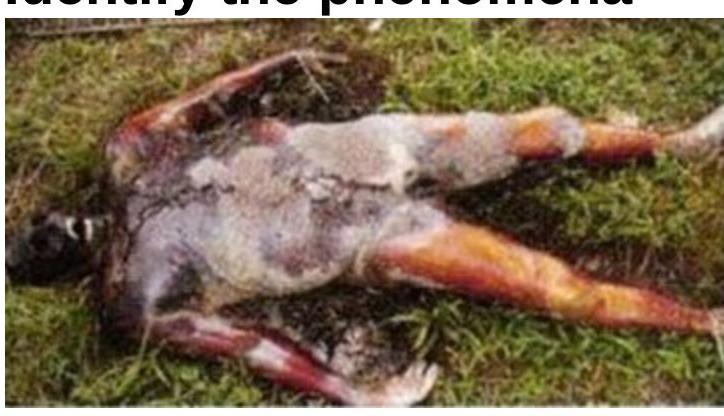
The image shows:

All are correct about the abrasion shown except:

The image shows presence of:

What type of abrasion is shown in the image?

What type of injury is shown in the image?

Identify the marks seen on the chest of the patient:

The following dead body shows presence of:

Which wound is shown below?

The following marks are indicative of:

Which injury is shown in the image?

Explanation: ***Split laceration*** - This is characterized by a wound where skin and subcutaneous tissue are split open due to **crushing forces** between two hard objects, often seen over bony prominences - The edges are typically straight, as if incised, and there may be **bruising** or abrasion around the wound - This is the characteristic appearance shown in the image *Stretch laceration* - This type of laceration occurs when the skin is **stretched beyond its elastic limit**, often seen in degloving injuries or avulsions - It usually results in **irregular, undermined edges** and significant tissue loss, which is not evident in the image *Tear laceration* - A tear laceration results from a forceful **tearing or ripping** of the skin and underlying tissues, often caused by a sharp object moving across the skin - These wounds tend to have **irregular, jagged edges** and often involve bridging strands of tissue that are visible across the wound gap *Crush laceration* - While crushing forces can cause split lacerations, a crush laceration specifically refers to injuries causing **extensive tissue damage**, often with crushing of underlying structures like bone or muscle - The wound itself might be less distinct or irregular, with widespread contusion and tissue non-viability
Explanation: **This is an EXCEPT question - we need to identify the INCORRECT statement about abrasions.** ***Correct Answer: Absence of inflammation*** - This statement is **INCORRECT** about abrasions, making it the right answer to this EXCEPT question. - Abrasions in living individuals **DO show inflammation** as part of the body's physiological response to injury. - The inflammatory response includes **redness, swelling, pain, heat, and cellular infiltration**, which are hallmarks of vital reaction. - **Absence of inflammation** would suggest a **postmortem abrasion** (injury after death), not an ante-mortem injury. *Incorrect: Pale parchment* - This statement is TRUE about abrasions, so it's not the answer to this EXCEPT question. - The **pale parchment** or dried, leathery appearance is characteristic of abrasions after desiccation. - Results from loss of superficial skin layers and exposure of dermis. *Incorrect: Occurs on bony prominence* - This statement is TRUE about abrasions, so it's not the answer to this EXCEPT question. - Abrasions commonly occur over **bony prominences** (knees, elbows, forehead, chin) due to less soft tissue padding. - These areas are more susceptible to friction and shearing forces during impacts or falls. *Incorrect: Presence of vital reaction* - This statement is TRUE about abrasions, so it's not the answer to this EXCEPT question. - **Vital reaction** refers to physiological responses indicating the injury occurred while the person was alive. - Includes **inflammation, hemorrhage, blood coagulation, cellular infiltration**, and early tissue repair. - Presence of vital reaction confirms ante-mortem injury.
Explanation: ***Contused abrasion*** - This image displays a large area of superficial skin injury with underlying **hemorrhage** and tissue discoloration, which are classic features of a **contused abrasion**. - A contused abrasion occurs when there is both **grazing/scraping** of the epidermis and an impact that causes bruising of the underlying dermis. *Postmortem abrasion* - **Postmortem abrasions** typically lack vital reactions such as hemorrhage and inflammation, appearing dry and parchment-like. - The presence of clear redness and probable bleeding in the image indicates a **vital injury**, ruling out postmortem changes. *Imprint abrasion* - An **imprint abrasion** (also known as a pattern abrasion) reproduces the pattern of the object that caused it. - The injury shown is diffuse and irregular, not reflecting a distinct pattern of an object. *Graze abrasion* - A **graze abrasion** (or scrape) is a superficial injury where only the epidermis is removed by friction or scraping. - While there is epidermal involvement, the extensive discoloration and deeper impact evident in the image suggest injury beyond a simple graze, indicating underlying contusion.
Explanation: ***Imprint abrasion*** - The image shows multiple distinct, rectangular areas where the epidermis has been scraped away, caused by **direct pressure from an object with a recognizable pattern or surface texture** - **Imprint abrasions** occur when a rough object presses firmly against the skin, leaving a pattern that reflects the object's shape or texture - The visible blood and fresh appearance indicate this is a **vital reaction** (perimortem or antemortem injury) *Postmortem abrasion* - **Postmortem abrasions** are typically caused by handling or dragging of the body after death, appearing as irregular scrapes without significant vital reaction - The abraded areas show visible blood and fresh appearance, indicating **vital reaction** inconsistent with postmortem injury *Contused abrasion* - A **contused abrasion** combines skin scraping with underlying contusion (bruising), indicating stronger blunt force - While underlying bruising might be present, the most prominent feature is the **patterned removal of superficial skin layer** with distinct rectangular shapes characteristic of imprint abrasion *Graze abrasion* - A **graze abrasion** occurs when an object slides across the skin in a tangential direction, removing epidermis in a linear or broad irregular pattern - The distinct **rectangular shapes** are inconsistent with sliding force, which typically produces less organized, more linear patterns
Explanation: ***Brush burn*** - A **brush burn** is a type of **abrasion** that results from scraping against a rough surface, often seen in falls or motor vehicle accidents, commonly called a "road rash". - The image shows a large, irregular, superficial skin injury where the **epidermis** has been scraped away, consistent with the appearance of a brush burn. *Postmortem abrasion* - **Postmortem abrasions** occur after death, often due to movement of the body or contact with surfaces. - They lack the signs of vitality (e.g., inflammation, bleeding into the tissues) seen in antemortem injuries. *Imprint abrasion* - An **imprint abrasion** occurs when a patterned object presses against and scrapes the skin, leaving a reproduction of its surface pattern. - The injury in the image is **diffuse and irregular**, not exhibiting a distinct pattern from a specific object. *Graze abrasion* - A **graze abrasion** is a superficial abrasion where the top layers of the skin are scraped off, usually in a linear fashion, often due to friction. - While a brush burn is a type of extensive graze, the term "brush burn" more accurately describes the **broad, irregular pattern** of injury shown in the image, often from sliding contact over a large area, as opposed to a simple linear graze.
Explanation: ***Grazed abrasion*** - The image shows **superficial injury patterns** across the skin, characterized by broad, irregular areas where the topmost layer of skin (epidermis) has been scraped away. - These patterns are consistent with a **graze**, which is a type of abrasion caused by contact with a rough surface, often leaving streaks or widespread removal of the epidermis. *Lacerations* - **Lacerations** are tears in the skin and underlying tissues typically caused by blunt force, resulting in irregular, jagged wound margins. - The injuries in the image do not show the deep tissue tears or distinct jagged edges characteristic of lacerations. *Incised wound* - An **incised wound** is a clean-cut injury with sharp, regular edges, typically caused by a sharp object like a knife. - The lesion in the image lacks the precise, linear, and deep cuts that define an incised wound. *Contusion* - A **contusion**, or bruise, is caused by trauma that damages capillaries, leading to blood leakage into the interstitial tissues without breaking the skin. - While there might be some underlying bruising, the predominant feature in the image is the visible removal of the superficial skin layers, which is not characteristic of a simple contusion.
Explanation: ***Patterned contusions*** - The image clearly displays multiple **linear and curvilinear marks** on the torso, which correspond in shape and arrangement to potential external objects or mechanisms. - **Patterned contusions** occur when a blunt object, often with a distinct shape (e.g., a stick, belt, or tire tread), impacts the skin, leaving a bruise that reflects the object's form. *Graze abrasions* - **Graze abrasions** are superficial injuries where the skin is scraped or rubbed rather than impacted, typically appearing as a broad, shallow area of epidermal loss. - These are characterized by the removal of the superficial layers of the skin, often leaving a raw, red, or oozing surface, which is not primarily seen here. *Brush Burn* - A **brush burn** is a type of abrasion caused by skin rubbing violently against a rough surface, typically covering a wide area and causing superficial exfoliation or denudation. - While it is a form of abrasion, the injuries in the image show distinct linear patterns indicating impact rather than widespread frictional rubbing. *Linear abrasions* - **Linear abrasions** are injuries where the skin is scraped in a straight line, often caused by a sharp-edged object or fingernails. - While some injuries in the image are linear, they appear to be deeper, subdermal hemorrhages (contusions) rather than superficial epidermal scrapes, and many exhibit varying widths and shapes indicating a patterned impact rather than a simple scratch.
Explanation: ***Stab injury*** - Stab wounds are typically **deeper than they are wide**, as seen in the image with distinct, relatively small entry points. - They are caused by **sharp, pointed objects** penetrating the skin, leading to clean-cut margins and varying depths. *Abrasion* - An abrasion involves the **scraping away of the superficial layers of the skin**, often appearing as grazed or scraped skin with a raw surface. - It would show a **wider, superficial area of injury** rather than the discrete, penetrating marks seen in the image. *Laceration* - A laceration is a **tear or rip in the skin** caused by blunt force trauma, characterized by irregular or jagged wound edges. - The wounds in the image appear to have cleaner edges, suggesting a **piercing rather than a tearing mechanism**. *Contusion* - A contusion, or **bruise**, is caused by blunt trauma leading to extravasation of blood into the subcutaneous tissues, without breaking the skin. - It would manifest as a discoloration of the skin (**ecchymosis**) rather than an open wound with a visible entry point.
Explanation: ***Suicide*** - The image shows **"tentative" or "hesitation" marks**, which are superficial, parallel cuts often made near a deeper, more lethal wound. These are highly indicative of **self-inflicted injury** in suicide attempts. - The location (forearm, often non-dominant side) is a common site for suicide attempts by cutting, reflecting the individual's intention and the nature of self-harm. *Homicide* - **Homicidal wounds** are typically inflicted with greater force and intent to kill, resulting in deeper, more irregular, and often more numerous wounds in defensive or offensive positions. - The pattern of cuts shown with multiple superficial marks is not typical for an intentional deadly attack by another person. *Accident* - **Accidental injuries** usually result from unforeseen events and lack the patterned, deliberate nature of the marks seen in the image. - Accidental cuts are often singular, vary in depth, and are not typically concentrated in parallel lines on the forearm in this manner. *Burking* - **Burking** refers to a method of homicide where an individual is suffocated, often in conjunction with body compression, to prevent signs of injury and mimic natural death. - The marks in the image are clearly cuts and do not relate to the mechanism of death associated with burking.
Explanation: ***Incised wound*** - An **incised wound** is characterized by a clean, sharp cut, typically deeper than it is wide, with **straight edges** and minimal tissue damage around the wound. The image shows multiple deep, linear cuts on the scalp. - These wounds are often caused by sharp objects like knives or glass, and the **profuse bleeding** depicted is consistent with severed blood vessels from such an injury. *Laceration* - A **laceration** is an irregular tear-like wound caused by blunt force trauma, leading to **jagged edges** and often bridging strands of tissue. - The wounds in the image appear clean-cut and linear, not jagged or torn. *Abrasion* - An **abrasion** involves superficial damage to the epidermis and possibly the upper dermis, resulting from friction against a rough surface. - These wounds are typically not deep and involve scraping rather than cutting of the skin, which is not what is shown in the image. *Contusion* - A **contusion**, or bruise, results from blunt force trauma that causes damage to underlying blood vessels without breaking the skin. - This leads to discoloration from extravasated blood and swelling, but no open wound as seen in the image.
Mechanical Injuries
Practice Questions
Transportation Injuries
Practice Questions
Fall from Height
Practice Questions
Blunt Force Trauma
Practice Questions
Sharp Force Trauma
Practice Questions
Ballistic Injuries
Practice Questions
Burn Injuries
Practice Questions
Drowning
Practice Questions
Electrocution
Practice Questions
Lightning Injuries
Practice Questions
Explosion Injuries
Practice Questions
Pattern Injuries and Their Recognition
Practice Questions
Get full access to all questions, explanations, and performance tracking.
Start For Free