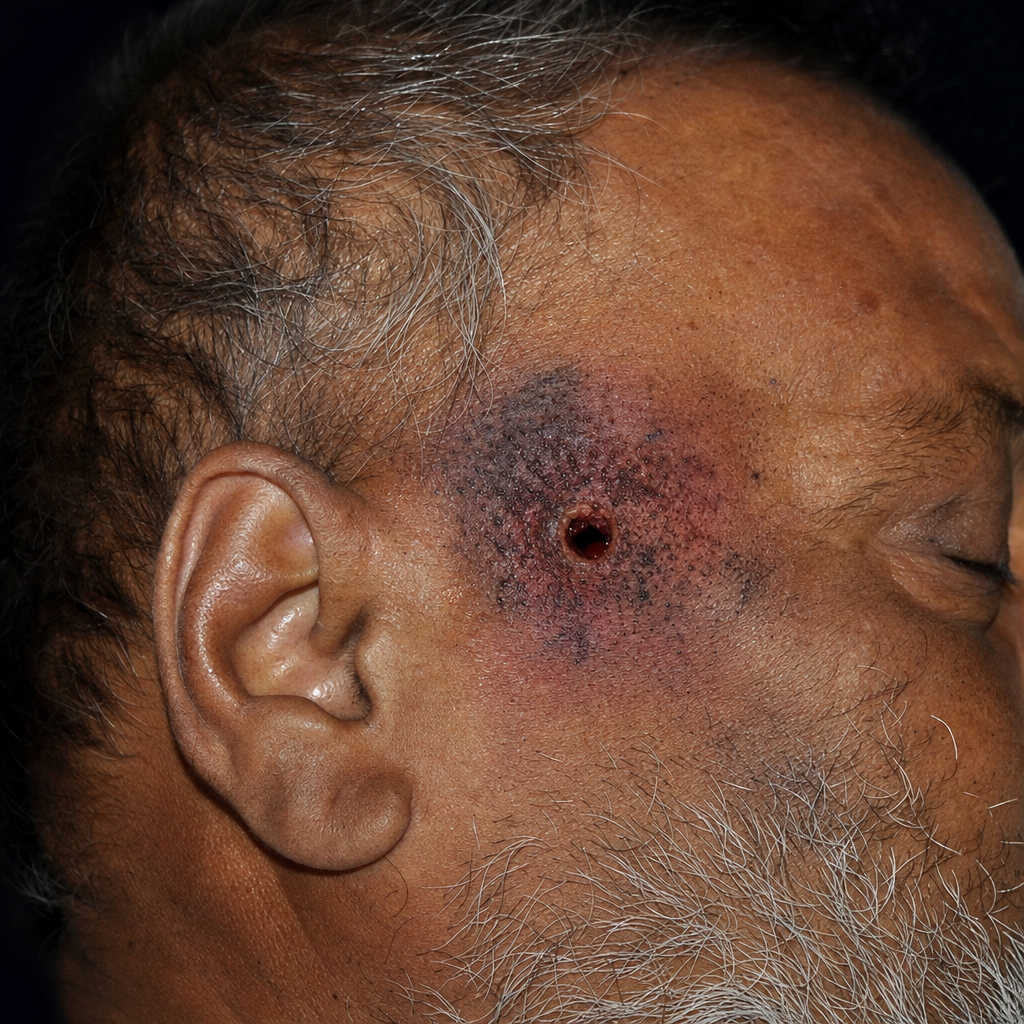
Which of the following is a feature of a lacerated wound?
Gutter fracture results from which type of injury?
Arborescent marks are seen in which type of injury?
A contusion can be differentiated from postmortem staining by performing which test?
What is the calibre of a firearm?
The yellow color of a bruise is due to which of the following?
Post mortem caloricity is seen with which of the following substances?
A gunshot wound cannot be evaluated as an entrance or exit wound due to surgical alteration of the wound. What is this phenomenon called?
Rigor mortis can be simulated by which of the following?
Which of the following findings is NOT consistent with ante-mortem burns?
Explanation: ### Explanation **Correct Answer: C. Irregular margin** **Underlying Medical Concept:** A **laceration** is a mechanical injury caused by the application of blunt force to the body, resulting in the tearing or splitting of skin and underlying tissues. Because the force is blunt and crushing rather than sharp, the tissue is torn apart unevenly. This results in **irregular, jagged, and bruised margins**. A hallmark feature of lacerations is the presence of **tissue bridges** (intact nerves, blood vessels, and connective tissue crossing the gap), which occurs because these structures resist blunt tearing more than the surrounding skin. **Analysis of Incorrect Options:** * **A. Clean cut wound:** This is a characteristic of an **incised wound** caused by a sharp-edged weapon (e.g., a knife or scalpel). In lacerations, the edges are crushed and torn, not cleanly cut. * **B. Regular margin:** Incised wounds and stab wounds have regular, linear margins. Lacerations are defined by their uneven and ragged appearance. * **D. Tapered margins:** This refers to the "tailing" effect seen in **incised wounds**, where the wound is deeper at the start and shallower (tapered) at the exit point. Lacerations do not show this specific directional tapering. **High-Yield Clinical Pearls for NEET-PG:** * **Tissue Bridging:** The most important diagnostic feature to differentiate a laceration from an incised wound. * **Hair Bulbs:** In a laceration, hair bulbs are crushed or intact; in an incised wound, they are cleanly cut. * **Incised-looking Laceration (Split Laceration):** Occurs when blunt force strikes skin over a bony prominence (e.g., scalp, shin, eyebrow). It may mimic an incised wound but will still show bruising and tissue bridges under magnification. * **Foreign Bodies:** Lacerations often contain dirt, grit, or grease, making them more prone to infection compared to clean-cut wounds.
Explanation: **Explanation:** A **gutter fracture** is a specific type of depressed skull fracture where a tangential or glancing blow results in a furrow-like groove in the outer table of the skull. **Why Bullet Injuries are Correct:** Gutter fractures are classically associated with **bullet wounds** where the projectile strikes the skull at an oblique or tangential angle. Depending on the velocity and angle, it may produce three types of gutters: 1. **First degree:** Only the outer table is grooved. 2. **Second degree:** The outer table is grooved, and the inner table is fractured (depressed). 3. **Third degree:** The bullet perforates the bone completely, creating a "gutter" or tunnel through the skull. **Why Other Options are Incorrect:** * **A. Large round objects:** These typically cause **pond fractures** (fissured or indented fractures without loss of bone continuity), common in the pliable skulls of infants. * **C. Automobile accidents:** These usually result in extensive **linear, comminuted, or ring fractures** due to high-energy blunt force impact over a broad area. * **D. Falling from a height:** This often leads to **basal skull fractures** or **remote fractures** (like a ring fracture around the foramen magnum) due to the transmission of force through the spinal column. **High-Yield Clinical Pearls for NEET-PG:** * **Pond Fracture:** Also known as "Indented fracture," seen in infants (like a dent in a ping-pong ball). * **Hinge Fracture:** A transverse fracture of the base of the skull, commonly seen in motorbike accidents (impact to the side of the head). * **Puppé’s Rule:** Used to determine the sequence of multiple impacts; a later fracture line will stop at a pre-existing fracture line. * **Beveling:** In bullet injuries, the exit wound is larger than the entry wound and shows external beveling.
Explanation: **Explanation:** **Correct Answer: C. Lightning injury** **Arborescent marks** (also known as **Lichtenberg figures**, filigree burns, or keraunographic marks) are pathognomonic of lightning strikes. These are transient, reddish, fern-like, or dendritic patterns found on the skin. They are not true burns but are caused by the extravasation of red blood cells into the superficial layers of the skin due to the massive electrical discharge (dielectric breakdown) following a lightning strike. They typically appear within an hour of the injury and usually disappear within 24–48 hours. **Why other options are incorrect:** * **Head injury:** While head injuries can present with specific signs like "raccoon eyes" (periorbital ecchymosis) or "Battle’s sign" (mastoid ecchymosis), they do not produce arborescent patterns. * **Thermal burns:** These are characterized by erythema, blistering (vesication), or charring, depending on the degree. They follow the area of heat contact rather than a branching pattern. * **Electric burns:** High-voltage or low-voltage electrocution typically produces "entry" and "exit" wounds. A characteristic finding is the **Joule burn** (endogenous burn) or a "crater-like" appearance, but not arborescent marks. **High-Yield Facts for NEET-PG:** * **Flashover effect:** When lightning flows over the surface of the body (moist skin/sweat), it may prevent internal organ damage but can cause "linear burns." * **Magnetization:** Metallic objects (keys, coins) in the victim's pocket may become magnetized—a diagnostic clue at the scene. * **Blast effect:** Lightning can cause mechanical injuries like tympanic membrane rupture (most common) or fractures due to the surrounding air expansion. * **Cause of death:** The immediate cause of death in lightning strikes is usually **cardiac arrest** (asystole) or respiratory paralysis.
Explanation: ### Explanation The differentiation between a **contusion (bruise)** and **postmortem staining (livor mortis)** is a classic forensic challenge. The correct method to distinguish them is the **Incision Test**. #### 1. Why the Incision Test is Correct The underlying medical concept is the state of the blood. * **Contusion:** This is an antemortem injury where blunt force causes rupture of capillaries, leading to blood **extravasation** into the surrounding tissues. The blood clots and infiltrates the tissue; therefore, when incised, the blood **cannot be washed away** with water. * **Postmortem Staining:** This is a physical process where blood settles in dependent vessels due to gravity. The blood remains **intravascular**. Upon incision, the blood flows out easily and **can be washed away** with water, leaving the underlying tissue pale. #### 2. Why Other Options are Incorrect * **Diaphanous Test:** An obsolete test for signs of death. A strong light is held against a finger web; in a living person, it appears red (due to circulation), while in the dead, it appears yellow/opaque. * **Picard’s Test:** Not a standard forensic test for injuries. (Often confused with various chemical or historical tests not relevant to this differentiation). * **Gettler’s Test:** Used in cases of **drowning**. It measures the chloride content in the blood of the left and right ventricles of the heart to determine if drowning occurred in freshwater or saltwater. #### 3. High-Yield Clinical Pearls for NEET-PG * **Color Changes in Bruise:** Follows the breakdown of hemoglobin: Red (0-3 days) → Blue/Livid (4-5 days) → Greenish (7-10 days) → Yellow (10-14 days) → Normal. * **Exception:** Subconjunctival hemorrhage does **not** change color (it stays red until it fades) because the oxygen from the air keeps the hemoglobin oxygenated. * **Fixation of Postmortem Staining:** Usually occurs between **6 to 12 hours** after death. Once fixed, the staining will not shift even if the body's position is changed.
Explanation: **Explanation:** The **calibre** of a rifled firearm refers to the internal diameter of the barrel. In forensic ballistics, rifling consists of a series of spiral ridges (**lands**) and depressions (**grooves**) cut into the bore to impart spin to the bullet for stability. **1. Why Option B is Correct:** The calibre is technically measured as the distance between **two diagonally opposite lands**. This represents the original diameter of the bore before the grooves were cut. When a bullet travels through the barrel, the lands "bite" into the projectile, creating the land marks seen on fired bullets. **2. Why the Other Options are Incorrect:** * **Option A:** The distance between a land and a groove is simply a measurement of the rifling pattern's width, not the diameter of the bore. * **Option C:** The distance between two opposite grooves is known as the **groove diameter**. This is always slightly larger than the calibre (land diameter) because the grooves are recessed into the barrel. **High-Yield Facts for NEET-PG:** * **Rifling:** The primary purpose is to provide **gyroscopic stability** and increase accuracy/range. * **Class Characteristics:** The number of lands/grooves, their width, and the direction of twist (Right/Left) help identify the **make and model** of the gun. * **Individual Characteristics:** Microscopic imperfections (striations) on the lands are unique to a specific weapon, acting like a "fingerprint" for forensic matching. * **Smoothbore Exception:** For shotguns (smoothbore), the internal diameter is expressed as **"Gauge" or "Bore"** (e.g., 12-gauge), which is determined by the number of lead balls of that diameter that weigh one pound.
Explanation: The color changes in a bruise (contusion) are a classic high-yield topic in Forensic Medicine, as they help in estimating the **age of the injury**. ### **Why Bilirubin is the Correct Answer** When a bruise occurs, blood escapes into the subcutaneous tissues. The body breaks down the extravasated red blood cells through a specific enzymatic pathway. Hemoglobin is first converted into hematin, then into **biliverdin** (green), and finally into **bilirubin** (yellow). The appearance of yellow signifies the final stage of hemoglobin degradation before the bruise fades completely. ### **Analysis of Incorrect Options** * **B. Hemoglobin:** This is the initial pigment present. A fresh bruise appears **red** due to oxygenated hemoglobin. * **D. Deoxyhemoglobin:** Within a few hours to 3 days, hemoglobin loses oxygen, turning the bruise **blue, purple, or blackish-blue**. * **C. Hemosiderin:** This pigment is responsible for the **brownish** hue seen around the 4th to 5th day as iron is released from the heme group. ### **High-Yield Clinical Pearls for NEET-PG** * **Chronological Sequence of Colors:** 1. **Red:** Fresh (0–24 hours) 2. **Blue/Black/Purple:** 1–3 days 3. **Green (Biliverdin):** 5–7 days 4. **Yellow (Bilirubin):** 7–12 days 5. **Normal Skin Tone:** 2 weeks * **The "Green" Exception:** A bruise on the **subconjunctiva** does not change color; it remains bright red until it fades because the thin membrane allows constant oxygenation of the blood. * **Key Rule:** Color changes always proceed from the **periphery to the center**.
Explanation: **Explanation:** **Post-mortem caloricity** refers to a paradoxical rise in body temperature for the first 1–2 hours after death, rather than the expected cooling (algor mortis). This occurs when the rate of heat production in the body exceeds the rate of heat loss at the time of death. **Why Strychnine is correct:** Strychnine is a potent spinal stimulant that causes intense, generalized muscle spasms and convulsions (opisthotonus). These violent muscular contractions generate massive amounts of metabolic heat. Additionally, strychnine poisoning often leads to death via asphyxia or exhaustion, which further impairs heat dissipation. The residual heat produced by these pre-mortal convulsions causes the body temperature to rise immediately after death. **Analysis of Incorrect Options:** * **Arsenic:** Typically causes death through fulminant gastroenteritis, leading to dehydration and peripheral circulatory collapse (shock). This usually results in a cold, clammy skin surface and a rapid fall in body temperature. * **Lead:** Chronic lead poisoning (plumbism) affects multiple systems but does not involve the acute, massive muscular activity required to produce post-mortem caloricity. * **Datura:** While Datura (deliriant poison) can cause hyperpyrexia (high fever) due to its anticholinergic effect (blocking sweat production), it is not the classic textbook association for post-mortem caloricity compared to the intense motor activity of Strychnine. **High-Yield Clinical Pearls for NEET-PG:** * **Causes of Post-mortem Caloricity:** 1. **Convulsive disorders:** Strychnine poisoning, Tetanus, Status Epilepticus. 2. **Infections:** Septicemia, Typhoid, Cholera, Lobar pneumonia. 3. **Environmental:** Heatstroke (Sunstroke). 4. **Neurological:** Pontine hemorrhage (disrupts thermoregulation). * **Strychnine Key Fact:** It acts by competitive antagonism of **Glycine** (an inhibitory neurotransmitter) at the postsynaptic receptor in the spinal cord.
Explanation: ### Explanation **1. Correct Answer: Kennedy Phenomenon** The **Kennedy phenomenon** occurs when a gunshot wound is surgically altered (e.g., by debridement, suturing, or the placement of a chest tube/drain) before a forensic examination can take place. This alteration makes it difficult or impossible for the medical examiner to distinguish between an entrance and an exit wound. It is named after the surgical intervention performed on President John F. Kennedy, where a tracheostomy was performed through the bullet wound in his neck, obscuring its original characteristics. **2. Analysis of Incorrect Options:** * **Rayalaseema Phenomenon:** This refers to a specific pattern of injury where multiple entry wounds are caused by a single discharge of a firearm, typically seen when a "country-made" weapon (zip gun) is loaded with multiple small pellets or scrap metal. * **Blow-back Phenomenon:** This occurs in contact shots where blood, tissue, and gunpowder residue are sucked back into the barrel of the gun due to the expansion and subsequent cooling of gases. It is useful for linking a weapon to a victim. * **Rat Hole Phenomenon:** This is seen in shotgun injuries. At very close range (usually within 1–2 meters), the entire pellet charge enters the body as a single mass, creating a large, circular wound with irregular edges, resembling a hole gnawed by a rat. **3. High-Yield Clinical Pearls for NEET-PG:** * **Entrance vs. Exit:** Remember that **abrasion collars** and **grease rings** are characteristic of entrance wounds, while exit wounds are typically larger, irregular, and lack these features. * **Tattooing vs. Scorching:** Scorching (burning) is seen in contact or near-contact shots, while tattooing (unburnt powder) is seen in intermediate-range shots (up to 60–90 cm). * **Puppy’s Sign:** This refers to the indentation of the skin without penetration, often seen in air-gun injuries.
Explanation: **Explanation:** **Rigor mortis** is the post-mortem stiffening of muscles due to the depletion of ATP, which prevents the detachment of actin-myosin cross-bridges. **Cadaveric spasm** (instantaneous rigor) is the correct answer because it is a condition that mimics rigor mortis by causing immediate muscular stiffening at the moment of death. * **Why Cadaveric Spasm?** Unlike rigor mortis, which develops gradually (usually 2–3 hours after death), cadaveric spasm occurs instantaneously. It typically involves specific groups of muscles (e.g., the hand) and is associated with intense emotional stress, sudden fear, or exhaustion before death. It is "simulated" rigor because the muscles bypass the primary flaccidity stage. **Analysis of Incorrect Options:** * **Algor mortis:** Refers to the post-mortem cooling of the body to match ambient temperature; it relates to thermal changes, not muscle stiffening. * **Adipocere (Saponification):** A late post-mortem change where body fat turns into a waxy, soap-like substance in moist, anaerobic conditions. * **Livor mortis (Post-mortem Lividity):** The reddish-purple discoloration of dependent body parts due to the gravitational settling of blood. **High-Yield Clinical Pearls for NEET-PG:** * **Rule of 12:** Rigor mortis typically takes 12 hours to set in, lasts for 12 hours, and takes 12 hours to disappear (in temperate climates). * **Order of Appearance:** Rigor mortis follows **Nysten’s Law**, appearing first in the eyelids, then the jaw, neck, upper limbs, and finally the lower limbs. * **Medico-legal Significance:** Cadaveric spasm cannot be induced after death; therefore, it is a sure sign that the object found in a victim's hand (e.g., a weapon or grass) was grasped **at the moment of death**, helping distinguish suicide from homicide.
Explanation: To differentiate between ante-mortem (before death) and post-mortem (after death) burns, one must look for signs of a **vital reaction**, which indicates that the body’s physiological processes were active at the time of injury. ### **Explanation of the Correct Answer** **Option C** is the correct answer because it describes **Post-mortem Blisters**. * **Ante-mortem Blisters:** These contain thick, protein-rich, highly albuminous fluid (which coagulates on heating) and chlorides. The base is typically red and inflamed. * **Post-mortem Blisters:** These are caused by the expansion of gases or putrefaction. They contain **air** or a **thin, clear, watery fluid** with negligible albumin. Crucially, the base is **dry, hard, and yellow** (parchment-like) rather than inflamed. ### **Analysis of Incorrect Options** * **Option A (Cellular Exudates):** This is a vital reaction. The presence of polymorphonuclear leukocytes and inflammatory exudates indicates an active immune response, proving the burn occurred while the person was alive. * **Option B (Line of Redness):** Also known as the "Zone of Hyperemia," this is a classic sign of ante-mortem burns. It is a narrow, bright red line of capillary congestion surrounding the burn area. It does not disappear after death. * **Option D (Increased Enzymatic Reaction):** Histochemical studies show an increase in enzymes like esterases and acid phosphatases at the periphery of the burn within 30–60 minutes of injury, confirming a vital process. ### **High-Yield Clinical Pearls for NEET-PG** * **Pugilistic Attitude:** A post-mortem finding due to heat coagulation of proteins (flexors are stronger than extensors); it does **not** indicate whether the burn was ante-mortem or post-mortem. * **Soot in Airways:** The presence of carbon particles in the trachea/bronchi is the **most reliable sign** of ante-mortem burns (indicates the person was breathing during the fire). * **Carboxyhemoglobin (COHb):** Levels >10% in the blood are strongly suggestive of ante-mortem inhalation of smoke. * **Rule of Nines:** Used to estimate the total body surface area (TBSA) involved in burns.
Mechanical Injuries
Practice Questions
Transportation Injuries
Practice Questions
Fall from Height
Practice Questions
Blunt Force Trauma
Practice Questions
Sharp Force Trauma
Practice Questions
Ballistic Injuries
Practice Questions
Burn Injuries
Practice Questions
Drowning
Practice Questions
Electrocution
Practice Questions
Lightning Injuries
Practice Questions
Explosion Injuries
Practice Questions
Pattern Injuries and Their Recognition
Practice Questions
Get full access to all questions, explanations, and performance tracking.
Start For Free