In a deceased individual with burns, the presence of contracted muscles indicates exposure to intense heat above what temperature?
In run-over accidents, which type of laceration is commonly seen?
Painful lockjaw is seen in which of the following conditions EXCEPT?
"Ewing's postulates" refers to:
What is the approximate killing range of a military rifle?
What is back spattering?
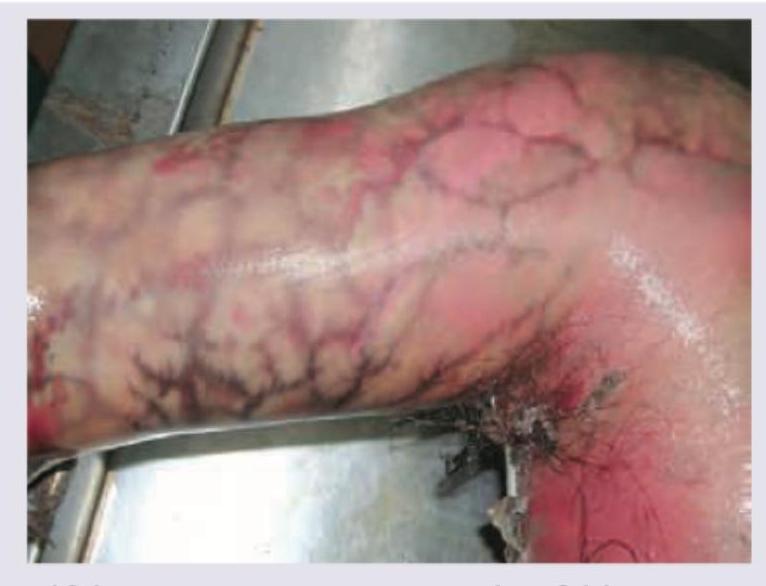
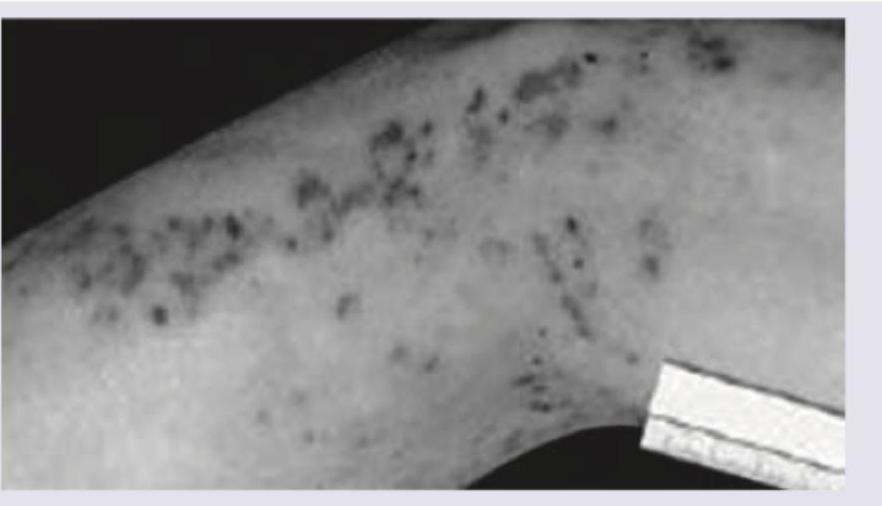
Which among the following is the immediate cause of death in electric shock?
Which of the following is NOT a characteristic of an incised wound?
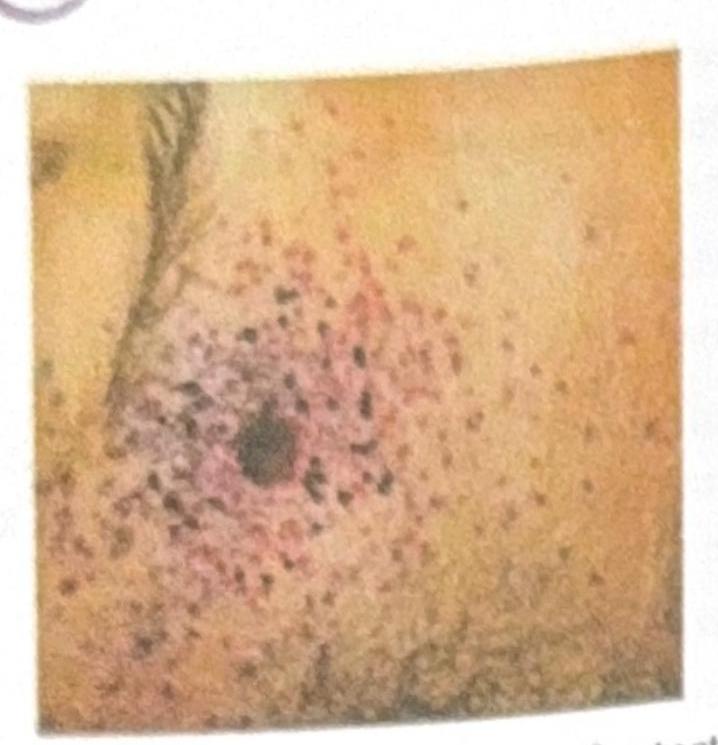
In cases of gunshot injuries to the skull with an entry wound surrounded by an abrasion collar and tattooing, and an exit wound along with metal fragments of the bullet inside the bullet track, what will be preserved for calculating the range of firing?
A bruise attains greenish discoloration by which day?
Explanation: **Explanation:** The correct answer is **60°C**. This question pertains to the phenomenon known as **Pugilistic Attitude** (or Boxer’s Attitude), a common finding in bodies recovered from fires. **1. Why 60°C is correct:** The characteristic flexion and contraction of muscles in a burn victim are caused by the **coagulation of muscle proteins** (albumin and globulin). When muscle tissue is exposed to intense heat—specifically temperatures exceeding **65°C** (with the process beginning significantly at **60°C**) —the proteins denature and shorten. Because the flexor muscles are bulkier and more powerful than the extensor muscles, their contraction dominates, resulting in the flexion of the elbows, knees, and wrists, resembling a boxer's stance. **2. Why other options are incorrect:** * **30°C & 40°C:** These temperatures are close to normal human core temperature (37°C). They do not cause protein denaturation or thermal contraction. * **50°C:** While this temperature can cause local tissue damage and burns over time, it is insufficient to cause the rapid, widespread coagulation of deep muscle proteins required to produce a pugilistic posture. **High-Yield Clinical Pearls for NEET-PG:** * **Pugilistic Attitude is an Antemortem or Postmortem finding?** It is purely a physical effect of heat and can occur in both; therefore, it is **not** a sign of a person being alive at the time of the fire. * **Heat Stiffening vs. Rigor Mortis:** Heat stiffening (at >60°C) is much more rigid than rigor mortis. If a body in heat stiffening is forcibly straightened, the muscles may tear, unlike in rigor mortis. * **Heat Ruptures:** Intense heat can cause skin to split, mimicking incised wounds. These can be differentiated by the presence of intact blood vessels and nerves across the floor of a heat rupture. * **Artifactual Epidural Hematoma:** Intense heat can cause blood to boil out of the diploe of the skull, creating a "heat hematoma" that mimics a traumatic extradural hemorrhage.
Explanation: **Explanation:** **Correct Answer: C. Avulsion** **Medical Concept:** In run-over accidents, the primary mechanism of injury is **flaying or degloving**. When a heavy vehicle wheel passes over a limb or body part, it exerts a combination of **crushing force** and **tangential (shearing) force**. This causes the skin and subcutaneous tissues to be forcibly torn away from the underlying fascia and muscle. This specific type of laceration, where a large area of skin is detached, is known as an **avulsion laceration**. A classic example is the "degloving injury" seen in the lower limbs during vehicular run-overs. **Analysis of Incorrect Options:** * **A. Split Laceration:** These occur when skin is crushed between two hard objects (e.g., a blunt weapon and underlying bone). They are commonly seen on the scalp, forehead, or shins and mimic incised wounds. * **B. Cut Laceration:** This is a general term often used interchangeably with incised-like wounds caused by blunt force. While they occur in accidents, they are not the *characteristic* lesion of a run-over. * **D. Stretch Laceration:** These occur due to over-stretching of the skin, leading to a tear. While they can occur in impact injuries (e.g., a pedestrian hit by a bumper), they do not involve the massive tissue detachment characteristic of a run-over. **High-Yield Clinical Pearls for NEET-PG:** * **Degloving Injury:** This is the hallmark of run-over accidents. * **Flaying:** Another term for extensive avulsion where skin is stripped off like a glove or stocking. * **Pocket Formation:** In run-overs, shearing forces can create a space between the skin and muscle which may fill with blood (hematoma), even if the skin remains intact. * **Tire Marks:** These are "patterned abrasions" or "grazes" that are diagnostic of the specific vehicle involved.
Explanation: **Explanation:** The question asks for the condition where **painful lockjaw (trismus)** is *not* typically seen. **1. Why Tetany is the Correct Answer:** In **Tetany** (caused by hypocalcemia), the characteristic clinical feature is **painless** carpopedal spasm. While it involves increased neuromuscular excitability and can cause facial muscle twitching (Chvostek's sign), it does not typically present with the inflammatory "lockjaw" seen in the other options. In contrast, **Tetanus** (caused by *Clostridium tetani*) presents with a classic, painful lockjaw (risus sardonicus) due to spastic paralysis. This distinction between Tetany (painless) and Tetanus (painful) is a common point of confusion in exams. **2. Analysis of Incorrect Options:** * **Temporomandibular joint (TMJ) abscess:** Any inflammatory process or infection involving the TMJ leads to severe pain and protective muscle guarding, resulting in trismus. * **Mandibular abscess:** Infections of the mandible or surrounding soft tissues (like submandibular space infections) cause significant pain and mechanical restriction of jaw movement. * **Odontogenic pulp abscess:** Severe dental infections can lead to periapical abscesses or cellulitis. When the infection spreads to the masticatory spaces (e.g., masseteric space), it triggers painful trismus. **3. High-Yield Clinical Pearls for NEET-PG:** * **Trismus (Lockjaw):** Most commonly caused by peritonsillar abscess (Quinsy), impacted third molars, or Tetanus. * **Tetanus vs. Tetany:** Tetanus = Painful spasms, Risus Sardonicus, Opisthotonus. Tetany = Painless spasms, Trousseau’s sign, Chvostek’s sign. * **Strychnine Poisoning:** Often mimics Tetanus but is characterized by rapid onset and complete muscle relaxation between convulsions (unlike Tetanus).
Explanation: **Explanation:** **Ewing’s Postulates** are a set of criteria used in forensic medicine and pathology to establish a **causal relationship between a traumatic injury and a subsequent complication**, most notably the development of a malignant tumor (post-traumatic sarcoma). For a complication or disease to be legally and medically attributed to a specific trauma, Ewing’s criteria must be met: 1. The site of the injury must have been previously healthy. 2. The trauma must be authentic and sufficiently severe. 3. The tumor/complication must develop at the exact site of the injury. 4. There must be a reasonable time interval (latency) between the trauma and the appearance of the complication. 5. The diagnosis of the complication must be histologically confirmed. **Analysis of Options:** * **Option B (Correct):** Ewing’s postulates specifically define the conditions under which a secondary complication (like a neoplasm) can be attributed to an initial trauma. * **Option A:** Accidents as a cause of death are classified under the "Manner of Death" and are determined by autopsy findings and scene investigation, not Ewing’s criteria. * **Option C:** The role of disease modifying trauma refers to "pre-existing conditions" (e.g., a person with hemophilia bleeding excessively from a minor cut), which is a separate forensic consideration. * **Option D:** Congenital anomalies caused by drugs refer to "Teratogenicity" (e.g., Thalidomide disaster), which is unrelated to traumatic postulates. **High-Yield Facts for NEET-PG:** * **Ewing’s Postulates** are most frequently cited in workers' compensation and medico-legal cases involving **post-traumatic malignancy**. * **Krompecher’s Theory:** Relates to the transformation of basal cells into rodent ulcers (Basal Cell Carcinoma), often confused with trauma-related theories. * **Courvoisier’s Law:** Relevant in surgery/forensics regarding gallbladder palpation and jaundice, often tested alongside eponymous laws/postulates.
Explanation: **Explanation:** In Forensic Ballistics, understanding the range of fire is crucial for determining the nature of an injury and the circumstances of a crime. **Why 300 yards is correct:** The **effective killing range** (also known as the effective range) of a standard military rifle is approximately **300 yards (approx. 275 meters)**. This is defined as the maximum distance at which a soldier can be expected to fire the weapon and consistently hit a human-sized target with enough terminal energy to cause a lethal injury. While the bullet can travel much further (extreme range), its accuracy and wounding potential drop significantly beyond this point due to external ballistics like gravity and wind drift. **Analysis of Incorrect Options:** * **100 yards:** This is well within the effective range. While highly lethal at this distance, it does not represent the *maximum* standard killing range for a rifle. * **500 yards:** While modern sniper rifles or heavy machine guns are effective at this range, for a standard-issue military rifle (like an AK-47 or INSAS), the probability of a lethal hit by an average marksman decreases significantly. * **1000 yards:** This represents the **extreme range** or the limit of the bullet's flight. At this distance, the velocity is low, and the "killing" capability is incidental rather than predictable. **High-Yield NEET-PG Pearls:** * **Rifling:** The presence of lands and grooves in the barrel imparts **gyroscopic stability** (spin) to the bullet, increasing accuracy and range compared to smoothbore weapons. * **Tandem Bullet:** When a second bullet is fired and gets lodged behind a stuck bullet in the barrel; both are expelled together. * **Ricochet Bullet:** A bullet that strikes an intermediate surface and deflects before hitting the victim. * **Souvenir Bullet:** A bullet that remains embedded in the body for a long duration, often becoming encapsulated by fibrous tissue.
Explanation: ### Explanation **Back spattering** (also known as the **"Drawback Phenomenon"**) is a critical concept in forensic ballistics, specifically associated with **contact or near-contact gunshot wounds**. #### 1. Why Option A is Correct When a firearm is discharged in contact with the body, the expansion of gases into the wound creates a momentary **partial vacuum** or negative pressure inside the barrel as the bullet leaves. This negative pressure "sucks" biological material—such as blood, hair, and soft tissue—back into the muzzle and the barrel of the gun. This is highly significant in forensic investigations as it can link a specific weapon to a victim, even if the weapon was cleaned externally. #### 2. Why Other Options are Incorrect * **Option B:** A "passive agent in sodomy" refers to the *pathic* or *catamite* in forensic sexology, which has no relation to ballistics. * **Option C:** Blood gushing from an exit wound is termed **Forward Spatter**. It follows the direction of the bullet and is usually more extensive than back spatter. * **Option D:** "Aerial bleed" is not a standard forensic term for gunshot dynamics; gushing blood from a high-pressure vessel is simply arterial spurting. #### 3. High-Yield NEET-PG Pearls * **Krompecher’s Line:** The deposition of soot and back-spattered material inside the barrel. * **Contact Wounds:** Back spattering is most prominent in contact shots. Look for **Cherry Red discoloration** of tissues (due to CO-hemoglobin) and a **Stellate (star-shaped) wound** over bony prominences (e.g., the skull). * **Muzzle Imprint:** A hard contact wound often leaves a "muzzle stamp" or abrasion caused by the hot metal and expanding gases pressing the skin against the barrel.
Explanation: **Explanation:** The immediate cause of death in electric shock depends primarily on the type and voltage of the current. **Cardiac arrhythmia**, specifically **Ventricular Fibrillation (VF)**, is the most common immediate cause of death in low-voltage alternating current (AC) injuries (the type found in domestic supplies). AC is particularly dangerous because it can interfere with the heart's electrical conduction system, leading to instantaneous circulatory collapse. In high-voltage cases, death may also occur immediately due to paralysis of the respiratory center in the medulla. **Analysis of Incorrect Options:** * **Cervical spine injury:** While falls or violent muscle contractions (tetany) during an electric shock can cause fractures or spinal injuries, these are secondary traumatic complications and rarely the immediate cause of death. * **Rhabdomyolysis:** This occurs due to extensive deep tissue and muscle necrosis from thermal energy. While it leads to acute kidney injury (myoglobinuria), this is a **delayed** or late complication, not an immediate cause of death. * **Hemorrhage:** Electrocution typically causes "coagulative necrosis" of blood vessels rather than immediate massive hemorrhage. Significant bleeding is uncommon unless there is associated major mechanical trauma. **High-Yield Facts for NEET-PG:** * **Low Voltage AC:** Causes death by **Ventricular Fibrillation**. * **High Voltage AC/DC/Lightning:** Causes death by **Respiratory Center Paralysis** or Asystole. * **Joule Burn:** The characteristic endogenous burn mark at the entry site, often appearing as a central charred crater with a pale peripheral elevation. * **Flash Burns:** Result from the heat of an electric arc (no direct contact required). * **Hold-on Phenomenon:** AC causes tetanic muscle spasms, preventing the victim from letting go of the conductor.
Explanation: ### Explanation **1. Why Option A is the correct answer (The "Not" characteristic):** In an incised wound, the **length of the wound has no correlation with the size of the weapon**. A small blade (like a surgical scalpel) can produce a very long incision if drawn across the skin, while a large knife can produce a short nick. Conversely, the **depth** of the wound is also not a reliable indicator of the blade's width. This is a classic trap in forensic exams; unlike stab wounds (where depth relates to the blade length) or lacerations (where size relates to the impact force), an incised wound's dimensions are determined by the movement of the weapon, not its physical dimensions. **2. Analysis of Incorrect Options:** * **Option B:** In an incised wound, blood vessels are cleanly cut, preventing them from retracting or crushing (unlike in lacerations). This leads to **profuse bleeding**. Therefore, the statement "bleeding is less than in a laceration" is factually incorrect in a general sense, but in the context of this specific question format, Option A remains the most definitive forensic principle being tested. * **Option C:** **Hesitation cuts** (tentative, superficial marks) are a hallmark of suicidal incised wounds, usually seen on the wrists or throat. * **Option D:** **Clean-cut, everted edges** are the defining feature of incised wounds because the weapon is sharp enough to sever tissues without crushing them. **3. NEET-PG High-Yield Pearls:** * **Tailoring:** Incised wounds are usually deeper at the beginning and shallower at the end (**"Tailing"**), which helps determine the direction of the cut. * **Bevelling:** If the weapon is held obliquely, one edge of the wound will be undermined (slanted), known as a bevelled cut. * **Self-inflicted vs. Homicidal:** Suicidal incisions are often accompanied by hesitation marks, whereas homicidal incisions (e.g., "cut-throat") are usually deep, single, and lack hesitation marks. * **Weapon:** Produced by sharp-edged weapons (knives, razors, glass).
Explanation: ### Explanation **1. Why Hair is the Correct Answer** In gunshot injuries, the **range of fire** is primarily determined by the presence and distribution of secondary projectiles (gunpowder residues) such as **tattooing** (unburnt powder embedded in skin) and **smudging** (soot). When the wound is on the scalp, the hair acts as a mechanical filter, trapping these particles before they reach the skin. Therefore, hair must be preserved and analyzed (often via scanning electron microscopy or chemical tests) to detect gunpowder residues that might be invisible on the skin surface. This is crucial for differentiating between close-range and intermediate-range shots. **2. Why the Other Options are Incorrect** * **B. Bullet pieces:** While bullet fragments help identify the caliber or type of weapon (ballistics), they do not provide information regarding the **distance** (range) from which the gun was fired. * **C. Blood:** Blood is preserved for DNA profiling, toxicology, or grouping, but it does not contain specific markers used to calculate the range of fire. * **D. Clothes:** While clothes are vital for range determination in body shots (as they trap gunpowder), the question specifically mentions a **skull injury**. In head wounds, the hair serves the same protective/trapping function that clothing does for the torso. **3. Clinical Pearls & High-Yield Facts for NEET-PG** * **Tattooing (Peppering):** Caused by unburnt gunpowder grains; it is an antemortem phenomenon and cannot be washed off. It indicates an **intermediate range** (usually 1–3 feet). * **Abrasion Collar:** A feature of an **entry wound** caused by the bullet rubbing against the invaginated skin. * **Exit Wounds:** Generally larger, irregular, and **lack** an abrasion collar or tattooing. * **Beveling:** In skull fractures, the inner table is beveled in entry wounds, while the outer table is beveled in exit wounds.
Explanation: **Explanation:** The color changes in a bruise (contusion) occur due to the progressive breakdown of hemoglobin following the extravasation of blood into the subcutaneous tissues. This sequence is a high-yield topic for determining the age of an injury in forensic practice. **1. Why 5-6 days is correct:** After the initial injury, hemoglobin undergoes enzymatic degradation. By the **5th to 6th day**, the pigment **biliverdin** is formed, which imparts a characteristic **greenish** hue to the bruise. **2. Analysis of incorrect options:** * **1 day (Option A):** Initially, a bruise appears **red** (fresh oxygenated hemoglobin). Within 24 hours, it typically turns **blue/purple/livid** as the hemoglobin becomes deoxygenated. * **2-3 days (Option B):** During this period, the bruise remains **blue to dark purple** as the red cells undergo hemolysis. * **7-12 days (Option D):** By the end of the first week (usually days 7-10), biliverdin is further reduced to **bilirubin**, which gives the bruise a **yellow** appearance. The color then fades until the bruise disappears, usually by 2 weeks. **Clinical Pearls for NEET-PG:** * **Mnemonic for Color Change:** **R**eal **B**oys **G**et **Y**ellow (Red $\rightarrow$ Blue/Purple $\rightarrow$ Green $\rightarrow$ Yellow). * **Exceptions:** Bruises in the **conjunctiva** do not change color; they remain bright red until they fade because the thin membrane allows atmospheric oxygen to keep the hemoglobin oxygenated. * **Deep Bruises:** May take longer to appear on the surface (delayed bruising) and may not follow the standard timeline. * **Ageing:** A bruise that shows multiple colors simultaneously is likely older than 5 days.
Mechanical Injuries
Practice Questions
Transportation Injuries
Practice Questions
Fall from Height
Practice Questions
Blunt Force Trauma
Practice Questions
Sharp Force Trauma
Practice Questions
Ballistic Injuries
Practice Questions
Burn Injuries
Practice Questions
Drowning
Practice Questions
Electrocution
Practice Questions
Lightning Injuries
Practice Questions
Explosion Injuries
Practice Questions
Pattern Injuries and Their Recognition
Practice Questions
Get full access to all questions, explanations, and performance tracking.
Start For Free