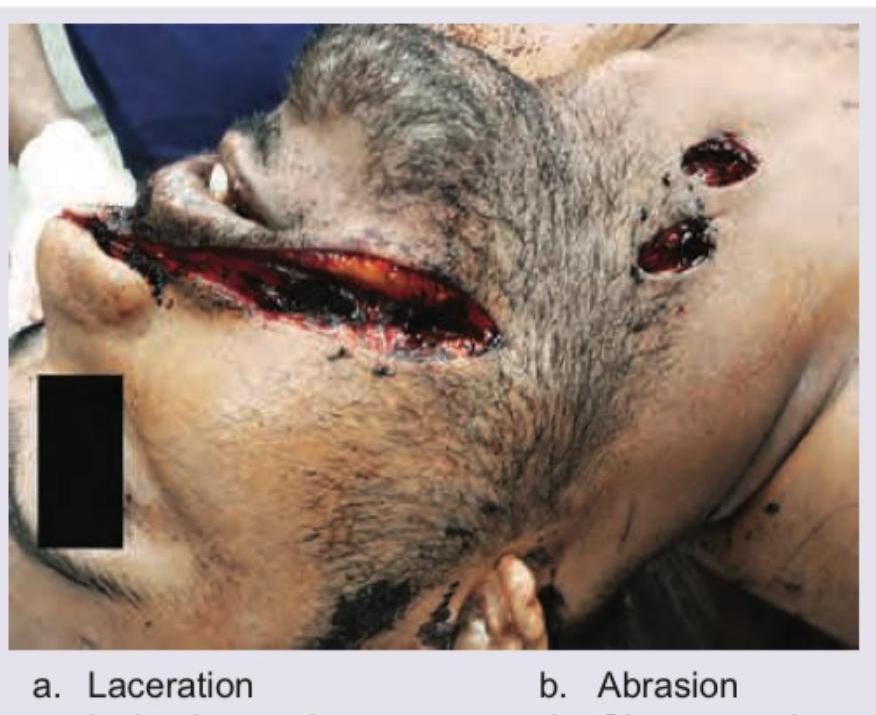
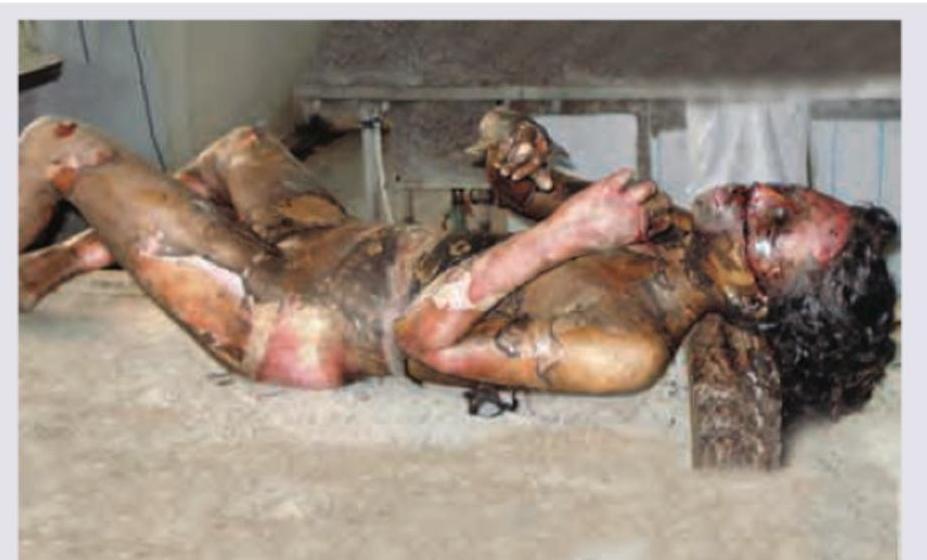
Pond fracture is typically seen in which of the following scenarios?
What is a motor cyclist fracture?
Linear abrasion is also known as which of the following?
A person hits another person with a wooden stick on provocation, leading to the formation of a bruise 3cm x 3cm on the forearm. No other injuries are noted. Which of the following is true regarding the punishment?
What is characteristic of cadaveric spasm?
A man fell from a height of 35 feet and landed on his feet. Which of the following injuries is possible?
Which is a smoothbore weapon?
Prominent bruise with minimum force is seen in which anatomical area?
A temporary cavity is seen in a gunshot injury caused by what type of projectile velocity?
Diastatic fractures are most commonly found along which suture line?
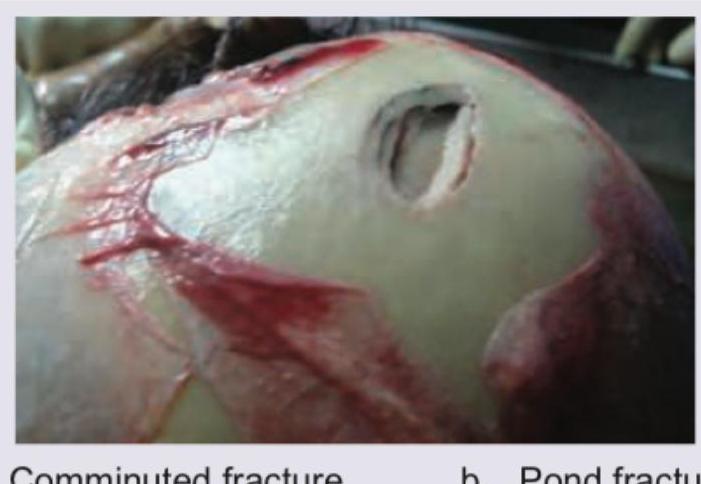
Explanation: ### Explanation **Correct Answer: C. A child born following a difficult forceps delivery.** **Understanding Pond Fracture** A **Pond fracture** (also known as a "Ping-pong" fracture) is a type of **depressed skull fracture** occurring exclusively in infants and young children. Because the infant skull is thin, elastic, and poorly mineralized, it tends to bend inward rather than snap when subjected to blunt force. This results in a shallow, saucer-like depression without a distinct fracture line, resembling a dent in a ping-pong ball. The most common clinical scenarios include: 1. **Birth Trauma:** Pressure from **forceps application** or the mother's promontory of the sacrum during a difficult labor. 2. **Accidental Trauma:** A fall onto a blunt object or a blow to the head. --- **Analysis of Incorrect Options:** * **Option A:** Bullet wounds typically cause **perforating or comminuted fractures** with characteristic bevelling (internal/external), not the elastic indentation seen in pond fractures. * **Option B:** Falls from height in adults usually result in **linear, comminuted, or ring fractures** of the skull base due to the rigidity and brittleness of adult bone. * **Option C:** **Sutural diastasis** refers to the separation of cranial sutures. While it can occur during putrefaction (due to gas pressure) or in head injuries (traumatic diastasis), it is a separation of joints, not a depressed bone deformity. --- **High-Yield NEET-PG Pearls:** * **Age Factor:** Pond fractures are unique to infants because their bones are "green" and flexible. * **Gutter Fracture:** A type of depressed fracture caused by a tangential bullet wound (oblique impact). * **Hinge Fracture:** A fracture of the base of the skull (usually the middle cranial fossa) often caused by heavy impact to the side of the head (e.g., motorcycle accidents). * **Treatment:** Many pond fractures are managed conservatively or with a "vacuum extractor" to pop the bone back into place.
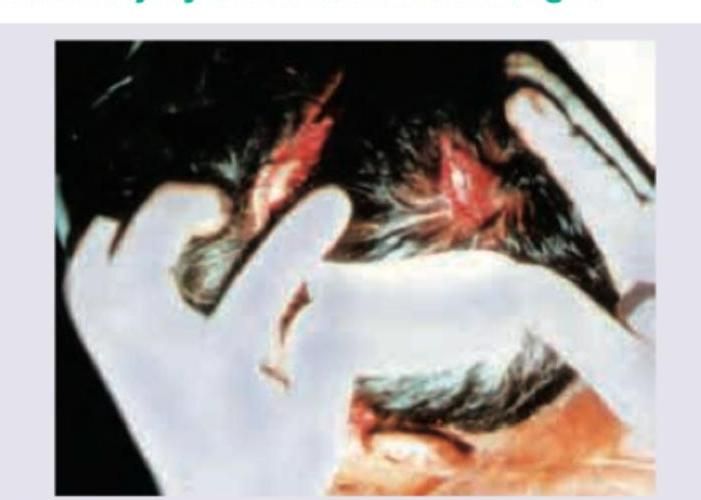
Explanation: ### Explanation **Correct Answer: C. Skull base divided into two halves** **Medical Concept:** A **Motorcyclist Fracture** (also known as a **Hinge Fracture**) is a specific type of transverse fracture of the skull base. It occurs when a forceful impact (usually to the side of the head or chin) causes a fracture line to run across the floor of the middle cranial fossa, typically passing through the sella turcica. This effectively divides the base of the skull into two distinct anterior and posterior halves. It is most commonly seen in motorcycle accidents due to the high-velocity lateral impact or heavy blows to the chin. **Analysis of Incorrect Options:** * **A. Ring Fracture:** This is a circular fracture around the foramen magnum. It is typically caused by a fall from a height where the victim lands on their feet or buttocks (vertical transmission of force) or by a heavy blow to the top of the head driving the skull down onto the spinal column. * **B. Comminuted Fracture:** This refers to the "eggshell" or "spider-web" appearance where the bone is broken into multiple small fragments. It is caused by a heavy blow with a broad object. * **D. Gutter Fracture:** This is a type of depressed fracture, often caused by a glancing blow from a bullet or a heavy blunt object, creating a "furrow" or groove in the outer table of the skull. **High-Yield Clinical Pearls for NEET-PG:** * **Hinge Fracture Mechanism:** Usually involves the petrous part of the temporal bone and the sella turcica. * **Pond Fracture:** A shallow, indented fracture seen in the pliable skulls of infants (similar to a dent in a ping-pong ball). * **Puppet’s Eye (Raccoon Eyes):** Often associated with fractures of the anterior cranial fossa, leading to periorbital ecchymosis. * **Battle’s Sign:** Post-auricular ecchymosis indicating a fracture of the posterior cranial fossa (petrous temporal bone).
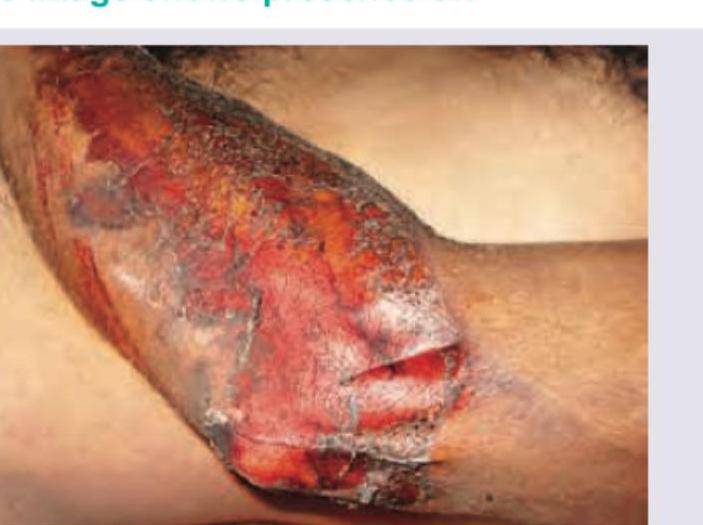
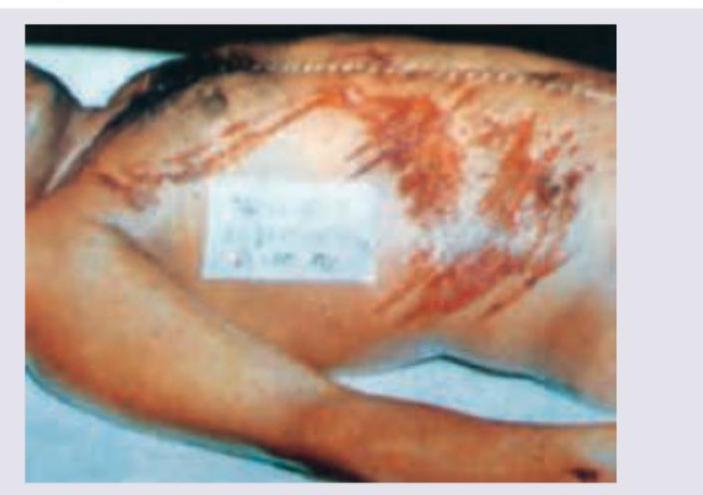
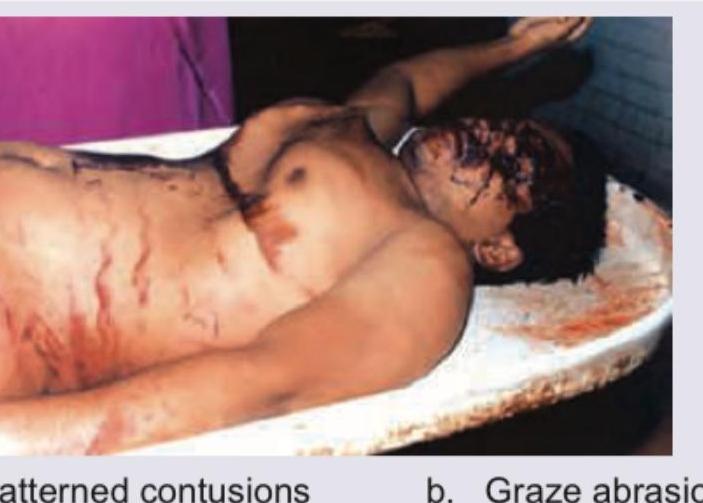
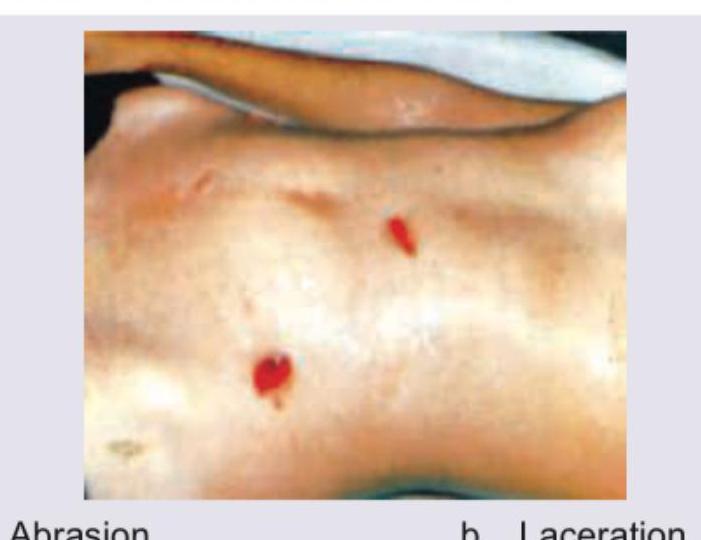
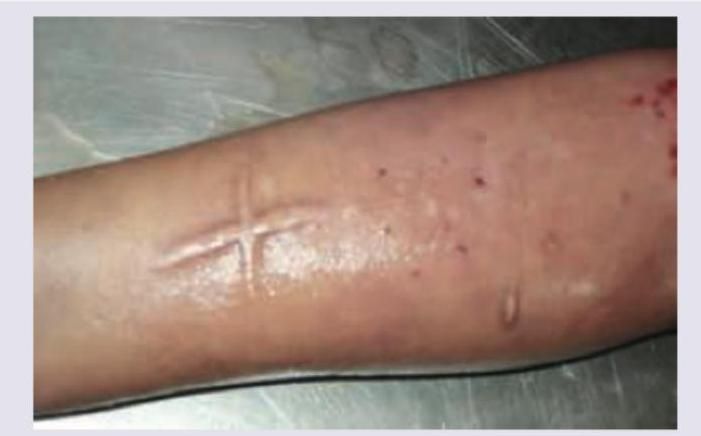
Explanation: **Explanation:** **Correct Answer: B. Scratch** **Understanding the Concept:** A **linear abrasion (scratch)** is caused by a sharp or pointed object (such as a needle, thorn, or fingernail) passing across the skin. The mechanism involves the object moving tangential to the surface, pushing the outer layers of the epidermis in front of it. This results in a narrow, line-like injury. A key diagnostic feature is that the **epithelial tags** are found at the distal end of the scratch, indicating the direction of the force. **Analysis of Incorrect Options:** * **A. Graze:** Also known as a sliding or scuff abrasion. These occur when a broad surface of the body slides against a rough surface (e.g., road rash in RTA). They are the most common type of abrasion but are characterized by a wider area of involvement rather than a single line. * **C. Pressure abrasion:** Also known as a crushing abrasion. These are caused by direct vertical pressure (compression) of a rough object against the skin, often seen in ligature marks in hanging or strangulation. There is no linear movement involved. * **D. Impact abrasion:** Also known as contact abrasion. These occur due to a direct vertical impact or blow. They often result in a "patterned abrasion" where the features of the impacting object (e.g., radiator grille, tire marks) are imprinted on the skin. **NEET-PG High-Yield Pearls:** * **Directionality:** In linear abrasions, the direction of force is from the clean end toward the end with epithelial tags/shreds. * **Fingernail Marks:** These are specific types of linear or curved (crescentic) abrasions. Their presence on the neck suggests **throttling**, while on the inner thighs/genitals, they suggest **sexual assault**. * **Post-mortem vs. Ante-mortem:** Ante-mortem abrasions show signs of vital reaction (scab formation/congestion), whereas post-mortem abrasions (parchmentization) appear yellowish, translucent, and leathery without bleeding.
Explanation: This question tests the integration of clinical forensic medicine (classification of injuries) with the legal framework of the Indian Penal Code (IPC). ### **1. Why Option C is Correct** The injury described is a **bruise (contusion)**, which is medically classified as a **Simple Hurt**. Under the IPC, the punishment for causing hurt depends on the presence or absence of provocation: * **Section 323 IPC:** Voluntarily causing hurt (without provocation) carries a punishment of up to 1 year imprisonment and/or a fine of ₹1,000. * **Section 334 IPC:** Voluntarily causing hurt **on provocation** (as specified in the question) reduces the gravity of the offense. The punishment is imprisonment for up to **1 month** and/or a fine of **₹500**. ### **2. Why Other Options are Incorrect** * **Option A:** This corresponds to Section 323 IPC (Simple hurt without provocation). * **Option B:** This corresponds to Section 324 IPC (Voluntarily causing hurt by dangerous weapons or means). A wooden stick used in this manner is generally not classified as a "dangerous weapon" unless it causes grievous injury. * **Option D:** Rigorous imprisonment for six months is not the standard punishment for simple hurt on provocation. ### **3. High-Yield Clinical Pearls for NEET-PG** * **Simple Hurt (Section 319 IPC):** Any bodily pain, disease, or infirmity caused to a person. * **Grievous Hurt (Section 320 IPC):** Includes 8 specific categories (e.g., permanent loss of sight/hearing, fracture, or any injury causing severe bodily pain for 20 days). * **Punishment for Grievous Hurt on Provocation (Section 335 IPC):** Up to 4 years imprisonment and/or a fine of ₹2,000. * **Age of Bruise:** Remember the color changes (Red $\rightarrow$ Blue/Black $\rightarrow$ Brown $\rightarrow$ Green $\rightarrow$ Yellow $\rightarrow$ Normal) to estimate the time of injury.
Explanation: **Explanation:** **Cadaveric spasm** (also known as instantaneous rigor) is a rare form of muscular stiffening that occurs at the exact moment of death, bypassing the stage of primary flaccidity. **Why the correct answer is "All of the above":** 1. **Instant in onset:** Unlike rigor mortis, which takes 1–2 hours to appear, cadaveric spasm occurs **immediately** at the time of death. It is usually triggered by extreme nervous tension, exhaustion, or intense emotion (e.g., fear or struggle) just before death. 2. **Confined to a small group of muscles:** While rigor mortis involves all muscles of the body, cadaveric spasm is typically localized to specific groups, most commonly the **hands**. 3. **Occurs only in voluntary muscles:** It involves the voluntary (skeletal) muscles that were in a state of intense contraction at the moment of death. **Clinical Significance & High-Yield Facts:** * **Medico-legal Importance:** It is of great significance because it preserves the **last act of life**. For example, a weapon gripped in the hand of a suicide victim or weeds grasped by a drowning person. It cannot be faked by a murderer, as placing an object in a hand during rigor mortis will not result in the same firm grip. * **Mechanism:** It is believed to be caused by the sudden exhaustion of ATP (Adenosine Triphosphate) in the specific muscle group due to intense pre-mortem activity. * **Comparison:** While rigor mortis is a post-mortem phenomenon, cadaveric spasm is an **ante-mortem phenomenon** that persists into the post-mortem period. It is eventually replaced by regular rigor mortis. **Key Distinction for NEET-PG:** * **Rigor Mortis:** Universal, slow onset, follows primary flaccidity. * **Cadaveric Spasm:** Localized, instantaneous, no primary flaccidity.
Explanation: ### Explanation **1. Why Option D is Correct:** The mechanism of injury described is a **vertical deceleration** (fall from height landing on feet). When a person lands on their feet, the kinetic energy is transmitted upwards through the lower limbs and vertebral column. * **Ring Fracture:** The weight of the body drives the vertebral column upward against the base of the skull, while the heavy skull remains momentarily stationary due to inertia. This "telescoping" effect causes a circular fracture around the **foramen magnum**, known as a **Ring Fracture**. * **Spinal Injury:** The vertical force frequently causes compression fractures of the **lumbar spine** (specifically L1-L2), as this is the transition zone between the rigid thoracic and mobile lumbar segments. **2. Why Other Options are Incorrect:** * **Option A (Gutter Fracture):** This is a tangential fracture caused by a glancing blow from a heavy weapon or a bullet, resulting in a furrow-like groove in the outer table of the skull. It is not associated with vertical falls. * **Option B (Pond Fracture):** Also known as a "fissured" or "dented" fracture, this occurs in infants whose skulls are pliable. It is caused by localized blunt force (like a blow from a hammer) and resembles a dent in a ping-pong ball. * **Option C (Depressed Fracture):** This occurs when a small area of the skull is struck with high force (e.g., a hammer blow), driving bone fragments into the brain parenchyma. It is a localized injury, not a result of indirect force from a fall on feet. **3. High-Yield Clinical Pearls for NEET-PG:** * **Ring Fractures** can also occur in "landing on buttocks" or from a heavy blow to the top of the head (driving the skull down onto the spine). * **Piedmont’s Sign:** Bruising over the heels in a fall from height, indicating the point of impact. * **Calcaneal Fractures:** Often associated with lumbar spine fractures in vertical falls (together known as **Don Juan Syndrome** or Lover's Triad). * **Primary Impact:** In a fall from height, the most severe internal injuries often occur opposite the side of impact due to deceleration forces.
Explanation: ### Explanation **Core Concept: Smoothbore vs. Rifled Firearms** Firearms are classified based on the internal characteristics of their barrels. A **smoothbore weapon** has a barrel with a completely smooth internal surface, lacking any internal grooves. The **Shotgun** is the classic example of a smoothbore weapon. It is designed to fire a "charge" consisting of multiple lead pellets (shot) or a single large slug. Because there is no rifling to impart spin, the projectiles do not have gyroscopic stability and tend to spread out over distance. **Analysis of Options:** * **Shotgun (Correct):** As a smoothbore weapon, it lacks "rifling." This is why forensic examination of shotgun wounds focuses on the spread of pellets and the presence of components like wads or plastic cups, rather than "striation marks" on the projectile. * **Rifle, Revolver, and Pistol (Incorrect):** These are all **rifled weapons**. Their barrels contain spiral grooves (lands and furrows) cut into the inner surface. These grooves impart a rapid spin to the bullet, ensuring aerodynamic stability, greater range, and accuracy. **High-Yield NEET-PG Clinical Pearls:** 1. **Choking:** This refers to the slight narrowing of the shotgun barrel at the muzzle end to control the spread of the shot (increasing the effective range). 2. **Rifling Characteristics:** The marks left by the lands and furrows on a fired bullet are unique to each weapon, acting as a "ballistic fingerprint" for forensic identification. 3. **Wad Significance:** In shotgun injuries, finding a wad inside a wound indicates the range of fire was likely within 5–10 meters. 4. **Tandem Bullet:** A rare forensic phenomenon where a second bullet follows a lodged bullet out of the barrel; this occurs in rifled weapons, not shotguns.
Explanation: **Explanation:** The correct answer is **Face**. The appearance and prominence of a bruise (contusion) are primarily determined by the vascularity of the tissue and the laxity of the subcutaneous space. The **Face**, particularly the area around the eyes (periorbital region), consists of extremely loose subcutaneous tissue and high vascularity. Due to this lack of structural resistance, even minimal blunt force can cause significant extravasation of blood, leading to a prominent, visible bruise. **Analysis of Incorrect Options:** * **Scalp (A):** The scalp is composed of dense, fibrous connective tissue that is firmly adherent to the underlying epicranial aponeurosis. This structural density limits the spread of blood, meaning more force is required to produce a visible bruise compared to the face. * **Soles (B) and Palms (C):** These areas are covered by thick, keratinized epidermis and contain dense, compartmentalized subcutaneous fat. The tough nature of the skin and the underlying fibrous septa act as a protective cushion, making it very difficult for a bruise to manifest unless the force applied is extreme. **High-Yield Clinical Pearls for NEET-PG:** * **Age of Bruise:** Color changes follow a specific sequence: Red (Fresh) → Blue/Livid (1–3 days) → Brownish (4–6 days) → Greenish (7–12 days) → Yellow (2 weeks) → Normal. * **Ectopic/Gravity Bruise:** A bruise may appear at a site distant from the impact due to gravity (e.g., a blow to the forehead causing a "Black Eye"). * **Factors affecting bruising:** Bruises appear more easily in children (soft skin), the elderly (fragile vessels), and obese individuals (more subcutaneous fat).
Explanation: **Explanation:** The formation of a **temporary cavity** is a hallmark of **high-velocity projectile** injuries (typically defined as velocities exceeding 600–750 m/s, such as those from rifles). **1. Why High Velocity is Correct:** When a high-velocity bullet enters the body, it transfers a massive amount of kinetic energy ($KE = \frac{1}{2}mv^2$) to the surrounding tissues. This energy creates a shockwave that pushes tissues radially away from the bullet's path. This results in a "temporary cavity"—a space much larger than the diameter of the bullet itself—which lasts for only milliseconds before collapsing. The rapid expansion and contraction cause extensive damage to internal organs and blood vessels even if they were not directly hit by the projectile. **2. Why Other Options are Incorrect:** * **Low Velocity:** Low-velocity projectiles (e.g., from most handguns) primarily damage tissue through direct contact and crushing. They produce a **permanent track** but lack the kinetic energy required to create a significant temporary cavity. * **High/Low Weight:** While mass ($m$) influences kinetic energy, the velocity ($v$) is squared in the formula, making it the dominant factor in cavitation. A heavy but slow bullet will not produce a temporary cavity. **Clinical Pearls for NEET-PG:** * **Permanent Cavity:** The actual track left by the bullet due to tissue destruction. * **Blast Effect:** The phenomenon where high-velocity bullets cause solid organs (like the liver or spleen) to "shatter" due to the pressure of the temporary cavity. * **Tail Waving/Yaw:** Increased instability of the bullet increases energy transfer and enhances cavitation. * **Velocity Threshold:** Critical velocity for significant cavitation is generally considered above **600 m/s**.
Explanation: **Explanation:** **Diastatic fractures** are a type of skull fracture characterized by the traumatic separation of cranial sutures. These occur when the force of an impact causes the cranial bones to pull apart at their natural junctions. **Why Sagittal Suture is Correct:** The **sagittal suture** is the most common site for diastatic fractures. This is primarily due to its anatomical length and central position on the vault of the skull. In pediatric populations, where sutures are not yet fused, these fractures are more frequent; however, in adults, they can occur if the impact is severe enough to overcome the interlocking mechanism of the suture. The sagittal suture's orientation makes it particularly vulnerable to lateral expansion forces during a head injury. **Analysis of Incorrect Options:** * **Frontal (Metopic) Suture:** While diastatic fractures can occur here in infants, this suture usually obliterates early in childhood (by age 6-8). Therefore, it is a much less common site compared to the sagittal suture. * **Occipital (Lambdoid) Suture:** Although the lambdoid suture can be involved in complex fractures (especially those extending from the base of the skull), it is statistically less frequently involved in isolated diastatic separation than the sagittal suture. **High-Yield Clinical Pearls for NEET-PG:** * **Age Factor:** Diastatic fractures are most common in **infants and young children** before the sutures have fully ossified (synostosis). * **Mechanism:** They are often associated with a "growing skull fracture" (leptomeningeal cyst) if the underlying dura is torn. * **Radiology:** On X-ray or CT, they appear as a widening of the suture line beyond **2mm**. * **Legal Significance:** In forensic medicine, the presence of a diastatic fracture indicates a significant application of force, often seen in falls from heights or vehicular accidents.
Mechanical Injuries
Practice Questions
Transportation Injuries
Practice Questions
Fall from Height
Practice Questions
Blunt Force Trauma
Practice Questions
Sharp Force Trauma
Practice Questions
Ballistic Injuries
Practice Questions
Burn Injuries
Practice Questions
Drowning
Practice Questions
Electrocution
Practice Questions
Lightning Injuries
Practice Questions
Explosion Injuries
Practice Questions
Pattern Injuries and Their Recognition
Practice Questions
Get full access to all questions, explanations, and performance tracking.
Start For Free