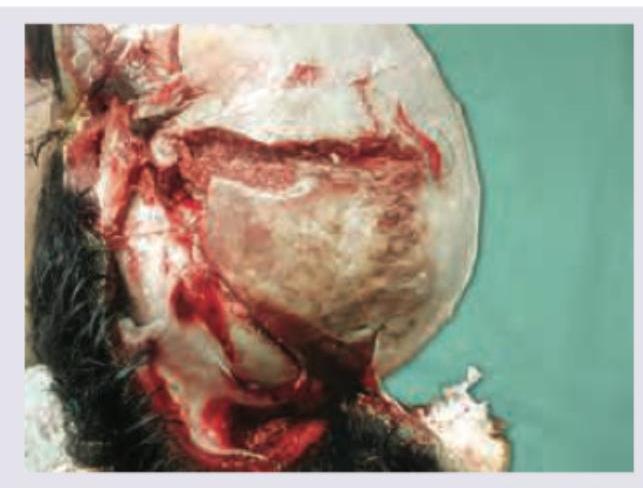
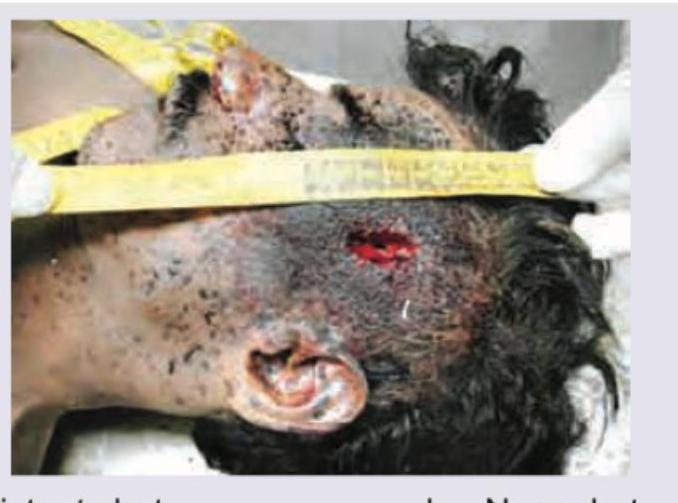
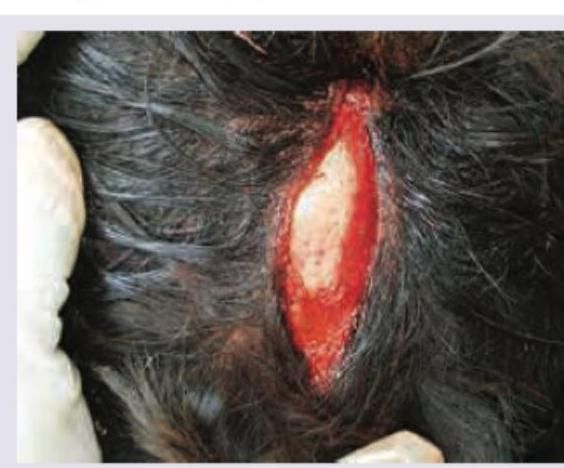
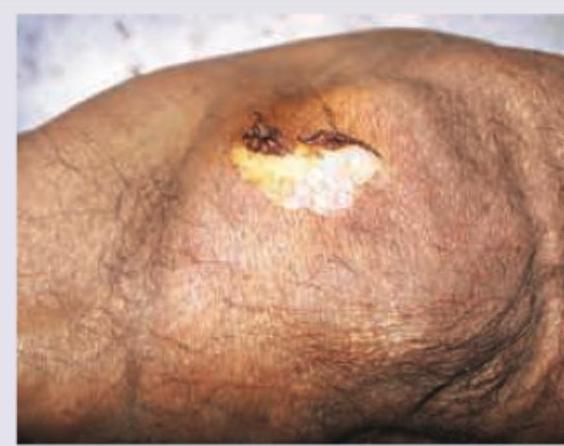
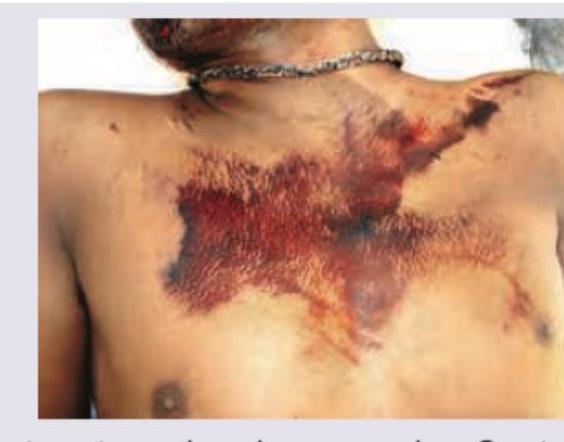
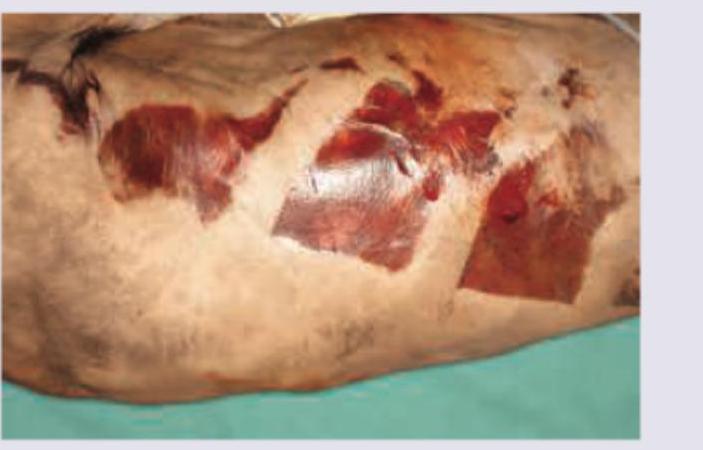
A tangentially directed injury may cause which of the following?
Which statement is NOT true regarding the color changes of a bruise over time?
In a shotgun cartridge, what is the flat felt disc that separates the gunpowder from the pellets called?
Smokeless gunpowder is composed of:
The assessment and differentiation of entry and exit wounds during a post-mortem examination of a case of death due to bullet injury is often difficult due to surgical alterations. This phenomenon is known as what?
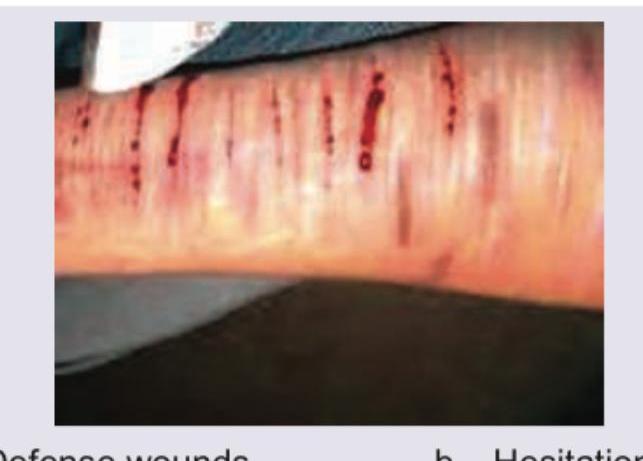
A person caused multiple incised wounds on the face of another person using a knife. Under which section of the Indian Penal Code (IPC) is this person liable for arrest?
Double based smokeless gun powder consists of which of the following components?
Which of the following is true for Contre-coup brain injury?
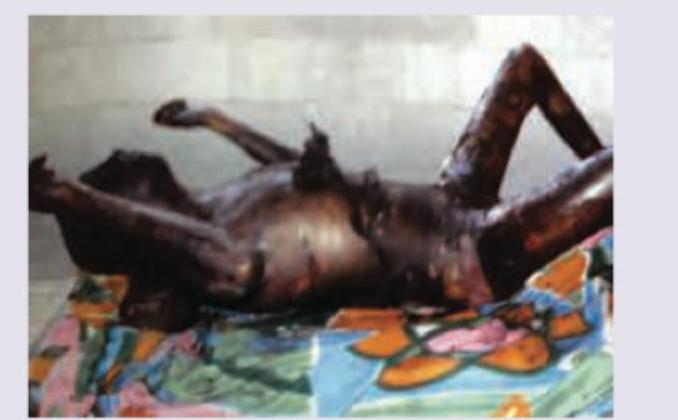
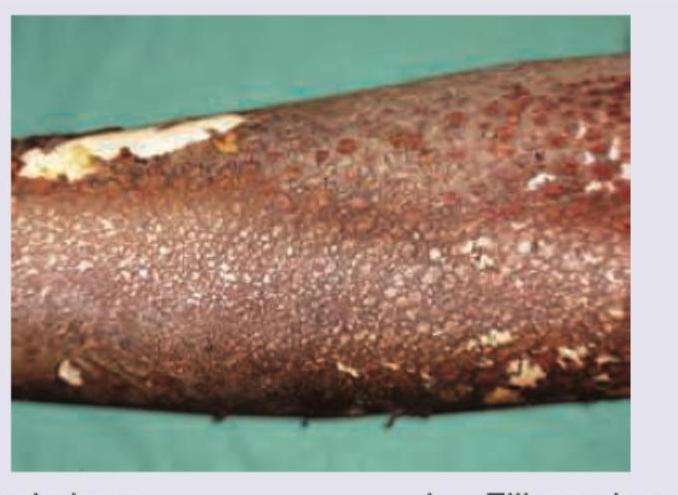
Which type of injury is commonly referred to as a "crocodile flesh burn"?
Brown color of contusion is due to which of the following?
Explanation: **Explanation:** The correct answer is **C. A horseshoe-shaped fracture.** **Mechanism and Concept:** When a blunt force is applied **tangentially** (at an angle) to the skull, it creates a specific type of depressed fracture. The force drives a segment of the bone inwards, but because the impact is slanted, the bone typically breaks in a **curved or horseshoe-shaped** pattern. This occurs because the force is concentrated on one side of the impact site, causing the inner table to fracture more extensively than the outer table, often resulting in a "hinged" or semi-circular flap of bone. **Analysis of Incorrect Options:** * **A. A through and through injury in the scalp:** This term usually refers to penetrating injuries (like a gunshot wound) where there is an entry and an exit. Tangential blunt force causes lacerations or abrasions, not "through and through" tracks. * **B. A complex fracture:** These are comminuted fractures with multiple intersecting lines, usually resulting from high-velocity impacts or heavy crushing forces applied perpendicularly, rather than tangentially. * **D. A semicircle fracture:** While similar in shape, the classic forensic description for a tangential blunt force impact on the vault of the skull is a "horseshoe-shaped" or "gutter" fracture. **High-Yield Clinical Pearls for NEET-PG:** * **Gutter Fracture:** A specific type of tangential injury caused by a bullet grazing the skull, creating a furrow. * **Pond Fracture:** A shallow, depressed fracture seen in infants (pliable skulls) resembling a dent in a ping-pong ball. * **Signature Fracture:** A depressed fracture that takes the shape of the impacting object (e.g., a hammer head). * **Hinge Fracture:** A fracture involving the base of the skull, typically crossing the middle cranial fossa (petrous temporal bone), often seen in heavy impacts to the side of the head or chin.
Explanation: **Explanation:** The color changes in a bruise (contusion) are caused by the progressive enzymatic breakdown of hemoglobin following the extravasation of blood into the tissues. This chronological sequence is a high-yield topic in Forensic Medicine for estimating the age of an injury. **Why Option B is the Correct Answer (The False Statement):** In the standard timeline of a bruise, the color **green** typically appears between **5 to 7 days**, not 7 to 12 days. By the 7th to 12th day, the bruise has usually transitioned to a **yellow** hue due to the formation of bilirubin. **Analysis of Other Options:** * **Option A (4th Day):** This is correct. As hemoglobin loses oxygen and converts to deoxyhemoglobin and hematin, the color shifts from red to bluish-black or brown (typically seen between days 3–6). * **Option C (1st Day):** This is correct. Initially, the bruise appears red due to the presence of fresh, oxygenated hemoglobin. * **Option D (After 2 weeks):** This is correct. By 14–15 days, the pigments are usually fully absorbed, and the skin returns to its normal color. **NEET-PG High-Yield Pearls:** 1. **Mnemonic for Color Changes:** **R**eally **B**ad **B**oys **G**et **Y**elled (Red $\rightarrow$ Blue/Black $\rightarrow$ Brown $\rightarrow$ Green $\rightarrow$ Yellow). 2. **Enzymatic Breakdown:** Hemoglobin (Red) $\rightarrow$ Deoxyhemoglobin (Blue) $\rightarrow$ Biliverdin (Green) $\rightarrow$ Bilirubin (Yellow). 3. **Subconjunctival Hemorrhage Exception:** This is a classic "catch" question. A bruise in the conjunctiva does **not** change color (it stays bright red until it fades) because the thin membrane allows atmospheric oxygen to keep the hemoglobin oxygenated. 4. **Factors Affecting Speed:** Bruises heal faster in children and slower in the elderly or those with coagulation disorders.
Explanation: ### Explanation **Correct Answer: C. Wad** In a shotgun cartridge, the **wad** is a crucial component typically made of felt, cardboard, or plastic. It serves three primary functions: it separates the gunpowder from the pellets, prevents the gas generated by the explosion from leaking through the pellets (acting as a piston), and protects the pellets from deformation. In forensic practice, the recovery of a wad from a wound is diagnostic of a shotgun injury and can help estimate the range of fire. **Analysis of Incorrect Options:** * **A. Gauge:** This refers to the **bore diameter** of the shotgun. It is determined by the number of pure lead balls (fitting the barrel) that total one pound in weight (e.g., a 12-gauge shotgun). * **B. Primer:** This is the small cap at the base of the cartridge containing a sensitive explosive (like mercury fulminate) that ignites the main gunpowder charge when struck by the firing pin. * **D. Anvil:** This is a small internal metal piece found within the primer cup. It provides a solid surface against which the primer mixture is crushed by the firing pin to initiate ignition. **High-Yield Clinical Pearls for NEET-PG:** * **Wad Dispersion:** The distance the wad travels can estimate range. A wad is usually found inside the wound if the range is **less than 2–3 meters**. Beyond this, it usually falls off. * **Plastic Cup Wads:** Modern cartridges often use plastic "cup" wads which may leave characteristic **"petal marks"** (abrasions) around the main entry wound at close ranges. * **Shotgun Choke:** This is the constriction at the muzzle end of the barrel used to control the spread of pellets. * **Entrance Wound:** At a range of **less than 1 meter**, a shotgun produces a single large "rat-hole" wound. Beyond this, individual pellet holes (satellite wounds) appear.
Explanation: **Explanation:** In Forensic Ballistics, gunpowder is classified into two main types: Black powder and Smokeless powder. **Nitrocellulose** (also known as guncotton) is the primary constituent of modern smokeless gunpowder. * **Single-base powder:** Contains only Nitrocellulose. * **Double-base powder:** Contains Nitrocellulose and Nitroglycerin. * **Triple-base powder:** Contains Nitrocellulose, Nitroglycerin, and Nitroguanidine. Smokeless powder is preferred in modern firearms because it produces significantly less smoke and residue compared to black powder, and it exerts higher pressure, increasing the projectile's velocity. **Analysis of Incorrect Options:** * **A. Potassium Permanganate:** This is a strong oxidizing agent used in medicine as an antiseptic and in chemistry, but it is not a component of gunpowder. * **B. Hydrogen Cyanide:** This is a highly toxic gas (lethal poison) that inhibits cellular respiration. It has no role in propellant composition. * **D. Sulphur:** Sulphur is a key component of **Black Powder** (Traditional gunpowder), which typically consists of Potassium Nitrate (75%), Charcoal (15%), and Sulphur (10%). **Clinical Pearls for NEET-PG:** * **Black Powder residue:** Leaves a heavy, dark fouling (soot) and produces a large cloud of white smoke. * **Smokeless Powder residue:** Leaves very little visible residue; however, it can be detected via the **Griess Test** (for nitrites) or **Dermal Nitrate Test** (Paraffin test). * **Tattooing (Peppering):** Caused by unburnt or partially burnt gunpowder grains embedding in the skin. It is a feature of "Intermediate range" fire and cannot be wiped off. * **Smudging (Sooting):** Caused by smoke/carbon deposits; it is a feature of "Close range" fire and can be wiped off.
Explanation: ### Explanation **Correct Answer: A. Kennedy Phenomenon** The **Kennedy phenomenon** refers to the difficulty or impossibility of distinguishing between an entry and an exit wound because the wound has been surgically altered. This typically occurs during life-saving emergency procedures (like a tracheostomy or chest tube insertion) where the surgeon inadvertently cuts through the bullet wound, or when the wound is debrided and sutured. This surgical intervention obscures the original characteristics (such as abrasion collars or beveling), making forensic reconstruction challenging. **Analysis of Incorrect Options:** * **B. Mc-Naughten’s Rule:** This is a legal standard used in psychiatry to determine **criminal responsibility** and the defense of insanity. It assesses whether the accused understood the nature of the act or that it was wrong. * **C. Alec Jeffrey’s Phenomenon:** Sir Alec Jeffreys is the father of **DNA profiling**. This term is often a distractor in exams, though his work is fundamental to forensic identification through DNA fingerprinting. * **D. Ricochet Phenomenon:** This occurs when a bullet strikes an intermediate object or surface at a shallow angle and **deflects** before hitting the target. Ricochet bullets often cause irregular, "tumbling" entry wounds. **High-Yield Pearls for NEET-PG:** * **Entry vs. Exit:** Entry wounds are generally smaller than the bullet (due to skin elasticity) and feature an **abrasion collar**. Exit wounds are typically larger, irregular, and lack an abrasion collar. * **Tattooing vs. Scorching:** Tattooing (unburnt gunpowder) indicates a **close-range** shot (up to 2-3 feet), while scorching/burning indicates a **contact or near-contact** shot. * **Puppy’s Rule:** Used to determine the sequence of multiple fractures in the skull; a later fracture line will stop when it reaches a pre-existing fracture line.
Explanation: ### Explanation **Correct Answer: D. Section 326** **Why it is correct:** The scenario describes the use of a **knife** (a dangerous weapon) to cause **multiple incised wounds on the face**. According to **Section 320 of the IPC**, "permanent disfiguration of the head or face" constitutes **Grievous Hurt**. When grievous hurt is caused voluntarily by means of any instrument for shooting, stabbing, or cutting (like a knife), it falls under **Section 326 IPC** (Voluntarily causing grievous hurt by dangerous weapons or means). Even if the wounds are superficial, multiple incised wounds on the face are legally interpreted as causing permanent scarring/disfiguration, elevating the offense from simple to grievous hurt. **Why other options are incorrect:** * **Section 323:** Pertains to punishment for voluntarily causing **Simple Hurt**. Since a dangerous weapon (knife) was used and the face was involved, this is too mild. * **Section 324:** Pertains to voluntarily causing **Simple Hurt by dangerous weapons**. While a knife is a dangerous weapon, the involvement of the face (disfiguration) upgrades the charge to "Grievous." * **Section 325:** Pertains to voluntarily causing **Grievous Hurt**, but *without* the use of a dangerous weapon (e.g., causing a fracture with a plain punch). **High-Yield Clinical Pearls for NEET-PG:** * **Section 320 IPC (Grievous Hurt):** Remember the mnemonic **E-M-A-S-C-U-L-A-T-I-O-N** (8 clauses): 1. Emasculation, 2. Permanent loss of sight, 3. Permanent loss of hearing, 4. Loss of limb/joint, 5. Impairment of limb/joint, 6. **Permanent disfiguration of head/face**, 7. Fracture/dislocation of bone/tooth, 8. Any hurt endangering life or causing 20 days of severe bodily pain. * **Weapon vs. Injury:** If the weapon is dangerous but the injury is simple = **324**. If the weapon is dangerous and the injury is grievous = **326**.
Explanation: ### Explanation **Concept Overview:** Gunpowder (propellant) is classified based on its chemical composition. Modern firearms primarily use **smokeless powder**, which is categorized into three types: single-base, double-base, and triple-base. **Why Option A is Correct:** **Double-base smokeless powder** consists of a mixture of **Nitrocellulose** (the primary energetic) and **Nitroglycerine** (added to increase the energy content and burning rate). This combination provides higher velocity and power compared to single-base powders. **Analysis of Incorrect Options:** * **Option B (Nitrocellulose + Sulphur):** This is an incorrect mixture. While Nitrocellulose is the sole component of *Single-base* powder, sulphur is a component of *Black powder*, not smokeless powder. * **Option C (Potassium nitrate + Nitroglycerine):** This is a mismatched combination. Potassium nitrate is an oxidizer used in black powder, whereas nitroglycerine is a high-energy liquid used in modern propellants. * **Option D (Potassium nitrate + Charcoal):** These are two of the three ingredients of **Black Powder** (the third being Sulphur). Black powder is the traditional, "smoky" propellant used in older firearms and muzzleloaders. **High-Yield Clinical Pearls for NEET-PG:** * **Single-base powder:** Contains Nitrocellulose only. * **Triple-base powder:** Contains Nitrocellulose, Nitroglycerine, and **Nitroguanidine** (used mainly in large-caliber military weapons). * **Black Powder Composition:** Potassium Nitrate (75%), Charcoal (15%), and Sulphur (10%). * **Forensic Significance:** Smokeless powder leaves less residue (fouling) in the barrel and produces significantly less smoke upon firing compared to black powder, which affects the visualization of "blackening" and "tattooing" in gunshot wounds.
Explanation: ### Explanation **Mechanism of Contre-coup Injury** A **Contre-coup injury** occurs on the side of the brain opposite the site of impact. The underlying medical concept is based on **deceleration kinematics**. When a **moving head** strikes a fixed object (e.g., a fall or a vehicular accident), the skull stops abruptly, but the brain continues to move due to inertia. This creates a momentary vacuum and tensile stress at the opposite pole, leading to parenchymal damage and vascular rupture. **Analysis of Options:** * **Option C (Correct):** Contre-coup injuries are characteristically seen when a **moving head hits a stationary object**. The differential movement between the brain and the skull is maximized during rapid deceleration. * **Option A (Incorrect):** This describes a **Coup injury**, which occurs directly at the site of impact. * **Option B (Incorrect):** When a **stationary head** is struck by a moving object (e.g., being hit by a bat), the skull is pushed against the brain, typically resulting in a **Coup injury** only. * **Option D (Incorrect):** While most common in the brain, the "contre-coup" phenomenon can rarely be seen in other organs like the lungs or bladder, though in the context of Forensic Medicine, it almost exclusively refers to intracranial dynamics. **High-Yield Clinical Pearls for NEET-PG:** * **Coup vs. Contre-coup:** Coup = Impact site (Stationary head); Contre-coup = Opposite site (Moving head). * **Common Sites:** Contre-coup injuries most frequently involve the **frontal and temporal lobes** (due to the irregular bony floor of the anterior and middle cranial fossae). * **Occipital Impact:** A fall on the back of the head (occipital impact) is the most common cause of significant frontal/temporal contre-coup lesions. * **Fractures:** Contre-coup fractures can also occur, most notably in the **orbital roofs** following an impact to the occiput.
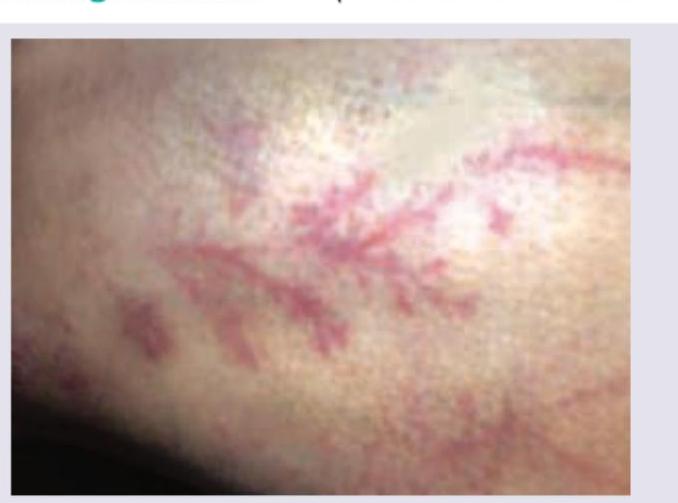
Explanation: **Explanation:** **Electrical injury** is the correct answer because "crocodile flesh" (or crocodile skin) appearance is a classic morphological feature of high-voltage electrical burns. When a high-voltage current passes through the skin, the intense heat causes coagulation necrosis and dehydration. This results in the skin becoming gray or brownish-black, firm, and parchment-like, with a cracked or fissured texture that mimics the scales of a crocodile. **Why other options are incorrect:** * **Explosive injury:** These typically present with a triad of blast effects (barotrauma), shrapnel injuries (lacerations/penetrations), and thermal burns, but do not produce the specific "crocodile" pattern. * **Lightning injury:** While a form of electricity, lightning characteristically produces **Lichtenberg figures** (arborescent or fern-like patterns) due to the "flashover" effect. It does not typically cause the deep, leathery fissuring seen in contact electrical burns. * **Gunshot injury:** These are characterized by entry/exit wounds, abrasion rims, tattooing, or scorching depending on the range, but lack the diffuse scaly necrosis of electrical burns. **High-Yield Clinical Pearls for NEET-PG:** 1. **Joule Burn (Electric Mark):** The specific entry wound of an electric current, often crater-like with elevated edges. 2. **Lichtenberg Figures:** Pathognomonic for lightning strikes; they disappear within 24 hours. 3. **Metallization:** A specific sign where metal ions from the conductor are deposited into the skin (can be confirmed by histochemical staining). 4. **Cause of Death:** In low-voltage (AC), death is usually due to **ventricular fibrillation**; in high-voltage, it is typically due to **respiratory paralysis**.
Explanation: **Explanation:** The color changes in a contusion (bruise) occur due to the sequential enzymatic breakdown of extravasated hemoglobin by macrophages. This is a high-yield topic for NEET-PG as it helps in determining the **age of the injury**. **Why Haemosiderin is Correct:** When a bruise occurs, hemoglobin is released into the tissues. After approximately **4 to 5 days**, the hemoglobin is converted into **Haemosiderin**, which imparts a characteristic **brown or greenish-brown** color to the skin. This marks the intermediate stage of healing. **Analysis of Incorrect Options:** * **A. Haematoidin:** This is chemically identical to bilirubin but is formed in anaerobic conditions (like the center of a large hematoma). It typically appears later (after 7-10 days) and is associated with a yellow color. * **B. Reduced Hemoglobin:** Immediately after the injury, the extravasated blood loses oxygen. The accumulation of reduced hemoglobin gives the bruise its initial **red, blue, or purplish-black** appearance (0–3 days). * **C. Bilirubin:** This is the final stage of breakdown, appearing around **7 to 12 days**, giving the bruise a distinct **yellow** color. **High-Yield Clinical Pearls for NEET-PG:** * **Sequence of Color Changes:** Red/Blue/Purple (Fresh) → Greenish/Brown (4-5 days) → Yellow (7-12 days) → Normal (2 weeks). * **Green color** is specifically due to **Biliverdin**. * **Exception:** Subconjunctival hemorrhages do *not* change color (they remain bright red and then fade) because the thin conjunctiva allows atmospheric oxygen to keep the hemoglobin oxygenated. * **Age Estimation:** A bruise that shows multiple colors is likely older than 4-5 days.
Mechanical Injuries
Practice Questions
Transportation Injuries
Practice Questions
Fall from Height
Practice Questions
Blunt Force Trauma
Practice Questions
Sharp Force Trauma
Practice Questions
Ballistic Injuries
Practice Questions
Burn Injuries
Practice Questions
Drowning
Practice Questions
Electrocution
Practice Questions
Lightning Injuries
Practice Questions
Explosion Injuries
Practice Questions
Pattern Injuries and Their Recognition
Practice Questions
Get full access to all questions, explanations, and performance tracking.
Start For Free