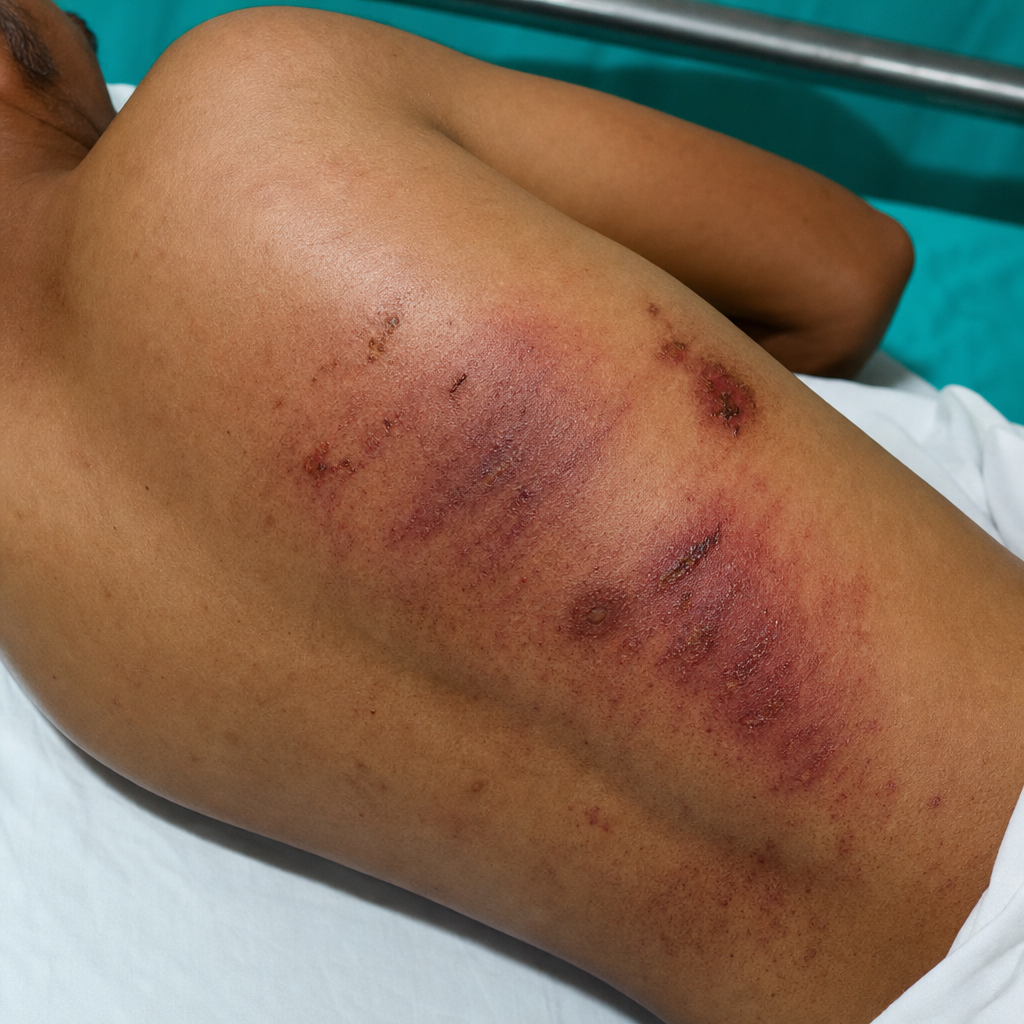
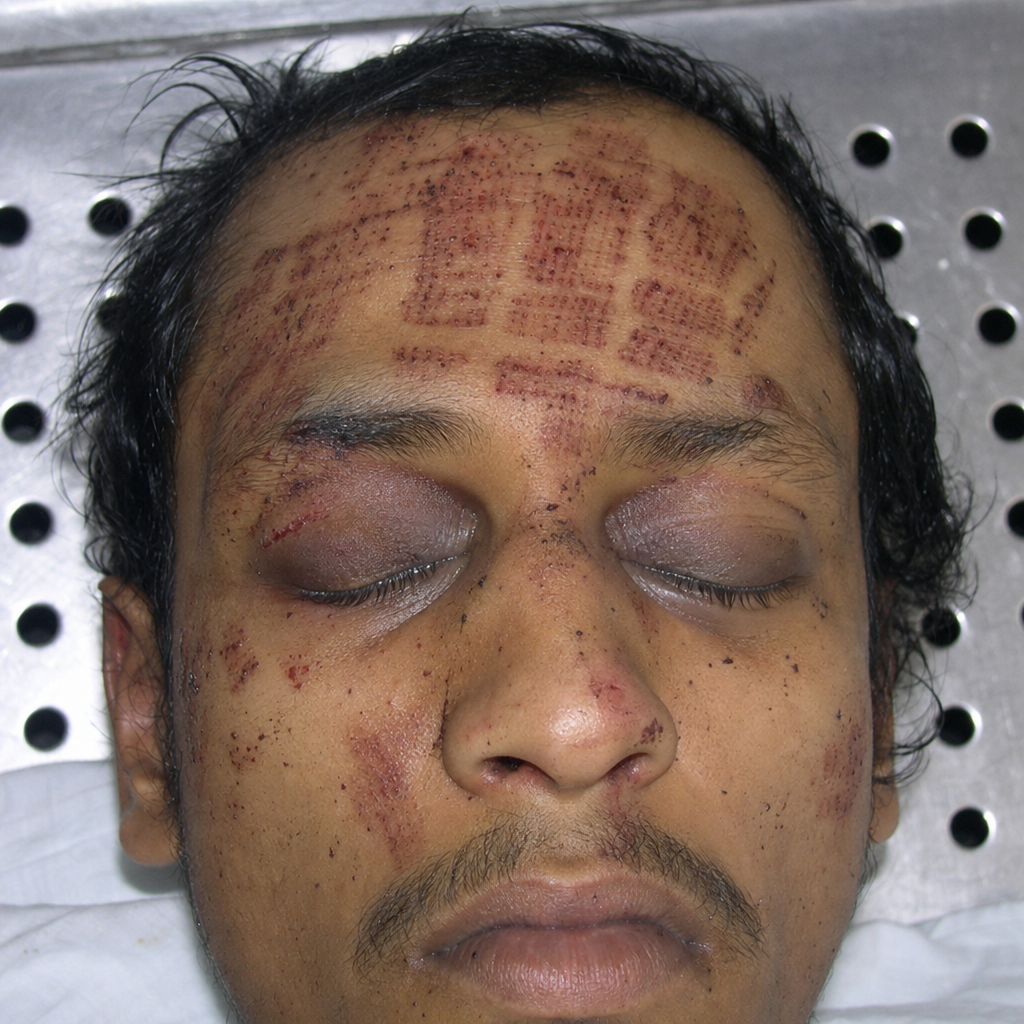
All of the following are true about contusions EXCEPT:
What is an 'Undertaker's fracture'?
In bursting of the skull due to firearm injury, a large portion of the brain may be thrown out of the bursting skull and found relatively intact. What is this phenomenon called?
What determines the destructive power of a bullet?
Di's collar is seen in which of the following conditions?
A split laceration resembles:
Ante-mortem burns differ from post-mortem burns by all of the following findings, EXCEPT:
Foamy liver is seen in which of the following post-mortem changes?
A lucid interval may be seen in which of the following conditions?
What is true about an antemortem wound?
Explanation: ### Explanation The core concept tested here is the **Antemortem vs. Postmortem** nature of injuries. A contusion (bruise) is an antemortem injury caused by blunt force that ruptures capillaries, leading to the extravasation of blood into the surrounding interstitial tissues. **Why "No inflammation" is the correct (False) statement:** Inflammation is a vital reaction. For a contusion to occur in a living person, the body responds to the tissue trauma with an **inflammatory process**. This includes the migration of leucocytes (neutrophils and macrophages) to the site to clear debris and broken red blood cells. Therefore, the presence of inflammation is a hallmark of an antemortem contusion. If there is "no inflammation," the injury is likely postmortem or a simple cadaveric lividity. **Analysis of other options:** * **Sequential color change:** This is a classic feature of antemortem contusions due to the enzymatic breakdown of hemoglobin (Hemoglobin [Red/Blue] → Biliverdin [Green] → Bilirubin [Yellow]). * **Raised enzyme levels:** Tissue trauma causes the release of enzymes like Histamine, 5-HT, and Acid Phosphatase at the site of injury, which can be used to determine the age of the wound. * **Blood cells in surrounding tissue:** By definition, a contusion involves the infiltration of blood into the subcutaneous tissues (extravasation), unlike a postmortem lividity where blood remains within the vessels. **High-Yield Clinical Pearls for NEET-PG:** * **Age of Contusion:** Red/Blue (0-3 days) → Greenish (4-7 days) → Yellowish (7-12 days) → Normal (2 weeks). * **Exception:** Subconjunctival hemorrhage does **not** change color (it stays bright red until it fades) because the loose tissue allows high oxygen tension, keeping hemoglobin oxygenated. * **Ectopic/Gravity Contusion:** A bruise appearing at a site distant from the impact (e.g., Black eye due to a forehead injury or a blow to the scalp).
Explanation: ### Explanation: Undertaker’s Fracture **Concept and Correct Answer:** An **Undertaker’s fracture** is a post-mortem injury, not a result of ante-mortem trauma. It refers to the **spondylolisthesis (displacement) of the lower cervical spine**, specifically involving the tearing of the **C6-C7 intervertebral disc** and the rupture of the anterior common ligament. It occurs during the handling of a body with **rigor mortis**. When an undertaker or mortuary handler forcibly extends the neck (by lifting the head) to place a pillow or to dress the body, the rigid spine resists the movement. This mechanical stress causes the brittle, stiffened cervical column to snap at its weakest point, typically the C6-C7 junction. **Analysis of Incorrect Options:** * **Option A (Traumatic spondylolisthesis of C1 over C2):** This describes a **Hangman’s fracture**, which is an ante-mortem injury caused by forceful hyperextension (commonly seen in judicial hanging or motor vehicle accidents). * **Option C (Burst fracture of C3):** Burst fractures (like a Jefferson fracture of C1) are caused by axial loading (vertical compression). They are not associated with post-mortem handling. * **Option D (Spinous process fractures):** This describes a **Clay-shoveler’s fracture**, typically involving the spinous processes of C6 or C7 due to sudden muscle contraction or direct trauma in living patients. **High-Yield Clinical Pearls for NEET-PG:** * **Nature of Injury:** It is a **post-mortem artifact**. It must not be confused with ante-mortem neck trauma during an autopsy. * **Distinguishing Feature:** Unlike ante-mortem fractures, an Undertaker’s fracture will show **no extravasation of blood (bruising)** or inflammatory response in the surrounding tissues. * **Common Site:** C6-C7 (The most mobile part of the lower cervical spine).
Explanation: ### Explanation **Correct Answer: A. Kronlein shot** **Mechanism and Definition:** A **Kronlein shot** (also known as "exenteration of the brain") occurs in high-velocity firearm injuries to the head, typically from rifles or close-range shotgun blasts. When a projectile enters the skull, it creates a massive **temporary cavitation** effect. Because the skull is a rigid, closed container filled with incompressible fluid (the brain), the sudden increase in intracranial pressure leads to an explosive "bursting" of the skull. This force can result in the complete or partial expulsion of the brain through the exit wound or shattered cranial vault, often leaving the brain found relatively intact at a distance from the body. **Analysis of Incorrect Options:** * **B. Back spatter:** This refers to the spray of blood and tissue fragments directed back toward the firearm or shooter from the entrance wound (also known as the *Blowback phenomenon*). * **C. Billiard ball effect:** This occurs in shotgun injuries where individual pellets strike each other inside the body, causing them to diverge and create a wider area of internal damage than predicted by the entry spread. * **D. Balling of shot:** This is a phenomenon where shotgun pellets fuse together (due to heat or manufacturing defects), causing them to act as a single projectile rather than dispersing, which results in a more severe, localized wound at longer ranges. **High-Yield NEET-PG Pearls:** * **Puppe’s Rule:** Used to determine the sequence of multiple skull fractures (a later fracture line will stop at a pre-existing fracture line). * **Hoffmann’s Sign:** The stellate (star-shaped) appearance of a contact entrance wound over a bony prominence (e.g., the forehead) due to gas expansion between the bone and scalp. * **Kennedy Phenomenon:** A surgical alteration of a firearm wound that makes it difficult for a forensic pathologist to distinguish between entrance and exit.
Explanation: **Explanation:** The destructive power (kinetic energy) of a bullet is the primary factor determining the extent of tissue damage. This is governed by the kinetic energy formula: **$KE = \frac{1}{2}mv^2$** (where $m$ = mass and $v$ = velocity). **1. Why Velocity is the Correct Answer:** In the kinetic energy equation, velocity is **squared**, whereas mass (weight) is only a linear factor. Therefore, doubling the mass of a bullet doubles its energy, but doubling the velocity **quadruples** its destructive potential. High-velocity missiles (velocity > 600-750 m/s), such as those from rifles, cause massive tissue destruction through "cavitation"—the formation of a temporary pulsating cavity that crushes and tears surrounding structures far beyond the actual track of the bullet. **2. Why Other Options are Incorrect:** * **Weight (Mass) and Size:** While a heavier or larger bullet carries more momentum, its impact on kinetic energy is significantly less than that of velocity. * **Shape:** The shape (e.g., pointed vs. hollow point) influences the aerodynamics and how the energy is *transferred* to the body (e.g., mushrooming), but it does not determine the baseline destructive power itself. **Clinical Pearls for NEET-PG:** * **Cavitation:** High-velocity bullets create a **temporary cavity** (lasting milliseconds) that can be 30–40 times the diameter of the bullet. * **Tumble and Yaw:** Irregularities in flight (yawing) increase the surface area of impact, leading to greater energy transfer and larger exit wounds. * **Rifle vs. Pistol:** Rifles are high-velocity weapons; pistols are generally low-velocity (< 300 m/s). * **Shockwave:** High-velocity bullets can cause fractures or organ rupture even without direct contact due to the transmitted pressure wave.
Explanation: **Explanation:** **Di’s Collar** (also known as the **Abrasion Collar** or Abrasion Rim) is a hallmark feature of a **firearm entry wound**. ### 1. Why the correct answer is right: When a bullet strikes the skin, it does not immediately pierce it. Instead, the bullet indents and stretches the skin inward until the skin's elastic limit is exceeded and it perforates. As the bullet enters, its rough surface scrapes against the inverted edges of the hole, denuding the epidermis. This creates a reddish-brown, circular or elliptical zone of abrasion surrounding the entry defect. The presence of this collar is a definitive sign of an entry wound. ### 2. Why the incorrect options are wrong: * **Firearm exit wound:** Exit wounds are typically formed by the bullet pushing the skin outward (eversion). Since the skin is not being stretched inward against the bullet's surface in the same manner, an abrasion collar is **absent**. Exit wounds are generally larger, more irregular, and lack the "collars" (abrasion and grease) seen in entry wounds. * **Both entry and exit wounds:** This is incorrect because the mechanism of injury (inversion vs. eversion) is fundamentally different, making the abrasion collar unique to entry points. ### 3. High-Yield Clinical Pearls for NEET-PG: * **Components of an Entry Wound:** Apart from the Abrasion Collar, look for the **Grease/Dirt Collar** (blackish ring due to lubricant/lead on the bullet) located internal to the abrasion collar. * **Exception:** An abrasion collar may be absent in entry wounds over bony prominences or in "shored" exit wounds (where the skin is supported by a hard surface like a wall or tight belt, mimicking an entry wound). * **Mnemonic:** Entry wounds are **Inverted**; Exit wounds are **Everted**. * **Contact Wounds:** Look for a **Muzzle Impression** (cherry-red discoloration due to CO) which is also specific to entry.
Explanation: ### Explanation **Why Option A is Correct:** A **split laceration** occurs when the skin is crushed between a blunt object and an underlying bony prominence (e.g., scalp, forehead, shin, or iliac crest). The force compresses the soft tissues until they rupture. Because the skin is stretched and split over the bone, the resulting wound often has **clean-cut, linear edges** that closely mimic an **incised wound** (caused by a sharp object). This is why it is frequently referred to as a "pseudo-incised" wound. To differentiate it from a true incised wound, a clinician must look for crushed hair follicles, tissue bridges in the depths of the wound, and abraded margins under magnification. **Why Other Options are Wrong:** * **B. Abrasion:** These are superficial injuries involving only the destruction of the epithelial layer (friction/pressure) without a full-thickness tear or "split" of the skin. * **C. Gunshot wound:** These typically present as entry/exit holes with specific features like tattooing, singeing, or a grease ring, which do not resemble the linear split of a blunt force injury. * **D. Contusion:** Also known as a bruise, this is an effusion of blood into the tissues without a break in the continuity of the skin. While often associated with lacerations, the physical appearance of a "split" is distinct from a bruise. **NEET-PG High-Yield Pearls:** * **Tissue Bridges:** The presence of tissue bridges (nerves, vessels, and fibers crossing the gap) is the **pathognomonic feature** that distinguishes a laceration from an incised wound. * **Common Sites:** Split lacerations are most common on the **scalp**; they can be mistaken for a machete or knife wound in forensic examinations. * **Foreign Bodies:** Lacerations often contain dirt or grit (unlike clean incised wounds), increasing the risk of infection and tetanus.
Explanation: **Explanation:** The distinction between ante-mortem (AM) and post-mortem (PM) burns is a high-yield forensic topic. The primary differentiator is the presence of a **vital reaction**, which occurs only when the body is alive and the circulation is intact. **Why Option C is Correct:** **Vesicles containing air** are a characteristic feature of **post-mortem burns**. When a dead body is exposed to heat, the gases produced by decomposition or the expansion of tissue fluids under high heat create "dry" blisters containing only air. These lack the biochemical markers of life. **Why the Other Options are Incorrect:** * **A. Pus in vesicle:** The formation of pus requires a functional immune response (leukocyte migration), which takes time and a living circulation. Its presence confirms the person survived the burn for at least 36–48 hours. * **B. Vesicle with hyperemic base:** In AM burns, blisters contain fluid rich in albumin and chloride. When the cuticle is removed, the base is red and congested (hyperemic) due to active inflammatory vasodilation. * **C. Inflammatory red line:** Also known as the "Line of Redness," this is a zone of capillary congestion surrounding the burn. It is the most reliable sign of an AM burn, as it cannot be produced after the heart stops beating. **Clinical Pearls for NEET-PG:** * **Rule of Nines:** Used for estimating the surface area of burns (Wallace’s Rule). * **Pugilistic Attitude:** A post-mortem finding due to heat-induced coagulation of muscle proteins (flexors), not a sign of AM struggle. * **Carbon Monoxide (CO):** Presence of Carboxyhemoglobin (>10%) in the blood is the surest sign that the victim was alive and breathing during the fire. * **Soot in Airways:** Presence of soot in the trachea/bronchi indicates the victim was alive (active inhalation) at the time of the fire.
Explanation: **Explanation:** **Foamy Liver** (also known as *Hepatitis gasosa*) is a classic pathological finding associated with **Putrefaction**. 1. **Why Putrefaction is correct:** During the process of decomposition, gas-producing anaerobic bacteria—most notably ***Clostridium welchii* (C. perfringens)**—proliferate within the tissues. These bacteria ferment carbohydrates and proteins, releasing gases (hydrogen, methane, and carbon dioxide). In the liver, these gas bubbles accumulate within the parenchyma, creating a porous, honeycomb, or "Swiss cheese" appearance. This makes the organ soft, crepitant, and buoyant in water. 2. **Why other options are incorrect:** * **Adipocere (Saponification):** This is a modification of putrefaction occurring in moist, anaerobic environments where body fats turn into a waxy, soap-like substance. It preserves the body's shape rather than creating gas-filled cavities. * **Mummification:** This occurs in hot, dry, airy conditions. It involves dehydration and desiccation of tissues, leading to a shriveled, leathery appearance, which is the opposite of the gas-distended foamy liver. * **Dry Drowning:** This is a physiological cause of death due to laryngeal spasm; it does not involve specific post-mortem tissue decomposition changes like gas formation. **High-Yield Clinical Pearls for NEET-PG:** * **Organ of earliest putrefaction:** Larynx and trachea (internally); Caecum (externally, seen as green discoloration). * **Organ of last putrefaction:** Prostate in males; non-gravid uterus in females (due to thick muscular walls). * **Casper’s Dictum:** Ratio of the rate of putrefaction in Air : Water : Earth is **1 : 2 : 8**. * **Color changes:** The greenish discoloration in the right iliac fossa is due to the formation of **Sulphmethaemoglobin**.
Explanation: **Explanation:** The **lucid interval** is a classic clinical phenomenon characterized by a temporary period of consciousness between two periods of unconsciousness. It occurs most characteristically in **Epidural Hemorrhage (EDH)**. **Why Epidural Hemorrhage is correct:** EDH usually results from a blow to the temple, causing a fracture of the temporal bone and rupture of the **middle meningeal artery**. The initial trauma causes a brief loss of consciousness (concussion). The patient then regains consciousness (the lucid interval) as the brain recovers from the initial shock. However, as the arterial bleed continues, the hematoma expands rapidly, increasing intracranial pressure and leading to a secondary, often fatal, loss of consciousness due to brain herniation. **Analysis of Incorrect Options:** * **Intracerebral Hemorrhage:** Usually presents with sudden focal neurological deficits or immediate, progressive loss of consciousness without a clear intervening period of normalcy. * **Alcohol Intake:** While it can mask head injuries, it does not produce a physiological lucid interval; it typically causes a steady decline or fluctuations in consciousness based on blood alcohol levels. * **Subdural Hemorrhage (SDH):** While a lucid interval *can* rarely occur in SDH, it is much longer (days to weeks) and less characteristic. In the context of competitive exams, EDH is the definitive "textbook" answer. **High-Yield Clinical Pearls for NEET-PG:** * **Source of Bleed:** Middle meningeal artery (most common). * **Radiology:** EDH appears as a **biconvex/lenticular** (lemon-shaped) hyperdense lesion on CT that does not cross suture lines. * **Classic Presentation:** "Talk and Die" syndrome. * **Frequency:** A lucid interval is seen in approximately 20-50% of EDH cases.
Explanation: **Explanation:** The distinction between antemortem (before death) and postmortem (after death) wounds is a high-yield topic in Forensic Medicine, primarily determined by the presence of **vital reactions**. **1. Why "Arterial Bleed" is Correct:** An antemortem wound occurs while the heart is still pumping and blood pressure is maintained. This leads to **active spurting** (arterial bleed), extensive infiltration of blood into the surrounding tissues, and the formation of firm, adherent clots. The presence of arterial spurting on nearby objects or the body is a definitive sign that the individual was alive when the injury was sustained. **2. Analysis of Incorrect Options:** * **A. No staining left after washing:** In antemortem wounds, blood infiltrates the tissues (extravasation). This staining is **permanent** and cannot be washed away with water. If staining washes away easily, it suggests a postmortem hypostasis or simple surface leakage. * **B. No gaping:** Antemortem wounds **gape** significantly because the living tissues possess "vitality" and elasticity; when cut, the edges retract. Postmortem wounds do not gape unless the area is under extreme tension. * **C. Uncoagulated blood:** Antemortem bleeding results in **clotted/coagulated blood** that is firmly adherent to the wound surface. Postmortem "bleeding" is usually just passive oozing of liquid, uncoagulated blood due to gravity. **Clinical Pearls for NEET-PG:** * **Microscopic Sign:** The most reliable sign of an antemortem wound is the infiltration of **polymorphonuclear leucocytes** (neutrophils) into the wound margins. * **Enzyme Histochemistry:** An increase in enzymes like esterases and aminopeptidases at the wound site indicates a vital reaction. * **Rule of Thumb:** If you see **haemorrhage, congestion, and inflammation**, think Antemortem. If the wound is dry, yellowish, and lacks a clot, think Postmortem.
Mechanical Injuries
Practice Questions
Transportation Injuries
Practice Questions
Fall from Height
Practice Questions
Blunt Force Trauma
Practice Questions
Sharp Force Trauma
Practice Questions
Ballistic Injuries
Practice Questions
Burn Injuries
Practice Questions
Drowning
Practice Questions
Electrocution
Practice Questions
Lightning Injuries
Practice Questions
Explosion Injuries
Practice Questions
Pattern Injuries and Their Recognition
Practice Questions
Get full access to all questions, explanations, and performance tracking.
Start For Free