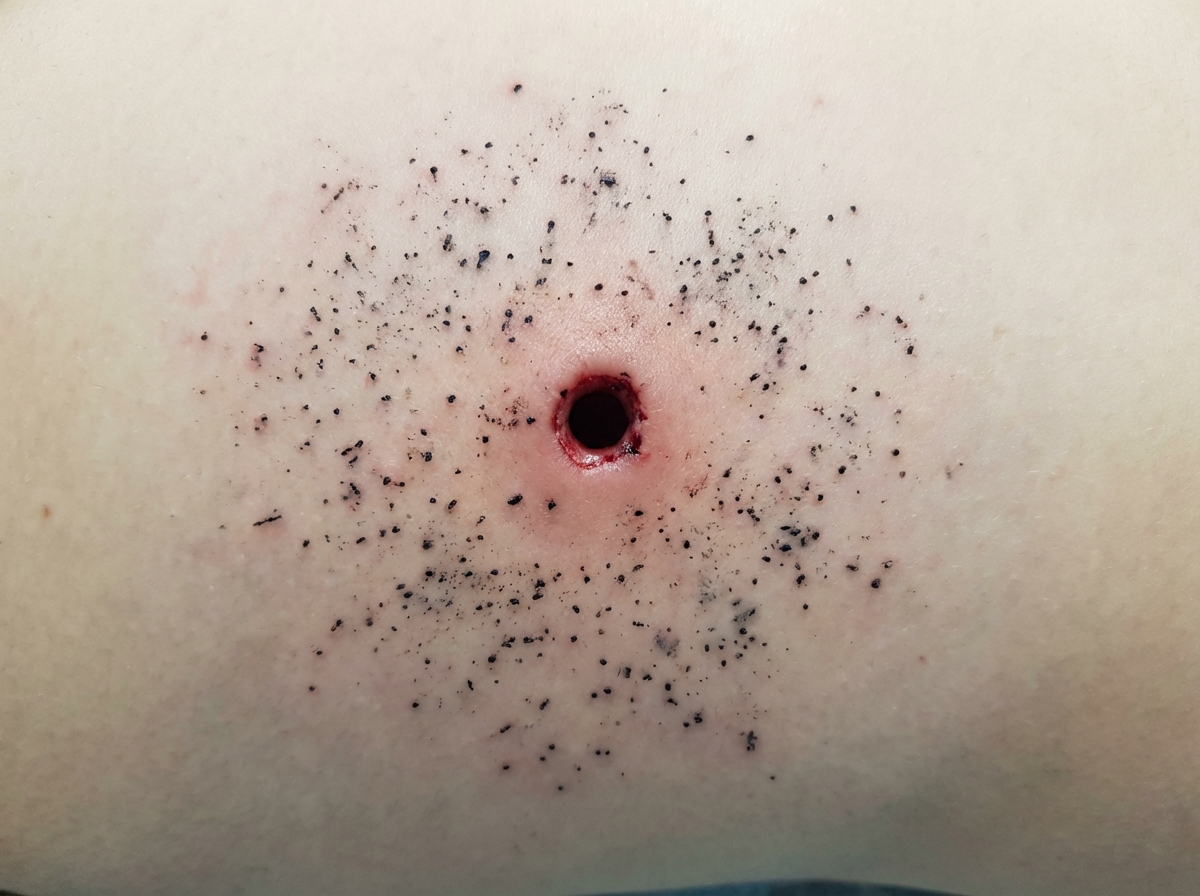
Beyond 30 meters, death is usually rare in case of a shotgun wound. What is the expected area of spread of pellets at 30 meters when fired from a full choke shotgun?
In which of the following types of burn is there minimal destruction of the skin?
Rigor mortis is first observed in which of the following locations?
Which of the following statements is FALSE regarding sparrow foot marks?
Extensive abrasions are found all over the body of a pedestrian lying by the roadside. What is the likely cause?
A person is said to be killed by Road Traffic Accident if he dies within how many days of the accident?
Gunpowder residues on forearms can be detected by which test?
All of the following are true about electrical injuries, EXCEPT:
Sparrow marks are seen in which type of injury?
Waddell's trial does not include which of the following injuries?
Explanation: **Explanation:** The spread of pellets in a shotgun injury is directly proportional to the distance from which the weapon was fired. This relationship is critical in forensic ballistics for determining the range of fire. **The Core Concept:** For a **full choke shotgun** (where the muzzle is constricted to keep pellets together longer), a standard forensic rule of thumb is used: the diameter of the pellet spread (in inches) is roughly equal to the distance (in yards). * At 30 yards (~27.5 meters), the spread is approximately 30 inches. * Converting 30 inches to centimeters: $30 \times 2.54 = 76.2 \text{ cm}$. * Therefore, at **30 meters**, the spread is approximately **75 cm**. Beyond this distance, the pellets disperse so widely that the kinetic energy per unit area decreases significantly, making fatal injuries rare. **Analysis of Options:** * **A (45 cm):** This spread corresponds to a distance of approximately 15–18 meters. * **B (55 cm):** This spread corresponds to a distance of approximately 20–22 meters. * **C (65 cm):** This spread corresponds to a distance of approximately 25 meters. * **D (75 cm):** This is the correct calculation for 30 meters/yards using the standard ballistic formula for full choke barrels. **High-Yield Clinical Pearls for NEET-PG:** 1. **Choking:** The narrowing of the distal 2–3 inches of the shotgun barrel. It increases the effective range by reducing the rate of pellet spread. 2. **Rule of Thumb:** Spread (inches) = Distance (yards). 3. **Wadding:** The presence of a "plastic cup" or cardboard wad in the wound suggests a range of less than 5–10 meters. 4. **Rat-hole Appearance:** Seen when the shotgun is fired from a distance of 1 to 3 meters; the pellets enter as a single mass with ragged edges. 5. **Satellite Pellets:** Individual pellet holes begin to appear around the central wound at distances beyond 3 meters.
Explanation: **Explanation:** The correct answer is **Electric burns**. **1. Why Electric Burns?** In electrical injuries, the primary damage occurs due to the resistance offered by internal tissues to the flow of current (Joule’s heating). This results in extensive deep-tissue destruction (muscles, nerves, and vessels) while often leaving the overlying skin relatively intact or showing only localized "entry" and "exit" wounds. The skin is a poor conductor; once the current breaches the epidermal resistance, it travels through internal pathways, causing massive internal necrosis that is disproportionate to the minimal visible skin damage. **2. Analysis of Incorrect Options:** * **Chemical Burns (A):** These involve direct contact with corrosive substances (acids/alkalis) that cause immediate and extensive destruction of the skin layers through protein coagulation or liquefactive necrosis. * **Dry Heat Burns (C):** Caused by flames or hot objects, these result in direct thermal damage to the skin surface, ranging from erythema to complete charring (3rd/4th degree), depending on the duration of contact. * **Moist Heat Burns (D):** Also known as scalds (steam or hot liquids), these typically cause blistering and superficial to deep dermal destruction but do not involve the deep internal sparing seen in electric burns. **3. NEET-PG High-Yield Pearls:** * **Joule’s Law:** $H = I^2RT$ (Heat produced is proportional to the square of the current, resistance, and time). * **Specific Sign:** Look for **"Joule Burn"** or **"Endogenous Burn"**—a hollowed-out area with elevated margins, characteristic of electrical entry. * **Systemic Risk:** In electric burns, always monitor for **Myoglobinuria** (due to muscle breakdown) leading to Acute Tubular Necrosis, and **Cardiac Arrhythmias**. * **Flash Burns:** A subtype of electric burn where the current does not pass through the body; these cause superficial skin singeing without internal damage.
Explanation: **Explanation:** **Rigor Mortis** (post-mortem rigidity) is the stiffening of muscles after death due to the depletion of ATP, which prevents the detachment of actin-myosin cross-bridges. **Why the Heart is Correct:** While many students believe rigor mortis starts in the eyelids, it actually begins in **involuntary muscles** before appearing in voluntary muscles. The **heart** is the first muscle in the body to exhibit rigor mortis, typically occurring within an hour after death. This is a crucial distinction in forensic pathology: internal organs (involuntary) precede external muscles (voluntary). **Analysis of Incorrect Options:** * **A. Eyelids:** According to **Nysten’s Law**, rigor mortis follows a cranio-caudal progression in voluntary muscles. The eyelids are the first **voluntary** muscles where rigor is visible externally, but they are not the first muscles overall. * **D. Neck:** Rigor appears in the neck and jaw after the eyelids but before the limbs. * **C. Limbs:** These are among the last areas to be affected. Rigor typically involves the upper limbs before the lower limbs, finally reaching the small muscles of the fingers and toes. **High-Yield Clinical Pearls for NEET-PG:** * **Sequence:** Heart (1st) → Eyelids → Jaw/Neck → Upper Limbs → Lower Limbs → Small muscles of fingers/toes. * **Timing (Rule of 12):** In temperate climates, rigor mortis usually takes 12 hours to set in, lasts for 12 hours, and takes 12 hours to disappear. * **Conditions mimicking Rigor:** Cadaveric spasm (instantaneous), Heat stiffening (protein coagulation), and Cold stiffening (frozen fat/fluids). * **Nysten’s Law:** Describes the sequential appearance of rigor in voluntary muscles (Head to Toe).
Explanation: **Explanation:** The correct answer is **B (Multiple incised wounds on the face)** because sparrow foot marks are technically **lacerated wounds**, not incised wounds. **Understanding Sparrow Foot Marks (Dicing Injuries):** When a vehicle’s toughened (tempered) glass windscreen or side window shatters during a collision, it breaks into small, relatively blunt, cuboidal fragments. These fragments strike the occupants, resulting in multiple, small, triangular, or square-shaped superficial injuries. Because these marks often resemble the footprints of a bird, they are termed "sparrow foot marks." * **Why Option B is False:** Although they appear sharp, these are **lacerations** caused by the impact of glass fragments rather than clean-cut incised wounds. * **Why Option A is Correct:** "Dicing injuries" is the standard synonym, referring to the "dice-like" shape of the tempered glass fragments. * **Why Option C is Correct:** These are pathognomonic of injuries caused by the shattering of **tempered/toughened glass** (commonly used in side windows and older windscreens). * **Why Option D is Correct:** These injuries are typically **superficial**, involving only the epidermis and dermis, rarely penetrating deeper tissues. **NEET-PG High-Yield Pearls:** 1. **Location:** Usually found on the side of the face or arm facing the window (e.g., the right side for a driver in India). 2. **Glass Type:** Modern windscreens are often **laminated** (do not shatter into fragments), whereas side windows are **tempered** (cause dicing). 3. **Forensic Significance:** They help determine the position of the occupant (driver vs. passenger) and the direction of impact. 4. **Distinction:** Do not confuse these with "Glass cuts" from plate glass, which are typically deep, clean-cut incised wounds.
Explanation: **Explanation:** In pedestrian-motor vehicle accidents, injuries are classified into three distinct phases based on the mechanism of trauma. The correct answer is **Secondary injury** because of the distribution and nature of the lesions described. 1. **Why "Secondary injury" is correct:** These injuries occur when the victim, after being struck and potentially thrown, hits the **ground or another stationary object**. The kinetic energy causes the body to slide or tumble across the road surface. This friction results in **extensive, multisite abrasions** (often called "grazes" or "brush burns"), lacerations, and contusions. Finding extensive abrasions "all over the body" is the classic hallmark of the body skidding against the road. 2. **Why other options are incorrect:** * **Primary impact injury:** This is the first contact between the vehicle and the victim (e.g., bumper hitting the legs). It typically results in localized "bumper fractures" or bruises, not generalized abrasions over the whole body. * **Secondary impact injury:** This occurs when the victim is thrown onto the **vehicle itself** (e.g., hitting the hood or windshield). While it causes significant trauma, it usually results in localized head or torso injuries rather than extensive "all over" abrasions. * **Postmortem artifact:** While scavenging or dragging can cause postmortem skin loss, the context of a roadside pedestrian strongly points toward an active accident mechanism. **NEET-PG High-Yield Pearls:** * **Bumper Fracture:** A classic primary impact injury, usually a comminuted fracture of the tibia/fibula. Its height from the heel can help identify the vehicle type (braking vs. non-braking). * **Quarrel's Classification:** Pedestrian injuries are divided into Primary Impact, Secondary Impact, and Secondary Injuries (Ground Impact). * **Run-over Injuries:** Characterized by "Flaying" (degloving) of the skin and "Tire Marks" (patterned abrasions/contusions).
Explanation: **Explanation:** In Forensic Medicine and global epidemiological standards (such as those set by the WHO), a death is attributed to a **Road Traffic Accident (RTA)** if the victim dies within **30 days** of the event. 1. **Why 30 days is correct:** This is the internationally accepted "30-day rule." It accounts for delayed complications resulting directly from the trauma, such as fat embolism, pulmonary embolism, secondary infections (pneumonia), or multi-organ failure. For statistical and legal reporting, if the death occurs within this window, the accident is cited as the primary cause. 2. **Why other options are incorrect:** * **12 days:** This is too short a window and would exclude many patients who succumb to late-stage complications in intensive care. * **40 days:** While 40 days is a significant number in other forensic contexts (e.g., the period for defining "Grievous Hurt" under Section 320 IPC involves being unable to follow ordinary pursuits for **20 days**, not 40), it is not the standard for RTA mortality reporting. * **47 days:** This value has no specific clinical or legal significance in forensic traumatology. **High-Yield Clinical Pearls for NEET-PG:** * **Grievous Hurt (Section 320 IPC):** Remember the "20-day rule"—if a victim is in severe bodily pain or unable to follow their ordinary pursuits for **20 days**, it is classified as grievous hurt. * **Most common cause of immediate death in RTA:** Head injury (Cranio-cerebral damage). * **Whiplash Injury:** A classic RTA injury involving sudden hyperextension followed by flexion of the neck, often seen in rear-end collisions. * **Sparrow Foot Mark (Dicing pattern):** Small, rectangular abrasions/cuts caused by shattered tempered glass from side windows.
Explanation: ### Explanation **Correct Answer: C. Dermal Nitrate Test** The **Dermal Nitrate Test** (also known as the **Paraffin Test** or **Gonzales Test**) is used to detect gunpowder residue (specifically nitrates and nitrites) on the hands or forearms of a person suspected of firing a weapon. When a firearm is discharged, a cloud of gases and partially burnt gunpowder particles escapes from the breech and muzzle, settling on the shooter's skin. In this test, molten paraffin wax is applied to the skin to pick up these particles; the wax cast is then treated with **diphenylamine** reagent. A positive result is indicated by the appearance of **blue specks**, signifying the presence of nitrates. **Analysis of Incorrect Options:** * **A. Benzidine Test:** This is a preliminary (presumptive) chemical test used to detect the presence of **blood**. It reacts with the peroxidase-like activity of hemoglobin to produce a blue color. * **B. Barberio’s Test:** This is a microchemical test used for the identification of **semen**. It involves the formation of yellow, needle-shaped crystals of spermine picrate when picric acid is added to the sample. * **D. Hydrostatic Test:** This is a post-mortem test used in cases of suspected infanticide to determine if a **newborn was born alive**. It tests whether the lungs float in water, indicating they have been aerated by breathing. **NEET-PG High-Yield Pearls:** * **Walker’s Test:** Used to detect nitrites on clothing (not skin). * **Harrison-Gilroy Test:** Detects heavy metals like Lead, Antimony, and Barium (components of the primer) rather than nitrates. * **False Positives in Dermal Nitrate Test:** This test is no longer considered definitive in modern forensics because common substances like fertilizers, tobacco, and matches can also yield a positive result (high false-positive rate). * **Scanning Electron Microscopy (SEM-EDX):** Currently the "gold standard" for Gunshot Residue (GSR) analysis.
Explanation: **Explanation:** In electrical injuries, the correct answer is **C** because **Crocodile Skin (Crocodile Burn)** is caused by **high-voltage current**, not low intense heat. When high-tension electricity passes through the body, it causes extensive coagulation necrosis and dehydration of the skin, resulting in a dark, dry, and cracked appearance resembling crocodile hide. **Analysis of Options:** * **A. Splitting at points of exit:** True. At the exit point, the current often causes a "blow-out" type of injury. The skin may appear split or lacerated as the energy leaves the body, sometimes mimicking an entry wound of a firearm. * **B. Electric mark at point of contact:** True. Also known as a **Joule burn** or **Endogenous burn**, this is the specific entry wound. It is typically a central depressed area of necrosis with a raised, pale periphery (halo), often mirroring the shape of the conductor. * **D. Bone pearls on radiography:** True. When high-voltage current passes through bones, the resistance generates intense heat, melting the calcium phosphate. Upon cooling, these areas solidify into hard, white, globule-like structures called **"Bone Pearls"** or **"Symmetrical Wax Drippings,"** which are visible on X-rays. **NEET-PG High-Yield Pearls:** * **Metallization:** A specific sign where metal ions from the conductor are deposited into the skin (e.g., copper leaves a green stain). * **Arborescent Marks (Lichtenberg figures):** Pathognomonic for **Lightning strikes**, not standard electrical injuries. They are transient, fern-like patterns caused by red blood cell extravasation. * **Most common cause of death:** In low voltage (AC), it is **Ventricular Fibrillation**; in high voltage, it is **Respiratory Paralysis**.
Explanation: **Explanation:** **Sparrow marks** (also known as "dicing patterns") are characteristic injuries seen in road traffic accidents, specifically involving **windshield glass injuries**. 1. **Why Windshield Glass Injury is Correct:** Modern automobiles use **tempered (toughened) glass** for side windows and sometimes windshields. Upon high-velocity impact, this glass does not shatter into long shards but breaks into small, relatively uniform, cuboidal or rectangular fragments. When these fragments strike the skin (usually the face or arms of the driver or passenger), they produce multiple, small, superficial, square or rectangular abrasions and lacerations. These clustered, geometric marks resemble the footprints of a sparrow, hence the name. 2. **Why Other Options are Incorrect:** * **Gunshot injuries:** These typically present with entry/exit wounds, tattooing, or singeing, but not geometric "sparrow" patterns. * **Stab injury of the face:** These result in clean-cut, linear, or spindle-shaped wounds caused by a sharp-pointed weapon. * **Vitriolage:** This refers to chemical burns caused by the throwing of corrosive acids. It results in "trickle marks" and deep tissue destruction, not discrete geometric abrasions. **High-Yield Clinical Pearls for NEET-PG:** * **Dicing Pattern:** Another synonym for sparrow marks; highly suggestive of the victim's position in a vehicle. * **Laminated Glass:** Unlike tempered glass, laminated glass (used in modern front windshields) tends to crack in a "spider-web" pattern rather than shattering into dicing fragments. * **Brush Abrasions:** Often confused with sparrow marks, these are "graze" injuries caused by tangential friction against a broad, rough surface (like a road).
Explanation: ### Explanation **Waddell’s Triad** (also known as the Waddell triad of injuries) describes a specific pattern of injury seen in **pediatric pedestrians** involved in motor vehicle accidents. Because children are shorter than adults, the impact occurs at different anatomical levels, leading to a predictable sequence of trauma. #### 1. Why "C1 vertebrae injury" is the correct answer: Waddell’s Triad specifically involves the **femur, the torso (chest/abdomen), and the head**. While spinal injuries can occur in high-velocity trauma, a **C1 vertebrae injury (Atlas fracture) is NOT a component** of this classic triad. The triad reflects the sequence of impact: bumper to thigh, hood to torso, and ground to head. #### 2. Analysis of Incorrect Options: * **Fracture shaft femur (Option C):** This is the **primary impact**. The vehicle's bumper strikes the child's thigh or pelvis (due to their height), resulting in a femoral shaft fracture. * **Intra-abdominal/Intra-thoracic injury (Option D):** This is the **secondary impact**. As the child is struck, their upper body (chest and abdomen) hits the vehicle's grille or hood. * **Head injury (Option A):** This is the **tertiary impact**. The force of the collision throws the child off the vehicle, causing them to strike their head on the ground or pavement. #### 3. High-Yield Clinical Pearls for NEET-PG: * **Mechanism:** Impact $\rightarrow$ Wrap-around $\rightarrow$ Projection. * **Adult vs. Child:** In adults, the primary impact is usually at the level of the tibia/fibula (forming **Messerer’s fracture**), whereas in children, it is the femur. * **Clinical Significance:** Recognizing one element of the triad should immediately prompt a clinician to search for the other two, as they represent life-threatening internal injuries. * **Key components to memorize:** 1. Femur shaft fracture, 2. Intra-thoracic/abdominal trauma, 3. Contralateral head injury.
Mechanical Injuries
Practice Questions
Transportation Injuries
Practice Questions
Fall from Height
Practice Questions
Blunt Force Trauma
Practice Questions
Sharp Force Trauma
Practice Questions
Ballistic Injuries
Practice Questions
Burn Injuries
Practice Questions
Drowning
Practice Questions
Electrocution
Practice Questions
Lightning Injuries
Practice Questions
Explosion Injuries
Practice Questions
Pattern Injuries and Their Recognition
Practice Questions
Get full access to all questions, explanations, and performance tracking.
Start For Free