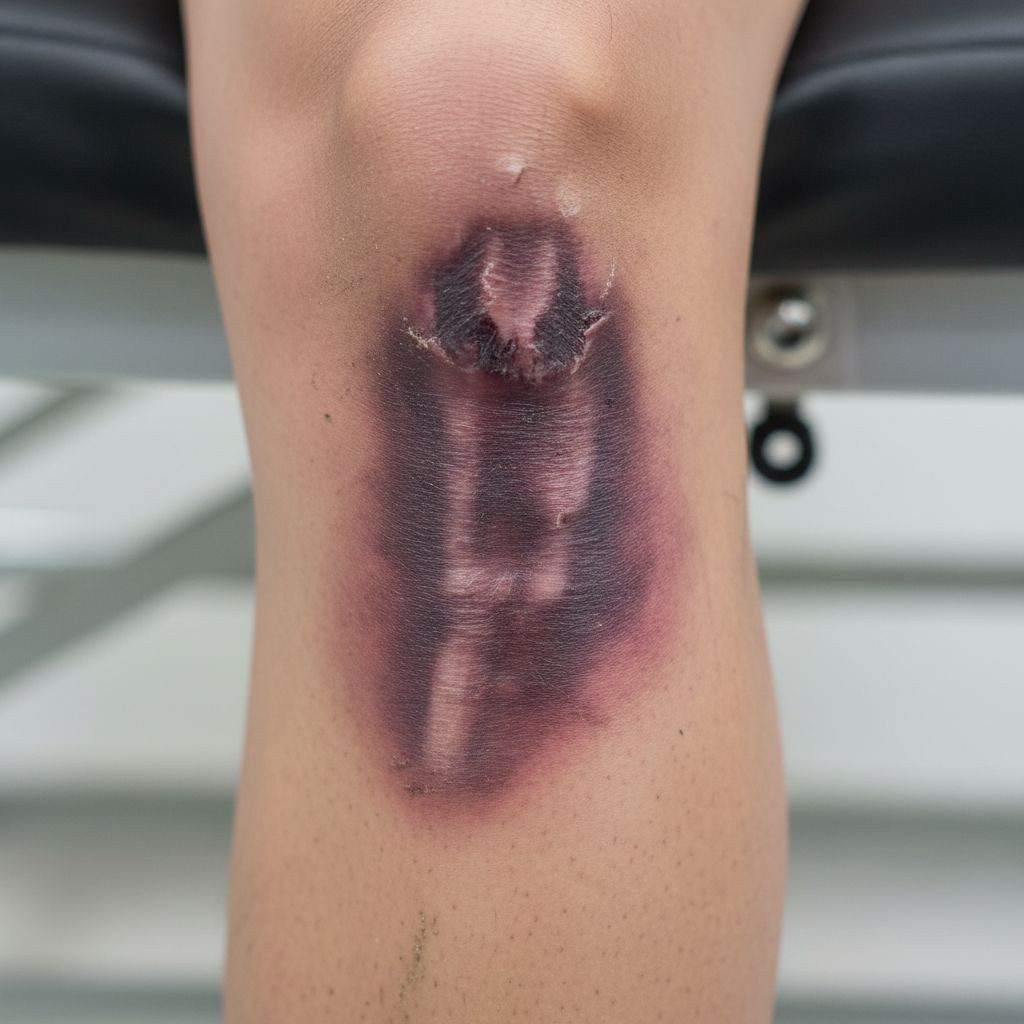
Traumatic bleeding may include all, except:
Pugilistic attitude is seen in:
What is the most common type of intracranial haemorrhage in boxers?
The commonest site of contrecoup fracture in an occipital fall is?
Delayed rigor mortis occurs with which poisoning?
Which of the following is NOT a feature of Epidural Hematoma (EDH) due to burns?
A bullet gets lodged in the barrel during firing and is dislodged with a subsequent bullet. What type of bullet is typically associated with this phenomenon?
Punch drunk syndrome in boxers is a type of?
A stellate wound may be seen in which of the following types of bullet entry wounds?
A bullet is typically picked up using which of the following instruments or methods?
Explanation: ### Explanation The question focuses on the primary etiology of intracranial hemorrhages. While all four types can occur following head trauma, **Intracerebral Hemorrhage (ICH)** is the correct answer because it is predominantly **spontaneous (non-traumatic)** in nature, usually secondary to systemic hypertension or vascular malformations. **1. Why Intracerebral Hemorrhage (ICH) is the "Except":** ICH refers to bleeding within the brain parenchyma. While "traumatic intracerebral hemorrhage" (contusions) exists, the term ICH in a clinical/forensic context most commonly refers to **spontaneous hypertensive hemorrhage** (rupture of Charcot-Bouchard aneurysms). In forensic examinations, if a hemorrhage is purely intraparenchymal without external signs of impact, it is considered medical/natural rather than traumatic until proven otherwise. **2. Analysis of Incorrect Options (Traumatic Bleeds):** * **Epidural Hematoma (EDH):** Almost exclusively traumatic. It is usually associated with a skull fracture and rupture of the **middle meningeal artery**. * **Subdural Hematoma (SDH):** Primarily traumatic, caused by the shearing of **bridging veins**. It is a classic marker of deceleration injuries or "shaken baby syndrome." * **Subarachnoid Hemorrhage (SAH):** While SAH can be spontaneous (ruptured Berry aneurysm), **trauma is the most common cause overall** of subarachnoid bleeding. **High-Yield Clinical Pearls for NEET-PG:** * **EDH:** Lucid interval is characteristic; CT shows biconvex (lentiform) shape. * **SDH:** More common in elderly and alcoholics (due to cerebral atrophy); CT shows concave (crescentic) shape. * **SAH:** "Worst headache of life" (Thunderclap headache); traumatic SAH often involves the rupture of vertebral arteries at the base of the brain. * **Heat Stroke/Asphyxia:** Can also cause petechial intracerebral bleeds, but these are secondary pathological processes, not primary traumatic bleeds.
Explanation: **Explanation:** **Pugilistic Attitude** (also known as the Fencing Attitude) is a characteristic posture found in bodies recovered from high-temperature fires. **1. Why Burns is Correct:** The "pugilistic" (boxer-like) posture—characterized by flexion of the elbows, knees, and hips, with clenched fists—is caused by the **heat-induced coagulation and contraction of muscle proteins**. Since the flexor muscles are bulkier and more powerful than the extensor muscles, their contraction overcomes the extensors, pulling the limbs into a defensive, crouched position. * **Key Concept:** This is a purely physical phenomenon occurring **post-mortem** due to high heat; it does not indicate that the person was alive or trying to fight the fire. **2. Why Other Options are Incorrect:** * **Drowning:** Bodies in water typically exhibit "Cadaveric Spasm" (if death was instantaneous) or eventually float in a face-down position, but do not naturally assume a pugilistic pose unless heat is involved. * **Lightning:** Death by lightning is associated with "Arborescent marks" (Lichtenberg figures) or blast injuries, not generalized muscle protein coagulation. * **Hanging:** Features include a ligature mark, vertical dribbling of saliva, and facial congestion, but the limbs remain flaccid or dependent due to gravity. **3. Clinical Pearls for NEET-PG:** * **Differential Diagnosis:** Do not confuse Pugilistic Attitude with **Cadaveric Spasm** (instantaneous rigor) or **Rigor Mortis**. * **Heat Ruptures:** Intense heat can cause skin to split, mimicking incised wounds. These can be differentiated by the absence of hemorrhage and the presence of intact nerves/vessels across the floor of the split. * **Artifacts:** Pugilistic attitude can lead to **Heat Fractures** (typically of the skull) which must be distinguished from ante-mortem trauma.
Explanation: **Explanation:** The correct answer is **Subdural Haemorrhage (SDH)**. In boxing, the primary mechanism of injury is repetitive, high-velocity rotational acceleration and deceleration of the head. This motion causes the brain to shift within the cranial cavity, putting immense mechanical stress on the **bridging veins** that traverse the subdural space from the cerebral cortex to the dural sinuses. Because these veins are thin-walled and fragile, they easily tear, leading to an accumulation of blood between the dura and the arachnoid mater. Acute SDH is the leading cause of mortality and morbidity in combat sports. **Why other options are incorrect:** * **Epidural Haemorrhage (EDH):** Usually results from a direct focal impact (like a hammer blow) causing a skull fracture that lacerates the middle meningeal artery. It is less common in boxing because the force is typically rotational rather than a localized crushing blow. * **Intraventricular Haemorrhage:** This is generally a secondary extension of severe intraparenchymal or subarachnoid bleeds and is not the primary characteristic injury of boxing. * **Cerebellar Haemorrhage:** While posterior fossa injuries can occur, they are rare compared to the supratentorial shearing of bridging veins. **High-Yield Pearls for NEET-PG:** * **Dementia Pugilistica (Punch Drunk Syndrome):** A chronic traumatic encephalopathy (CTE) seen in boxers due to repeated subconcussive blows, characterized by neurofibrillary tangles and cavum septum pellucidum. * **CT Appearance:** SDH appears as a **concave/crescent-shaped** hyperdensity that can cross suture lines, whereas EDH is **biconvex/lens-shaped** and limited by suture lines. * **Source of Bleed:** SDH is typically **venous** (bridging veins); EDH is typically **arterial** (middle meningeal artery).
Explanation: **Explanation:** A **contrecoup injury** occurs when the brain or skull sustains damage at a site opposite to the point of impact. This typically happens when the moving head hits a fixed object (deceleration injury). In an **occipital fall** (impact to the back of the head), the force is transmitted through the brain and cerebrospinal fluid. The **orbital roofs** (frontal bone) are the most common site for contrecoup fractures because they are composed of thin, brittle plates of bone with an irregular surface. When the brain thrusts forward due to momentum, it strikes these sharp bony ridges, leading to "blow-out" style fractures of the orbital plates, often resulting in periorbital ecchymosis (Spectacle eyes). **Analysis of Options:** * **Orbital Roof (Correct):** Its anatomical fragility and position directly opposite the occiput make it the primary site for contrecoup fractures. * **Parietal Bone:** While it can be involved in direct impact (coup), it is rarely a site for contrecoup fractures in a pure occipital fall due to its thickness and lateral position. * **Temporal Bone:** More commonly associated with direct lateral impacts or longitudinal/transverse fractures of the base of the skull rather than contrecoup mechanisms from the occiput. * **Ethmoidal Bone:** Though located anteriorly, the cribriform plate is less frequently fractured as a contrecoup phenomenon compared to the broader, thinner orbital roofs. **High-Yield Pearls for NEET-PG:** * **Coup Injury:** Injury at the site of impact (Head is stationary, object is moving). * **Contrecoup Injury:** Injury opposite the site of impact (Head is moving, object is stationary). * **Spectacle Eyes:** Can be caused by a fracture of the orbital roof (contrecoup) or a fracture of the base of the skull (Le Fort fractures). * **Contrecoup Contusions:** Most common in the **frontal and temporal lobes**, regardless of the site of impact.
Explanation: **Explanation:** **Correct Answer: C. Arsenic** **Mechanism:** Rigor mortis is the post-mortem stiffening of muscles caused by the depletion of Adenosine Triphosphate (ATP). Normally, ATP is required to break the cross-bridges between actin and myosin filaments. In **Arsenic poisoning**, the onset of rigor mortis is significantly delayed. This occurs because arsenic acts as a potent preservative and protoplasmic poison that inhibits bacterial growth and putrefaction. Furthermore, chronic arsenic poisoning often leads to extreme wasting and dehydration (emaciation), which slows down the chemical processes leading to muscle stiffening. **Analysis of Incorrect Options:** * **A. Mercury & B. Lead:** These heavy metals do not have a specific, characteristic effect on the timing of rigor mortis that is frequently tested. While they are toxic, they do not preserve tissues or alter ATP depletion in the same manner as arsenic. * **D. Strychnine:** This is a classic "distractor." Strychnine causes **early onset** and rapid disappearance of rigor mortis. This is because strychnine induces violent convulsions before death, which rapidly exhausts the body's ATP stores, leading to almost instantaneous rigor (sometimes confused with cadaveric spasm). **High-Yield Clinical Pearls for NEET-PG:** * **Delayed Rigor Mortis:** Seen in Arsenic poisoning, Asphyxia (hanging/drowning), and cold atmospheric temperatures. * **Early Rigor Mortis:** Seen in Strychnine poisoning, Tetanus, high fever (Septicemia), and intense physical activity immediately before death. * **Arsenic Fact:** Arsenic is known as the "King of Poisons" and can be detected in hair, nails, and bones long after death due to its affinity for keratin. * **Rule of 12 (Nysten’s Rule):** In temperate climates, rigor mortis typically takes 12 hours to develop, lasts for 12 hours, and takes 12 hours to pass off.
Explanation: In Forensic Medicine, it is crucial to differentiate between a **Traumatic Epidural Hematoma (EDH)** and a **Heat Hematoma** (EDH due to burns). ### Explanation of the Correct Option **C. Reddish purple in colour:** This is the correct answer because it is a **false** statement regarding heat hematomas. A heat hematoma is typically **chocolate brown** in color due to the cooking of blood and the formation of methemoglobin. A reddish-purple or bright red color is characteristic of traumatic EDH or carbon monoxide poisoning in living tissue, but the heat-altered blood in a burn victim loses this appearance. ### Explanation of Incorrect Options * **A. Honeycomb appearance:** This is a classic feature of heat hematomas. As the blood boils, steam is produced, creating small air bubbles or vesicles within the clot, giving it a friable, "Swiss cheese" or honeycomb texture. * **B. Contains carboxyhemoglobin:** In victims who were alive during the fire, carbon monoxide is inhaled and absorbed into the bloodstream. This carboxyhemoglobin remains detectable in the heat hematoma, helping differentiate it from a post-mortem artifact. * **D. Mechanism of formation:** Heat hematomas occur when intense heat causes the skull to contract and the brain to shrink. This creates a vacuum in the epidural space. Blood is then "boiled" out of the **diploic veins** and venous sinuses, accumulating as a clot. ### NEET-PG High-Yield Pearls * **Shape:** Traumatic EDH is typically **biconvex (lenticular)**, whereas Heat Hematoma is often **crescentic** and can be bilateral. * **Site:** Heat hematomas are most common in the **frontal or parietal regions**, often underlying a charred area of the scalp. * **Associated Finding:** Look for **Heat Fractures** of the skull, which are irregular, involve only the outer table, and show no signs of vital reaction (unlike traumatic fractures). * **Key Differentiator:** The presence of **soot in the airways** and **carboxyhemoglobin** in the hematoma confirms the victim was alive at the time of the fire.
Explanation: ### Explanation **Correct Answer: B. Piggy tail bullet** **Mechanism and Concept:** A **Piggy tail bullet** (also known as a tandem bullet) occurs when a primary bullet fails to exit the barrel due to a defective propellant charge or mechanical obstruction. When a subsequent round is fired, it strikes the lodged bullet. The two bullets may fuse together or travel in tandem, often resulting in a single, large, irregularly shaped entry wound that mimics a close-range or high-velocity injury. This phenomenon is a classic "ballistics oddity" frequently tested in forensic medicine. **Analysis of Incorrect Options:** * **A. Frangible bullet:** These are designed to disintegrate into tiny particles upon striking a hard surface to prevent ricochet. They do not involve lodging in the barrel or tandem firing. * **C. Incendiary bullet:** These contain chemical compounds (like phosphorus) designed to ignite on impact. Their primary purpose is to start fires, not to interact with other bullets in the barrel. * **D. Dum dum bullet:** This is a historical term for expanding (hollow-point or soft-point) bullets. They are designed to mushroom upon entering the body to increase tissue damage; they do not involve the "piggyback" mechanism in the barrel. **High-Yield Clinical Pearls for NEET-PG:** * **Tandem Bullet Sign:** On X-ray, if two bullets are seen but only one entry wound is present, suspect a piggy tail bullet. * **Ricochet Bullet:** A bullet that strikes an intervening object before hitting the victim; it often enters the body sideways, causing a "keyhole" wound. * **Souvenir Bullet:** An old, fibrosed bullet from a previous injury found incidentally during autopsy or imaging. * **Exit vs. Entry:** Remember that exit wounds are typically larger, irregular, and lack the "abrasion collar" seen in entry wounds.
Explanation: **Explanation:** **Punch Drunk Syndrome**, also known as **Dementia Pugilistica** or **Chronic Traumatic Encephalopathy (CTE)**, is a neurodegenerative disease caused by repeated concussive or sub-concussive blows to the head. It is most commonly seen in professional boxers and contact sport athletes. **Why Dementia is the correct answer:** The pathophysiology involves the accumulation of **Tau protein** in the brain, leading to progressive cognitive decline. Clinically, it presents with a triad of: 1. **Cognitive impairment:** Memory loss and executive dysfunction (Dementia). 2. **Motor symptoms:** Parkinsonian features (tremors, rigidity) and ataxia. 3. **Behavioral changes:** Irritability, aggression, and lack of impulse control. **Why other options are incorrect:** * **Delirium:** This is an acute, reversible state of confusion usually caused by metabolic derangements or infections. Punch drunk syndrome is a chronic, irreversible, and progressive condition. * **Disability:** While the syndrome leads to significant functional impairment, "disability" is a broad legal/functional term rather than a specific clinical diagnosis for the underlying pathology. * **Depression:** Although mood disturbances and depression can be *symptoms* of CTE, the core clinical entity is classified as a form of progressive dementia. **High-Yield Clinical Pearls for NEET-PG:** * **Martland’s Syndrome:** Another name for Punch Drunk Syndrome (first described by Harrison Martland in 1928). * **Pathological hallmark:** Neurofibrillary tangles (Tauopathy) and cavum septum pellucidum fenestrations. * **Commonly associated with:** Boxers, American football players, and victims of domestic violence (repeated head trauma). * **Differential:** It must be distinguished from Alzheimer’s disease, though both involve cognitive decline; the history of repetitive trauma is the key diagnostic clue.
Explanation: ### Explanation **1. Why "Contact Shot" is Correct:** In a **contact shot** (specifically a hard contact shot), the muzzle of the gun is pressed firmly against the skin. When the weapon is fired, the bullet, hot gases, and flame are forced directly into the subcutaneous space. If the skin is stretched over a flat bone (like the **skull**), these gases cannot expand forward; instead, they reflect back and expand laterally between the skin and the bone. This sudden, high-pressure expansion causes the skin to burst outward, resulting in a characteristic **stellate (star-shaped)** or cruciform laceration with ragged, everted edges. **2. Why the Other Options are Incorrect:** * **B. Close Shot (Near Contact):** In a close shot (within a few centimeters), the gases have space to dissipate into the atmosphere before hitting the body. While you will see **smudging** (soot) and **tattooing** (unburnt powder), the pressure is insufficient to cause the stellate tearing seen in contact shots. * **C. Distance Shot:** At a distance (usually >2 feet for handguns), only the bullet reaches the target. The wound is typically circular or oval with an **abrasion collar** and a **grease ring**, but lacks gas-induced tearing. * **D. Shot from Two Feet Away:** This is a type of distance shot. At this range, there is no burning, singeing, or tattooing, and certainly no stellate tearing. **3. High-Yield Clinical Pearls for NEET-PG:** * **Muzzle Impression:** A hallmark of a firm contact shot is the "muzzle stamp" or "muzzle imprint" caused by the heat and pressure of the gun’s barrel. * **Cherry Red Discoloration:** In contact shots, the tissues around the wound track may appear bright pink/cherry red due to the presence of **Carboxyhemoglobin** (from Carbon Monoxide in the gun gases). * **Entrance vs. Exit:** While entrance wounds are usually smaller than exit wounds, a **contact entrance wound over the skull** can be much larger and more irregular (stellate) than the exit wound due to gas expansion. * **Tattooing (Peppering):** This is a sign of a **close-range shot** and cannot be wiped off (unlike smudging/soot).
Explanation: **Explanation:** The primary objective when recovering a bullet during an autopsy is to preserve its **ballistic integrity**. Every bullet possesses unique "rifling marks" (lands and grooves) imprinted by the barrel of the firearm. These marks act as a "ballistic fingerprint" that allows forensic experts to match a projectile to a specific weapon. **Why Hands are the Correct Choice:** Using your **hands** (gloved) is the safest method because it prevents any accidental scratching or deformation of the soft lead or copper jacket of the bullet. If the bullet is lodged deeply or is difficult to grasp, **rubber-tipped forceps** may be used as an alternative. The goal is to ensure no new metallic marks are introduced that could interfere with microscopic comparison. **Why Other Options are Incorrect:** * **Toothed Forceps (A):** These are strictly contraindicated. The sharp metal teeth will create new scratches (artifacts) on the bullet surface, potentially obliterating the original rifling marks and making forensic matching impossible. * **Scissors (C) and Needles (D):** These sharp metallic instruments can easily gouge or nick the projectile. Using them risks altering the evidence and can lead to the loss of critical forensic data. **High-Yield Clinical Pearls for NEET-PG:** * **Marking Evidence:** Never mark a bullet on its side (the bearing surface). Always scratch the investigator's initials on the **base** or the **nose**. * **X-ray Requirement:** In all cases of firearm injuries, an X-ray must be taken before the autopsy to locate the bullet and any fragments. * **Chain of Custody:** Once recovered, the bullet should be washed, dried, and placed in a sealed container (labeled glass or plastic tube) to maintain the chain of evidence.
Mechanical Injuries
Practice Questions
Transportation Injuries
Practice Questions
Fall from Height
Practice Questions
Blunt Force Trauma
Practice Questions
Sharp Force Trauma
Practice Questions
Ballistic Injuries
Practice Questions
Burn Injuries
Practice Questions
Drowning
Practice Questions
Electrocution
Practice Questions
Lightning Injuries
Practice Questions
Explosion Injuries
Practice Questions
Pattern Injuries and Their Recognition
Practice Questions
Get full access to all questions, explanations, and performance tracking.
Start For Free