Which type of burn typically appears as branching patterns, resembling tree branches or fern fronds?
Which of the following is a true statement regarding postmortem wounds?
Bevelling of the inner table of the skull is typically found in which type of wound?
What is the term for a fracture of the cervical spine that occurs during the post-mortem period?
Which of the following are grievous injuries?
An open wound is a:
Contre coup injury is characteristically seen in which organ?
In road traffic accidents, a "shattered aorta" injury is typically seen in:
The blue color of a bruise is due to which of the following?
What is the most common cause of injury-related deaths in pediatrics?
Explanation: **Explanation:** The correct answer is **Filigree burn** (Option C). This is a classic high-yield finding in forensic medicine associated with **lightning strikes**. **1. Why Filigree Burn is Correct:** Filigree burns, also known as **Lichtenberg figures**, arborescent marks, or fern-like patterns, are non-thermal, transient cutaneous manifestations of a lightning strike. They are not true burns but are caused by the extravasation of red blood cells into the superficial layers of the skin due to the massive electrical discharge following the path of least resistance. They typically appear within an hour of the strike and disappear within 24–48 hours. **2. Why Other Options are Incorrect:** * **Joule burn (A):** Also known as an endogenous burn, this occurs at the entry point of a high-voltage **alternating current (AC)**. It is characterized by a central charred area with a peripheral halo of pallor (resembling a "target"). * **Linear burn (B):** These occur in lightning strikes when sweat or rainwater on the skin surface is vaporized into steam, causing superficial stripping of the skin in narrow lines. * **Crocodile burn (C):** This is a specific type of high-voltage electrical burn where the skin becomes dry, charred, and cracked, resembling the **skin of a crocodile**. **3. NEET-PG High-Yield Pearls:** * **Lichtenberg figures** are pathognomonic of lightning strikes but are **not** seen in every case. * **Keraunoparalysis:** Temporary paralysis and sensory loss in limbs following a lightning strike (associated with vasospasm). * **Flashover effect:** When lightning flows over the surface of the body (due to wet skin), it often prevents internal organ damage, increasing the chance of survival. * **Blast effect:** Lightning can cause indirect injuries like tympanic membrane rupture or fractures due to the surrounding air expansion.
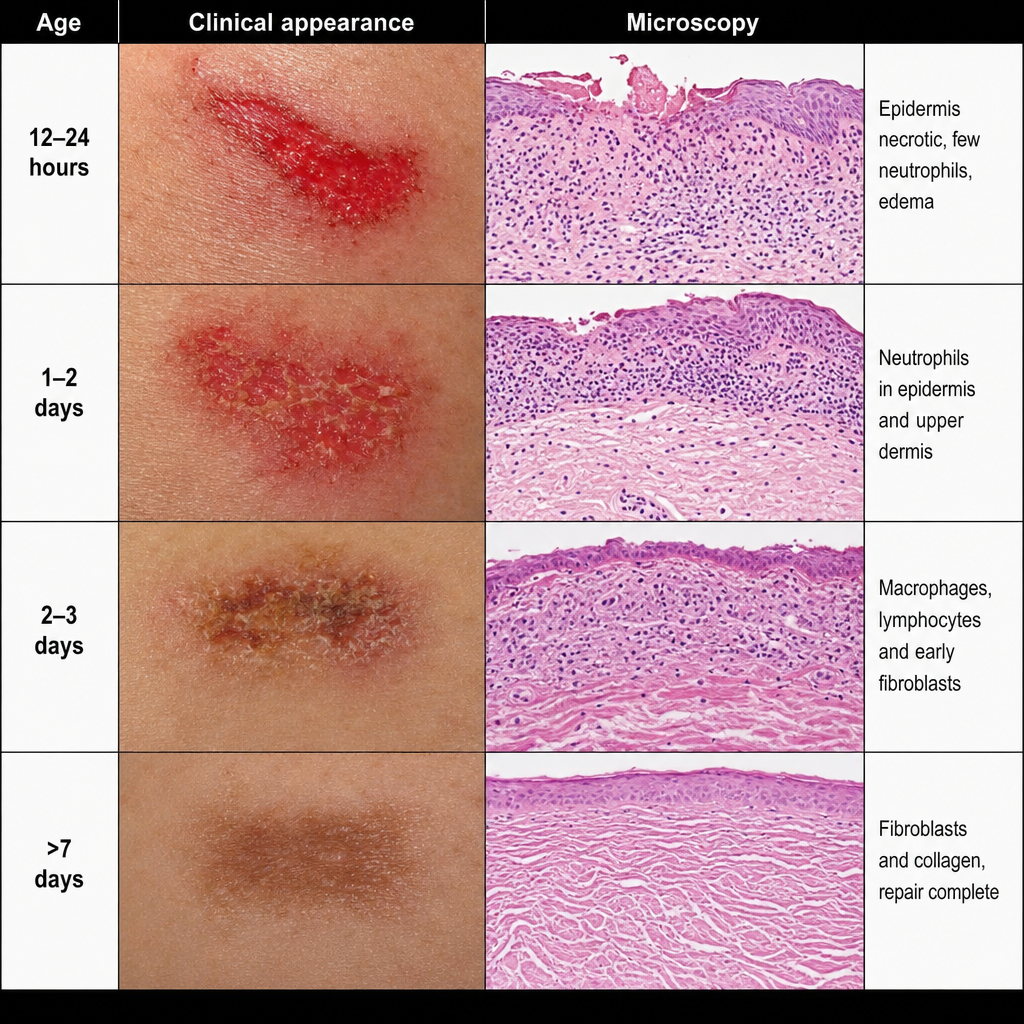
Explanation: ### Explanation The distinction between antemortem (before death) and postmortem (after death) wounds is a high-yield topic in Forensic Medicine. The primary factor determining the appearance of a wound is the presence or absence of **vital reaction**. **Why Option C is Correct:** In a living individual, skin is under natural tension (Langer’s lines). When an antemortem cut occurs, the underlying muscles and elastic fibers contract, causing the wound edges to **gape**. In postmortem wounds, the loss of muscle tone and skin elasticity means the edges do not retract; they remain apposed or "do not gape" unless the body is positioned to stretch the area. **Analysis of Incorrect Options:** * **Option A (Spurting of blood):** This is a hallmark of **antemortem** arterial injury. It requires active cardiac output and blood pressure to project blood onto surrounding surfaces. * **Option B (Firmly coagulated blood):** In antemortem wounds, blood clots are firm, tenacious, and difficult to wash away because of the active clotting cascade. In postmortem wounds, any blood present is usually liquid or forms soft, "currant-jelly" clots that wash away easily. * **Option D (Increased enzyme activity):** Histochemical changes, such as an increase in enzymes (e.g., acid phosphatase, aminopeptidases) at the wound margin, are a **vital reaction** indicating the body was alive for a period after the injury. **NEET-PG High-Yield Pearls:** * **Vital Reaction:** The most definitive sign of an antemortem wound. * **Microscopic Sign:** Infiltration of PMNs (Polymorphonuclear leukocytes) is a reliable indicator that the injury occurred before death. * **Postmortem Lividity vs. Bruise:** A bruise (antemortem) shows extravasation of blood into tissues that cannot be washed away, whereas lividity (postmortem) is intravascular and clears with washing or pressure (initially).
Explanation: **Explanation:** The correct answer is **Firearm entry wound**. This phenomenon is based on the mechanical principle that when a projectile passes through a flat bone (like the skull), it creates a cone-shaped defect that widens in the direction of the bullet's travel. 1. **Firearm Entry Wound:** When a bullet strikes the outer table of the skull, it creates a clean, punched-out hole. As the force is transmitted forward, it displaces a larger area of the bone on the opposite side. Therefore, in an entry wound, the **inner table is more widely fractured than the outer table**, creating a "funnel" or **internal bevelling**. 2. **Firearm Exit Wound:** Conversely, as the bullet exits the skull, it strikes the inner table first and pushes outward. This results in **external bevelling**, where the outer table shows a larger defect than the inner table. 3. **Drowning and Infanticide:** These are broad categories of death. While specific signs exist for both (e.g., Froth in drowning or hydrostatic tests in infanticide), they do not involve the specific mechanical bone-bevelling patterns characteristic of ballistic trauma. **NEET-PG High-Yield Pearls:** * **Directionality:** Bevelling always occurs on the side **opposite** to the point of impact. * **Puppe’s Rule:** If two fracture lines meet, the second fracture line will stop at the first. This helps determine the sequence of multiple shots. * **Keyhole Deformity:** Occurs when a bullet strikes the skull at a tangential angle, producing both internal and external bevelling in a single wound. * **Contact Wounds:** Look for "Cherry Red" discoloration of underlying tissues due to Carbon Monoxide (CO) and the presence of a muzzle imprint.
Explanation: **Explanation:** **Undertaker’s fracture** is a post-mortem fracture of the cervical spine, typically occurring at the level of the **C6 or C7 vertebrae**. It is an artifact caused by the rough handling of a body during transport or by the sudden backward tilting of the head when a body with rigor mortis is forcibly laid flat. Because it occurs after death, there is a characteristic absence of ante-mortem features like extravasation of blood or tissue reaction. **Analysis of Incorrect Options:** * **Pond Fracture:** Also known as a "fissured" or "depressed" fracture, this occurs in the thin, elastic skulls of infants. The bone indents without a complete break, resembling a dent in a ping-pong ball. * **Signature Fracture:** A type of depressed skull fracture where the shape of the fractured bone indicates the nature or shape of the weapon used (e.g., a hammer head or a brick). * **Hangman’s Fracture:** A specific ante-mortem fracture involving the **bilateral pedicles of the C2 (axis) vertebra**. It is caused by forceful hyperextension of the neck, classically seen in judicial hanging or high-impact motor vehicle accidents. **High-Yield Pearls for NEET-PG:** * **Post-mortem Artifacts:** Always look for the absence of "vital reaction" (bruising/clots) to distinguish these from ante-mortem injuries. * **Jefferson Fracture:** A burst fracture of the C1 (atlas) vertebra caused by axial loading. * **Whiplash Injury:** A soft tissue injury of the cervical spine due to sudden acceleration-deceleration.
Explanation: **Explanation:** This question pertains to **Section 320 of the Indian Penal Code (IPC)**, which defines "Grievous Hurt." In Forensic Medicine, distinguishing between simple and grievous hurt is crucial for legal classification and sentencing. Under **Section 320 IPC**, eight specific types of injuries are classified as grievous: 1. **Emasculation:** Depriving a male of his masculine vigor (Option A). 2. **Permanent privation of sight** of either eye. 3. **Permanent privation of hearing** of either ear. 4. **Privation of any member or joint** (Option B). 5. **Destruction or permanent impairing** of the powers of any member or joint. 6. **Permanent disfiguration of the head or face** (Option C). 7. **Fracture or dislocation** of a bone or tooth. 8. **Any hurt which endangers life** or causes the sufferer to be in severe bodily pain or unable to follow his ordinary pursuits for **20 days**. Since options A, B, and C are all explicitly listed under Section 320 IPC, **Option D (All of the above)** is the correct answer. **Clinical Pearls for NEET-PG:** * **The "20-Day Rule":** For an injury to be grievous under the 8th clause, the victim must be unable to follow their "ordinary pursuits" for at least 20 days. * **Fractures:** Even a simple crack in a bone or a chipped tooth is legally considered "Grievous Hurt." * **Dangerous vs. Grievous:** While all "dangerous to life" injuries are grievous, not all "grievous" injuries (like a fractured finger) are necessarily "dangerous to life." * **IPC 323 & 325:** Punishment for voluntarily causing simple hurt is under IPC 323, while grievous hurt is under **IPC 325**.
Explanation: ### Explanation **Correct Answer: C. Laceration** In Forensic Medicine, wounds are broadly classified into **Open** and **Closed** injuries based on the integrity of the skin or mucous membrane. * **Laceration:** This is an **open wound** caused by the application of blunt force, resulting in the tearing or splitting of tissues (skin, subcutaneous tissue, or internal organs). The force exceeds the elastic limit of the tissue, causing a full-thickness breach. Key features include irregular margins, tissue bridging, and crushed hair follicles. **Why the other options are incorrect:** * **A. Contusion (Bruise):** This is a **closed wound**. It involves the rupture of small blood vessels (capillaries/venules) in the dermis or subcutaneous tissue without a breach in the continuity of the skin. * **B. Abrasion:** While often confused with open wounds, an abrasion is technically a **superficial injury** involving only the destruction of the epithelial layer (epidermis). It does not penetrate the full thickness of the skin to expose underlying tissues in the same manner as a laceration. * **D. Concussion:** This refers to a functional derangement of an organ (usually the brain) due to blunt trauma, without any gross structural or visible open injury. **High-Yield Clinical Pearls for NEET-PG:** * **Tissue Bridging:** This is the pathognomonic feature of a **Laceration**, helping to distinguish it from an incised wound (where nerves and vessels are cleanly cut). * **Incised-looking Laceration:** Occurs when skin is stretched over a bony prominence (e.g., scalp, shin), mimicking a sharp-force injury. * **Graze/Sliding Abrasion:** Most common type of abrasion seen in road traffic accidents (RTA), indicating the direction of force. * **Color changes in Contusion:** Red (Fresh) → Blue/Black (1-3 days) → Brownish (4-5 days) → Green (7-12 days) → Yellow (7-12 days) → Normal (2 weeks). *Note: Biliverdin causes the green color.*
Explanation: **Explanation:** **Coup and Contre-coup** injuries are specific patterns of blunt force trauma most characteristically observed in the **Brain**. * **Coup Injury:** Occurs at the site of impact when the head is stationary and struck by a moving object. * **Contre-coup Injury (Correct Answer):** Occurs at a site diametrically opposite to the point of impact. This typically happens when the **moving head strikes a stationary object** (e.g., a fall). The brain, floating in CSF, continues to move due to inertia after the skull has stopped, causing it to collide with the internal bony prominences of the skull opposite the impact site. This is most common in the frontal and temporal lobes during an occipital impact. **Why other options are incorrect:** * **Spleen & Heart:** While these organs can suffer from "deceleration injuries" or "concussive tears," they do not exhibit the classic coup-contrecoup mechanism because they are not suspended in a fluid-filled rigid cavity (the cranium) in the same manner as the brain. * **Limb:** Injuries to limbs are usually direct (at the site of impact) or indirect (e.g., a fracture of the femur due to a fall on the feet), but they do not follow the contre-coup physiological mechanism. **High-Yield Clinical Pearls for NEET-PG:** 1. **Mechanism:** Coup = Moving object, Stationary head. Contre-coup = Moving head, Stationary object. 2. **Common Sites:** Contre-coup injuries are most frequently seen at the **base of the frontal lobes** and the **tips of the temporal lobes**. 3. **CSF Role:** The "Liquor Cushion" theory suggests that the displacement of CSF during impact contributes to the negative pressure (cavitation) that causes contre-coup lesions. 4. **Fractures:** Contre-coup fractures can also occur, such as an orbital roof fracture resulting from a blow to the back of the head (occiput).
Explanation: **Explanation:** The correct answer is **Drivers**. **Medical Concept:** A "shattered aorta" (also known as traumatic aortic rupture) in road traffic accidents is a classic deceleration injury. When a vehicle traveling at high speed comes to a sudden halt, the heart and the mobile part of the aortic arch continue to move forward due to inertia. However, the descending aorta is fixed to the posterior thoracic wall. This creates a massive shearing force at the **isthmus** (the junction between the mobile arch and the fixed descending aorta), leading to a transverse tear or complete shattering. In drivers, this is specifically associated with **steering wheel impact**. The chest strikes the steering column, causing sudden compression and displacement of the heart, which exacerbates the shearing stress on the aorta. **Analysis of Options:** * **Pedestrians:** Usually suffer from "primary impact" injuries (bumper fractures of the tibia/fibula) or "secondary impact" injuries (head injuries from hitting the ground). Aortic shattering is rare as the mechanism is usually direct blunt force rather than high-velocity internal deceleration. * **Front seat passengers:** While they can suffer deceleration injuries, they lack the rigid steering column to provide the specific focal impact point that characterizes the "shattered aorta" mechanism seen in drivers. They are more prone to "dashboard injuries" (hip dislocations/patellar fractures). * **Rear seat passengers:** They are generally protected from direct frontal impact and are more likely to suffer from whiplash or injuries related to being thrown forward if unrestrained. **High-Yield Clinical Pearls for NEET-PG:** * **Most common site of rupture:** Aortic Isthmus (just distal to the origin of the left subclavian artery). * **Steering Wheel Impact:** Besides the aorta, drivers are also prone to **"Flail Chest"** and **"Cardiac Contusion."** * **Seatbelt Syndrome:** Includes mesenteric tears, chance fractures (lumbar spine), and abdominal wall bruising. * **Whiplash Injury:** Common in rear-end collisions, involving hyperextension followed by flexion of the neck.
Explanation: **Explanation:** The color changes in a bruise (contusion) are a classic high-yield topic in Forensic Medicine, as they help in estimating the **age of the injury**. **Why Deoxyhemoglobin is Correct:** When a blunt force impacts the body, capillaries rupture, causing blood to extravasate into the subcutaneous tissues. Initially, the bruise appears red due to oxygenated hemoglobin. Within a few hours to 3 days, the oxygen is consumed, and the hemoglobin is reduced to **deoxyhemoglobin**. This pigment absorbs light in a way that reflects a **blue, purple, or bluish-black** color. **Analysis of Incorrect Options:** * **A. Hemosiderin:** This is an iron-storage complex. It appears **brownish** and typically develops towards the end of the healing process (usually after 7–10 days). * **C. Bilirubin:** As biliverdin is further metabolized, it turns into bilirubin, which gives the bruise its characteristic **yellow** hue (usually seen after 7–12 days). * **D. Hematoidin:** This is chemically similar to bilirubin and contributes to the **yellow** coloration in the later stages of healing. **High-Yield Clinical Pearls for NEET-PG:** * **Chronological Sequence of Colors:** 1. **Red:** Fresh (Oxyhemoglobin) 2. **Blue/Purple/Black:** 1–3 Days (Deoxyhemoglobin) 3. **Greenish:** 4–7 Days (Biliverdin) 4. **Yellow:** 7–12 Days (Bilirubin) 5. **Normal Skin Tone:** 2 weeks (Complete absorption) * **Key Exception:** A bruise in the **conjunctiva** does not change color (it stays red until it fades) because the loose tissue allows constant oxygenation from the air, preventing the formation of reduced hemoglobin. * **Aging:** A bruise that shows multiple colors simultaneously is likely older than 4–5 days.
Explanation: **Explanation:** **Road Traffic Accidents (RTAs)** are globally recognized as the leading cause of injury-related mortality and morbidity in the pediatric population, particularly in children over the age of five. This is attributed to increased physical mobility, lack of traffic safety awareness, and the vulnerability of children as pedestrians or unrestrained passengers. In the context of Forensic Medicine, RTAs often present as "patterned injuries" (e.g., bumper fractures or tire marks), which are high-yield diagnostic features. **Analysis of Incorrect Options:** * **Homicides:** While a significant cause of death in specific demographics (e.g., infanticide or child abuse/Battered Baby Syndrome), it does not statistically surpass accidental trauma in the general pediatric population. * **Burns:** These are a major cause of domestic morbidity and accidental death, especially in toddlers, but they rank lower than mechanical trauma from accidents. * **Drowning:** This is a leading cause of *accidental* death in specific age groups (1–4 years) and geographic regions, but RTAs remain the most frequent cause across the broader pediatric age spectrum. **Clinical Pearls for NEET-PG:** * **Battered Baby Syndrome (Caffey’s Syndrome):** Suspect this if there is a discrepancy between the history provided and the clinical findings (e.g., multiple fractures in different stages of healing). * **Waddell’s Triad:** A specific pattern of injury in pediatric pedestrian RTAs involving: 1. Femur fracture, 2. Intra-abdominal/Intra-thoracic injury, and 3. Head injury. * **Rule of Nines:** Remember that for pediatric burns, the head accounts for 18% and each leg for 14% (Lund and Browder chart is more accurate for children).
Mechanical Injuries
Practice Questions
Transportation Injuries
Practice Questions
Fall from Height
Practice Questions
Blunt Force Trauma
Practice Questions
Sharp Force Trauma
Practice Questions
Ballistic Injuries
Practice Questions
Burn Injuries
Practice Questions
Drowning
Practice Questions
Electrocution
Practice Questions
Lightning Injuries
Practice Questions
Explosion Injuries
Practice Questions
Pattern Injuries and Their Recognition
Practice Questions
Get full access to all questions, explanations, and performance tracking.
Start For Free