What is the sequence of rigor mortis in the human body?
Q242
Post-mortem examination of a patient reveals the following. What is this finding known as?
Q243
On conducting the autopsy on a victim of hanging, the ligature mark is seen at the lower 1/3rd of the neck. The victim is seen to have a protruded tongue. He was found with his head hanging to his left side with saliva dribbling from the left angle of his mouth. The right pupil appears constricted and there is ptosis (drooping) of the right eyelid. Compression of which of the following structures is the most probable reason for the unilateral ptosis in this case?
Q244
The dead body of a 20 year old man found in the sea was brought in for postmortem examination. Which of the following findings would you see in seawater drowning?
1. Hemoconcentration
2. Pulmonary edema
3. Hyponatremia
4. Hypernatremia
5. Hemolysis
Q245
A 45-year-old man is found dead in his garage. His skin appears bright cherry red, and initial toxicology screening reveals elevated carboxyhemoglobin levels. The garage door was closed, and his car's engine was running. During the autopsy, which of the following patterns of lividity would most likely be observed?
Q246
A 42-year-old man is found hanging from a ceiling beam with a rope around his neck. At autopsy, which of the following findings would be most consistent with suicidal hanging rather than homicidal strangulation?
Q247
A 45-year-old man is found deceased in his bedroom. Time of death needs to be established for legal purposes. The body temperature is 32°C (89.6°F), and the ambient temperature is 20°C (68°F). Rigor mortis is complete in all muscle groups. Assuming normal conditions, which of the following best estimates the postmortem interval?
Q248
During an autopsy of a decomposed body, the forensic pathologist notes marbling of the skin, bloating, and a green discoloration of the abdomen. Based on these findings, which of the following best estimates the postmortem interval?
Q249
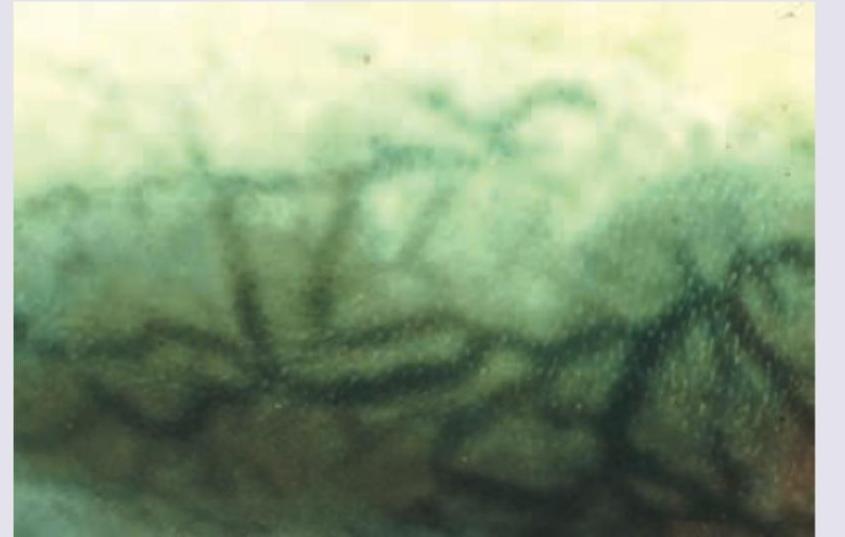
A dead body is found to have marks like branching of a tree on the front of the chest. The most likely cause of death could be due to:
Q250
True about rigor mortis are all, except:
Forensic Pathology Indian Medical PG Practice Questions and MCQs
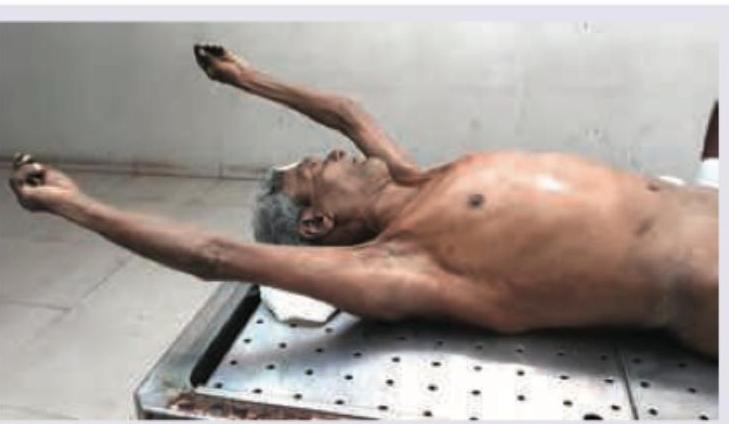
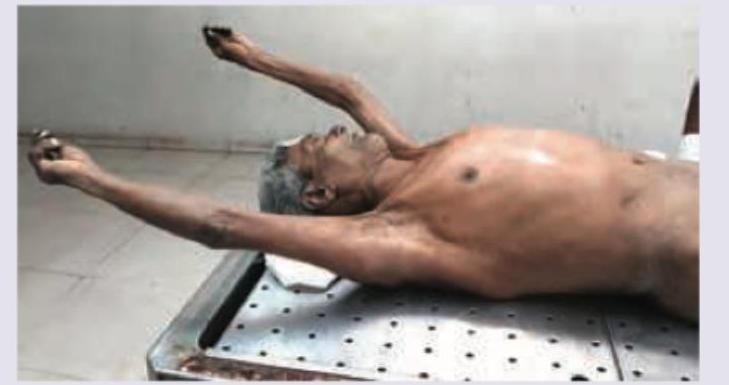
Question 241: What is the sequence of rigor mortis in the human body?
A. Centre to periphery
B. Head to foot (Correct Answer)
C. Foot to head
D. Simultaneously
Explanation: ***Head to foot***
- Rigor mortis follows **Nysten's Law**, progressing in a **descending pattern** from head to feet.
- Begins in smaller muscles with higher metabolic activity: **masseter (jaw), eyelids, and facial muscles** (2-4 hours post-mortem).
- Then progresses to **neck → upper extremities → trunk → lower extremities** (completing over 12 hours).
- This sequence relates to muscle size, ATP depletion rates, and surface area-to-volume ratios.
*Centre to periphery*
- This pattern does **not accurately describe** rigor mortis progression.
- While smaller muscles are affected first, the progression follows a **craniocaudal (head-to-foot) direction**, not a radial center-to-periphery pattern.
- The anatomical distribution is vertically sequential, not centrifugal.
*Foot to head*
- This is the **opposite of the established progression** described by Nysten's Law.
- Lower extremity muscles develop rigor mortis **last**, not first.
- This would contradict classic forensic pathology observations.
*Simultaneously*
- Rigor mortis is a **time-dependent sequential process**, not simultaneous.
- Different muscle groups deplete ATP and accumulate calcium at **varying rates over several hours**.
- The progressive nature (2-4 hours onset, 12 hours peak, 36-48 hours resolution) demonstrates it cannot be simultaneous.
Question 242: Post-mortem examination of a patient reveals the following. What is this finding known as?
A. Grazed abrasion
B. Hesitation cuts (Correct Answer)
C. Defense wounds
D. Chop wounds
Explanation: ***Hesitation cuts***
- The image displays multiple, parallel or semi-parallel **superficial incised wounds**, often with varying depths, which are characteristic of **hesitation cuts** (also called hesitation marks or tentative cuts).
- These cuts are frequently observed in cases of **suicide attempts** where the individual makes several tentative or trial cuts before making a more serious or fatal wound.
- Typically found on **wrists, neck, or antecubital fossa** and run parallel to each other with progressively increasing depth.
- The pattern of multiple superficial parallel cuts is **pathognomonic** of hesitation marks.
*Grazed abrasion*
- A **grazed abrasion** is a superficial injury where the epidermis is scraped off, typically caused by friction against a rough surface, resulting in a broad, irregular area of skin loss.
- The injuries in the image are clearly distinct **incised wounds** (clean cuts), not broad areas of scraped or abraded skin.
*Defense wounds*
- **Defense wounds** are injuries sustained while attempting to ward off an attack, typically found on the **palmar surface of hands and forearms**.
- These are usually deeper, irregular cuts from grabbing or blocking a weapon during homicidal assault.
- The pattern in the image shows **organized, parallel, superficial cuts** in one location, inconsistent with defensive injuries sustained during a struggle.
*Chop wounds*
- **Chop wounds** are deep incised wounds caused by heavy cutting instruments like axes, cleavers, or machetes, often with underlying **bone injury**.
- These are characterized by **deep tissue damage** with a wedge-shaped wound profile.
- The wounds shown are **superficial and parallel**, not deep chopping injuries.
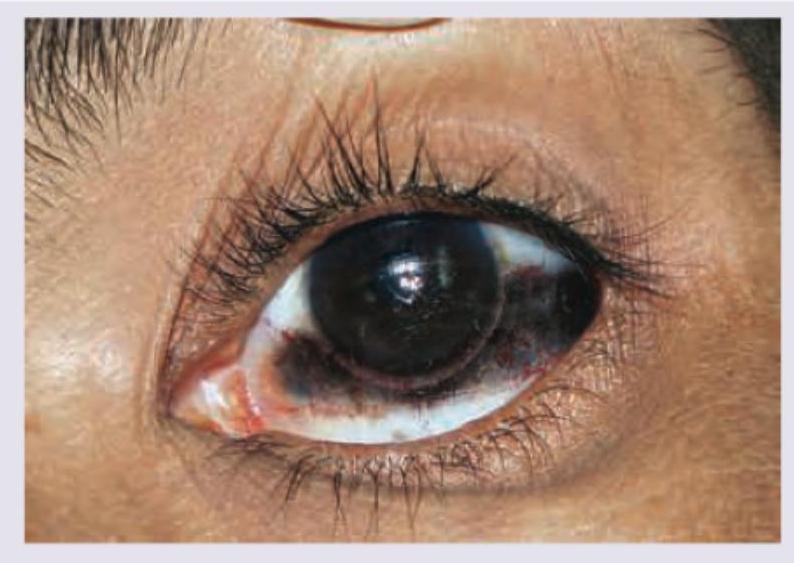
Question 243: On conducting the autopsy on a victim of hanging, the ligature mark is seen at the lower 1/3rd of the neck. The victim is seen to have a protruded tongue. He was found with his head hanging to his left side with saliva dribbling from the left angle of his mouth. The right pupil appears constricted and there is ptosis (drooping) of the right eyelid. Compression of which of the following structures is the most probable reason for the unilateral ptosis in this case?
A. Left vagus nerve
B. Right internal jugular vein
C. Right internal carotid artery
D. Cervical sympathetic chain (Correct Answer)
Explanation: ***Cervical sympathetic chain***
- The combination of **unilateral ptosis**, **miosis** (constricted pupil), and sometimes **anhidrosis** (lack of sweating) is characteristic of **Horner's syndrome**, which results from damage to the **cervical sympathetic chain**.
- Hanging can cause compression or injury to this chain, leading to the observed **Horner's syndrome** on the ipsilateral side of the injury.
*Left vagus nerve*
- Compression of the **vagus nerve** is associated with cardiac arrhythmias, bradycardia, or gastric disturbances, not directly with ptosis.
- The symptoms observed are specific to sympathetic dysfunction, not parasympathetic vagal stimulation.
*Right internal jugular vein*
- Compression of the **internal jugular vein** would cause venous congestion and edema in the head and neck, not neurological signs like ptosis or miosis.
- While it can be injured in hanging, it does not directly explain the specific neurological findings.
*Right internal carotid artery*
- Compression of the **internal carotid artery** could lead to cerebral ischemia or stroke symptoms, such as weakness or sensory deficits, but not typically isolated ptosis and miosis.
- The observed symptoms point to a specific sympathetic pathway disruption rather than arterial occlusion.
Question 244: The dead body of a 20 year old man found in the sea was brought in for postmortem examination. Which of the following findings would you see in seawater drowning?
1. Hemoconcentration
2. Pulmonary edema
3. Hyponatremia
4. Hypernatremia
5. Hemolysis
A. 2,4 and 5
B. 2,3 and 5
C. 1 and 3
D. 1 and 4 (Correct Answer)
Explanation: ***1 and 4***
- In **seawater drowning**, the hypertonic seawater (3-4% salt) creates an osmotic gradient that pulls plasma fluid from the blood into the alveoli, leading to **hemoconcentration**.
- The absorption of hypertonic seawater into the bloodstream results in **hypernatremia** and hyperchloremia.
- These are the characteristic electrolyte and hematologic findings specific to seawater drowning.
*2, 4 and 5*
- While **hypernatremia** is correct, this option incorrectly includes **pulmonary edema** (which is non-specific to drowning type) and **hemolysis** (which is characteristic of freshwater drowning, not seawater).
- **Hemolysis** occurs in freshwater drowning when hypotonic water enters the bloodstream, causing red blood cells to swell and lyse.
*2, 3 and 5*
- This option is incorrect as it includes findings characteristic of **freshwater drowning**: **hyponatremia** and **hemolysis**.
- In freshwater drowning, hypotonic water absorption causes hemodilution (not hemoconcentration), leading to hyponatremia and hemolysis.
- **Pulmonary edema** is present in both types but does not differentiate between them.
*1 and 3*
- While **hemoconcentration** is correct for seawater drowning, **hyponatremia** is incorrect.
- Hyponatremia is a feature of freshwater drowning due to dilution of serum sodium by absorbed hypotonic water.
Question 245: A 45-year-old man is found dead in his garage. His skin appears bright cherry red, and initial toxicology screening reveals elevated carboxyhemoglobin levels. The garage door was closed, and his car's engine was running. During the autopsy, which of the following patterns of lividity would most likely be observed?
A. Cherry red-colored lividity concentrated in dependent areas (Correct Answer)
B. Yellow-colored lividity in extremities
C. Blue-purple lividity in dependent areas
D. Brown-colored lividity in non-dependent areas
Explanation: ***Cherry red-colored lividity concentrated in dependent areas***
- The **bright cherry red skin** and **elevated carboxyhemoglobin levels** are classic signs of **carbon monoxide poisoning**, which causes this specific color of **livor mortis**.
- **Lividity** (livor mortis) occurs in dependent areas due to the gravitational settling of blood after circulation ceases.
*Yellow-colored lividity in extremities*
- **Yellow lividity** is not a typical presentation of **livor mortis** and is not associated with carbon monoxide poisoning.
- While jaundice can cause yellow discoloration, it's a systemic condition, not a post-mortem dependent discoloration.
*Blue-purple lividity in dependent areas*
- **Blue-purple lividity** is the most common presentation of **livor mortis** in cases without carbon monoxide or other specific toxic exposures.
- This color is due to the deoxygenated hemoglobin settling in the capillaries, which is distinct from the **carboxyhemoglobin** seen here.
*Brown-colored lividity in non-dependent areas*
- **Brown lividity** is characteristic of **methemoglobinemia**, a condition where iron in hemoglobin is oxidized, not typical for carbon monoxide poisoning.
- **Lividity** always occurs in **dependent areas** due to gravity, making "non-dependent areas" incorrect for any form of lividity.
Question 246: A 42-year-old man is found hanging from a ceiling beam with a rope around his neck. At autopsy, which of the following findings would be most consistent with suicidal hanging rather than homicidal strangulation?
A. Circular continuous mark
B. Inverted V-shaped mark (Correct Answer)
C. Horizontal ligature mark
D. Multiple parallel marks
Explanation: ***Inverted V-shaped mark***
- In **suicidal hanging**, the ligature is typically suspended from above, creating an **inverted V-shaped mark** on the neck where the knot is located.
- This results from the **weight of the body pulling downwards**, causing the ligature to ascend towards the suspension point.
- The mark is **oblique, incomplete posteriorly**, and directed upward toward the point of suspension.
*Circular continuous mark*
- A **circular continuous mark** is more characteristic of **manual strangulation** or a tightly applied ligature in homicidal strangulation where the force is applied horizontally around the entire neck.
- This type of mark suggests a **uniform pressure** around the neck, often seen when the body is not suspended.
*Horizontal ligature mark*
- A **horizontal ligature mark** around the neck is more indicative of **homicidal strangulation** where the force is applied directly and continuously around the neck, or when the body remains horizontal during the act.
- In hanging, the suspension point usually prevents a perfectly horizontal mark.
*Multiple parallel marks*
- **Multiple parallel marks** are generally indicative of **repeated application of force** or different ligature materials, which is more commonly seen in **homicidal strangulation** or a struggle.
- In suicidal hanging, a single, clear ligature mark is typical.
Question 247: A 45-year-old man is found deceased in his bedroom. Time of death needs to be established for legal purposes. The body temperature is 32°C (89.6°F), and the ambient temperature is 20°C (68°F). Rigor mortis is complete in all muscle groups. Assuming normal conditions, which of the following best estimates the postmortem interval?
A. 24-26 hours
B. 6-8 hours
C. 12-14 hours (Correct Answer)
D. 2-4 hours
Explanation: ***12-14 hours***
- **Complete rigor mortis** in all muscle groups typically occurs between **12-18 hours** postmortem.
- The body temperature of 32°C (89.6°F) with an ambient temperature of 20°C (68°F) indicates significant cooling, suggesting a **postmortem interval of several hours**, consistent with the stages of rigor mortis.
- This timeframe represents the peak of complete rigor mortis across all muscle groups.
*24-26 hours*
- By **24-36 hours**, rigor mortis would typically be **passing or completely absent** due to autolysis and decomposition.
- The body temperature would also be closer to the ambient temperature at this stage, unless other factors were involved.
*6-8 hours*
- At 6-8 hours, rigor mortis would typically be **developing or fully established in smaller muscles** (like the face and neck), but likely **not complete in all muscle groups**.
- Body temperature would be higher than 32°C, as a significant drop to 32°C would take longer.
*2-4 hours*
- At this early stage, rigor mortis would likely be **absent** or only just beginning to develop in the smallest muscles.
- The body temperature would also be much closer to normal body temperature (37°C or 98.6°F), with only a slight drop.
Question 248: During an autopsy of a decomposed body, the forensic pathologist notes marbling of the skin, bloating, and a green discoloration of the abdomen. Based on these findings, which of the following best estimates the postmortem interval?
A. 7-10 days
B. 1-2 months
C. 2-3 weeks
D. 3-5 days (Correct Answer)
Explanation: ***3-5 days***
- The combination of **marbling of the skin**, **bloating**, and **green discoloration of the abdomen** are classic signs of early to moderate putrefaction. These changes typically become evident within **3 to 5 days** postmortem in temperate environments.
- **Green discoloration** of the abdomen is usually the first visible sign of putrefaction, appearing within 24-48 hours, followed by **bloating** due to gas production and then **marbling** as bacterial decomposition spreads through blood vessels.
*7-10 days*
- By **7-10 days**, decomposition would likely be more advanced, with prominent desquamation (**skin slipping**) and potentially the formation of **blisters** filled with putrefactive fluid, which are not explicitly mentioned here.
- While these changes can occur within this timeframe, the observed combination specifically points to an earlier stage than a full week.
*1-2 months*
- At **1-2 months**, the body typically enters the **skeletonization** stage, with significant loss of soft tissues due to insect activity and continued bacteria.
- The findings described (bloating, marbling, green discoloration) represent early putrefactive changes, not the advanced decomposition seen after several weeks or months.
*2-3 weeks*
- By **2-3 weeks**, extensive **bloating** and **tissue liquefaction** would be expected, and the body may begin to show signs of **maggot activity** if exposed to insects.
- The described findings are characteristic of a less advanced stage of decomposition compared to this longer interval.
Question 249: A dead body is found to have marks like branching of a tree on the front of the chest. The most likely cause of death could be due to:
A. Lightning injury (Correct Answer)
B. Road traffic accident
C. Injuries due to bomb blast
D. Firearm
Explanation: ***Lightning injury***
- The branching, tree-like marks described are known as **Lichtenberg figures**, which are characteristic cutaneous patterns caused by the passage of high-voltage electrical current, such as during a **lightning strike**.
- These transient patterns are believed to be due to dilation of capillaries or arborizing superficial burns, sometimes referred to as ferning.
*Road traffic accident*
- Injuries from a **road traffic accident** typically include blunt force trauma, lacerations, fractures, and internal organ damage, but they do not produce branching, tree-like skin marks.
- The pattern of injury is usually widespread and indicative of impact, shearing, or crushing forces, which is distinct from the described branching marks.
*Injuries due to bomb blast*
- **Bomb blast injuries** are usually categorized as primary (blast wave), secondary (projectiles), tertiary (body displacement), and quaternary (miscellaneous, e.g., burns, toxic inhalation). They would not typically produce the specific Lichtenberg figures.
- While burns can occur, they are usually thermal or chemical burns, not the characteristic superficial dendritic branching marks seen with lightning.
*Firearm*
- **Firearm injuries** result from projectiles (bullets), leading to entrance wounds, exit wounds (if applicable), and internal organ damage along the bullet's path.
- The markings associated with firearms do not include branching, tree-like patterns on the skin; instead, they might show tattooing, stippling, or muzzle imprint with close-range shots.
Question 250: True about rigor mortis are all, except:
A. It disappears in the sequence as it appears
B. It lasts 18-36 h in summer
C. Seen immediately after death (Correct Answer)
D. It lasts 24-48 h in winter
Explanation: ***Seen immediately after death***
- **Rigor mortis** does not appear immediately after death; it typically begins 2-4 hours post-mortem.
- The onset and progression of rigor mortis are dependent on the depletion of **ATP** and accumulation of lactic acid, which takes time.
*It disappears in the sequence as it appears*
- The resolution of rigor mortis, often referred to as **secondary flaccidity**, generally follows the same order of onset.
- This sequential relaxation is due to the breakdown of muscle proteins by **autolytic enzymes**.
*It lasts 18-36 h in summer*
- In warmer conditions, such as summer, the metabolic processes and decomposition accelerate, causing rigor mortis to develop faster and resolve sooner.
- The duration of rigor mortis in summer can indeed be shorter, typically ranging from **18 to 36 hours**.
*It lasts 24-48 h in winter*
- In colder environments, like winter, the onset and duration of rigor mortis are prolonged due to slower biochemical reactions.
- The duration of rigor mortis can extend to **24-48 hours or even longer** under these conditions.