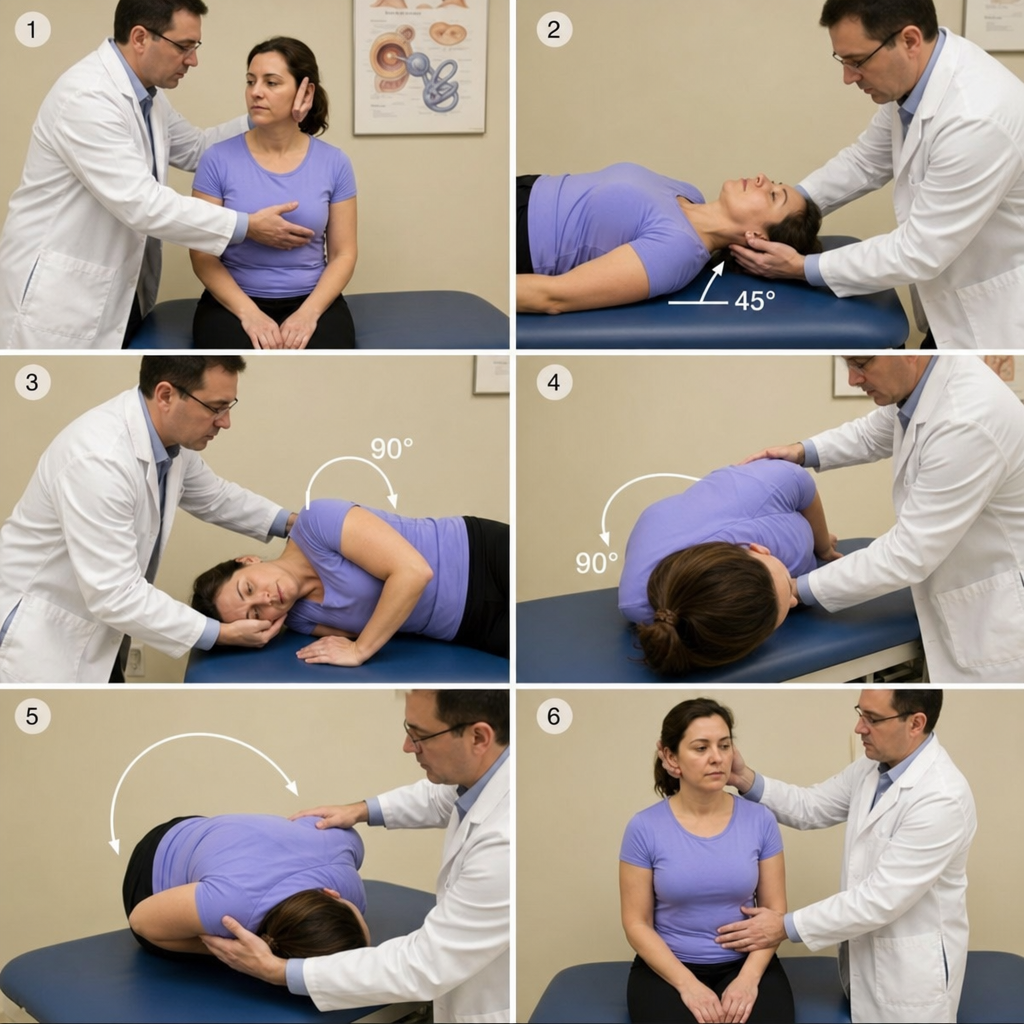
A patient presents with episodic dizziness lasting 30-60 seconds, triggered by rolling over in bed and looking upward. Which test is most likely to confirm the diagnosis of benign paroxysmal positional vertigo?
Which semicircular canal is most commonly involved in BPPV?
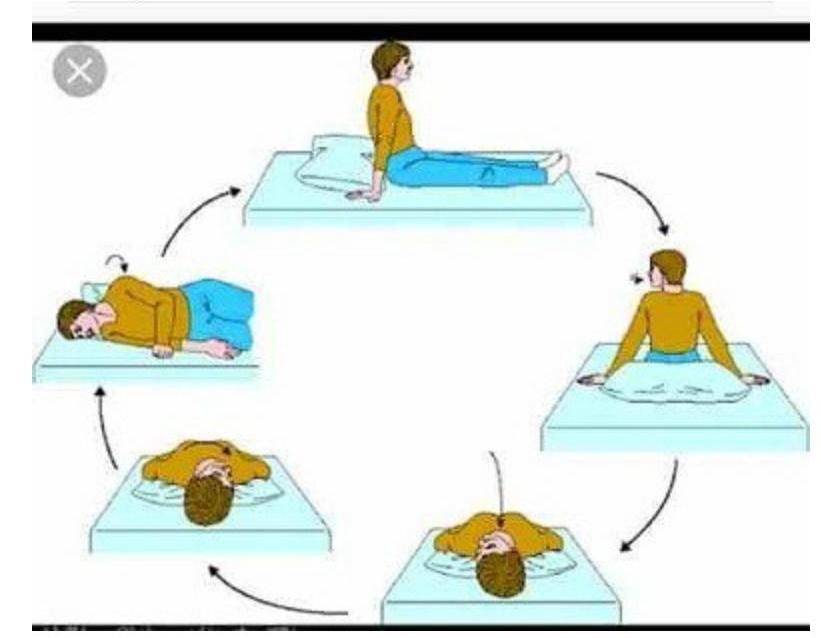
Identify the maneuver shown in the image.
A patient with ear complaints showed positive Hennebert sign. Which of the following conditions shows positive Hennebert sign?
Chemical labyrinthectomy by transtympanic route is done in Meniere's disease using which drug?
Endolymphatic sac decompression is done in?
Which of the following tests is specifically used to assess vestibular function?
What is the condition characterized by an abnormal accumulation of endolymph fluid in the inner ear, leading to symptoms such as vertigo, tinnitus, and hearing loss?
What does the acronym 'COWS' refer to in the context of vestibular testing?
Which of the following is the MOST accurate definition of vertigo?
Explanation: ***Dix-Hallpike maneuver*** - The **Dix-Hallpike maneuver** is the gold standard for diagnosing **benign paroxysmal positional vertigo (BPPV)** by provoking vertigo and nystagmus characteristic of otoconia displacement in the semicircular canals. - This maneuver typically elicits **nystagmus** (rotatory and upbeating) that has a latency of a few seconds and fatigues quickly, which is highly indicative of **BPPV**. *Rinne test* - The **Rinne test** is used to assess **conductive** versus **sensorineural hearing loss** by comparing air and bone conduction, not vertigo. - A normal Rinne test shows **air conduction** better than **bone conduction**. *Weber test* - The **Weber test** also evaluates **hearing loss** by placing a vibrating tuning fork on the patient's forehead, determining if sound lateralizes to one ear. - It helps differentiate between **conductive** and **sensorineural hearing loss** laterally. *Electronystagmography* - While **electronystagmography (ENG)** assesses eye movements and nystagmus to identify vestibular disorders, it is not specific for diagnosing BPPV. - ENG can detect central or peripheral vestibular dysfunction but does not directly provoke the specific nystagmus seen in BPPV during positional changes.
Explanation: ***Correct Option: Posterior*** - The **posterior semicircular canal** is most commonly affected in **Benign Paroxysmal Positional Vertigo (BPPV)**, accounting for approximately **80-90% of cases**. - Its **gravity-dependent anatomical position** allows for the accumulation of displaced otoconia (calcium carbonate crystals) from the utricle more readily. - This anatomical configuration makes it the most susceptible canal for canalithiasis. *Incorrect: Horizontal* - While the **horizontal (lateral) canal** can be involved in BPPV, it accounts for only **10-20% of cases**, making it less common than the posterior canal. - **Horizontal canal BPPV** typically presents with different nystagmus characteristics, such as **geotropic or apogeotropic horizontal nystagmus** depending on whether it's canalithiasis or cupulolithiasis. *Incorrect: Superior* - Involvement of the **superior (anterior) semicircular canal** in BPPV is very rare, occurring in **less than 2-3% of cases**. - When it does occur, it presents with specific diagnostic features including **downbeat nystagmus** during provocative maneuvers. *Incorrect: All of the options* - Although BPPV can theoretically affect any of the semicircular canals, they are **not equally affected**. - The **posterior canal** is overwhelmingly the most common site (~80-90%), followed by horizontal (~10-20%), with superior canal involvement being rare (<3%). - Therefore, stating "all of the options" as the most commonly involved canal is incorrect.
Explanation: ***Epley*** - The image displays the classic sequence of head and body movements characteristic of the **Epley maneuver**, designed to reposition otoconia from the semicircular canals back into the utricle. - This maneuver involves a series of specific head turns and body positions, often starting in an upright seated position, then lying down while turning the head, and rotating the body, as depicted. *Brandt daroff* - The **Brandt-Daroff exercises** involve rapid, self-administered movements between sitting and lying on one side, then sitting up and lying on the other side. - These exercises are typically performed multiple times a day and differ in their sequence from the repositioning maneuvers shown. *Foster* - The **Foster maneuver**, also known as the "half-somersault maneuver," is a self-administered variant used for posterior canal BPPV, particularly when the Epley maneuver is difficult to perform. - It involves beginning in a kneeling position, looking up, placing the head on the floor, and tucking the chin, which is distinct from the sequence shown. *Semont* - The **Semont maneuver** involves rapid movement from a sitting position to lying on one side with the head turned up, then rapidly moving to lie on the opposite side with the head turned down. - While it is a repositioning maneuver for BPPV, its specific rapid movements and head orientations differ from those illustrated in the image.
Explanation: ***Meniere's disease*** - The **Hennebert sign** involves nystagmus and vertigo induced by positive or negative pressure in the external auditory canal, indicating abnormal communication between the middle and inner ear. - While **congenital syphilis** and **perilymphatic fistula** are the classic associations with Hennebert sign, it can also occur in **Meniere's disease** due to increased endolymphatic pressure and membrane abnormalities. - In Meniere's disease, the sign may be related to **distention of the endolymphatic system** causing abnormal response to pressure changes in the external canal. - Among the options provided, Meniere's disease is the condition that can demonstrate a positive Hennebert sign. *Acoustic neuroma* - This condition presents with **unilateral progressive hearing loss**, tinnitus, and balance issues, but does not typically cause a positive Hennebert sign. - An acoustic neuroma is a **benign tumor** (vestibular schwannoma) that compresses the vestibulocochlear nerve, not directly affecting pressure sensitivity of the labyrinth. - The tumor causes symptoms through **compression** rather than through abnormal pressure transmission mechanisms. *Vestibular neuronitis* - Characterized by **sudden onset of severe vertigo** without hearing loss, caused by inflammation of the vestibular nerve. - Does not involve pressure-induced nystagmus or abnormal middle-inner ear communication. - Diagnosis is made clinically based on acute **vertigo**, **absence of auditory symptoms**, and normal ear examination. *Glossopharyngeal neuralgia* - This is a **cranial nerve IX disorder** causing severe, stabbing pain in the throat, tongue, ear, and tonsil area, completely unrelated to vestibular function. - The pain is triggered by specific actions like **swallowing**, **coughing**, or **touching the tonsils**. - Has no association with the Hennebert sign or vestibular pressure phenomena.
Explanation: ***Gentamicin*** - **Gentamicin** is an **aminoglycoside antibiotic** that is commonly used for chemical labyrinthectomy due to its **ototoxic** properties, particularly its selective toxicity to **vestibular hair cells** at lower doses. - When administered transtympanically, it achieves high concentrations in the **inner ear fluid**, effectively ablating the vestibular function and reducing severe vertigo in **Meniere's disease**. *Amikacin* - **Amikacin** is also an **aminoglycoside antibiotic** with ototoxic potential, but it is typically reserved for severe bacterial infections and is not the primary drug of choice for **chemical labyrinthectomy** in Meniere's disease. - While it can cause hearing loss, **gentamicin** has a more established and preferential effect on the **vestibular system** at therapeutic doses for Meniere's. *Amoxycillin* - **Amoxycillin** is a common **beta-lactam antibiotic** used for bacterial infections, and it does not possess **ototoxic** properties that would make it suitable for chemical labyrinthectomy. - It is primarily known for its antibacterial action and has no role in the management of vertigo in **Meniere's disease** via transtympanic administration. *Cyclosporine* - **Cyclosporine** is an **immunosuppressant drug** used to prevent organ rejection and treat autoimmune conditions; it does not have properties for chemical ablation of the labyrinth. - While some autoimmune components are sometimes considered in Meniere's disease, cyclosporine is not used for **transtympanic chemical labyrinthectomy**.
Explanation: ***Definitive treatment for intractable vertigo in Meniere's disease*** - **Endolymphatic sac decompression** is a surgical procedure aimed at relieving pressure in the inner ear for patients with **Meniere's disease** who experience **intractable vertigo** despite medical management. - It works by improving fluid drainage from the **endolymphatic sac**, thereby reducing episodes of vertigo without significantly affecting hearing. *Management of endolymphatic hydrops in early-stage Meniere's disease* - This procedure is typically reserved for **later stages** of Meniere's disease when medical treatments have failed, not early-stage management. - Early-stage management usually involves **dietary modifications**, **diuretics**, and other medical therapies. *Prophylactic treatment in recurrent vertigo syndromes* - Endolymphatic sac decompression is a **therapeutic intervention** for diagnosed Meniere's disease, not a prophylactic treatment for general recurrent vertigo syndromes. - Its use is specific to the underlying **endolymphatic hydrops** of Meniere's disease. *Primary surgical approach for cochlear disorders* - This procedure addresses issues related to the **vestibular system** and fluid balance in Meniere's disease, not primary cochlear disorders like hearing loss unrelated to hydrops. - **Cochlear disorders** primarily affecting hearing might involve different surgical approaches, such as **cochlear implantation**.
Explanation: ***Caloric test*** - The caloric test assesses the function of the **horizontal semicircular canal** and its associated neural pathways by introducing warm or cold water/air into the ear canal. - It induces nystagmus and vertigo, allowing for evaluation of the **vestibular reflex arc**. *Fistula test* - The fistula test assesses for a **perilymphatic fistula**, an abnormal connection between the middle and inner ear, which is a specific cause of vestibular dysfunction. - While related to vestibular function, it tests for a **structural defect** rather than directly assessing overall vestibular response. *Dix-Hallpike maneuver* - The Dix-Hallpike maneuver is used to diagnose **Benign Paroxysmal Positional Vertigo (BPPV)** by provoking positional nystagmus and vertigo. - It assesses for **otoconia displacement** within the semicircular canals but is not a general test of overall vestibular function. *All of the options* - While all listed tests relate to the ear and balance, only the **caloric test** is considered a foundational and specific assessment of the vestibular system's response to thermal stimulation. - The Dix-Hallpike and fistula tests investigate specific conditions or structural defects rather than a broad evaluation of vestibular end-organ function.
Explanation: ***Meniere's disease*** - This condition is precisely defined by the **triad of symptoms**: episodic **vertigo**, **tinnitus**, and fluctuating sensorineural **hearing loss**, all resulting from **endolymphatic hydrops** (abnormal accumulation of endolymph in the inner ear). - The excess fluid in the **membranous labyrinth** disrupts the normal function of the vestibular and cochlear systems. *Monoaural Diplacusis* - This refers to a phenomenon where an individual perceives a single sound as having a **different pitch or timbre** in the same ear, often a symptom rather than a disease itself. - It does not involve the characteristic triad of vertigo, tinnitus, and hearing loss caused by endolymphatic hydrops. *Lermoyez Syndrome* - This is a rare variant of Meniere's disease where **hearing loss and tinnitus precede** and gradually worsen before an episode of vertigo, with hearing often improving after the vertigo attack. - While related to endolymphatic hydrops, the **temporal sequence** of symptoms is distinct from classic Meniere's disease. *Otosclerosis* - This is a condition involving abnormal bone growth in the **middle ear**, specifically around the **stapes bone**, leading to **conductive hearing loss**. - While it causes hearing loss, it is not characterized by endolymphatic hydrops, vertigo, or tinnitus as primary symptoms, unlike Meniere's disease.
Explanation: ***Caloric test*** - 'COWS' stands for **C**old **O**pposite, **W**arm **S**ame, describing the direction of **nystagmus** relative to the ear being irrigated in a **caloric test**. - This mnemonic is used in **vestibular function testing** to evaluate the integrity of the horizontal semicircular canal and its central connections. *Romberg test* - The Romberg test assesses **proprioception** and **vestibular function** by observing a patient's sway with eyes open and closed. - It does not involve the 'COWS' mnemonic, which is specific to **caloric stimulation**. *Fistula test* - The fistula test is used to detect an abnormal connection between the **middle ear** and the **inner ear**, often caused by a cholesteatoma or trauma. - It involves applying pressure changes to the external ear canal and observing for **nystagmus** or **vertigo**, but it is not associated with 'COWS'. *Hallpike positional test* - Also known as the Dix-Hallpike maneuver, this test is used to diagnose **Benign Paroxysmal Positional Vertigo (BPPV)**. - It involves specific head and body movements to provoke **vertigo** and **nystagmus** by dislodging otoconia in the semicircular canals, and does not use the 'COWS' acronym.
Explanation: ***Correct: Sensation of spinning or whirling*** - Vertigo is medically defined as an **illusion of movement**, typically a sensation that the patient or their surroundings are spinning, rotating, or whirling. - This is the **hallmark feature** that distinguishes vertigo from other forms of dizziness according to **Harrison's Principles** and standard ENT textbooks. - The **vestibular system** provides spatial orientation, and when disrupted (as in **BPPV, Meniere's disease, vestibular neuritis**), it creates this false perception of rotational movement. - The spinning sensation can be subjective (patient feels they are moving) or objective (environment appears to move). *Incorrect: Subjective sense of imbalance* - This describes **disequilibrium** or nonspecific dizziness, NOT vertigo specifically. - Imbalance without rotational sensation suggests different pathologies like **cerebellar dysfunction, proprioceptive loss**, or multisensory deficit. - While vertigo can cause secondary imbalance, the **defining feature** is the illusory movement, not just imbalance alone. *Incorrect: Sense of pressure in the ear* - Aural fullness or ear pressure is an **associated symptom** in conditions like **Meniere's disease** or **eustachian tube dysfunction**. - This is not the definition of vertigo but rather a **concurrent symptom** that may accompany vestibular disorders. *Incorrect: Infection of the inner ear* - Inner ear infections like **labyrinthitis** or **vestibular neuritis** are **etiologies** (causes) that can produce vertigo. - An infection is a pathological process, not the definition of the symptom itself—many non-infectious causes also produce vertigo.
Anatomy and Physiology of Balance
Practice Questions
Vestibular Testing Methods
Practice Questions
Videonystagmography
Practice Questions
Rotational Chair Testing
Practice Questions
Vestibular Evoked Myogenic Potentials
Practice Questions
Video Head Impulse Test
Practice Questions
Benign Paroxysmal Positional Vertigo
Practice Questions
Vestibular Neuritis
Practice Questions
Ménière's Disease
Practice Questions
Vestibular Migraine
Practice Questions
Central Vertigo
Practice Questions
Vestibular Rehabilitation
Practice Questions
Get full access to all questions, explanations, and performance tracking.
Start For Free