Calorie testing with warm and cold water stimulates which of the following vestibular structures?
The Head Impulse Test is used to diagnose which condition?
The caloric test is performed to assess the function of which structure?
Which of the following statements is not true regarding the caloric test?
Semicircular canals are stimulated by:
In the caloric test, cold water stimulation causes movement of the eye towards which side?
A 50-year-old female complains of an episode of acute vertigo with vomiting and unsteadiness and light-headedness, which was triggered by changing her head position in the morning. She denied hearing loss, recent viral illness, medication use, head injury, or trauma. Choose the most appropriate diagnosis:
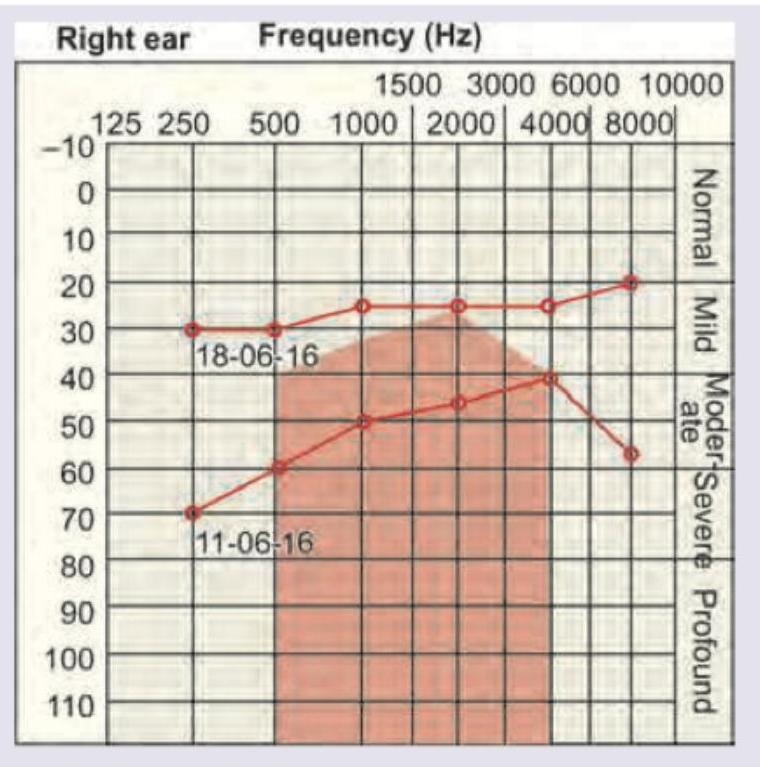
A 40-year-old woman presents with history of recurrent episodes of spinning sensation in horizontal direction with vertigo incapacitating her for hours and resolving with medication. She also report roaring tinnitus during the attacks. Her sequential audiogram done on 11.06.16 and 18.06.16 is given below. Diagnosis is:
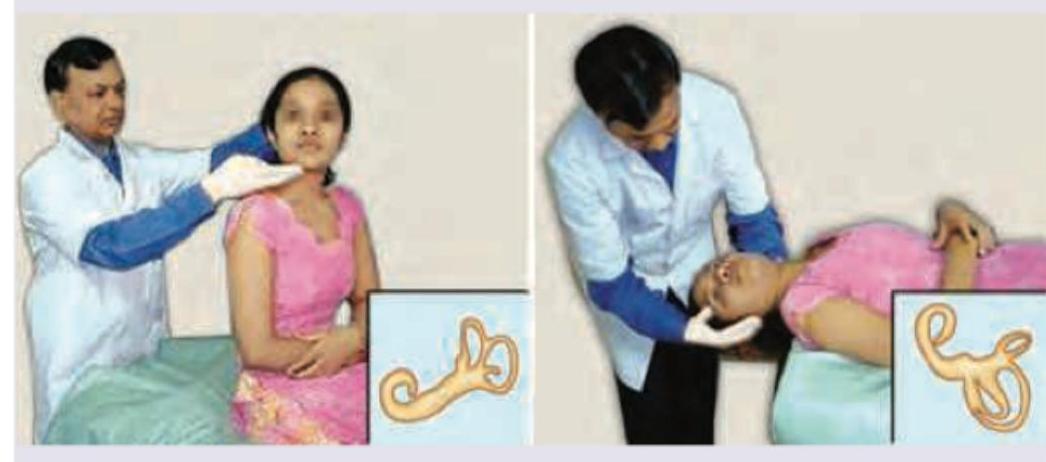
Which of the following test is being performed on the patient?
In a patient with right vestibular neuronitis, what will be the finding on the head impulse test?
Explanation: **Explanation:** **Caloric testing** is a component of the Electronystagmography (ENG) battery used to assess the function of the vestibular system. The correct answer is the **Lateral (Horizontal) semicircular canal (SCC)** because of its anatomical orientation. 1. **Why the Lateral SCC is correct:** During the test, the patient’s head is elevated to 30°, bringing the lateral SCC into a **vertical plane**. When cold or warm water is introduced into the external auditory canal, it creates a temperature gradient across the canal. This causes the endolymph to change density and move (convection currents), stimulating the hair cells. The lateral SCC is the most superficial canal and is most directly affected by these thermal changes. 2. **Why other options are incorrect:** * **Saccule & Utricle (Otolith organs):** These respond to linear acceleration and gravity, not thermal convection. * **Superior & Posterior SCCs:** These canals are located deeper within the petrous temporal bone and are not oriented in a way that allows thermal gradients to induce significant endolymphatic flow during standard caloric testing. **Clinical Pearls for NEET-PG:** * **COWS Mnemonic:** **C**old **O**pposite, **W**arm **S**ame. (Cold water induces nystagmus to the opposite side; warm water to the same side). * **Fitzgerald-Hallpike Test:** The standard method using water at 30°C and 44°C. * **Indication:** It is the gold standard for diagnosing **Unilateral Canal Paresis** (e.g., Vestibular Neuronitis or Meniere’s disease). * **Dead Labyrinth:** If no nystagmus occurs with either temperature, it indicates a non-functioning vestibular system on that side.
Explanation: ### Explanation **Correct Answer: D. Vestibular disease** The **Head Impulse Test (HIT)**, also known as the Halmagyi-Curthoys test, is a clinical bedside assessment of the **Vestibulo-Ocular Reflex (VOR)**. * **Mechanism:** When a patient’s head is rapidly turned (impulsed) toward the side of a functional lesion, the VOR fails to keep the eyes fixed on the target. The eyes move with the head, followed by a corrective "catch-up" saccade back to the target. * **Clinical Significance:** A positive HIT (presence of a corrective saccade) indicates a **peripheral vestibular lesion** (e.g., Vestibular Neuritis). In central causes of vertigo (like a stroke), the VOR usually remains intact, and the HIT is typically normal. **Why the other options are incorrect:** * **A. Subarachnoid hemorrhage:** This is a neurosurgical emergency typically diagnosed via CT scan and characterized by a "thunderclap" headache. It does not involve the VOR. * **B. Lhermitte sign:** This is an electrical sensation running down the spine upon neck flexion, commonly seen in Multiple Sclerosis or cervical cord compression. * **C. Nuchal rigidity:** This refers to neck stiffness, a classic sign of meningeal irritation (Meningitis) or subarachnoid hemorrhage, tested via Kernig’s or Brudzinski’s signs. **High-Yield Clinical Pearls for NEET-PG:** 1. **HINTS Exam:** HIT is part of the HINTS battery (**H**ead **I**mpulse, **N**ystagmus, **T**est of **S**kew) used to differentiate peripheral vertigo from a central stroke in the ER. 2. **Paradox:** In acute vestibular syndrome, a **normal** Head Impulse Test is more concerning because it suggests a **central** (brainstem/cerebellar) pathology. 3. The HIT specifically tests the **lateral (horizontal) semicircular canal** and the superior vestibular nerve.
Explanation: **Explanation:** The **Caloric Test** (part of the VNG/ENG battery) is a clinical tool used to assess the integrity of the **Lateral (Horizontal) Semicircular Canal (SCC)** and its associated nerve, the superior vestibular nerve. **Why Semicircular Canal is correct:** The test relies on the principle of **convection currents** within the endolymph. When cold or warm water/air is introduced into the external auditory canal, it creates a temperature gradient across the lateral SCC (which lies closest to the tympanic membrane). This causes the endolymph to move, stimulating the hair cells in the crista ampullaris and inducing nystagmus. Because of the anatomical orientation of the canals during the test (head tilted 30° back), only the horizontal SCC is significantly stimulated. **Why other options are incorrect:** * **B & C (Macula and Saccule):** These are components of the **Otolith organs**, which detect linear acceleration and static head tilt. They do not respond to thermal convection. They are clinically assessed using **VEMP** (Vestibular Evoked Myogenic Potentials) tests. * **D (Cochlea):** This is the organ of hearing. Its function is assessed via Pure Tone Audiometry (PTA) or Otoacoustic Emissions (OAE), not vestibular testing. **High-Yield Clinical Pearls for NEET-PG:** 1. **COWS Mnemonic:** Describes the direction of the **Fast Phase** of nystagmus: **C**old **O**pposite, **W**arm **S**ame. 2. **Positioning:** The patient is supine with the head tilted **30° up** to bring the lateral SCC into a vertical plane. 3. **Canal Paresis:** A difference of **>20-25%** between the two sides indicates a peripheral vestibular lesion on the weaker side. 4. **Prerequisite:** The tympanic membrane must be intact (unless using air caloric testing) to avoid pain or contamination.
Explanation: ### Explanation The **Caloric Test** is a clinical assessment of the vestibulo-ocular reflex (VOR) that evaluates the function of the lateral semicircular canal and the superior vestibular nerve. **1. Why Option C is the correct answer (The "Not True" statement):** In **canal paresis**, the test is **not** inconclusive; rather, it is a definitive finding. Canal paresis refers to a significantly reduced or absent response (nystagmus) from one ear compared to the other when stimulated. This indicates a peripheral vestibular lesion on the side of the reduced response (e.g., Meniere’s disease, Vestibular Schwannoma, or Labyrinthitis). **2. Analysis of Incorrect Options:** * **Option A:** This is **true**. The test uses thermal stimulation (water or air) to create a convection current in the endolymph of the lateral semicircular canal, which triggers nystagmus. * **Option B:** This is **true**. It follows the mnemonic **COWS** (**C**old **O**pposite, **W**arm **S**ame). Cold water (30°C) causes endolymph to sink (ampullopetal flow), resulting in nystagmus to the opposite side. Warm water (44°C) causes endolymph to rise (ampullofugal flow), resulting in nystagmus to the same side. **3. High-Yield Clinical Pearls for NEET-PG:** * **Fitzgerald-Hallpike Technique:** The standard method using water at 7°C below and above body temperature (30°C and 44°C). * **Patient Positioning:** The patient is supine with the head tilted 30° up to bring the lateral semicircular canal into a vertical plane. * **Direction of Nystagmus:** Defined by the direction of the **fast component**. * **Directional Preponderance:** When nystagmus is more prolonged in one direction (e.g., to the right) regardless of which ear is stimulated; seen in both peripheral and central lesions. * **Ice Cold Caloric Test:** Used to confirm brain death; if the VOR is intact, the eyes should deviate toward the irrigated ear.
Explanation: ### **Explanation** The vestibular system is divided into two functional components: the **semicircular canals (SCCs)** and the **otolith organs** (utricle and saccule). **Why Rotation is Correct:** The three semicircular canals (Lateral, Superior, and Posterior) are oriented at right angles to each other to detect **angular (rotational) acceleration** in three-dimensional space. When the head rotates, the **endolymph** within the canals moves due to inertia, displacing the **cupula** (a gelatinous structure in the ampulla). This displacement bends the hair cells, triggering a neural impulse. **Why Other Options are Incorrect:** * **Gravity & Linear Acceleration (Options A & B):** These are the primary stimuli for the **Otolith organs**. The **Utricle** detects horizontal linear acceleration (e.g., moving in a car), while the **Saccule** detects vertical linear acceleration and gravity (e.g., moving in an elevator). * **Sound (Option D):** Sound waves stimulate the **Organ of Corti** within the cochlea for hearing. Under normal conditions, the vestibular system does not respond to sound. (Note: Sensitivity to sound in the vestibular system, known as the *Tullio phenomenon*, is a pathological finding seen in Superior Semicircular Canal Dehiscence). ### **High-Yield Clinical Pearls for NEET-PG:** 1. **Receptor Organ:** The sensory organ of the SCC is the **Crista Ampullaris**, whereas the sensory organ of the Otoliths is the **Macula**. 2. **BPPV:** Benign Paroxysmal Positional Vertigo most commonly involves the **Posterior SCC** due to canalithiasis (displaced otoconia from the utricle). 3. **Caloric Testing:** This test specifically stimulates the **Horizontal (Lateral) SCC** to evaluate vestibular function. 4. **Ewald’s Second Law:** In the horizontal canal, ampullopetal endolymph flow (towards the ampulla) causes a stronger stimulus than ampullofugal flow.
Explanation: The caloric test is a clinical assessment of the vestibulo-ocular reflex (VOR) used to evaluate the function of the horizontal semicircular canal. ### **Explanation of the Correct Answer** The direction of the nystagmus (the fast phase) is traditionally remembered by the mnemonic **COWS**: **C**old **O**pposite, **W**arm **S**ame. When **cold water** is introduced into the external auditory canal, it cools the endolymph in the horizontal semicircular canal. This causes the endolymph to become denser and sink (convection current), leading to **ampullopetal** flow away from the ampulla. This inhibits the vestibular nerve on that side, causing a slow drift of the eyes toward the stimulated ear, followed by a corrective **fast phase (nystagmus) toward the opposite side.** ### **Explanation of Incorrect Options** * **Option A (Same side):** This occurs with **warm water** stimulation. Warm water causes the endolymph to rise, stimulating the nerve and producing a fast-phase nystagmus toward the same ear. * **Options C & D (Upwards/Downwards):** Caloric testing specifically stimulates the horizontal semicircular canal due to the patient’s positioning (head tilted 30° back). Vertical nystagmus usually indicates central vestibular lesions rather than peripheral canal stimulation. ### **High-Yield Clinical Pearls for NEET-PG** * **Patient Position:** The patient is supine with the head elevated at **30°** to bring the horizontal canal into a vertical plane. * **Water Temperatures:** Standard temperatures used are **30°C** (Cold) and **44°C** (Warm). * **Fitzgerald-Hallpike Test:** This is the formal name for the bithermal caloric test. * **Canal Paresis:** A reduction in response (usually >20-25% difference between sides) indicates a peripheral vestibular lesion, such as Meniere’s disease or Vestibular Schwannoma. * **Dead Labyrinth:** If no response is elicited even with ice-cold water, the labyrinth is considered non-functional.
Explanation: ***Correct: BPPV*** - The characteristic presentation of **acute, brief episodes of vertigo** triggered specifically by **changing head position** (positional vertigo) is the hallmark of Benign Paroxysmal Positional Vertigo. - The absence of associated symptoms like **hearing loss**, new medications, or antecedent **viral illness** further supports BPPV, which is caused by dislodged **otoconia** floating in the semicircular canals. *Incorrect: Meniere disease* - This diagnosis is characterized by a specific triad: episodic vertigo, **fluctuating sensorineural hearing loss**, and **tinnitus** (aural fullness), which are absent in this presentation. - Vertigo attacks in Meniere disease are typically severe but **not necessarily positionally triggered** in the classic sense, lasting minutes to hours. *Incorrect: Vestibular neuritis* - Vestibular neuritis (or labyrinthitis if hearing is involved) causes a single, severe, **prolonged attack of vertigo** that lasts for days, not brief, positional episodes. - It is often preceded by a recent upper **respiratory tract infection** or viral syndrome, which the patient explicitly denied. *Incorrect: Acoustic neuroma* - An acoustic neuroma (**Vestibular Schwannoma**) typically presents with **slowly progressive unilateral sensorineural hearing loss** and **tinnitus**, often for months or years. - Acute, recurrent, positionally-triggered vertigo with vomiting is extremely atypical, as the symptoms caused by this tumor are usually **gradual** due to slow growth.
Explanation: ### ***Meniere's disease*** - This patient presents with the classic triad of **Meniere's disease**: recurrent **vertigo**, **roaring tinnitus**, and fluctuating **sensorineural hearing loss** (as shown by the sequential audiograms with improvement). - The audiogram demonstrates **fluctuating hearing loss**, which is typical for Meniere's, with the hearing loss being worse on June 11th and improving by June 18th, particularly at lower frequencies (a pattern often seen in Meniere's). ### *Migraine variant* - While migraine can cause vertigo (**vestibular migraine**), it typically does not present with characteristic **roaring tinnitus** or **fluctuating hearing loss** on audiometry. - The audiogram showing a clear pattern of fluctuating sensorineural hearing loss points away from an isolated migraine variant. ### *Benign paroxysmal positional vertigo* - BPPV causes **brief episodes of vertigo** triggered by specific head movements, usually lasting seconds to a minute, and is not associated with roaring tinnitus or hearing loss. - The patient's vertigo episodes are described as "incapacitating her for hours," which is inconsistent with the short duration of BPPV attacks. ### *Acoustic neuroma* - An acoustic neuroma typically causes **progressive, unilateral sensorineural hearing loss**, persistent tinnitus (often high-pitched), and sometimes imbalance, but **recurrent, sudden, severe vertigo** and **fluctuating hearing** are less common. - The rapid fluctuation and improvement in hearing shown on the sequential audiograms are not characteristic of the generally slow, progressive nature of hearing loss due to an acoustic neuroma.
Explanation: ***Dix-Hallpike test*** - The image depicts a patient being moved from an upright sitting position to a supine position with the head turned to one side and extended, which is characteristic of the **Dix-Hallpike maneuver**. - This test is used to diagnose **benign paroxysmal positional vertigo (BPPV)** by provoking vertigo and nystagmus as a result of otoconia displacement in the semicircular canals. *Caloric stimulation test* - This test involves introducing **warm or cold water/air into the ear canal** to induce nystagmus, assessing the vestibular system. - It's typically performed with the patient lying supine with their head elevated at 30 degrees, not involving the specific positional changes shown in the image. *Doll's eye reflex* - Also known as the **oculocephalic reflex**, it assesses brainstem function by rapidly turning the patient's head while observing eye movement. - This reflex is primarily used to evaluate comatose patients and does not involve the complex body and head positioning seen in the image. *Frenzel maneuver* - The Frenzel maneuver is performed during **otoscopy** to check for nystagmus by having the patient gaze through high plus lenses in a dark room. - It is often used to suppress visual fixation and enhance nystagmus, but it does not involve the specific body or head movements depicted.
Explanation: ***Head turned to right, corrective saccade to the left*** - In **right vestibular neuronitis**, the right vestibular apparatus is impaired, affecting the **vestibulo-ocular reflex (VOR)** on that side. - During the head impulse test, when the head is rapidly turned **to the right** (toward the affected side), the impaired VOR cannot maintain eye fixation on the target. - The eyes initially move **with the head** (to the right), then a visible **corrective saccade** (catch-up saccade) brings them **back to the left** to refixate on the target. - This corrective saccade is the **hallmark positive finding** in head impulse test for right vestibular dysfunction. *Head turned to left, corrective saccade to the right* - This would indicate a **left vestibular lesion**, not right vestibular neuronitis. - When turning the head to the left with left vestibular dysfunction, a corrective saccade to the right would be observed. *Head turned to right, no corrective saccade* - This would indicate **normal VOR function** on the right side. - A normal response shows no corrective saccade because the eyes maintain fixation throughout the head turn. - This is the **opposite** of what is expected in right vestibular neuronitis. *Head turned to left, no corrective saccade* - This indicates normal VOR function on the left side. - In right vestibular neuronitis, turning the head to the left (away from the affected side) typically shows **normal VOR** with no corrective saccade needed.
Anatomy and Physiology of Balance
Practice Questions
Vestibular Testing Methods
Practice Questions
Videonystagmography
Practice Questions
Rotational Chair Testing
Practice Questions
Vestibular Evoked Myogenic Potentials
Practice Questions
Video Head Impulse Test
Practice Questions
Benign Paroxysmal Positional Vertigo
Practice Questions
Vestibular Neuritis
Practice Questions
Ménière's Disease
Practice Questions
Vestibular Migraine
Practice Questions
Central Vertigo
Practice Questions
Vestibular Rehabilitation
Practice Questions
Get full access to all questions, explanations, and performance tracking.
Start For Free