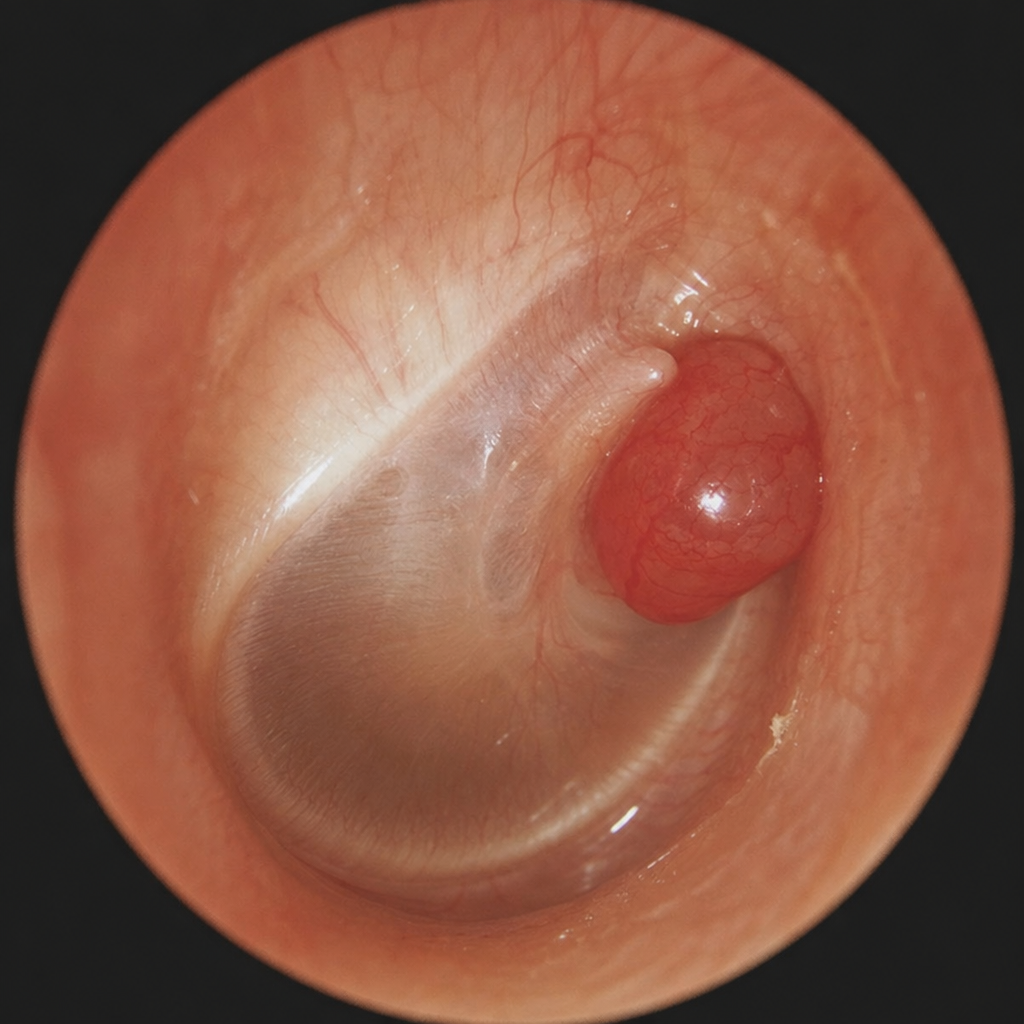
"Cone of light" is due to:
A 58-year-old male presents with persistent fullness of the left ear for 3 months and hearing loss. On examination, there is fluid behind the tympanic membrane. Impedance audiometry shows a type B audiogram. What is the next step in the management of this patient?
What is the nerve supply of the Stapedius muscle?
What is the approximate surface area of the tympanic membrane?
What is the most common extra-cranial complication of acute suppurative otitis media (ASOM)?
What is the most common bone affected by otosclerosis?
A Bezold abscess is a deep neck space infection that lies in relation to which anatomical structure?
Attenuation reflex is lost in case of?
What is the primary function of the middle ear?
Which of the following is a cause of positive Hennebert's sign?
Explanation: **Explanation:** The **Cone of Light** (also known as the light reflex) is a triangular reflection of light seen in the **anteroinferior quadrant** of a healthy tympanic membrane during otoscopy. **Why the Handle of Malleus is correct:** The tympanic membrane is not flat; it is cone-shaped, with the apex (the **Umbo**) pointing inwards. This shape is maintained by the attachment of the **handle of the malleus**, which pulls the center of the drum medially. When light from an otoscope hits this specific angulation created by the handle of the malleus and the sloping surface of the drum, it reflects perpendicularly, forming the "Cone of Light." Without the structural tension provided by the malleus, this reflection would not occur. **Analysis of Incorrect Options:** * **A. Malleolar folds:** These (anterior and posterior) represent the boundaries between the pars tensa and pars flaccida. They do not contribute to light reflection. * **C. Anterior inferior quadrant:** This is the **location** where the cone of light is seen, but it is not the **cause**. The question asks for the anatomical structure responsible for the reflection. * **D. Stapes:** The stapes is located in the middle ear medial to the incus and does not interact with the tympanic membrane to produce a light reflex. **High-Yield Clinical Pearls for NEET-PG:** * **Direction:** In a right ear, the cone of light points towards 5 o'clock; in a left ear, it points towards 7 o'clock. * **Clinical Significance:** The cone of light becomes **distorted or absent** in conditions like Otitis Media with Effusion (due to fluid) or Eustachian tube dysfunction (due to retraction). * **Umbo:** The most retracted part of the tympanic membrane where the tip of the malleus handle attaches; it forms the apex of the cone of light.
Explanation: **Explanation:** The clinical presentation describes **Unilateral Serous Otitis Media (SOM)** in an adult. The persistent fullness, fluid behind the tympanic membrane, and Type B (flat) tympanogram are classic indicators of Eustachian tube dysfunction leading to middle ear effusion. **1. Why Option B is correct:** In an adult, especially a male over 40, **unilateral** serous otitis media is considered **Nasopharyngeal Carcinoma (NPC) until proven otherwise**. The tumor can originate in the Fossa of Rosenmüller, obstructing the pharyngeal opening of the Eustachian tube. Therefore, the mandatory next step is a diagnostic nasal endoscopy (DNE) or fiberoptic nasopharyngoscopy to rule out a space-occupying lesion in the nasopharynx. **2. Why other options are incorrect:** * **Option A (Myringotomy):** While this treats the symptom (fluid), it is premature. One must diagnose the *cause* of the effusion before surgical intervention. * **Option C (Valsalva):** This may temporarily equalize pressure but is ineffective for chronic effusion and delays the diagnosis of a potential malignancy. * **Option D (Antihistamines):** These are used for Eustachian tube dysfunction related to allergies or URIs. In a 58-year-old with persistent unilateral symptoms, medical management without investigation is a clinical error. **High-Yield Clinical Pearls for NEET-PG:** * **Trotter’s Triad (for NPC):** 1. Conductive hearing loss (due to SOM), 2. Ipsilateral facial pain/numbness (CN V involvement), 3. Palatal paralysis (CN X involvement). * **Type B Tympanogram:** Indicates fluid (effusion), perforation, or patent grommet. * **Rule of Thumb:** Any adult with new-onset unilateral middle ear effusion must have their nasopharynx examined.
Explanation: **Explanation:** The **Stapedius muscle** is the smallest skeletal muscle in the human body, located within the pyramidal eminence of the middle ear. Its primary function is the **acoustic reflex**, where it contracts to pull the stapes bone away from the oval window, dampening loud sounds to protect the inner ear from noise-induced trauma. **Why the 7th Cranial Nerve is Correct:** The Stapedius muscle is embryologically derived from the **second branchial arch**. In anatomy, muscles are supplied by the nerve of the arch they originate from. The nerve of the second arch is the **Facial Nerve (CN VII)**. Specifically, the "Nerve to Stapedius" arises from the mastoid (vertical) segment of the facial nerve. **Analysis of Incorrect Options:** * **2nd Cranial Nerve (Optic):** This is a purely sensory nerve responsible for vision; it has no motor function or involvement in the ear. * **3rd Cranial Nerve (Oculomotor):** This nerve supplies most of the extraocular muscles and provides parasympathetic supply to the eye. * **5th Cranial Nerve (Trigeminal):** The mandibular branch (V3) supplies muscles derived from the **first branchial arch**, such as the **Tensor Tympani**. While both muscles act on the ossicles, they have different nerve supplies. **High-Yield Clinical Pearls for NEET-PG:** * **Hyperacusis:** Paralysis of the stapedius muscle (often seen in **Bell’s Palsy**) leads to an inability to dampen loud sounds, causing patients to perceive normal sounds as intolerably loud. * **Tensor Tympani vs. Stapedius:** Remember the "Rule of Arch": Tensor Tympani (1st Arch) = CN V; Stapedius (2nd Arch) = CN VII. * **Topodiagnostic Testing:** If the stapedial reflex is absent during impedance audiometry but the facial nerve is intact distally, it indicates a lesion of the facial nerve proximal to the pyramidal eminence.
Explanation: **Explanation:** The tympanic membrane (TM) is an oval, semi-transparent structure that serves as the partition between the external auditory canal and the middle ear. Understanding its dimensions is crucial for grasping the physiology of hearing. **Why Option D is Correct:** The total surface area of the adult tympanic membrane is approximately **90 mm²**. However, it is important to distinguish between the *total* area and the *effective* (vibratory) area. While the total area is 90 mm², only about **55 mm²** (two-thirds) of the membrane is free to vibrate effectively in response to sound. **Analysis of Incorrect Options:** * **Option A (55 mm²):** This is a common distractor. It represents the **effective vibratory area** of the TM, not the total surface area. * **Option B (70 mm²) & Option C (80 mm²):** These values do not correspond to standard anatomical measurements of the tympanic membrane and are incorrect. **Clinical Pearls & High-Yield Facts for NEET-PG:** * **Hydraulic Action (Areal Ratio):** The ratio between the effective vibratory area of the TM (55 mm²) and the area of the stapes footplate (3.2 mm²) is approximately **17:1**. This is the most significant component of the middle ear transformer mechanism, contributing to a pressure gain of about 25–30 dB. * **Dimensions:** The TM measures roughly 9–10 mm in height and 8–9 mm in width. * **Thickness:** It is approximately 0.1 mm thick. * **Position:** It is set obliquely at an angle of 55° to the floor of the external auditory canal. * **Structure:** It consists of three layers: outer epithelial (ectoderm), middle fibrous (mesoderm), and inner mucosal (endoderm). Note that the *Pars Flaccida* (Shrapnell’s membrane) lacks the organized middle fibrous layer.
Explanation: **Explanation:** The correct answer is **Subperiosteal abscess**. **Why it is correct:** Complications of Otitis Media are divided into intra-cranial and extra-cranial (intra-temporal). Among the extra-cranial complications of Acute Suppurative Otitis Media (ASOM), the most frequent is a **subperiosteal abscess**, specifically a **Post-auricular abscess**. This occurs when the infection spreads from the mastoid air cells through the lateral mastoid cortex, collecting between the bone and the periosteum. In children, this is particularly common due to the thinness of the mastoid cortex and open sutures. **Analysis of incorrect options:** * **A. Facial nerve paralysis:** While a common intra-temporal complication of *chronic* otitis media (cholesteatoma), it is less frequent than a subperiosteal abscess in the setting of *acute* infection. * **B. Lateral sinus thrombosis:** This is an **intra-cranial** vascular complication. While serious, it occurs less frequently than localized abscess formation. * **C. Brain abscess:** This is the most common **intra-cranial** complication of otitis media overall, but it is not an extra-cranial complication. **High-Yield Clinical Pearls for NEET-PG:** * **Most common extra-cranial complication (ASOM/CSOM):** Subperiosteal (Post-auricular) abscess. * **Most common intra-cranial complication:** Brain abscess (specifically in the temporal lobe or cerebellum). * **Most common route of spread:** Decalification (retrograde thrombophlebitis) in ASOM; Bone erosion in CSOM. * **Bezold’s Abscess:** A rare extra-cranial complication where pus tracks into the sternocleidomastoid muscle. * **Citelli’s Abscess:** Pus tracks into the posterior belly of the digastric muscle.
Explanation: **Explanation:** **Otosclerosis** is a primary metabolic bone disease of the **bony labyrinth** (otic capsule). It is characterized by pathological bone remodeling where normal dense endochondral bone is replaced by vascular, irregular spongy bone (otospongiosis), which later becomes sclerotic. **Why Bony Labyrinth is Correct:** The disease process is unique to the otic capsule because this bone normally undergoes very little remodeling after fetal development. In otosclerosis, this stability is lost. The most common site of involvement within the bony labyrinth is the **fissula ante fenestram** (just anterior to the oval window), leading to stapes fixation and conductive hearing loss. **Why Other Options are Incorrect:** * **External Auditory Canal (A):** This consists of cartilage (lateral 1/3) and bone (medial 2/3). It is not involved in the metabolic remodeling seen in otosclerosis; pathologies here are typically inflammatory (otitis externa) or neoplastic. * **Mastoid Process (C):** While the mastoid is part of the temporal bone, it consists of cancellous bone and air cells. Otosclerosis specifically targets the dense endochondral bone of the inner ear capsule, not the mastoid air cell system. **High-Yield Clinical Pearls for NEET-PG:** * **Genetics:** Often autosomal dominant with incomplete penetrance; most common in females (20–40 years). * **Schwartze Sign:** A flamingo-pink flush seen on the promontory due to increased vascularity in the active stage (otospongiosis). * **Carhart’s Notch:** A characteristic dip in the bone conduction threshold at **2000 Hz**. * **Gelle’s Test:** Negative (indicates stapes fixation). * **Treatment of Choice:** Stapedotomy (using a Teflon piston). Medical management includes Sodium Fluoride to arrest progression.
Explanation: **Explanation:** **Bezold’s Abscess** is a rare but classic complication of acute coalescent mastoiditis. It occurs when pus erodes through the thin medial wall of the mastoid notch (digastric groove) at the mastoid tip. 1. **Why Option A is Correct:** The mastoid tip serves as the origin for the **sternocleidomastoid (SCM)** and the posterior belly of the digastric muscle. When the cortex perforates medially to these attachments, the pus is funneled deep into the neck, tracking along the sheath of the **SCM muscle**. This results in a deep neck swelling that is often firm and poorly localized. 2. **Why Other Options are Incorrect:** * **Option B (Behind the mastoid):** This describes a **Luc’s abscess**, where pus tracks under the temporal muscle, or a **Citelli’s abscess**, which tracks posteriorly toward the occipital bone/digastric muscle (though Citelli's is often grouped with Bezold's, it is anatomically distinct). * **Option C (Submandibular region):** This is the site for **Ludwig’s Angina**, typically arising from odontogenic infections, not otogenic ones. * **Option D (Bony meatus):** A Sagging of the posterosuperior meatal wall is a sign of mastoiditis, but an abscess here (Post-auricular) is usually due to lateral cortex perforation. **High-Yield Clinical Pearls for NEET-PG:** * **Anatomical Landmark:** The pus tracks deep to the **investing layer of deep cervical fascia**. * **Clinical Presentation:** Patients present with "torticollis" (neck tilt) and a painful swelling in the upper neck. * **Diagnosis:** Contrast-enhanced CT (CECT) is the gold standard to visualize the mastoid erosion and neck extension. * **Management:** Requires cortical mastoidectomy to clear the source and incision/drainage of the neck abscess.
Explanation: **Explanation:** The **Attenuation Reflex** (also known as the Acoustic Reflex) is an involuntary muscle contraction in the middle ear in response to high-intensity sound stimuli (usually >70–90 dB). It primarily involves the **stapedius muscle**, which is innervated by the **Stapedial branch of the Facial Nerve (CN VII)**. When triggered, the stapedius muscle contracts, pulling the stapes bone away from the oval window, thereby increasing the stiffness of the ossicular chain and protecting the inner ear from noise-induced damage. **Why Option A is correct:** In **Stapedial palsy** (commonly seen in Bell’s palsy or lesions proximal to the stapedial branch of the facial nerve), the stapedius muscle fails to contract. This loss of the reflex leads to **hyperacusis** (abnormal sensitivity to loud sounds) because the damping mechanism of the middle ear is non-functional. **Why other options are incorrect:** * **B. Glomus tumor:** These are vascular tumors of the middle ear. While they may cause conductive hearing loss or pulsatile tinnitus, they do not specifically cause a loss of the reflex unless they physically destroy the ossicular chain or the facial nerve. * **C. Internal ear pathology:** The reflex arc requires an intact sensory limb (CN VIII), but "internal ear pathology" is too broad. Sensory-neural hearing loss only abolishes the reflex if the loss is profound (>60-80 dB). * **D. Malingerers:** The acoustic reflex is **involuntary**. It is actually used objectively to detect malingerers (those faking deafness), as the reflex will still be present despite the patient claiming they cannot hear. **High-Yield Clinical Pearls for NEET-PG:** 1. **Reflex Arc:** Afferent (CN VIII) → Cochlear Nucleus → Superior Olivary Complex → Efferent (CN VII) → Stapedius Muscle. 2. **Function:** It primarily attenuates **low-frequency** sounds and protects against chronic noise, but it is too slow to protect against sudden impulsive noises (like explosions). 3. **Metz Recruitment Test:** Used to differentiate cochlear from retrocochlear lesions; in cochlear lesions, the reflex is elicited at lower intensity levels (<60 dB above threshold).
Explanation: ### Explanation **Correct Answer: A. Impedance matching** The primary function of the middle ear is **impedance matching**. Sound waves travel through air (low impedance) but must enter the fluid-filled cochlea (high impedance). If sound were to hit the oval window directly, approximately 99.9% of the energy would be reflected. The middle ear acts as a mechanical transformer to overcome this resistance through three main mechanisms: 1. **Areal Ratio (Hydraulic Action):** The effective area of the tympanic membrane is much larger than the stapes footplate (ratio of 14:1 to 17:1). This is the most significant contributor to pressure gain. 2. **Lever Action of Ossicles:** The handle of the malleus is longer than the long process of the incus (ratio of 1.3:1). 3. **Catenary Leverage:** The curved shape of the tympanic membrane further concentrates force. Together, these mechanisms provide a theoretical gain of about **30 dB**, ensuring efficient energy transfer. **Why other options are incorrect:** * **B. Converting sound energy into electrical energy:** This is the function of the **Inner Ear** (specifically the Organ of Corti), where mechanical vibrations are transduced into action potentials. * **C. Increasing the intensity of sound:** While the middle ear increases *pressure* to overcome impedance, its primary biological "purpose" is matching, not merely amplification for the sake of volume. * **D. Assisting with equilibrium:** This is the function of the **Vestibular System** (Semicircular canals, Utricle, and Saccule). **High-Yield Clinical Pearls for NEET-PG:** * **Transformer Ratio:** The total gain of the middle ear transformer mechanism is approximately **22:1** (Areal ratio 17 × Lever ratio 1.3). * **Phase Difference:** For hearing to occur, sound must reach the round and oval windows at different times. A perforation in the TM or middle ear pathology can abolish this phase difference, leading to conductive hearing loss. * **Stapedial Reflex:** This reflex (mediated by the CN VII) protects the inner ear from loud sounds (>70-90 dB) by increasing the stiffness of the ossicular chain.
Explanation: **Explanation:** **Hennebert’s Sign** is defined as the occurrence of vertigo and nystagmus induced by pressure changes in the external auditory canal (using a Siegle’s speculum or tragal pressure) in the **absence** of a visible fistula on the bony labyrinth. **1. Why Congenital Syphilis is Correct:** In **Congenital Syphilis**, the underlying mechanism is **endolymphatic hydrops** or osteitis of the otic capsule. This leads to an abnormally mobile stapes footplate or fibrous adhesions between the stapes and the membranous labyrinth. When pressure is applied, it is transmitted directly to the vestibular receptors, triggering a positive sign. This is often associated with **Tullio’s phenomenon** (vertigo induced by loud sounds). **2. Analysis of Incorrect Options:** * **Fenestration Surgery:** While this creates a "fistula" for hearing, a positive pressure test here is typically referred to as a **Fistula Test**, not Hennebert’s sign (which specifically implies an intact bony canal wall). * **Cholesteatoma:** This is the most common cause of a **Fistula Sign** (usually in the lateral semicircular canal). It involves an actual erosion of the bone, whereas Hennebert’s sign occurs with an intact canal. * **Dead Labyrinth:** A fistula test or Hennebert’s sign will be **negative** in a dead labyrinth because the vestibular sense organ is no longer functional and cannot respond to pressure stimuli. **Clinical Pearls for NEET-PG:** * **Hennebert’s Sign** is classically seen in: 1. Congenital Syphilis (70% of cases), 2. Meniere’s Disease (due to adhesions between the footplate and saccule). * **Hennebert’s Symptom:** The subjective sensation of dizziness without objective nystagmus. * **False Negative Fistula Test:** Occurs in a dead labyrinth or when the cholesteatoma matrix completely plugs the fistula.
Tympanic Membrane Perforation
Practice Questions
Cholesteatoma
Practice Questions
Tympanoplasty Techniques
Practice Questions
Ossicular Chain Reconstruction
Practice Questions
Mastoidectomy
Practice Questions
Stapedectomy
Practice Questions
Implantable Hearing Devices
Practice Questions
Congenital Aural Atresia
Practice Questions
Otologic Trauma
Practice Questions
Glomus Tumors
Practice Questions
Facial Nerve Decompression
Practice Questions
Rehabilitative Audiology
Practice Questions
Get full access to all questions, explanations, and performance tracking.
Start For Free