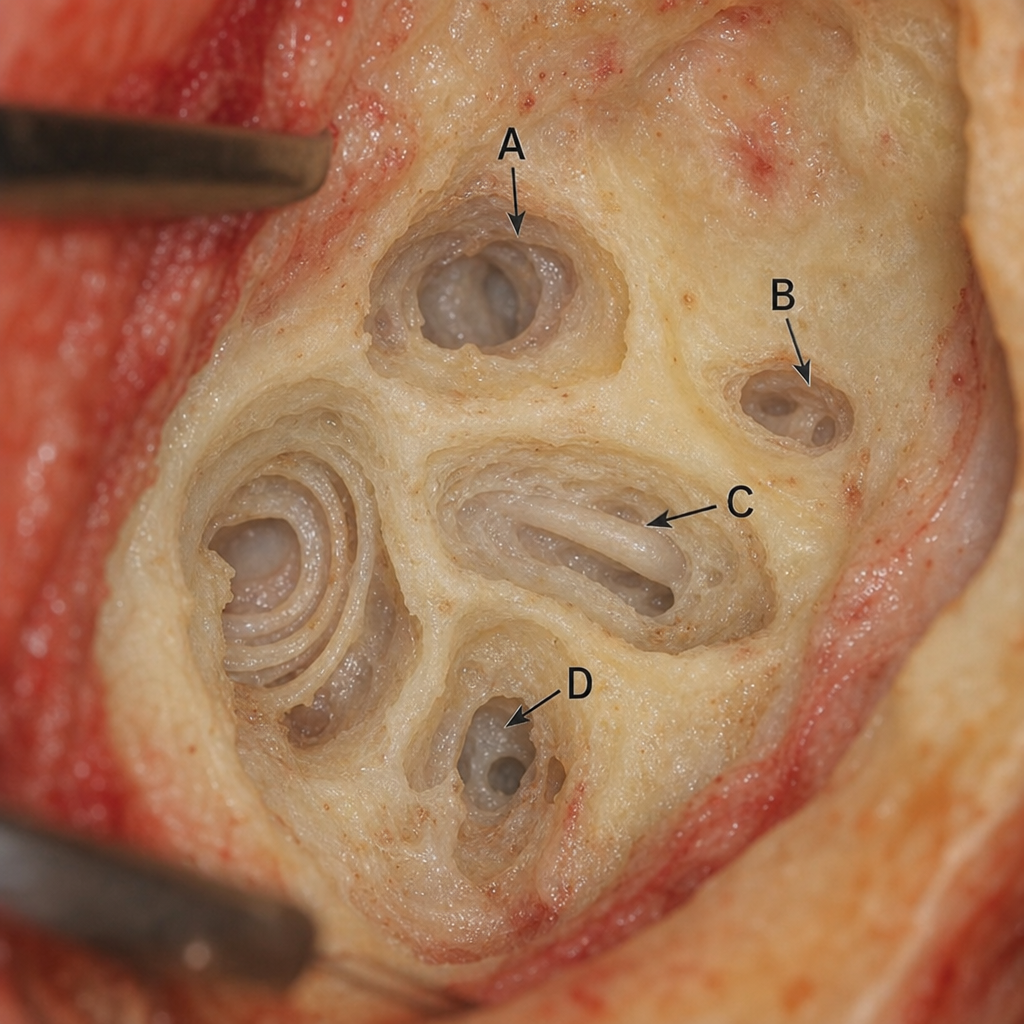
MicroWick and Microcatheter sustained release devices are used for what purpose?
What is the most important sensory organ in the ampulla?
What is the consequence of prolonged blockade of the Eustachian tube?
Scanty, foul-smelling, painless discharge from the ear is a characteristic feature of which of the following lesions?
A female patient who has undergone stapedectomy presents with a conductive hearing loss of 60 dB. What is the most likely diagnosis?
Use of Siegel's speculum during an examination of the ear provides all except?
What is the lever ratio of the tympanic membrane?
In stapedotomy, which of the following is removed?
Which statement about deafness in Alport syndrome is true?
Carha's notch is associated with which of the following conditions?
Explanation: **Explanation:** The correct answer is **D. Delivering drugs to the round window membrane.** **Underlying Concept:** The MicroWick and Microcatheter are specialized **intratympanic drug delivery systems** designed for "Transtympanic Micropumps." These devices facilitate the sustained release of medications (most commonly steroids like dexamethasone or aminoglycosides like gentamicin) directly to the **round window membrane (RWM)**. From the RWM, the drug diffuses into the perilymph of the inner ear. This method is preferred in conditions like **Meniere’s disease** and **Sudden Sensorineural Hearing Loss (SSNHL)** because it achieves high local concentrations in the cochlea while avoiding the systemic side effects of oral steroids. **Analysis of Incorrect Options:** * **A & B (Drooling and Frey’s Syndrome):** These conditions are related to salivary gland pathology. Drooling is often managed with glycopyrrolate or Botox injections into the salivary glands. Frey’s syndrome (gustatory sweating) is managed with topical antiperspirants or Botox; it is not treated via middle ear delivery systems. * **C (Epistaxis):** Epistaxis is managed via nasal packing (anterior/posterior), cauterization, or arterial ligation/embolization. These ear-specific micro-devices have no role in nasal hemostasis. **High-Yield Clinical Pearls for NEET-PG:** * **MicroWick:** A small polyvinyl acetate sponge inserted through a tympanostomy tube that rests against the round window. The patient self-administers ear drops onto the wick. * **Silverstein MicroWick:** Often associated with the treatment of intractable vertigo in Meniere’s. * **Round Window Membrane:** The primary portal for non-invasive entry of medications into the inner ear. * **Intratympanic Gentamicin:** Used for chemical labyrinthectomy in Meniere's to control vertigo while attempting to preserve hearing.
Explanation: **Explanation:** The inner ear consists of the bony and membranous labyrinth, housing the sensory organs for both hearing and equilibrium. The vestibular system, responsible for balance, is divided into the **semicircular canals** and the **otolith organs** (utricle and saccule). 1. **Why Crista is Correct:** Each of the three semicircular canals has a dilated end called the **ampulla**. Inside this ampulla lies the **Crista Ampullaris**, the sensory neuroepithelium responsible for detecting **angular acceleration** (rotational movements of the head). It consists of hair cells embedded in a gelatinous mass called the cupula. 2. **Why the other options are incorrect:** * **Organ of Corti:** This is the sensory organ for **hearing**, located within the scala media of the **cochlea**, not the vestibular system. * **Macula:** This is the sensory epithelium found in the **utricle and saccule**. It detects **linear acceleration** and gravitational forces (static equilibrium). * **Otolith:** These are calcium carbonate crystals (statoconia) located on top of the otolithic membrane in the **macula**. They are components of the sensory organ, not the organ itself, and are not found in the ampulla. **High-Yield Clinical Pearls for NEET-PG:** * **Crista:** Detects **Angular** acceleration (Mnemonic: **A**mpulla = **A**ngular). * **Macula:** Detects **Linear** acceleration (Mnemonic: **M**acula = **L**inear). * The **Utricle** responds to horizontal linear acceleration, while the **Saccule** responds to vertical linear acceleration. * **BPPV (Benign Paroxysmal Positional Vertigo):** Occurs when otoliths (canaliths) from the macula displace into the semicircular canals, most commonly the posterior canal.
Explanation: ### Explanation The Eustachian tube (ET) is essential for middle ear ventilation, protection, and drainage. Prolonged blockade leads to a sequence of pathological changes known as **Eustachian Tube Dysfunction (ETD)**. **1. Why "All of the above" is correct:** The underlying mechanism is the development of **negative middle ear pressure**. According to Boyle’s Law, when the ET fails to open, oxygen in the middle ear is absorbed by the mucosal vessels, creating a vacuum. * **Atelectatic Ear:** The negative pressure causes the tympanic membrane (TM) to be sucked inward (retraction). Over time, the fibrous layer of the TM weakens, leading to a collapsed or "atelectatic" ear. * **Cholesteatoma:** Prolonged retraction (especially in the pars flaccida) creates a **retraction pocket**. As keratin debris accumulates within this pocket and cannot be cleared, it forms a primary acquired cholesteatoma. * **Perforation:** Chronic negative pressure and recurrent inflammation (Otitis Media with Effusion) can lead to atrophy of the TM. This thinned membrane is highly susceptible to spontaneous rupture or necrosis, resulting in a permanent perforation. **2. Clinical Pearls for NEET-PG:** * **Toynbee Phenomenon:** Swallowing when the nose is obstructed leads to negative middle ear pressure. * **Earliest Sign of ETD:** Retraction of the tympanic membrane (short process of malleus becomes prominent). * **Management:** Valsalva maneuver, decongestants, or surgical intervention like Myringotomy with Grommet insertion to equalize pressure. **Conclusion:** Prolonged ET blockade is the "starting point" for a spectrum of chronic ear diseases, ranging from simple retraction to bone-eroding cholesteatoma and permanent perforation.
Explanation: ### Explanation The correct answer is **Cholesteatoma (Option B)**. **1. Why Cholesteatoma is Correct:** Cholesteatoma is a hallmark of **Attico-antral type** (unsafe) Chronic Suppurative Otitis Media (CSOM). The discharge is characteristically **scanty, foul-smelling, and painless**. * **Scanty:** Because the discharge arises from bone erosion and desquamated keratin rather than active mucosal secretion. * **Foul-smelling:** Due to the presence of anaerobic organisms and the osteitic (bone-eroding) nature of the disease. * **Painless:** Chronic ear disease is typically painless unless complications like mastoiditis or intracranial abscess occur. **2. Why the Other Options are Incorrect:** * **A. ASOM:** Presents with **severe earache** (otalgia) and fever. If the drum ruptures, the discharge is typically **profuse and blood-stained** initially, followed by mucopurulent discharge. * **C. Central Perforation:** This is seen in **Tubotympanic type** (safe) CSOM. The discharge is typically **profuse, mucoid/mucopurulent, and odorless**. It is not associated with bone erosion. * **D. Otitis Externa:** Usually presents with **severe pain** (especially on moving the pinna or tragus) and itching. The discharge is watery or serous, not typically "scanty and foul-smelling" in a chronic sense. **3. High-Yield Clinical Pearls for NEET-PG:** * **Safe vs. Unsafe CSOM:** Safe (Tubotympanic) involves the pars tensa and has mucoid discharge; Unsafe (Attico-antral) involves the pars flaccida/posterosuperior quadrant and has purulent, foul discharge. * **Bone Erosion:** Cholesteatoma produces enzymes like **collagenases and acid phosphatases** that destroy bone. * **The "Painless" Rule:** In ENT, a painless, foul-smelling ear discharge should always raise suspicion of Cholesteatoma or Malignancy. * **Microscopy:** The presence of "flakes of white" (keratin) in the discharge is pathognomonic for Cholesteatoma.
Explanation: ### Explanation **1. Why "Closure of the Oval Window" is correct:** In a patient who has undergone stapedectomy, the reappearance of a significant conductive hearing loss (CHL) suggests a mechanical failure in the sound conduction mechanism. A **60 dB conductive hearing loss** is the maximum possible CHL (representing a complete loss of ossicular continuity or total blockage). In the context of post-stapedectomy, "closure of the oval window" refers to **re-obliterative otosclerosis** or the formation of thick fibrous tissue/bone over the oval window. This effectively seals the window, preventing the piston from transmitting vibrations to the perilymph, leading to a maximal air-bone gap. **2. Analysis of Incorrect Options:** * **Implant failure (Piston displacement):** While a common cause of post-operative CHL, displacement usually results in a moderate hearing loss (30-40 dB). A 60 dB loss specifically points toward a total lack of oval window mobility. * **Fistula (Perilymph fistula):** This typically presents with **sensorineural hearing loss (SNHL)**, vertigo, and a positive fistula sign, rather than a pure 60 dB conductive loss. * **Tympanic membrane perforation:** While this causes CHL, a simple perforation rarely causes a 60 dB loss unless accompanied by total ossicular disconnection. It is also a less common late complication compared to oval window issues in stapedectomy patients. **3. Clinical Pearls for NEET-PG:** * **Maximal CHL:** Always remember that a **60 dB Air-Bone Gap** indicates complete ossicular discontinuity or total oval window fixation. * **Carhart’s Notch:** A characteristic dip in the bone conduction curve at **2000 Hz** seen in otosclerosis, which disappears after successful stapedectomy. * **Schwartz Sign:** A flamingo-pink hue seen through the TM indicating active otosclerosis (vascularization of the promontory). * **Gelle’s Test:** Negative in otosclerosis (indicates a fixed ossicular chain).
Explanation: **Explanation:** Siegel’s speculum is a specialized pneumatic speculum used in clinical otology to create an airtight seal in the external auditory canal, allowing for the observation of the tympanic membrane (TM) under pressure changes. **Why Option C is the correct answer:** Siegel’s speculum is a diagnostic and therapeutic tool, but it is **not** used for the removal of foreign bodies. Foreign body removal requires specialized instruments like Hartmann’s forceps, a Jobson-Horne probe, or syringing. The closed system of the Siegel’s speculum would actually obstruct the mechanical access needed to extract a foreign body. **Analysis of other options:** * **A. Magnification:** The eyepiece of the Siegel’s speculum contains a convex lens (usually +2.5 to +3 diopters), which provides a magnified view of the TM. * **B. Assessment of TM movement:** By squeezing the attached rubber bulb, the clinician changes the air pressure in the canal. This is the gold standard clinical method to assess TM mobility (e.g., restricted in Otitis Media with Effusion or fixed in tympanosclerosis). * **D. Applicator for powdered antibiotics:** In a technique known as "powder insufflation," the speculum can be used to blow antibiotic powder into the middle ear or mastoid cavity through a perforation. **Clinical Pearls for NEET-PG:** * **Fistula Test:** Siegel’s speculum is used to perform the Fistula test. Positive pressure induces vertigo and nystagmus if a labyrinthine fistula (usually in the lateral semicircular canal) is present. * **Gelle’s Test:** Used to differentiate between ossicular fixation (Otosclerosis) and sensorineural hearing loss. * **Differentiation:** It helps distinguish a **safe (mucosal)** perforation from an **unsafe (squamosal)** one by providing a clearer, magnified view of the attic and posterior-superior quadrant.
Explanation: The middle ear acts as an **impedance matching transformer** to bridge the gap between the low impedance of air and the high impedance of cochlear fluids. This is achieved through three primary mechanisms: the Area Ratio, the Lever Ratio, and the Catenary Effect. ### 1. The Correct Answer: 1.3:1 The **Lever Ratio** is derived from the anatomical relationship between the ossicles. The handle of the malleus is approximately **1.3 times longer** than the long process of the incus. According to the laws of physics, this creates a mechanical advantage where the force exerted at the incus is increased by a factor of 1.3. This contributes significantly to the overall pressure gain required for hearing. ### 2. Analysis of Incorrect Options * **A & D (1.4:1 and 1.5:1):** These are common distractors. While minor anatomical variations exist, the standard physiological value taught in textbooks (like Dhingra) and tested in NEET-PG is 1.3:1. * **C (18.2:1):** This represents the **Hydraulic Ratio (Area Ratio)**. The effective vibrating area of the tympanic membrane (55 $mm^2$) is about 17–18 times larger than the area of the stapes footplate (3.2 $mm^2$). ### 3. High-Yield Clinical Pearls for NEET-PG * **Total Transformer Ratio:** The product of the Area Ratio (17:1) and the Lever Ratio (1.3:1) equals approximately **22:1**. * **Decibel Gain:** This transformer mechanism provides a pressure gain of about **25–30 dB**. * **Catenary Effect:** The curved shape of the tympanic membrane provides an additional mechanical advantage (factor of 2), though it is often grouped within the area ratio calculations in simplified models. * **Natural Resonance:** The external auditory canal resonates at **3000 Hz**, while the middle ear resonates at **800–1000 Hz**.
Explanation: In **Stapedotomy**, the primary objective is to bypass the fixed stapes footplate to restore sound conduction. The surgical procedure involves several critical steps that necessitate the removal of specific structures to gain access and facilitate the placement of a prosthesis. ### Why the Lenticular Process of Incus is the Correct Answer To disconnect the incudostapedial joint and create space for the piston, the **lenticular process of the incus** is often functionally bypassed or partially removed during the separation process. In the context of this specific question (which frequently appears in PG entrance exams), it refers to the separation and management of the incudostapedial joint. However, it is important to note that in a standard stapedotomy, the **stapedius tendon** and the **posterior crus** are routinely divided/removed, while the **anterior crus** is fractured. *Note: There is often debate in ENT literature regarding this specific question. In clinical practice, the posterior crus and tendon are always removed, but "Lenticular process" is sometimes cited in specific question banks referring to the joint separation.* ### Explanation of Other Options * **Stapedius Tendon:** This is always divided during the procedure to mobilize the ossicular chain. * **Posterior Crus:** This is routinely removed (crural arch is broken) to provide a clear view of the footplate for the fenestration. * **Anterior Crus:** This is typically fractured or snapped, but not necessarily "removed" from the middle ear cavity in the same way the posterior crus is. ### High-Yield Clinical Pearls for NEET-PG * **Indication:** Otosclerosis (conductive hearing loss with a normal TM and intact mobility). * **Schwartz Sign:** Reddish hue on the promontory (active otosclerosis). * **Carhart’s Notch:** Dip in bone conduction at **2000 Hz**, which disappears after successful surgery. * **Prosthesis:** Usually made of Teflon or Stainless Steel. It connects the **long process of the incus** to the oval window. * **Most common complication:** Vertigo (post-operative) or Chorda tympani nerve injury (taste disturbance).
Explanation: ### Explanation **Alport Syndrome** is a hereditary disorder caused by mutations in the genes encoding **Type IV collagen** (specifically the $\alpha3$, $\alpha4$, and $\alpha5$ chains). Since Type IV collagen is a structural component of basement membranes in the kidney (glomerulus), eye, and cochlea, the clinical manifestations are multisystemic. #### Why Option C is Correct: The auditory involvement in Alport syndrome is a **progressive sensorineural hearing loss (SNHL)**. Crucially, the hearing loss never occurs in isolation; it is **always accompanied by renal manifestations**, such as hematuria or proteinuria, which typically precede the deafness. The defect lies in the stria vascularis of the cochlea, which shares similar basement membrane characteristics with the renal glomerulus. #### Why Other Options are Incorrect: * **Option A:** The deafness is **Sensorineural**, not conductive. It typically affects high frequencies (2000–8000 Hz) initially. * **Option B:** It is **not congenital**. Hearing is usually normal at birth; the deficit typically manifests during late childhood or adolescence (usually before age 20). * **Option C:** The progression is generally **gradual**, not "fast progressing," though it can lead to significant impairment by early adulthood. #### NEET-PG High-Yield Pearls: * **Inheritance:** Most common is **X-linked Dominant** (COL4A5 mutation). * **Classic Triad:** 1. **Renal:** Progressive hematuria leading to End-Stage Renal Disease (ESRD). 2. **Ocular:** **Anterior Lenticonus** (pathognomonic) and "dot-and-fleck" retinopathy. 3. **Auditory:** Bilateral high-frequency SNHL. * **Diagnosis:** Electron microscopy of renal biopsy shows a characteristic **"Basket-weave" appearance** of the Glomerular Basement Membrane (GBM).
Explanation: **Explanation:** **Carhart’s Notch** is a classic audiometric finding pathognomonic for **Otosclerosis**. It is characterized by a dip in the bone conduction threshold, most prominent at **2000 Hz (2 kHz)**. **Why Otosclerosis is correct:** In Otosclerosis, stapes fixation occurs due to bony overgrowth at the oval window. This fixation disrupts the normal mechanical resonance of the ossicular chain. Since bone conduction thresholds partially depend on the inertial movement of the ossicles, this mechanical impairment results in a "false" sensorineural deficit. Importantly, this notch is **reversible**; following a successful stapedectomy, the bone conduction thresholds typically improve (the notch disappears). **Why other options are incorrect:** * **ASOM:** This is an acute bacterial infection of the middle ear. It presents with a bulging tympanic membrane and conductive hearing loss, but not a specific notch at 2 kHz. * **CSOM:** This involves chronic inflammation and perforation. While it causes conductive hearing loss, the bone conduction remains stable unless there is labyrinthine involvement (causing a general SNHL). * **Cholesteatoma:** This is a destructive keratinizing squamous epithelium. It causes ossicular erosion leading to conductive hearing loss, but it does not produce the specific mechanical resonance shift seen in stapes fixation. **High-Yield Clinical Pearls for NEET-PG:** * **Frequency:** Carhart’s notch is maximum at **2000 Hz**. * **Schwartz Sign:** A flamingo-pink flush seen on the promontory through the TM (indicates active otosclerosis/otospongiosis). * **Gelle’s Test:** Negative in Otosclerosis (indicates fixed ossicles). * **Tympanometry:** Typically shows an **As type** curve (stiffened system). * **Treatment of Choice:** Stapedotomy/Stapedectomy.
Tympanic Membrane Perforation
Practice Questions
Cholesteatoma
Practice Questions
Tympanoplasty Techniques
Practice Questions
Ossicular Chain Reconstruction
Practice Questions
Mastoidectomy
Practice Questions
Stapedectomy
Practice Questions
Implantable Hearing Devices
Practice Questions
Congenital Aural Atresia
Practice Questions
Otologic Trauma
Practice Questions
Glomus Tumors
Practice Questions
Facial Nerve Decompression
Practice Questions
Rehabilitative Audiology
Practice Questions
Get full access to all questions, explanations, and performance tracking.
Start For Free