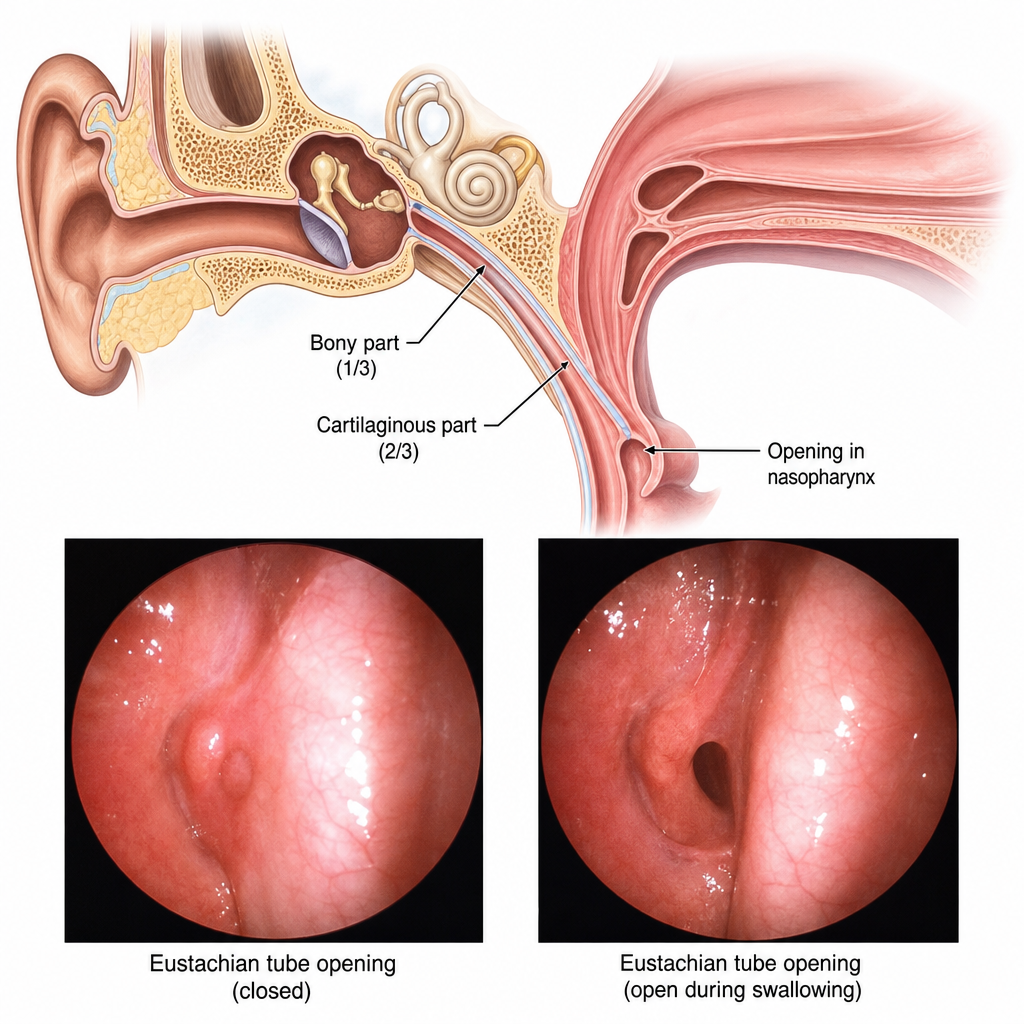
A child presents with barotrauma pain without middle ear inflammation. What is the management?
The Queckenstedt test is performed to assess:
What is the most common site for a vestibular schwannoma (VIIIth cranial nerve schwannoma)?
Fisch classification is used for classifying which of the following malignancy?
The columella effect is observed in which surgical procedure?
Otoacoustic emissions arise from which structure?
All of the following will produce conductive hearing loss, EXCEPT?
What is the treatment of choice for perforation in the pars flaccida of the tympanic membrane with cholesteatoma?
Which virus is known to cause unilateral sensorineural hearing loss?
Which of the following is true about the stapedial reflex?
Explanation: ### Explanation **Core Concept: Understanding Otic Barotrauma** Otic barotrauma occurs due to a pressure difference between the middle ear and the external environment, typically during rapid altitude changes (diving or flying). This results from **Eustachian tube dysfunction**. In the absence of middle ear inflammation, infection, or significant hemotympanum, the condition is usually self-limiting. **Why Supportive Care is Correct:** The primary goal in uncomplicated barotrauma is to restore middle ear pressure. **Supportive care** is the first-line management. This includes: * **Decongestants** (nasal or systemic) to reduce edema around the Eustachian tube orifice. * **Autoinflation maneuvers** (e.g., Valsalva maneuver) to force air into the middle ear. * **Analgesics** (NSAIDs) for pain relief. Most cases resolve spontaneously once the pressure equilibrates. **Why Other Options are Incorrect:** * **A. Antibiotics:** These are only indicated if there is secondary bacterial infection (Otitis Media). In this scenario, there is no inflammation or infection. * **B. Myringotomy:** This is a surgical procedure to release fluid or pressure. It is reserved for severe, refractory cases or when there is intense pain and significant middle ear effusion that fails medical therapy. * **C. Grommet Insertion:** This is a long-term solution for chronic Eustachian tube dysfunction or recurrent Serous Otitis Media. It is not indicated for an acute, uncomplicated episode of barotrauma. **High-Yield Clinical Pearls for NEET-PG:** * **Boyle’s Law** explains barotrauma: Volume of gas is inversely proportional to pressure. * **Teed Classification** is used to grade the severity of middle ear barotrauma (Grade 0-5). * **Prevention:** Advise patients to chew gum, swallow, or use the Valsalva maneuver during aircraft descent. * **Diving:** Barotrauma occurs most commonly during **descent** (negative middle ear pressure).
Explanation: The **Queckenstedt test** (also known as the jugular compression test) is a clinical maneuver used to assess the patency of the spinal subarachnoid space or to confirm the presence of a cerebrospinal fluid (CSF) leak. ### **Explanation of the Correct Answer** In the context of **CSF rhinorrhea**, the Queckenstedt test is used as a provocative maneuver. When the internal jugular veins are compressed, there is an acute increase in intracranial pressure (ICP). This rise in pressure forces CSF through any existing dural defect in the skull base (e.g., cribriform plate or sphenoid sinus), causing an increase in the rate of clear fluid dripping from the nose. This helps the clinician confirm that the nasal discharge is indeed CSF. ### **Why Other Options are Incorrect** * **Glomus Tumor:** These are vascular tumors. While the **Brown’s sign** (blanching of the mass on positive pressure) is relevant here, the Queckenstedt test has no diagnostic value for these tumors. * **Otosclerosis:** This is a bony remodeling disorder of the otic capsule. Diagnosis is primarily via clinical history, otoscopy (Schwartze sign), and pure tone audiometry (Carhart’s notch). * **Acoustic Neuroma:** This is a tumor of the 8th cranial nerve. Diagnosis relies on Gadolinium-enhanced MRI and Audiometry (retrocochlear pathology). ### **High-Yield Clinical Pearls for NEET-PG** * **Original Use:** Historically, the Queckenstedt test was used during lumbar puncture to rule out spinal canal obstruction (e.g., spinal cord tumor). If JVP compression fails to raise CSF pressure in the manometer, it indicates a block (Positive Queckenstedt). * **Differentiating CSF from Nasal Mucus:** * **Target/Halo Sign:** CSF forms a central blood spot with a clear outer ring on filter paper. * **Beta-2 Transferrin:** The most specific biochemical marker for CSF. * **Glucose content:** CSF has high glucose; mucus does not. * **Contraindication:** Never perform this test if increased intracranial pressure (e.g., intracranial mass) is suspected, as it can precipitate brain herniation.
Explanation: **Explanation:** **Vestibular Schwannoma** (incorrectly termed Acoustic Neuroma) is a benign tumor arising from the Schwann cells of the vestibular portion of the VIIIth cranial nerve. **1. Why Intracanalicular is correct:** The most common site of origin for a vestibular schwannoma is the **inferior vestibular nerve** within the **Internal Auditory Canal (IAC)**. Specifically, the tumor typically originates at the **Obersteiner-Redlich zone**, which is the transition point where the peripheral myelin (Schwann cells) meets the central myelin (oligodendrocytes). Since this transition zone is located within the IAC, the initial and most common site is **intracanalicular**. **2. Why other options are incorrect:** * **Intrapetrous:** While the IAC is located within the petrous part of the temporal bone, "intrapetrous" is a broad anatomical region and not the specific site of origin for these nerve tumors. * **Intraparotid:** This refers to the facial nerve (VII) as it passes through the parotid gland. Schwannomas here are rare and would present as a parotid mass, not vestibulocochlear symptoms. * **Cisternal:** This refers to the Cerebellopontine Angle (CPA) cistern. While tumors often grow out of the canal into this space (becoming "cisternal"), they do not typically *originate* here. **Clinical Pearls for NEET-PG:** * **Most common symptom:** Progressive unilateral sensorineural hearing loss (SNHL) and tinnitus. * **Gold Standard Investigation:** Gadolinium-enhanced MRI (shows "ice-cream cone" appearance). * **Bilateral Vestibular Schwannomas:** Pathognomonic for **Neurofibromatosis Type 2 (NF2)**. * **Early Sign:** Loss of corneal reflex (due to pressure on the Vth nerve as the tumor expands). * **Hitselberger’s Sign:** Hypesthesia of the posterior meatal wall (due to VIIth nerve compression).
Explanation: **Explanation:** The **Fisch Classification** is the most widely used system for staging **Glomus tumors** (Paragangliomas) of the temporal bone. It is based on the anatomical extension of the tumor and its involvement of the skull base, which is crucial for determining the surgical approach. * **Class A:** Tumors limited to the middle ear cleft (Glomus tympanicum). * **Class B:** Tumors limited to the tympanomastoid area without bone destruction in the infralabyrinthine compartment. * **Class C:** Tumors extending into the infralabyrinthine and apical compartments with destruction of the infralabyrinthine bone. * **Class D:** Tumors with intracranial extension. **Analysis of Incorrect Options:** * **A, C, & D:** Paravertebral tumors, synovial sarcomas, and retroperitoneal tumors use different staging systems (such as TNM or Enneking classification). The Fisch classification is specific to the complex anatomy of the temporal bone and skull base. **High-Yield Clinical Pearls for NEET-PG:** 1. **Glomus Tumors:** These are highly vascular tumors arising from paraganglia. The most common symptom is **pulsatile tinnitus**, and the classic sign is a **"Rising Sun" appearance** behind the tympanic membrane. 2. **Brown’s Sign:** Blanching of the tumor on positive pressure with a Siegel’s speculum (seen in Glomus tumors). 3. **Phelps' Sign:** Loss of the bony plate between the carotid canal and the jugular bulb (seen on CT). 4. **Glasscock-Jackson Classification:** Another common staging system specifically for Glomus Tympanicum and Glomus Jugulare. 5. **Treatment of Choice:** Surgical excision (e.g., Tympanotomy for Class A, Infratemporal fossa approach for Class C). Pre-operative embolization is often used to reduce vascularity.
Explanation: **Explanation:** The **Columella Effect** is a fundamental principle in middle ear reconstructive surgery, specifically **Tympanoplasty**. In a normal ear, the surface area ratio between the tympanic membrane and the stapes footplate (17:1) creates a hydraulic pressure gain. When the ossicular chain is damaged but the stapes remains mobile, surgeons perform a **Type III Tympanoplasty**. In this procedure, the tympanic membrane (or a graft) is placed directly in contact with the head of the stapes. This creates a "columella" (a single bone link), similar to the anatomy found in birds. This direct transmission of sound from the drum to the stapes bypasses the malleus and incus, maintaining an effective, albeit reduced, sound conduction mechanism. **Analysis of Options:** * **A. Tympanoplasty (Correct):** As described, the columella effect is the physiological basis for Type III tympanoplasty, ensuring sound reaches the oval window directly via the stapes. * **B. Septoplasty:** This is a surgical procedure to straighten a deviated nasal septum. It involves the nasal airway and has no physiological connection to middle ear sound conduction. * **C. Tracheostomy:** This is an operative procedure to create an opening in the trachea to facilitate breathing. It does not involve the auditory apparatus. **High-Yield Clinical Pearls for NEET-PG:** * **Wullstein’s Classification:** Remember that Type III Tympanoplasty is specifically known as the **"Myringostapediopexy"** or the Columella technique. * **Acoustic Separation:** In cases where the ossicular chain is absent, the goal is to provide sound protection for the round window while sound is directed to the oval window (the "Shield Effect"). * **Prerequisite:** For the columella effect to be successful, the stapes footplate must be **mobile**. If it is fixed, a stapedectomy or fenestration is required.
Explanation: **Explanation:** Otoacoustic Emissions (OAEs) are low-intensity sounds generated within the cochlea that can be measured in the external auditory canal. The correct answer is **Outer Hair Cells (OHCs)** because they possess a unique property called **electromotility**. 1. **Why Outer Hair Cells (OHCs) are correct:** OHCs contain a specialized motor protein called **Prestin**. When stimulated by sound, these cells physically contract and elongate (the cochlear amplifier). This mechanical movement enhances the sensitivity and frequency selectivity of the cochlea. A byproduct of this mechanical energy travels backward through the middle ear and vibrates the tympanic membrane, creating the sound we record as OAEs. 2. **Why Inner Hair Cells (IHCs) are incorrect:** IHCs are the primary sensory receptors that convert mechanical vibrations into neural signals (via the auditory nerve). They do not possess electromotility and do not generate mechanical energy; therefore, they do not produce OAEs. 3. **Why "Both" or "Organ of Corti" are incorrect:** While OHCs are part of the Organ of Corti, the question asks for the specific structure responsible. Attributing OAEs to the entire Organ of Corti or IHCs is physiologically inaccurate. **High-Yield Clinical Pearls for NEET-PG:** * **Clinical Use:** OAEs are the gold standard for **Universal Newborn Hearing Screening (UNHS)** because they are non-invasive, objective, and quick. * **Prerequisite:** To record OAEs, the patient must have a **normal middle ear function**. * **Interpretation:** The presence of OAEs indicates a hearing threshold of **30 dB or better**. * **Auditory Neuropathy:** A classic exam scenario involves a patient with **Normal OAEs but absent/abnormal BERA** (indicating a lesion distal to the OHCs, such as the auditory nerve).
Explanation: **Explanation:** The core concept in this question is distinguishing between **Conductive Hearing Loss (CHL)**, which results from pathology in the external or middle ear, and **Sensorineural Hearing Loss (SNHL)**, which arises from disorders of the inner ear (cochlea) or the vestibulocochlear nerve (CN VIII). **Why Endolymphatic Hydrops is the correct answer:** Endolymphatic hydrops (the underlying pathology of **Meniere’s disease**) is a disorder of the inner ear characterized by increased pressure of the endolymph. Since it affects the cochlea, it produces a **Sensorineural Hearing Loss**, typically fluctuating and involving lower frequencies in the early stages. It does not interfere with the mechanical conduction of sound through the middle ear. **Analysis of incorrect options (Causes of CHL):** * **Otosclerosis:** A condition involving bony overgrowth of the stapes footplate, which prevents it from vibrating against the oval window, leading to CHL. * **Serous Otitis Media:** The presence of non-purulent fluid in the middle ear space creates a physical barrier to sound transmission, causing CHL. * **Suppurative Otitis Media (ASOM/CSOM):** Inflammation, pus accumulation, or tympanic membrane perforation in the middle ear disrupts the ossicular chain's efficiency, resulting in CHL. **Clinical Pearls for NEET-PG:** * **Meniere’s Disease Triad:** Vertigo, Tinnitus, and Fluctuating SNHL. * **Carhart’s Notch:** A characteristic dip in bone conduction at **2000 Hz** seen in Otosclerosis (a "pseudo-SNHL" finding in a CHL case). * **Gelle’s Test:** Used to differentiate Otosclerosis (Negative) from other causes of CHL. * **Schwartz Sign:** A flamingo-pink flush on the promontory seen in active otosclerosis.
Explanation: **Explanation:** The clinical presentation of a **pars flaccida perforation** associated with **cholesteatoma** indicates **Attico-antral type** of Chronic Suppurative Otitis Media (CSOM). This is considered the "unsafe" type because cholesteatoma is bone-eroding and can lead to life-threatening intracranial complications. 1. **Why Modified Radical Mastoidectomy (MRM) is correct:** The primary goal in treating Attico-antral disease is the complete removal of the cholesteatoma and the creation of a "safe" ear. **Modified Radical Mastoidectomy (Bondy’s procedure)** is the treatment of choice because it exteriorizes the disease by removing the posterior canal wall and opening the mastoid antrum, while specifically **preserving the remnants of the tympanic membrane and the ossicular chain** (if functional). This allows for both disease clearance and the possibility of hearing preservation/reconstruction. 2. **Why other options are incorrect:** * **Myringoplasty:** This is a simple repair of the tympanic membrane (Pars Tensa). It is contraindicated in the presence of cholesteatoma as it would "trap" the disease inside the middle ear. * **Antibiotics:** While topical or systemic antibiotics may control secondary infection (ear discharge), they cannot eliminate a cholesteatoma, which is a structural/epithelial pathology requiring surgical intervention. * **Radical Mastoidectomy:** This involves the removal of the tympanic membrane, ossicles (except stapes), and closure of the Eustachian tube. It is reserved for cases with extensive disease, complications, or where hearing preservation is impossible. MRM is preferred over Radical Mastoidectomy to maintain better functional outcomes. **High-Yield Clinical Pearls for NEET-PG:** * **Safe vs. Unsafe:** Pars tensa perforations (Tubotympanic) are "safe"; Pars flaccida/Marginal perforations (Attico-antral) are "unsafe." * **Cholesteatoma Hallmark:** Presence of keratin debris and bone erosion (via osteoclast activation). * **Surgery Goal:** The hierarchy of surgery is: 1. Safety (clearance), 2. Dry ear, 3. Hearing preservation.
Explanation: **Explanation:** **Mumps** is the most common viral cause of **sudden, profound, unilateral sensorineural hearing loss (SNHL)** in children and young adults. The virus causes endolymphatic labyrinthitis, leading to the destruction of the hair cells in the Organ of Corti and the stria vascularis. While the parotitis is usually bilateral, the associated hearing loss is characteristically unilateral and often permanent. **Analysis of Options:** * **Rubella (Option A):** Congenital Rubella Syndrome typically causes **bilateral**, severe to profound SNHL (often described as a "cookie-bite" audiogram). It is a classic cause of congenital deafness rather than acquired unilateral loss. * **Herpes Simplex (Option C):** While HSV is implicated in conditions like Bell’s Palsy or vestibular neuritis, it is not the primary viral association for isolated unilateral SNHL. * **Epstein-Barr Virus (Option D):** EBV can cause infectious mononucleosis and is associated with Nasopharyngeal Carcinoma, but it is a rare cause of sensorineural hearing loss. **Clinical Pearls for NEET-PG:** * **Mumps:** The hearing loss is typically sudden in onset and may occur even in the absence of clinical parotitis. * **Measles:** Usually causes **bilateral** SNHL. * **Labyrinthitis:** Viral labyrinthitis (often following a URI) is another common cause of sudden unilateral SNHL, but among specific named viruses, Mumps is the classic examiner favorite. * **Management:** Sudden SNHL is a medical emergency; the treatment of choice is systemic (and sometimes intratympanic) corticosteroids.
Explanation: ### Explanation The **stapedial reflex** (acoustic reflex) is an involuntary muscle contraction in the middle ear in response to high-intensity sound stimuli. **1. Why the correct answer is right:** When a loud sound (typically >70–90 dB above threshold) enters the ear, the **stapedius muscle** contracts. This increases the stiffness of the ossicular chain, specifically pulling the stapes away from the oval window. This mechanism reduces the transmission of low-frequency sound energy to the cochlea, thereby **protecting the delicate hair cells from noise-induced damage** and preventing "masking" of high-frequency sounds by low-frequency background noise. **2. Why the other options are wrong:** * **Option A:** It is a **cranial reflex**, not a spinal reflex. The arc involves the Vestibulocochlear nerve (CN VIII) as the afferent limb and the Facial nerve (CN VII) as the efferent limb. * **Option B:** In **Meniere’s disease**, the reflex is typically present (often showing "recruitment"), but it is **not** the first manifestation. Early signs usually include episodic vertigo, fluctuating sensorineural hearing loss, and tinnitus. * **Option D:** It is a **polysynaptic reflex**, but the question asks for the "most true" functional description. While it involves multiple synapses in the brainstem (Ventral Cochlear Nucleus → Superior Olivary Complex → Facial Nerve Nucleus), its primary physiological *purpose* is protection. *Note: In some contexts, it is classified as a disynaptic or polysynaptic arc; however, "protection" is its defining clinical characteristic.* **Clinical Pearls for NEET-PG:** * **Reflex Arc:** CN VIII (Afferent) → Cochlear Nucleus → Superior Olivary Complex (Bilateral) → CN VII Nucleus → CN VII (Efferent) → Stapedius Muscle. * **Bilateral Response:** A sound in one ear causes contraction in both ears (ipsilateral and contralateral reflexes). * **Absence of Reflex:** Seen in Otosclerosis (stapes fixation), CN VII palsy (proximal to the nerve to stapedius), and profound SNHL. * **Metz Recruitment Test:** If the reflex is elicited at <60 dB above the hearing threshold, it indicates **cochlear pathology** (Recruitment).
Tympanic Membrane Perforation
Practice Questions
Cholesteatoma
Practice Questions
Tympanoplasty Techniques
Practice Questions
Ossicular Chain Reconstruction
Practice Questions
Mastoidectomy
Practice Questions
Stapedectomy
Practice Questions
Implantable Hearing Devices
Practice Questions
Congenital Aural Atresia
Practice Questions
Otologic Trauma
Practice Questions
Glomus Tumors
Practice Questions
Facial Nerve Decompression
Practice Questions
Rehabilitative Audiology
Practice Questions
Get full access to all questions, explanations, and performance tracking.
Start For Free