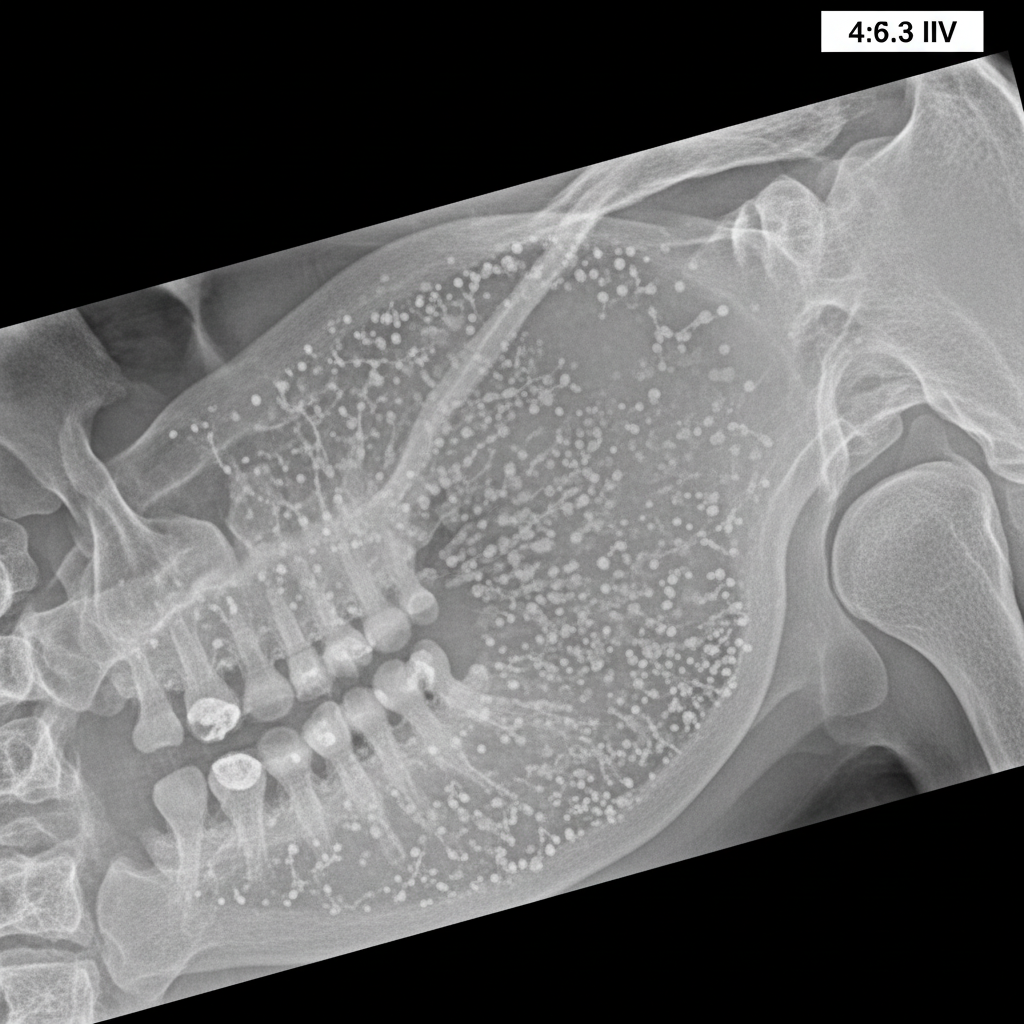
What is the most malignant tumor of the salivary glands?
Mucous retention cysts are most commonly found on which anatomical location?
What is the most common cause of trismus due to infection in a muscle?
A businessman notices a lump in front of his ear while shaving. His wife thinks it has been present for several months. What is the most likely cause of a mass in the parotid gland in this patient?
A painless, fluid-filled retention cyst appearing in an area of recent dental treatment may be the result of which of the following?
In community-acquired acute bacterial sialadenitis, what is the most common causative pathogen?
During extraction of a maxillary molar, a root tip is left in the maxillary sinus. What is the treatment of choice?
What treatment yields the best results in oral submucous fibrosis?
The most dangerous type of spread of infection from an apical abscess is to which of the following spaces?
A dentigerous cyst arises from which of the following?
Explanation: **Explanation:** The correct answer is **Adenoid cystic carcinoma (C)**. While Mucoepidermoid carcinoma is the most *common* malignant salivary gland tumor, Adenoid cystic carcinoma is considered the most *malignant* or aggressive due to its unique biological behavior. It is characterized by **perineural invasion** (spreading along nerve sheaths), which leads to high rates of local recurrence and late distant metastasis, most commonly to the lungs. **Analysis of Options:** * **Pleomorphic adenoma (A):** This is the most common **benign** tumor of the salivary glands (usually the parotid). While it can undergo malignant transformation (*Carcinoma ex pleomorphic adenoma*), the tumor itself is benign. * **Warthin tumor (B):** Also known as Papillary Cystadenoma Lymphomatosum, this is a **benign** tumor almost exclusively found in the parotid gland. It is strongly associated with smoking and is frequently bilateral. * **Acinic cell tumor (D):** This is a low-grade malignancy. It has a much better prognosis compared to Adenoid cystic carcinoma and rarely exhibits aggressive perineural spread. **NEET-PG High-Yield Pearls:** * **Most common overall tumor:** Pleomorphic adenoma. * **Most common malignant tumor:** Mucoepidermoid carcinoma. * **Most common site for salivary tumors:** Parotid gland. * **Site with highest malignancy rate:** Sublingual gland (approx. 80% are malignant). * **Adenoid cystic carcinoma hallmark:** "Swiss-cheese" appearance (cribriform pattern) on histopathology and a high propensity for cranial nerve involvement (e.g., Facial nerve palsy).
Explanation: **Explanation:** **Mucous Retention Cysts** (often used interchangeably with **Mucocele**) are common lesions of the oral cavity caused by the accumulation of saliva due to trauma or obstruction of a minor salivary gland duct. 1. **Why Lower Lip is Correct:** The **lower lip** is the most common site for a mucocele (specifically the extravasation type), accounting for over **70-80% of cases**. This is primarily due to the high frequency of accidental trauma (biting the lip) which ruptures the minor salivary gland ducts, leading to the leakage of mucus into the surrounding subepithelial tissue. 2. **Analysis of Incorrect Options:** * **Floor of the mouth:** While common, a mucous cyst in this location is specifically termed a **Ranula** (arising from the sublingual gland). It is less frequent than the lower lip mucocele. * **Buccal mucosa:** Mucoceles can occur here, but the incidence is significantly lower than on the lip. * **All of the above:** While these cysts *can* occur in all these locations, the question asks for the **most common** site, making "Lower lip" the specific correct choice. **NEET-PG High-Yield Pearls:** * **Pathogenesis:** Most common type is **Extravasation mucocele** (lacks an epithelial lining; caused by trauma). The **Retention type** (true cyst with epithelial lining) is rarer and usually seen in older patients. * **Clinical Feature:** Presents as a painless, bluish, translucent, fluctuant swelling. * **Treatment of Choice:** Complete surgical excision along with the offending minor salivary gland to prevent recurrence. * **Ranula:** A "Plunging Ranula" occurs when the cyst herniates through the mylohyoid muscle into the neck.
Explanation: **Explanation:** **1. Why Medial Pterygoid is Correct:** Trismus (lockjaw) is the inability to open the mouth due to muscle spasms. In the context of infection, the **Medial Pterygoid muscle** is the most common culprit. This is primarily due to its anatomical proximity to the **parapharyngeal space** and the **pterygomandibular space**. Infections arising from the lower third molars (pericoronitis) or complications from an Inferior Alveolar Nerve Block (IANB) often lead to inflammation or abscess formation in these spaces. Because the medial pterygoid forms the medial boundary of the pterygomandibular space, it is the first muscle to undergo inflammatory irritation (myositis), leading to protective muscle guarding and severe trismus. **2. Why Other Options are Incorrect:** * **Masseter Muscle:** While the masseter is a powerful elevator of the mandible and is involved in trismus, it is located laterally on the ramus. It is more commonly involved in trismus due to external trauma or masseteric space infections, which are less frequent than pterygomandibular infections. * **Temporalis Muscle:** This muscle is involved in elevating and retracting the mandible. While it can be affected in deep temporal space infections, these are clinically rarer than infections affecting the medial pterygoid. * **All of the above:** While all these muscles are "muscles of mastication" that can cause trismus, the question asks for the *most common* cause due to infection, which specifically points to the medial pterygoid. **Clinical Pearls for NEET-PG:** * **Most common cause of trismus (overall):** Impacted third molar (pericoronitis). * **Most common muscle involved in trismus:** Medial Pterygoid. * **Quinsy (Peritonsillar Abscess):** A classic ENT cause of trismus due to irritation of the medial pterygoid muscle. * **Tetanus:** Causes "Risus Sardonicus" due to sustained spasms of facial and masticatory muscles.
Explanation: **Explanation:** The most likely diagnosis for a slow-growing, painless lump in the parotid gland of an adult is a **Pleomorphic Adenoma**, also known as a **Benign Mixed Tumor**. **1. Why Benign Mixed Tumor is correct:** Pleomorphic adenoma is the **most common salivary gland tumor**, accounting for approximately 80% of all parotid neoplasms. It typically presents as a slow-growing, painless, firm, and mobile mass, often discovered incidentally (e.g., while shaving). The term "mixed tumor" refers to its histological composition of both epithelial and mesenchymal elements. **2. Why other options are incorrect:** * **Lymphoma (A):** While the parotid contains intra-nodal lymph nodes, primary salivary lymphoma is rare. It usually presents in patients with underlying autoimmune conditions like Sjögren’s syndrome. * **Squamous Cell Carcinoma (B):** Primary SCC of the parotid is rare. Malignancies usually present with rapid growth, pain, skin fixation, or facial nerve palsy—none of which are mentioned here. * **Metastatic Skin Cancer (C):** The parotid can be a site for metastasis from scalp or facial skin cancers (e.g., melanoma or SCC), but this is statistically less common than a primary benign tumor. **Clinical Pearls for NEET-PG:** * **Rule of 80s for Parotid:** 80% are in the parotid; 80% of parotid tumors are benign; 80% of those are Pleomorphic Adenomas. * **Most common site:** Superficial lobe of the parotid gland. * **Treatment of choice:** Superficial parotidectomy (Enucleation is avoided due to the risk of recurrence from pseudopod extensions). * **Malignant transformation:** If left for years, it can transform into *Carcinoma ex-pleomorphic adenoma*. * **Warthin’s Tumor:** The second most common benign tumor; typically occurs in older males, often bilateral, and associated with smoking.
Explanation: **Explanation:** The clinical presentation described is characteristic of a **Mucocele** (Mucous extravasation cyst). **1. Why the correct answer is right:** A mucocele is a common lesion of the oral mucosa caused by the **traumatic injury to a minor salivary gland duct**. In the context of dental treatment, accidental biting, surgical trauma, or instrumentation can lacerate a duct. This leads to the leakage (extravasation) of mucus into the surrounding subepithelial connective tissue. Since the mucus is not lined by epithelium but rather by granulation tissue, it forms a painless, bluish, fluctuant, fluid-filled swelling. The lower lip is the most common site. **2. Why incorrect options are wrong:** * **Option A:** Local anesthetics are rapidly absorbed into the systemic circulation. Failure of absorption would lead to prolonged anesthesia or localized toxicity, not a fluid-filled retention cyst. * **Option B:** Allergic reactions (Type I hypersensitivity) typically present as diffuse swelling (angioedema), erythema, or itching immediately after exposure, rather than a localized, persistent cyst. * **Option C:** Post-treatment infections usually present with the classic signs of inflammation: pain, warmth, redness, and potentially purulent discharge (abscess), which contradicts the "painless" nature of this lesion. **3. NEET-PG High-Yield Pearls:** * **Ranula:** A mucocele specifically located on the floor of the mouth, arising from the **sublingual gland**. A "Plunging Ranula" extends below the mylohyoid muscle into the neck. * **Treatment:** Simple incision often leads to recurrence. The definitive treatment is **surgical excision** of the cyst along with the involved minor salivary gland. * **Most common site:** Lower lip (due to frequent trauma). It rarely occurs on the upper lip.
Explanation: **Explanation:** **Acute Bacterial Sialadenitis** (also known as Acute Suppurative Sialadenitis) is an infection of the salivary glands, most commonly the parotid gland. **Why Staphylococcus aureus is correct:** *Staphylococcus aureus* is the most common causative pathogen in both community-acquired and hospital-acquired cases. The pathogenesis typically involves **retrograde contamination** of the salivary duct by oral flora. This occurs when salivary flow is reduced (stasis), often due to dehydration, debilitation, or medications (anticholinergics/antihistamines). *S. aureus* possesses specific virulence factors that allow it to adhere to the ductal epithelium and cause suppurative inflammation. **Why other options are incorrect:** * **Staphylococcus albus (S. epidermidis):** While part of the normal skin flora and occasionally found in the oral cavity, it is a low-virulence organism and rarely the primary cause of acute suppurative infections in the salivary glands. * **Streptococcus salivarius:** This is a prominent member of the normal oral microbiota. While viridans group streptococci can be co-isolated in mixed infections, they are significantly less common than *S. aureus* as a primary pathogen. **High-Yield Clinical Pearls for NEET-PG:** 1. **Risk Factors:** The "classic" patient is an elderly, dehydrated post-operative patient (traditionally called "Surgical Mumps"). 2. **Clinical Presentation:** Sudden onset of painful swelling, overlying erythema, and **expression of pus** from Stensen’s duct upon massaging the gland. 3. **Treatment:** Aggressive rehydration, sialogogues (to stimulate saliva), and intravenous antibiotics (e.g., Nafcillin or Cephalosporins) to cover *S. aureus*. 4. **Most Common Gland:** The **Parotid gland** is most frequently involved because its secretions are serous (lacking the bacteriostatic mucins found in the submandibular gland).
Explanation: ### Explanation **Correct Option: A. Perform Caldwell-Luc procedure to remove the tip** The maxillary sinus (Antrum of Highmore) is in close anatomical proximity to the roots of the maxillary molars (especially the first and second molars). During extraction, a root fragment may be displaced through the thin sinus floor, creating an **oro-antral communication (OAC)**. The **Caldwell-Luc procedure** is the treatment of choice because it provides direct surgical access to the maxillary sinus. An incision is made in the gingivolabial sulcus (canine fossa), allowing the surgeon to create a bony window into the sinus, visualize the displaced root tip, and remove it under direct vision. This prevents the development of chronic maxillary sinusitis or a persistent oro-antral fistula. **Why other options are incorrect:** * **B. Hemi maxillectomy:** This is a radical surgery involving the removal of half the maxilla, typically reserved for malignant tumors. It is entirely inappropriate for a minor foreign body like a root tip. * **C. Enlarge the opening in the socket area:** Attempting to retrieve the tip through the extraction socket often leads to further displacement of the fragment deeper into the sinus or causes excessive alveolar bone loss, which complicates future prosthetic rehabilitation. * **D. No treatment indicated:** A retained root tip acts as a foreign body, leading to infection, mucosal edema, and chronic sinusitis. It must be removed. **High-Yield Clinical Pearls for NEET-PG:** * **Caldwell-Luc Procedure:** Traditionally used for removing foreign bodies, treating chronic sinusitis (now largely replaced by FESS), and as an approach to the pterygopalatine fossa. * **Most common tooth involved:** Maxillary first molar. * **Complication of OAC:** If left untreated, it epithelializes to form an **Oro-antral Fistula (OAF)**. * **Diagnostic Sign:** The "nose-blowing test" (Valsalva maneuver) may show air bubbles or blood escaping from the extraction socket.
Explanation: **Explanation:** **Oral Submucous Fibrosis (OSMF)** is a chronic, progressive, premalignant condition characterized by juxta-epithelial inflammatory reactions followed by fibroelastic changes in the lamina propria. The primary goal of treatment is to improve mouth opening by breaking down fibrous bands and reducing inflammation. **Why Option A is Correct:** The combination of **Intralesional Corticosteroids (e.g., Triamcinolone/Dexamethasone)** and **Hyaluronidase** is considered the gold standard medical therapy. * **Corticosteroids** act by inhibiting the inflammatory response and decreasing fibroblast proliferation. * **Hyaluronidase** breaks down hyaluronic acid (a component of the extracellular matrix), which decreases the viscosity of the intercellular ground substance, leading to the breakdown of collagen bundles and improved drug penetration. This synergistic effect yields the best clinical results in reducing trismus. **Analysis of Incorrect Options:** * **Option B:** Oral corticosteroids are generally avoided due to systemic side effects and lack of localized efficacy compared to direct intralesional injection into the fibrous bands. * **Option C:** Vitamin E (Antioxidant) is a supportive therapy used to scavenge free radicals, but it is insufficient as a primary treatment compared to the mechanical and chemical action of intralesional injections. * **Option D:** Placental extract (e.g., Placentrex) acts as a biogenic stimulator. While used in some protocols, it has shown less consistent results and slower improvement compared to the steroid-hyaluronidase combination. **High-Yield Clinical Pearls for NEET-PG:** * **Etiology:** Strongly associated with **Areca nut (Betel nut)** chewing. * **Pathogenesis:** Alkaloids (Arecoline) stimulate fibroblasts; Flavonoids inhibit collagenase. * **Clinical Feature:** "Burning sensation" on eating spicy food is the earliest symptom; "Vertical fibrous bands" and "Blanching of mucosa" are hallmark signs. * **Malignant Transformation:** OSMF has a high transformation rate (approx. 7–13%) to **Squamous Cell Carcinoma**. * **Surgical Management:** Reserved for severe cases (Mouth opening <20mm); involves excision of bands and grafting (e.g., using a Buccal Fat Pad).
Explanation: **Explanation:** The **parapharyngeal space** is considered the most dangerous site for the spread of odontogenic infections (like an apical abscess) because it acts as the "central hub" for deep neck spaces. It is shaped like an inverted pyramid, extending from the skull base to the hyoid bone. Its danger lies in its anatomical connections: it communicates directly with the **retropharyngeal space**, which provides a "highway" to the **superior mediastinum** (leading to life-threatening mediastinitis). Furthermore, it contains the carotid sheath; infection here can lead to internal jugular vein thrombosis (Lemierre’s syndrome) or carotid artery erosion. **Analysis of Incorrect Options:** * **Infratemporal fossa:** While infection can spread here from maxillary molars, it is generally contained and less likely to cause immediate systemic or life-threatening airway/cardiac complications compared to the parapharyngeal space. * **Pterygoid space:** This is a sub-compartment of the masticator space. Infection here causes severe trismus but remains localized to the jaw area. * **Submandibular space:** This is the most *common* site for spread (e.g., Ludwig’s Angina), but it is not considered the most *dangerous* in terms of rapid vertical spread to the thorax. **Clinical Pearls for NEET-PG:** * **Ludwig’s Angina:** A bilateral cellulitis of the submandibular, sublingual, and submental spaces, usually originating from the 2nd or 3rd mandibular molars. * **Danger Space:** Located between the alar and prevertebral fascia; it is the primary route for the spread of infection from the neck to the **posterior mediastinum**. * **Trismus:** If present with a sore throat, always suspect a parapharyngeal or peritonsillar abscess.
Explanation: **Explanation:** A **dentigerous cyst** (also known as a follicular cyst) is the most common type of non-inflammatory odontogenic cyst. It originates from the **reduced enamel epithelium** surrounding the crown of an **unerupted tooth**. The cyst attaches at the cemento-enamel junction (CEJ), and fluid accumulates between the enamel and the dental follicle, leading to its expansion. **Analysis of Options:** * **A. An unerupted tooth (Correct):** This is the hallmark of a dentigerous cyst. It most frequently involves the **mandibular third molar**, followed by the maxillary canine. * **B. The apex of an infected tooth:** This describes a **Radicular cyst** (Periapical cyst). It is inflammatory in nature and arises from the rests of Malassez due to pulpal necrosis at the root apex. * **C. Nasopalatine cysts:** This is a non-odontogenic, developmental cyst located in the midline of the anterior maxilla (incisive canal). It is not related to tooth development. * **D. Solitary bone cyst:** Also known as a "Simple Bone Cyst" or "Traumatic Bone Cyst," this is a pseudocyst (lacks an epithelial lining) and is not odontogenic in origin. **High-Yield Clinical Pearls for NEET-PG:** * **Radiological Appearance:** Presents as a well-defined, unilocular radiolucency surrounding the crown of an impacted tooth (often described as a **"halo"**). * **Most Common Site:** Mandibular 3rd molar > Maxillary canine. * **Potential Complications:** If left untreated, it carries a risk of transforming into an **Ameloblastoma** or, rarely, Squamous Cell Carcinoma. * **Treatment:** Surgical enucleation and extraction of the associated tooth.
Stomatitis
Practice Questions
Oral Ulcers
Practice Questions
Oral Leukoplakia
Practice Questions
Oral Cancers
Practice Questions
Sialadenitis
Practice Questions
Sialolithiasis
Practice Questions
Salivary Gland Tumors
Practice Questions
Ranula
Practice Questions
Xerostomia
Practice Questions
Sjögren's Syndrome
Practice Questions
Oral Manifestations of Systemic Diseases
Practice Questions
Temporomandibular Joint Disorders
Practice Questions
Get full access to all questions, explanations, and performance tracking.
Start For Free