Submaxillary calculi can be visualized by X-ray in what percentage of cases?
What is the most common site for carcinoma of the oral tongue?
What is the most common location of ectopic submandibular salivary gland tissue?
An etiological factor for macrolossia is:
A 50-year-old male patient complains of restricted mouth opening following TMJ surgery three weeks prior. Arthrography revealed fibrous adhesions in the joint space. Which of the following is most likely to occur during the diagnostic procedure in this patient?
Which of the following syndromes is not associated with a talon's cusp?
Mucooceles are rarely seen in which of the following locations?
Tender submandibular swelling is mostly due to?
What is the treatment of choice for pleomorphic adenoma?
What is the most common reason for the removal of impacted mandibular third molars?
Explanation: **Explanation:** The correct answer is **80% of cases**. The submaxillary (submandibular) gland is the most common site for salivary calculi (sialolithiasis), accounting for approximately 80% of all cases. The high incidence of stone formation in this gland is due to the alkaline pH of the saliva, high calcium and phosphate concentration, and the long, upward course of Wharton’s duct. Crucially, **80% of submandibular stones are radiopaque** (visible on X-ray) because they contain high amounts of calcium salts. In contrast, stones in the parotid gland are radiolucent in about 60-80% of cases, making them much harder to detect via standard radiography. **Analysis of Options:** * **Option A (80%):** Correct. This reflects the high mineral content of submandibular stones, making the majority visible on an Intraoral Periapical (IOPA) view or an Occlusal view of the floor of the mouth. * **Options B, C, and D:** These are incorrect as they underestimate the radiopacity of submandibular calculi. While 20% of submandibular stones are radiolucent (invisible on X-ray), the vast majority are easily visualized. **High-Yield Clinical Pearls for NEET-PG:** * **Best Initial Investigation:** For suspected submandibular stones, an **Occlusal view X-ray** is the standard initial imaging. * **Gold Standard Investigation:** **Sialography** (though contraindicated during acute infection). * **Modern Choice:** **Non-contrast CT (NCCT)** is highly sensitive for detecting even small or poorly calcified stones. * **Rule of 80s:** 80% of salivary stones occur in the submandibular gland; 80% of these are radiopaque; 80% of parotid stones are radiolucent.
Explanation: **Explanation:** The **lateral border** of the tongue is the most common site for squamous cell carcinoma (SCC) of the oral tongue. This is primarily due to the pooling of saliva containing carcinogens (like tobacco and alcohol) in the lateral gutters of the mouth and the constant mechanical irritation from sharp or jagged teeth, which can lead to chronic inflammation and malignant transformation. **Analysis of Options:** * **Lateral Border (Correct):** Approximately 50% of all oral tongue cancers occur here, typically in the middle third. It is the most vulnerable area to both chemical and mechanical trauma. * **Tip (Incorrect):** While SCC can occur here, it is much less common than the lateral border. * **Dorsum (Incorrect):** The dorsal surface is a rare site for primary carcinoma. If a lesion is found here, it is often associated with chronic hyperplastic glossitis or syphilis in older literature. * **Ventral Surface (Incorrect):** While the ventral surface and the floor of the mouth are high-risk areas, the lateral border remains the statistically dominant site for tongue-specific malignancy. **High-Yield Clinical Pearls for NEET-PG:** * **Most common site of Oral Cavity Cancer:** Lower lip (globally), but in India, it is the **buccal mucosa** (due to tobacco/betel nut chewing). * **Most common site of Tongue Cancer:** Lateral border of the oral tongue (anterior 2/3rd). * **Lymphatic Spread:** Tongue cancer has a high rate of early bilateral lymphatic spread. The tip drains to Submental nodes (Level Ia), while the lateral border drains to Submandibular (Level Ib) and Deep Cervical nodes. * **Prognosis:** Carcinoma of the posterior 1/3rd (base of tongue) generally has a poorer prognosis than the anterior 2/3rd because it is often diagnosed late and is more aggressive.
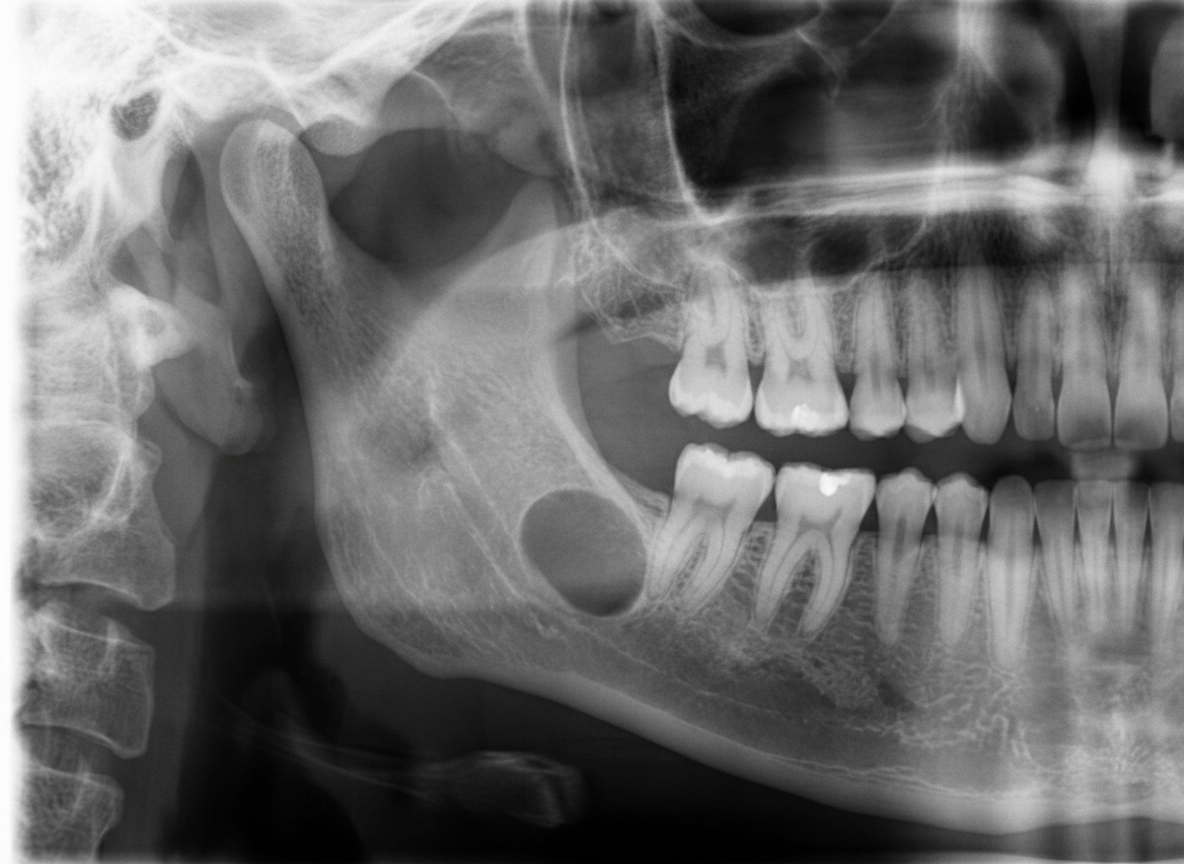
Explanation: **Explanation:** The correct answer is **Angle of mandible**. This clinical entity is famously known as a **Stafne’s Bone Cavity (or Stafne’s Cyst)**. **1. Why it is correct:** Ectopic (or aberrant) submandibular gland tissue occurs when a portion of the salivary gland becomes entrapped during the development of the mandible. It is typically found as a well-defined, cortical depression on the lingual aspect of the posterior mandible, located **below the inferior alveolar nerve canal** near the **angle of the mandible**. Radiographically, it appears as a classic "punched-out" radiolucency. **2. Why the other options are incorrect:** * **Cheek (A):** While ectopic salivary tissue can occur here (often associated with the accessory parotid gland), it is not the most common site for submandibular ectopia. * **Palate (B):** The palate is the most common site for **minor salivary gland tumors** (like Pleomorphic Adenoma), but not for ectopic submandibular tissue. * **Tongue (D):** Ectopic thyroid tissue (Lingual Thyroid) is common at the base of the tongue, but ectopic submandibular tissue is rare in this location. **3. High-Yield Clinical Pearls for NEET-PG:** * **Stafne’s Cyst is a "Pseudocyst":** It is not a true cyst because it lacks an epithelial lining; it is simply a bone depression containing normal salivary tissue. * **Gender Predominance:** It is significantly more common in **males** (80-90%). * **Management:** It is usually asymptomatic and discovered incidentally on OPG. No treatment is required; observation is the standard of care. * **Differential Diagnosis:** Must be distinguished from a keratocystic odontogenic tumor (KCOT) or ameloblastoma, which are usually located *above* the mandibular canal.
Explanation: **Explanation:** **Macroglossia** refers to the abnormal enlargement of the tongue relative to the oral cavity. It can be congenital, inflammatory, or metabolic. **Why Hurler’s Syndrome is Correct:** Hurler’s Syndrome (Mucopolysaccharidosis Type I) is a lysosomal storage disorder characterized by the deficiency of the enzyme alpha-L-iduronidase. This leads to the systemic accumulation of glycosaminoglycans (GAGs), specifically dermatan sulfate and heparan sulfate. The infiltration of these substances into the lingual tissues results in significant enlargement of the tongue (macroglossia), which is a classic clinical feature of the "gargoyle-like" facies associated with this syndrome. **Analysis of Incorrect Options:** * **Atrophic glossitis:** This condition involves the depapillation of the tongue (smooth, red appearance), often due to nutritional deficiencies (B12, Iron). It leads to a **reduction** in bulk or a "bald" tongue, not enlargement. * **Oral submucous fibrosis (OSMF):** This is a premalignant condition characterized by juxta-epithelial fibrosis. It primarily affects the buccal mucosa and leads to **microstomia** (restricted mouth opening) and tongue stiffness/atrophy, rather than macroglossia. * **Syphilitic glossitis:** Chronic superficial glossitis in tertiary syphilis typically leads to atrophy of the filiform and fungiform papillae (leukoplakia and "interstitial glossitis"), often resulting in a scarred or shrunken tongue. **High-Yield Clinical Pearls for NEET-PG:** * **Congenital causes of Macroglossia:** Hemangioma, Lymphangioma (most common), Down Syndrome, and Beckwith-Wiedemann Syndrome (Macroglossia + Omphalocele + Gigantism). * **Acquired causes:** Amyloidosis (most common acquired cause in adults), Myxedema (Hypothyroidism), and Acromegaly. * **Management:** Surgical reduction (wedge resection) is indicated if it causes airway obstruction, speech difficulties, or orthodontic deformities.
Explanation: ### Explanation **Correct Option: A. Resistance to injection of contrast agent** The patient is suffering from **fibrous ankylosis/adhesions** of the Temporomandibular Joint (TMJ) following surgery. In a normal TMJ, the joint spaces (superior and inferior) are potential spaces that can easily accommodate a small volume of contrast medium (about 0.5 to 1.0 ml) during arthrography. When **fibrous adhesions** are present, these bands of scar tissue bridge the joint space, obliterating the potential volume and reducing the compliance of the joint capsule. During arthrography, as the clinician attempts to inject the contrast agent, the reduced space and rigid fibrous tissue offer significant **physical resistance**. This is a classic diagnostic sign of intra-articular adhesions. **Why other options are incorrect:** * **B. Free flow of contrast agent:** This occurs in a normal, healthy joint where the joint space is patent and the capsule is distensible. * **C. No contrast agent can be injected:** This is typically seen in **bony ankylosis**, where the joint space is completely obliterated by bone, or if the needle is improperly positioned (extra-articular). In fibrous ankylosis, some contrast can usually be forced in, albeit with difficulty. --- ### High-Yield Clinical Pearls for NEET-PG * **Arthrography Gold Standard:** While MRI is now the preferred non-invasive modality for TMJ internal derangements (like disc displacement), arthrography remains useful for dynamic studies and identifying perforations or adhesions. * **TMJ Ankylosis Etiology:** Trauma is the most common cause of TMJ ankylosis in children, while infection and post-surgical scarring are common in adults. * **Clinical Sign:** The hallmark of TMJ ankylosis is a progressive reduction in the **inter-incisor distance** (normal is 35-50 mm). * **Imaging:** In **bony ankylosis**, X-rays/CT show a "mushroom-shaped" deformity of the condyle and loss of joint space. In **fibrous ankylosis**, the joint space may appear narrow but is still visible.
Explanation: **Explanation:** **Talon’s Cusp** (dens evaginatus) is a rare developmental anomaly characterized by a cusp-like projection from the cingulum or cemento-enamel junction of maxillary or mandibular incisors. It is frequently associated with specific genetic syndromes involving ectodermal disturbances. **Why Peutz-Jeghers Syndrome is the Correct Answer:** Peutz-Jeghers syndrome is an autosomal dominant disorder characterized by **mucocutaneous hyperpigmentation** (melanotic macules on lips and oral mucosa) and **gastrointestinal hamartomatous polyposis**. While it has distinct oral manifestations, it is **not** associated with dental structural anomalies like Talon’s cusp. **Analysis of Other Options:** * **Rubinstein-Taybi Syndrome:** This is the most classic association. It features broad thumbs/great toes, facial dysmorphism, and mental retardation. Talon’s cusp is a highly characteristic dental finding in these patients. * **Mohr Syndrome (Orofacial-Digital Syndrome Type II):** Characterized by cleft tongue, polydactyly, and facial anomalies. Dental anomalies, including Talon’s cusp, are frequently reported. * **Sturge-Weber Syndrome:** A phakomatosis characterized by port-wine stains and vascular malformations. It has been documented in association with various dental abnormalities, including Talon’s cusp. **NEET-PG High-Yield Pearls:** * **Most common site:** Maxillary lateral incisor (permanent dentition). * **Clinical Significance:** It can cause occlusal interference, displacement of teeth, and "T-shaped" or "X-ray" appearance on radiographs. * **Other Associations:** Incontinentia pigmenti and Ellis-van Creveld syndrome. * **Management:** Gradual periodic reduction of the cusp to allow reparative dentin formation, preventing pulp exposure.
Explanation: **Explanation:** A **mucocele** is a common clinical condition involving the accumulation of mucus due to the rupture of a minor salivary gland duct (extravasation cyst) or, less commonly, the blockage of the duct (retention cyst). **Why the Upper Lip is the Correct Answer:** Mucooceles occur most frequently in areas prone to minor trauma, which leads to ductal rupture. The **lower lip** is the most common site (approx. 70–80%) because it is frequently bitten or traumatized against the teeth. In contrast, the **upper lip** is rarely traumatized in this manner. Clinically, a minor salivary gland swelling on the upper lip is statistically more likely to be a **salivary gland neoplasm** (like a Pleomorphic Adenoma or Canalicular Adenoma) rather than a mucocele. **Analysis of Incorrect Options:** * **Lower Lip:** This is the **most common** site for mucoceles. It is a high-yield fact that any cystic swelling on the lower lip is a mucocele until proven otherwise. * **Buccal Mucosa:** This is a relatively common site, often occurring along the line of occlusion due to accidental biting. * **Floor of the Mouth:** A mucocele in this location is specifically called a **Ranula** (usually arising from the sublingual gland). While less common than the lower lip, it is still more frequent than upper lip mucoceles. **High-Yield Clinical Pearls for NEET-PG:** * **Most common site:** Lower lip (lateral to midline). * **Ranula:** A mucocele on the floor of the mouth; "Plunging Ranula" occurs when it herniates through the mylohyoid muscle into the neck. * **Histology:** Most mucoceles are **Extravasation cysts** (lacking an epithelial lining, surrounded by granulation tissue). * **Differential Diagnosis:** If you see a swelling on the **upper lip**, always suspect a **salivary gland tumor** first.
Explanation: **Explanation:** The submandibular region is a frequent site for swellings, but the most common cause of a **tender** swelling in this area is **reactive lymphadenopathy (enlarged lymph nodes)**. This occurs due to infections in the drainage areas, such as the teeth, floor of the mouth, or tonsils. **Why "Enlarged Lymph Nodes" is the correct answer:** In clinical practice, inflammatory conditions of the head and neck are the leading cause of submandibular masses. When a patient presents with acute tenderness, it most often signifies an inflammatory response within the submandibular lymph nodes (Level IB) secondary to a primary focus of infection nearby. **Analysis of other options:** * **Ludwig’s Angina:** While it causes tender submandibular swelling, it is a life-threatening, diffuse cellulitis of the submandibular space (sublingual and submaxillary). It is less common than simple lymphadenopathy and presents with systemic toxicity and "woody" edema. * **Stone (Sialolithiasis):** A stone in the Wharton’s duct typically causes **intermittent** swelling that increases specifically during meals (meal-time syndrome). While it can become tender if secondary infection (sialadenitis) occurs, it is not the "most common" cause of general submandibular tenderness. * **All of the above:** While all these conditions cause tender swelling, the question asks for the most frequent etiology, which is lymphadenopathy. **High-Yield Clinical Pearls for NEET-PG:** * **80% Rule:** In adults, 80% of non-thyroid neck lumps are neoplastic; in children, 80% are inflammatory (lymph nodes). * **Painless vs. Tender:** A firm, painless submandibular mass in an elderly patient should be considered malignant (Submandibular gland tumor or Metastasis) until proven otherwise. * **Wharton’s Duct:** The most common site for salivary calculi (80%) due to the alkaline nature of saliva and the upward course of the duct.
Explanation: **Explanation:** **Pleomorphic Adenoma** (Mixed Tumor) is the most common benign tumor of the salivary glands, most frequently involving the superficial lobe of the parotid gland. **Why Superficial Parotidectomy is the Correct Choice:** The treatment of choice for a pleomorphic adenoma located in the superficial lobe is **superficial parotidectomy** (removal of the gland superficial to the facial nerve). This approach is preferred because pleomorphic adenomas possess a **false capsule** with microscopic finger-like projections (pseudopods) extending into the surrounding tissue. A wide margin of healthy tissue must be removed to ensure these projections are cleared, preventing recurrence. **Why Other Options are Incorrect:** * **Excision of tumor (Enucleation):** Simple enucleation is contraindicated. Because of the pseudopods mentioned above, "shelling out" the tumor leaves behind microscopic disease, leading to a very high recurrence rate (up to 45%). * **Radical Parotidectomy:** This involves the sacrifice of the facial nerve. It is reserved for malignant tumors showing clinical evidence of nerve involvement. Since pleomorphic adenoma is benign, the facial nerve must be preserved. * **Radiotherapy:** Pleomorphic adenoma is **radioresistant**. Radiation is generally avoided due to the risk of inducing malignant transformation (Carcinoma ex-pleomorphic adenoma). **Clinical Pearls for NEET-PG:** * **Most common site:** Parotid gland (Tail of the gland). * **Recurrence:** If it recurs, it often presents as multiple "satellite" nodules, making subsequent surgery difficult. * **Malignant Transformation:** Occurs in about 3–5% of cases; suspected if a long-standing painless lump suddenly grows rapidly or causes facial nerve palsy. * **Deep Lobe Involvement:** If the tumor involves the deep lobe, **Total Conservative Parotidectomy** (preserving the facial nerve) is performed.
Explanation: ### Explanation The most common indication for the surgical removal of an impacted mandibular third molar is **recurrent pericoronitis**. **1. Why Recurrent Pericoronitis is Correct:** Pericoronitis is the inflammation of the soft tissues (operculum) surrounding the crown of a partially erupted tooth. The space between the crown and the overlying gingiva acts as a "food trap," promoting bacterial growth (predominantly anaerobes). Because the mandibular third molar is the most common tooth to be partially impacted, it is highly susceptible to repeated bouts of infection. Recurrence is common because the anatomical niche cannot be cleaned effectively, eventually necessitating surgical extraction to prevent complications like peritonsillar abscess or Ludwig’s angina. **2. Analysis of Incorrect Options:** * **Referred Pain (A):** While impacted teeth can cause neuralgic pain or headaches, it is a subjective symptom and less frequent than clinical infection. * **Orthodontic Treatment (B):** Extraction is often done to prevent "late incisor crowding" or to create space, but statistically, this is a elective reason and less common than inflammatory indications. * **Chronic Periodontal Disease (D):** While impaction can lead to bone loss on the distal aspect of the second molar, it is usually a localized consequence rather than the primary driver for the majority of extractions. **3. High-Yield Clinical Pearls for NEET-PG:** * **Winter’s Classification:** Based on the angulation of the third molar to the long axis of the second molar (**Mesioangular** is the most common type of impaction). * **Pell and Gregory Classification:** Based on the relationship to the anterior border of the ramus and the occlusal plane. * **Most common nerve injured** during extraction: **Lingual nerve** (temporary) or **Inferior Alveolar Nerve**. * **Dry Socket (Alveolar Osteitis):** The most common post-operative complication, occurring 3–5 days after extraction due to fibrinolysis of the clot.
Stomatitis
Practice Questions
Oral Ulcers
Practice Questions
Oral Leukoplakia
Practice Questions
Oral Cancers
Practice Questions
Sialadenitis
Practice Questions
Sialolithiasis
Practice Questions
Salivary Gland Tumors
Practice Questions
Ranula
Practice Questions
Xerostomia
Practice Questions
Sjögren's Syndrome
Practice Questions
Oral Manifestations of Systemic Diseases
Practice Questions
Temporomandibular Joint Disorders
Practice Questions
Get full access to all questions, explanations, and performance tracking.
Start For Free