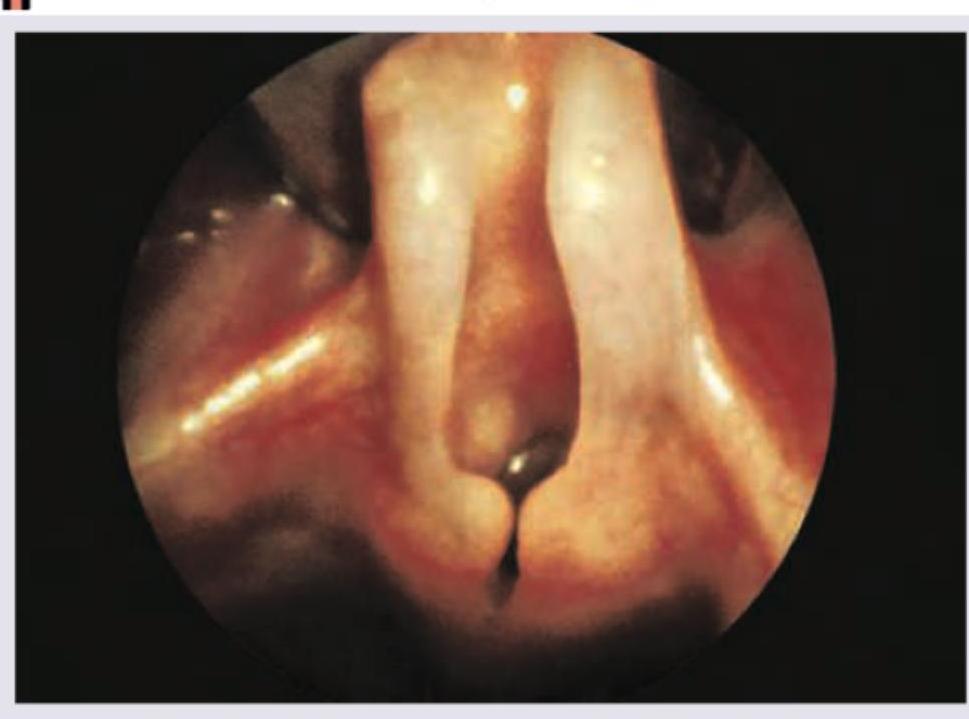
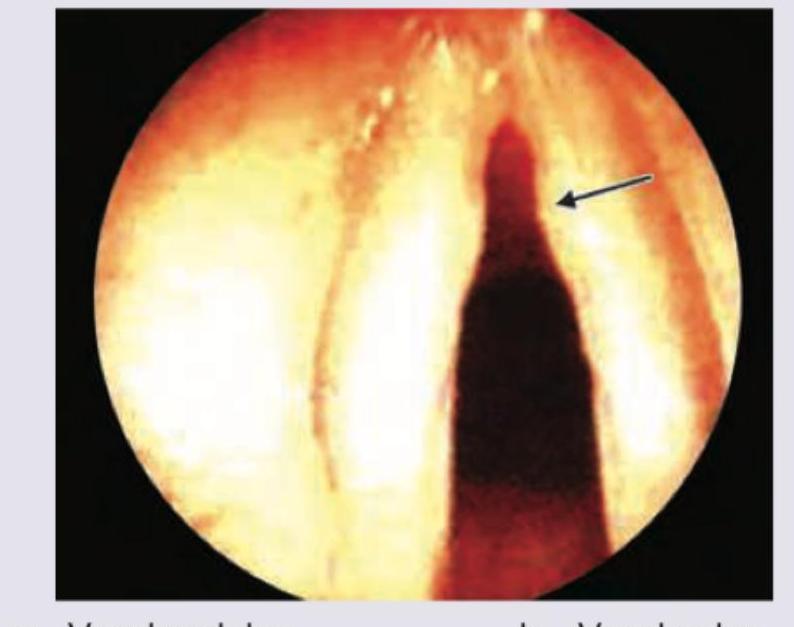
A patient presents with a hoarse voice and cough for two weeks. Laryngoscopy reveals inflammation of the vocal cords. What is the most likely diagnosis?
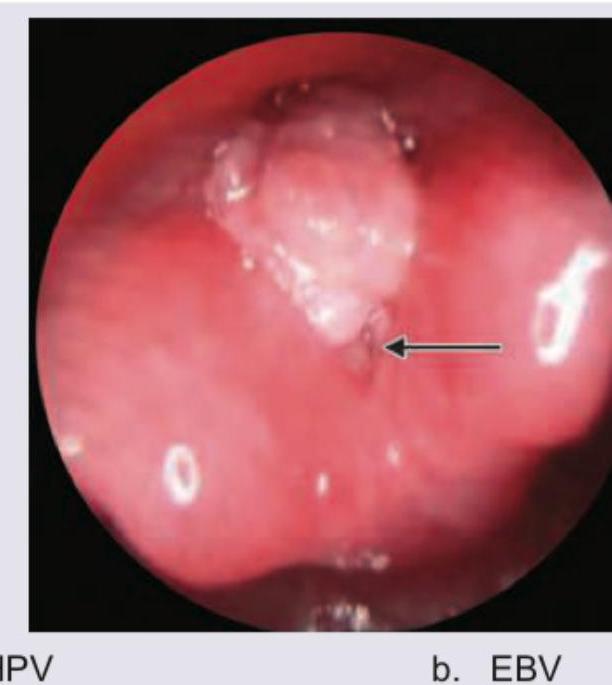
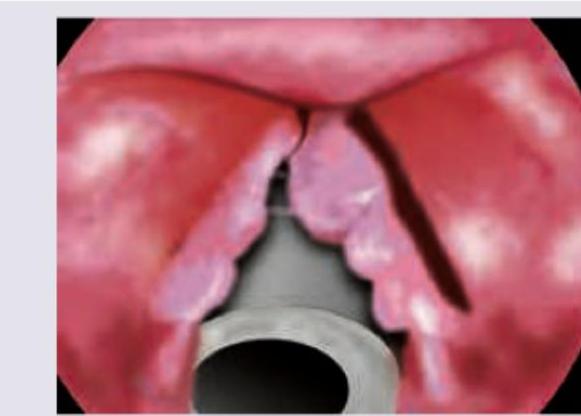
A patient presents with hoarseness and laryngoscopy reveals a warty, cauliflower-like growth on the vocal cord. Identify the most likely lesion.
Which of the following statements about laryngeal cancer is correct?
Inspiratory stridor is found in what kind of lesions:
Laryngitis sicca is associated with ?
Which of the following statements about laryngeal tuberculosis (TB) is true?
Moure's sign (lateral displacement of the soft palate) is associated with which of the following conditions?
Which part of the larynx is most commonly involved in tuberculosis (TB)?
Hot potato voice is characteristic of ?
Which of the following statements about Laryngomalacia is false?
Explanation: ***Correct: Laryngitis*** - The symptoms of a **hoarse voice** and **cough** for two weeks, coupled with **inflammation of the vocal cords** on laryngoscopy, are classic for laryngitis. - This condition is typically caused by viral infections, vocal cord overuse, or irritants, leading to swelling of the vocal cords. *Incorrect: Vocal cord paralysis* - While it causes **hoarseness**, **vocal cord paralysis** would present as a lack of movement or immobility of one or both vocal cords on laryngoscopy, not primarily inflammation. - It often results from nerve damage, surgery, or underlying neurological conditions, which are not suggested here. *Incorrect: Vocal cord nodules* - **Vocal cord nodules** (often called "singer's nodes") are bilateral, symmetrical lesions that develop on the vocal cords due to chronic voice abuse. - While they cause hoarseness, laryngoscopy would reveal distinct **nodular growths**, not general inflammation. *Incorrect: Reinke's edema* - **Reinke's edema** is characterized by diffuse gelatinous swelling of the superficial lamina propria of the vocal folds, usually associated with **chronic smoking**. - While it causes hoarseness, the laryngoscopic appearance would be a characteristic **edematous, fluid-filled appearance**, not simply inflammation.
Explanation: ***Laryngeal papilloma*** - **Hoarseness** and a **warty, cauliflower-like growth** on the vocal cord are classic descriptions of a laryngeal papilloma, often caused by **HPV infection**. - These lesions can be solitary or multiple, and while benign, they can recur and cause voice changes and respiratory obstruction. *Laryngeal malignancy* - While hoarseness is a common symptom of laryngeal malignancy, the description of a **"warty, cauliflower-like growth"** is more characteristic of a papilloma than most typical carcinomas, which might appear more ulcerative or infiltrative. - Malignancies are more commonly associated with risk factors like **smoking and alcohol use**, and often present with other symptoms like dysphagia or weight loss. *Tracheomalacia* - **Tracheomalacia** refers to softening of the tracheal cartilage, leading to airway collapse, typically causing stridor or respiratory distress. - It does not present as a **discrete growth** on the vocal cords but rather as a diffuse structural weakness of the trachea. *Reinke’s edema* - **Reinke's edema** (polypoid corditis) is characterized by a **gelatinous or fluid-filled swelling** of the vocal cords, usually associated with chronic irritation like smoking. - It presents as a swollen, boggy appearance of the vocal cords, not a warty or cauliflower-like growth.
Explanation: ***Glottic cancer is the most common type of laryngeal cancer.*** - **Glottic carcinomas** (involving the true vocal cords) account for roughly **60%** of all laryngeal cancers, making them the most prevalent subtype. - Early symptoms like **hoarseness** lead to earlier detection and better prognosis compared to other sites. *Subglottic cancer is the most common type of laryngeal cancer.* - **Subglottic cancers** (below the true vocal cords) are actually the **rarest** type, accounting for only **1-2%** of laryngeal cancers. - They often present at an advanced stage and have the **poorest prognosis** among all laryngeal subsites. *Supraglottic cancer has the best prognosis.* - **Supraglottic cancers** (involving the epiglottis, false vocal cords) tend to present at a **later stage** due to vague initial symptoms (e.g., throat discomfort, muffled voice), leading to a poorer prognosis than glottic cancer. - They also have a **richer lymphatic supply**, increasing the likelihood of early nodal metastasis. *Lymphatic spread is most common in subglottic cancer.* - While **subglottic cancers** can metastasize, **supraglottic cancers** generally have a higher incidence of lymphatic spread due to their more extensive lymphatic drainage network. - The true vocal cords (glottis) have sparse lymphatic drainage, while the supraglottis has rich bilateral lymphatic networks.
Explanation: ***Supraglottic*** - Lesions in the **supraglottic** region (e.g., epiglottitis, supraglottic foreign body) cause inspiratory stridor due to the collapse of soft tissues above the vocal cords during inspiration. - The narrowed airway during inspiration creates a high-pitched, harsh sound. *Subglottic* - **Subglottic** lesions typically cause a **biphasic stridor**, meaning stridor is present during both inspiration and expiration. - This is because the subglottis is a rigid area; narrowing at this level causes turbulent airflow during both phases of breathing. *Tracheal* - **Tracheal** lesions can produce **biphasic stridor** if they are in the cervical trachea due to fixed airway narrowing. - If the lesion is in the lower, intrathoracic trachea, it might primarily cause **expiratory stridor** or a biphasic stridor depending on the degree of narrowing and its fixity. *Bronchus* - Lesions in the **bronchus** (e.g., foreign body, tumor) typically lead to **expiratory stridor** or wheezing. - Airway narrowing at this level causes air trapping and turbulent flow predominantly during exhalation when the bronchial walls naturally constrict.
Explanation: ***Klebsiella rhinoscleromatis*** - **Laryngitis sicca** is characterized by extreme dryness and crusting of the laryngeal mucosa, which is a known manifestation of complications due to **Rhinoscleroma**. - **Rhinoscleroma** is a chronic granulomatous disease caused by *Klebsiella rhinoscleromatis* (formerly *K. rhinoscleromatosis*), primarily affecting the upper respiratory tract including the larynx. *Rhinosporidium* - **Rhinosporidium seeberi** is an aquatic protistan parasite that causes **rhinosporidiosis**, characterized by friable, polypoidal lesions, often in the nose, but typically not laryngitis sicca. - The lesions caused by Rhinosporidium are usually vascular and bleeding, rather than dry and crusting. *M. leprae* - **Mycobacterium leprae** is the causative agent of **leprosy**, a chronic infectious disease primarily affecting the skin, peripheral nerves, upper respiratory tract mucosa, eyes, and testes. - While *M. leprae* can affect the larynx, it typically causes **granulomatous infiltration** and nodule formation leading to hoarseness and stridor, not specifically laryngitis sicca. *Klebsiella ozaenae* - *Klebsiella ozaenae* is associated with **ozena**, a form of chronic atrophic rhinitis characterized by a foul odor, crusting, and atrophy of nasal mucosa. - While it causes dryness and crusting, its primary manifestation is in the **nasal cavity**, and it is not directly linked to laryngitis sicca in the context tested here.
Explanation: ***It presents with a mouse-nibbled appearance of the vocal cord.*** - The appearance of a **mouse-nibbled vocal cord** is a classic and pathognomonic description of the irregular, ulcerated, and often edematous lesions seen in laryngeal tuberculosis. - This characteristic finding is due to the granulomatous inflammation and tissue destruction caused by *Mycobacterium tuberculosis* in the larynx. *It commonly involves the posterior 1/3 of the vocal cord.* - Laryngeal tuberculosis typically affects the **anterior two-thirds of the vocal cord**, rather than the posterior third, and often involves the arytenoids and epiglottis. - The involvement pattern can be variable, but posterior involvement is less common than mid-cord or anterior involvement. *It is more common in females.* - Laryngeal tuberculosis is generally **more common in males** than in females, with a male-to-female ratio often reported to be around 2-3:1. - This higher prevalence in males may be attributed to a combination of factors including occupational exposure and lifestyle choices. *It is a common form of tuberculosis.* - Laryngeal tuberculosis is considered a **rare form of extrapulmonary TB**, accounting for a small percentage of all TB cases. - Pulmonary tuberculosis is much more common, and laryngeal involvement is often secondary to active pulmonary disease, occurring via direct spread of infected sputum.
Explanation: ***Peritonsillar abscess (Quinsy)*** - **Moure's sign** refers to the **lateral displacement of the soft palate** toward the affected side, which is a classic finding in **peritonsillar abscess**. - This occurs due to the **accumulation of pus** between the tonsillar capsule and the superior constrictor muscle, causing the soft palate to bulge and deviate. - Other features include **severe throat pain**, trismus, drooling, and a "hot potato" voice. *Laryngeal carcinoma* - **Laryngeal carcinoma** presents with **hoarseness**, dysphagia, and potential airway obstruction. - While laryngeal examination may show mass lesions or vocal cord fixation, **soft palate displacement is not a feature** of laryngeal malignancy. *Chronic tonsillitis* - **Chronic tonsillitis** involves recurrent throat infections with tonsillar hypertrophy and cryptic debris. - It does **not cause acute soft palate displacement** like peritonsillar abscess does. *Acute epiglottitis* - **Acute epiglottitis** is characterized by **supraglottic inflammation** causing severe dysphagia, drooling, and stridor. - The pathology is at the **epiglottis level**, not the peritonsillar space, so **Moure's sign is absent**.
Explanation: ***Posterior*** - The **posterior larynx**, specifically the **arytenoids** and **interarytenoid area**, is the most common site for tuberculosis involvement. - This region is susceptible due to its rich **lymphatic supply** and direct exposure to infected secretions from the lungs. *Anterior* - While TB can affect any part of the larynx, the **anterior laryngeal structures** are less frequently the primary site of involvement. - The vocal cords, which are in the anterior-middle aspect, are less commonly affected initially compared to the posterior structures. *Middle* - The middle part of the larynx, including the **vocal cords**, is not the predominant site for initial tuberculous lesions. - Involvement here often occurs as the disease progresses from more commonly affected areas. *Anywhere* - Although TB can theoretically affect any part of the larynx, it demonstrates a strong predilection for the **posterior laryngeal region**. - Stating "anywhere" does not accurately reflect the statistically significant preference for specific anatomical sites.
Explanation: ***Supraglottic carcinoma*** - Among the given options, **supraglottic carcinoma** is the best answer, as it can produce a **"hot potato" voice** (also known as a "muffled" or "potato-in-the-mouth" voice) due to tumor bulk in the supraglottic region. - The tumor interferes with normal resonance and articulation of speech by reducing the pharyngeal space and impairing the mobility of the **epiglottis** and aryepiglottic folds. - **Clinical note:** Hot potato voice is **classically** associated with **acute supraglottic inflammatory conditions** such as **peritonsillar abscess (quinsy)**, **acute epiglottitis**, and **retropharyngeal abscess** rather than malignancies. However, any mass lesion in the supraglottic region that causes pharyngeal space reduction can theoretically produce this voice quality. *Nasopharyngeal carcinoma* - **Nasopharyngeal carcinoma** is located in the **nasopharynx** (above the soft palate) and typically presents with **nasal obstruction**, epistaxis, **conductive hearing loss** (Eustachian tube involvement), and cranial nerve palsies. - It does not affect the supraglottic larynx or oropharynx in a way that would produce the characteristic "hot potato" voice. *Glottic carcinoma* - **Glottic carcinoma** primarily affects the **true vocal cords**, leading to early symptoms of **progressive hoarseness** or dysphonia due to impaired vocal cord vibration. - While it affects voice quality significantly, it produces a **hoarse or breathy voice**, not the muffled "hot potato" quality associated with supraglottic space-occupying lesions. *Subglottic carcinoma* - **Subglottic carcinoma** is located **below the true vocal cords** and is the rarest laryngeal malignancy, often presenting late with **stridor** and **dyspnea** due to airway narrowing. - Voice changes occur late and are related to **airway obstruction** or superior extension to the vocal cords, not the characteristic muffled sound of a "hot potato" voice.
Explanation: ***Stridor disappears when the infant is in a supine position.*** - In laryngomalacia, the **omega-shaped epiglottis** and redundant supraglottic tissues **prolapse into the airway** upon inspiration. - The stridor typically **worsens** when the infant is in a **supine position** or crying, as gravity causes further collapse of the airways. *It is the most common congenital anomaly of the larynx.* - **Laryngomalacia** is indeed the **most frequent congenital cause of stridor** in infants. - It results from the **immaturity of the laryngeal cartilages**, leading to their collapse during inspiration. *Symptoms typically manifest many weeks after birth.* - Symptoms of laryngomalacia usually appear in the first few weeks of life, typically around **2-4 weeks post-birth**, and rarely at birth. - This delay is often due to the time it takes for the infant's respiratory efforts to become more vigorous. *Most cases do not require treatment.* - The majority of infants with laryngomalacia have **mild symptoms** that **resolve spontaneously** as the larynx matures, usually by 12 to 18 months of age. - Only a small percentage of severe cases require surgical intervention, such as a **supraglottoplasty**.
Acute Laryngitis
Practice Questions
Chronic Laryngitis
Practice Questions
Vocal Cord Nodules and Polyps
Practice Questions
Reinke's Edema
Practice Questions
Laryngeal Papillomatosis
Practice Questions
Vocal Cord Paralysis
Practice Questions
Laryngeal Trauma
Practice Questions
Laryngeal Stenosis
Practice Questions
Laryngeal Cancer
Practice Questions
Laryngomalacia
Practice Questions
Epiglottitis
Practice Questions
Voice Disorders
Practice Questions
Get full access to all questions, explanations, and performance tracking.
Start For Free