HLA-Cw6 is associated with
Acrodermatitis continua of Hallopeau is due to which of the following?
The important feature of psoriasis is –
A patient with psoriasis was started on systemic steroids. After stopping treatment, the patient developed generalized pustules all over the body. The cause is most likely to be:
Which one of these should not be used in severe widespread psoriasis?
A 30-year-old male presented with silvery scales on elbow and knee, that bleed on removal. The probable diagnosis is:
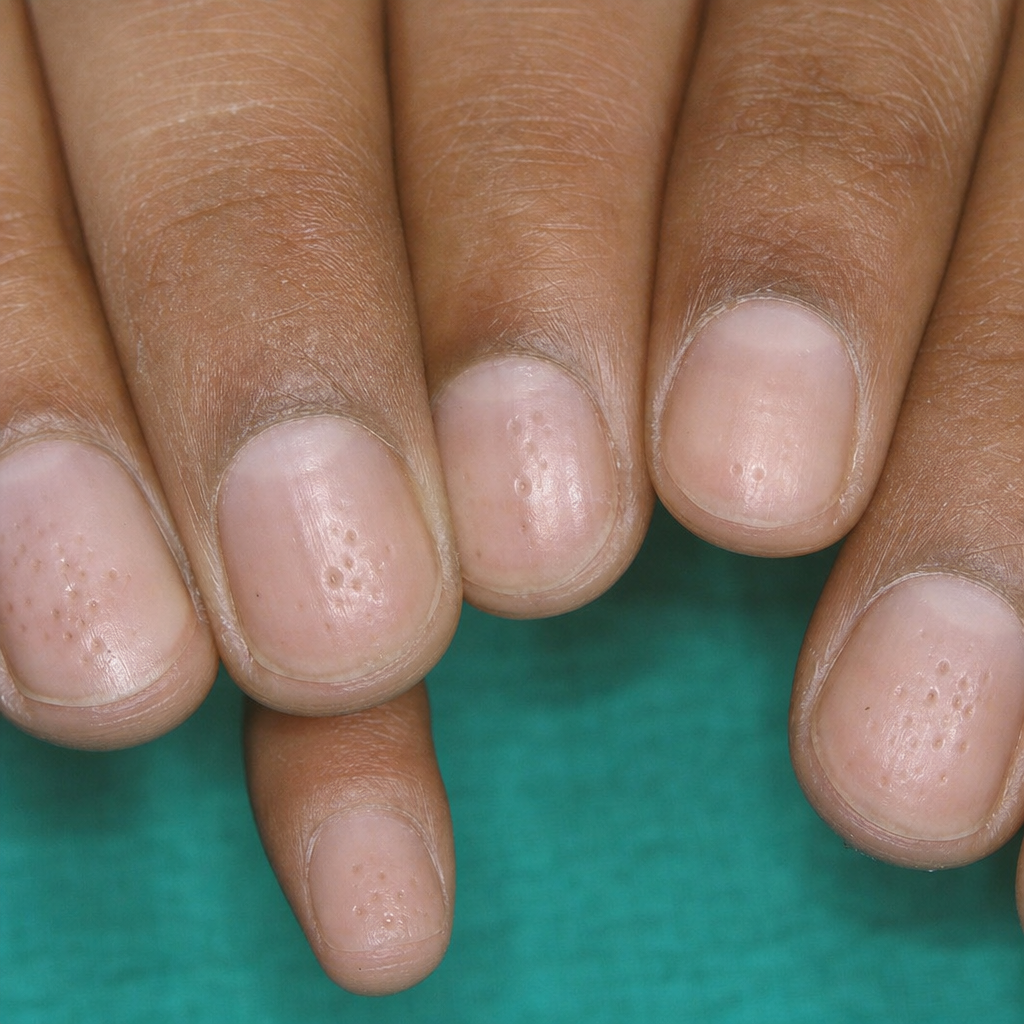
Which of the following nail findings is seen in the condition shown below?
Which statement about systemic steroids in psoriasis is correct:
A 54-year-old man presents with well-demarcated, erythematous plaques covered with silvery-white scales on the extensor surfaces of his elbows and knees. What is the most likely diagnosis?
Koebner's phenomenon is seen in all of the following, except?
Explanation: ***Psoriasis vulgaris*** - **HLA-Cw6** is the **strongest genetic risk factor** associated with an increased susceptibility to psoriasis vulgaris, particularly early-onset forms. - Its presence is linked to a more severe and widespread presentation of the disease. *Myasthenia gravis* - This autoimmune disorder is primarily associated with **HLA-DR3** and **HLA-B8**, and autoantibodies against the acetylcholine receptor. - While other HLA alleles may be involved, **HLA-Cw6** is not a primary or strong genetic association for myasthenia gravis. *Behcet's disease* - **HLA-B51** is the most significant genetic association with Behcet's disease, particularly in populations of Middle Eastern and East Asian descent. - Symptoms include **recurrent oral and genital ulcers**, **uveitis**, and skin lesions. *Pemphigus vulgaris* - This autoimmune blistering disease is strongly associated with **HLA-DR4** and **HLA-DRw6**, especially in individuals of Jewish descent. - It involves autoantibodies targeting **desmoglein 1 and 3**, leading to acantholysis within the epidermis.
Explanation: ***Pustular psoriasis*** - **Acrodermatitis continua of Hallopeau** is considered a severe, chronic, and localized variant of **pustular psoriasis** that primarily affects the distal extremities, particularly the nail beds and fingertips. - It involves recurrent outbreaks of **sterile pustules** that can lead to onychodystrophy, anonychia, and bone resorption. *Zinc toxicity* - **Zinc toxicity** can cause symptoms such as nausea, vomiting, abdominal pain, and copper deficiency, but it is not linked to acrodermatitis continua of Hallopeau. - Dermatological manifestations of zinc toxicity are generally not pustular or associated with nail and digit changes seen in this condition. *Zinc deficiency* - **Zinc deficiency** can lead to acrodermatitis enteropathica, a condition characterized by periorificial and acral dermatitis, alopecia, and diarrhea. - While it involves skin involvement in similar areas, the primary lesions are **eczematous and psoriasiform**, not typically sterile pustules as seen in acrodermatitis continua. *Collodion baby* - **Collodion baby** refers to a newborn covered by a taut, shiny membrane that resembles plastic wrap, typically associated with congenital ichthyoses. - It is a specific neonatal presentation of a skin barrier defect and is not related to acrodermatitis continua of Hallopeau or pustular skin conditions.
Explanation: ***Scaling*** - Psoriasis is characterized by **erythematous plaques** covered with **silvery-white scales**, which is the **hallmark and most distinguishing feature** of the condition. - These scales result from **accelerated epidermal turnover** (3-4 days vs. normal 28 days) causing **hyperproliferation and abnormal differentiation of keratinocytes**. - The **Auspitz sign** (pinpoint bleeding upon scale removal) is a classic diagnostic feature. - Scaling is what differentiates psoriasis from other erythematous conditions. *Oozing* - **Oozing**, also known as weeping, is typically associated with acute inflammatory skin conditions, such as **acute eczema** or **bacterial infections**. - It indicates the presence of serous exudate from the skin, which is not a primary feature of psoriasis. *Crusting* - **Crusting** involves dried serum, blood, or pus on the skin surface and is commonly seen in conditions like **impetigo** or healing wounds. - While secondary infections can occur in psoriatic lesions, crusting itself is not a defining characteristic. *Erythema* - **Erythema**, or redness, is indeed present in psoriatic plaques, but it is not the *most important distinguishing feature*. - Many inflammatory skin conditions cause erythema, so it is a non-specific finding without the presence of prominent scaling.
Explanation: ***Pustular psoriasis*** - The sudden withdrawal of **systemic corticosteroids** in a patient with psoriasis can trigger a severe flare-up, specifically **generalized pustular psoriasis** (GPP), characterized by widespread sterile pustules. - GPP is a distinct, severe form of psoriasis that can be precipitated by various factors, including drug withdrawal. *Drug induced reaction* - While steroids themselves can have side effects, the development of **generalized pustules** shortly after stopping treatment in a known psoriasis patient points more specifically to a paradoxical worsening of their underlying disease rather than a general drug reaction. - Drug-induced reactions are typically directly related to the drug's properties or an allergic response, whereas this scenario describes an exacerbation of the existing condition due to treatment cessation. *Septicemia* - Septicemia, or **sepsis**, would present with signs of systemic infection such as **fever, chills, hypotension, and organ dysfunction**, which are not explicitly mentioned as the primary cause of the pustules. - While severe GPP can lead to systemic symptoms and potentially secondary infections, the initial development of pustules post-steroid withdrawal is a primary dermatological event, not directly caused by septicemia. *Bacterial infections* - **Bacterial infections** would typically manifest with purulent pustules, often with signs of inflammation, pain, and potentially fever. These pustules would contain bacteria upon Gram stain and culture. - The pustules in **pustular psoriasis** are typically sterile, meaning they do not contain bacteria, and their appearance is a manifestation of the underlying autoimmune inflammatory process exacerbated by steroid withdrawal.
Explanation: ***Oral glucocorticoids*** - While they may provide temporary relief, **oral glucocorticoids** can exacerbate psoriasis upon withdrawal, leading to a severe flare-up or **pustular psoriasis**. - Their long-term use is associated with numerous side effects, making them unsuitable for widespread, chronic conditions like severe psoriasis. *Methotrexate* - **Methotrexate** is a systemic agent commonly used for severe psoriasis due to its immune-modulating and anti-proliferative effects. - It is effective in reducing inflammation and slowing down epidermal cell turnover. *Oral retinoids* - **Oral retinoids** like acitretin are effective systemic treatments for severe widespread psoriasis, especially **pustular** and **erythrodermic** forms. - They work by normalizing keratinocyte proliferation and differentiation. *Cyclosporin* - **Cyclosporin** is a potent immunosuppressant widely used for severe psoriasis, particularly when rapid disease control is needed. - It works by inhibiting T-cell activation and is highly effective in clearing psoriatic lesions.
Explanation: ***Psoriasis*** - The presence of **silvery scales** on the elbows and knees, which **bleed upon removal** (Auspitz sign), is a classic presentation of **plaque psoriasis**. - Psoriasis is a chronic inflammatory skin condition characterized by **accelerated epidermal turnover**. *Secondary syphilis* - Secondary syphilis typically presents with a **generalized maculopapular rash**, which can affect the palms and soles, but it does not usually feature silvery scales or the Auspitz sign. - Other common symptoms of secondary syphilis include **fever, lymphadenopathy, and condyloma lata**. *Pityriasis* - **Pityriasis rosea** is characterized by an oval, fawn-colored, scaly rash, often preceded by a **herald patch**, and usually resolves spontaneously. It does not typically present with silvery scales or bleeding on removal. - **Pityriasis versicolor** is caused by yeast and presents as hypopigmented or hyperpigmented macules with fine scales, commonly on the trunk, not silvery scales on elbows and knees. *Seborrhoeic dermatitis* - Seborrhoeic dermatitis involves greasy, yellowish scales on red skin, typically affecting areas rich in sebaceous glands like the scalp, face (nasolabial folds, eyebrows), and chest. - It does not present with silvery scales or the Auspitz sign, which are specific to psoriasis.
Explanation: ***Pitting*** - The image displays multiple small, **punctate depressions** on the nail plate, which are characteristic features of nail pitting. - Nail pitting is a common finding in conditions affecting the **nail matrix**, such as psoriasis. *Pterygium* - **Pterygium** refers to the forward growth of the proximal nail fold onto the nail plate, or the lateral nail folds onto the nail plate, often leading to nail loss. - This is not observed in the image, which primarily shows depressions rather than overgrowth of skin onto the nail. *Pigmentation* - **Nail pigmentation** involves discoloration of the nail plate, appearing as streaks, spots, or diffuse changes in color (e.g., brown, black, blue). - The nail in the image does not show abnormal discoloration but rather surface irregularities. *Ridges* - **Ridges** in nails (longitudinal or transverse) are linear elevations or grooves on the nail surface. - While some linear texture is present, the predominant feature in the image is distinct, small, and scattered depressions, which are consistent with pitting rather than continuous ridges.
Explanation: ***No definitive indication exists*** - Systemic steroids have **no established therapeutic role** in psoriasis management and are **strongly avoided** in clinical practice. - They can cause severe **rebound flares** upon withdrawal and may precipitate life-threatening **pustular psoriasis** or **erythrodermic psoriasis**. - While not absolutely contraindicated in every conceivable scenario, they provide **no long-term benefit** and actively worsen disease control by masking symptoms and creating dependency. - This statement most accurately reflects the medical consensus: systemic steroids lack definitive indications and should be avoided. *Systemic steroids are contraindicated in all forms of psoriasis* - While systemic steroids are strongly discouraged, the absolute term "contraindicated in **all forms**" is **too extreme**. - There may be rare emergency situations where short-term use under specialist care is considered when safer alternatives are unavailable. - The statement overstates the position; "no definitive indication" is more medically accurate. *Only as bridge therapy in rare cases* - Bridge therapy with systemic steroids is **not recommended** in psoriasis due to high risk of disease exacerbation. - Unlike other inflammatory conditions, psoriasis responds poorly to steroid withdrawal, making bridge therapy particularly dangerous. *Emergency situations under specialist supervision only* - This suggests systemic steroids have a defined role in emergencies, which is **misleading**. - Even in urgent situations, alternative treatments like **cyclosporine**, **methotrexate**, or **biologics** are strongly preferred. - The rare exceptions don't constitute a "definitive indication."
Explanation: ***Psoriasis*** - **Psoriasis** classically presents with **scaly plaques** that often appear on the **extensor surfaces** such as the elbows and knees. - The scales are typically silvery-white and can be itchy or painful, consistent with the characteristic presentation of chronic plaque psoriasis. *Pityriasis rosea* - This condition presents with a **herald patch** followed by smaller, oval, pinkish-red patches with fine scales, often distributed in a **Christmas tree pattern** on the trunk. - It primarily affects the trunk and proximal extremities, rarely involving the extensor surfaces in the same way as psoriasis. *Eczema* - **Eczema**, particularly atopic dermatitis, typically presents with **itchy, erythematous patches** that are often ill-defined and can be dry or weeping. - While it can occur on extensor surfaces, it is more commonly found on flexural surfaces in adults and lacks the distinct, thick silvery scales characteristic of psoriasis. *Lichen planus* - **Lichen planus** is characterized by **pruritic, purple, polygonal, planar papules and plaques** (**the 6 P's**). - It usually affects the flexural surfaces, wrists, ankles, and oral mucosa, rather than predominantly presenting as scaly plaques on extensor surfaces.
Explanation: ***Herpes*** - **Koebner's phenomenon**, also known as the isomorphic response, involves the development of new skin lesions at sites of trauma. It is not characteristic of **herpes simplex virus (HSV)** infections. - Herpes lesions typically appear in a dermatomal distribution or as localized clusters due to **viral replication** and spread, not trauma. *Lichen Planus* - **Lichen planus** is well-known for exhibiting Koebner's phenomenon, where new papules or plaques can emerge along scratch lines or other areas of skin injury. - This response is thought to be mediated by the **immunological activation** of keratinocytes in response to trauma. *Vitiligo* - **Vitiligo** often demonstrates Koebner's phenomenon, where new depigmented patches can develop in areas of skin trauma like cuts, abrasions, or burns. - This suggests that injury can trigger auto-immune destruction of **melanocytes** in susceptible individuals. *Psoriasis* - **Psoriasis** is a classic example of a condition exhibiting Koebner's phenomenon, with new psoriatic plaques appearing at sites of skin injury, such as scratches, surgical incisions, or sunburns. - This phenomenon highlights the role of **trauma** in triggering or exacerbating inflammatory skin conditions in genetically predisposed individuals.
Get full access to all questions, explanations, and performance tracking.
Start For Free