Which of the following is false about Lichen planus?
Koebner's phenomenon is seen in all of the following conditions, EXCEPT?
Kogoj's pustules are seen in which condition?
What is the drug of choice for pustular psoriasis in pregnancy?
The oil drop sign of the nail is seen in which condition?
Auspitz sign is seen in:
A 30-year-old male presents with silvery, scaling plaques on his elbows and knees. His mother has a history of the same condition. What is the most likely diagnosis?
Peripheral 'Collarette of scales' is a characteristic feature of which dermatological condition?
Herald patch is characteristic of which condition?
The Auspitz sign is a characteristic clinical finding in which dermatological condition?
Explanation: ### Explanation **Lichen Planus (LP)** is a chronic inflammatory condition characterized by the "6 Ps": **P**lanar (flat-topped), **P**urple, **P**olygonal, **P**ruritic, **P**apules, and **P**laques. **Why Option A is False (The Correct Answer):** Lichen planus **frequently involves the mucosa**. In fact, oral involvement occurs in approximately 50–70% of cases and may occur in isolation without skin lesions. The most common site is the buccal mucosa, often presenting as **Wickham striae** (a white, reticulate/lace-like pattern). It can also affect the genital mucosa, nails, and scalp. **Analysis of Other Options:** * **Option B (Purple colored):** This is a classic clinical feature. The violaceous (purple) hue is due to the dense inflammatory infiltrate and the way light scatters through the thickened epidermis. * **Option C (Involves basal layer):** Histopathologically, LP is characterized by an **interface dermatitis**. There is "liquefactive degeneration" or vacuolar alteration of the **basal cell layer** caused by a T-cell mediated autoimmune attack. * **Option D (Shows hyperkeratosis):** LP typically shows **orthokeratotic hyperkeratosis** (thickening of the stratum corneum without retained nuclei), along with a prominent granular layer (hypergranulosis) and "saw-tooth" rete ridges. **High-Yield Clinical Pearls for NEET-PG:** * **Koebner Phenomenon:** Positive (lesions appear at sites of trauma). * **Wickham Striae:** White lace-like lines on the surface of papules or mucosa. * **Civatte Bodies:** Shrunken, eosinophilic, apoptotic keratinocytes found at the dermo-epidermal junction. * **Nail Findings:** Pterygium formation (v-shaped scarring of the proximal nail fold) is highly characteristic. * **Associations:** Strongly associated with **Hepatitis C virus** infection.
Explanation: **Explanation:** **Koebner’s Phenomenon** (also known as the isomorphic response) refers to the development of skin lesions in previously unaffected skin following trauma or irritation. This is a classic diagnostic sign in several inflammatory and infectious dermatoses. **Why Ichthyosis is the correct answer:** Ichthyosis is a genetic disorder of keratinization characterized by dry, scaly skin. It is **not** associated with Koebner’s phenomenon. While the skin is fragile, trauma does not trigger the specific morphology of the disease in new areas. **Analysis of Incorrect Options:** * **Psoriasis:** This is the most classic example of Koebner’s phenomenon. Trauma (like a scratch or surgical scar) triggers the hyperproliferation of keratinocytes, leading to new psoriatic plaques. * **Lichen Planus:** Along with psoriasis, this is a "true" Koebner-positive condition. Linear lesions often form along scratch marks (linear lichen planus). * **Pemphigus:** Specifically, **Pemphigus Erythematosus** (Senear-Usher syndrome) can exhibit Koebner’s phenomenon. While less common than in psoriasis, it is a documented feature in certain autoimmune bullous diseases. **High-Yield Clinical Pearls for NEET-PG:** 1. **True Koebner’s:** Psoriasis, Lichen Planus, Vitiligo. 2. **Pseudo-Koebner’s:** Seen in infectious conditions where trauma inoculates the virus into a new site (e.g., **Molluscum Contagiosum, Verruca plana**). 3. **Reverse Koebner’s:** The disappearance of an existing lesion following trauma to the site. 4. **Wolf’s Isotopic Response:** The appearance of a new skin disease at the exact site of a previously healed, unrelated skin disease (most commonly post-Herpes Zoster).
Explanation: **Explanation:** **Kogoj’s spongiform pustules** are a hallmark histopathological feature of **Psoriasis**. They are formed by the migration of neutrophils from the papillary dermis into the upper layers of the epidermis (stratum spinosum). These neutrophils aggregate between degenerating keratinocytes, creating a "spongelike" appearance. When these neutrophils migrate further up into the stratum corneum, they form **Munro’s microabscesses**. While most characteristic of pustular psoriasis, they can be seen in Psoriasis vulgaris as well. **Analysis of Incorrect Options:** * **Lichen Planus:** Characterized by "saw-tooth" rete ridges, Civatte bodies (apoptotic keratinocytes), and a band-like lymphocytic infiltrate at the dermo-epidermal junction, not neutrophilic pustules. * **Pemphigus Vulgaris:** An autoimmune blistering disease characterized by **acantholysis** (loss of intercellular connections) and the "row of tombstones" appearance on the basal layer. * **Mycosis Fungoides:** A cutaneous T-cell lymphoma characterized by **Pautrier’s microabscesses**, which are clusters of atypical T-lymphocytes (not neutrophils) within the epidermis. **NEET-PG High-Yield Pearls for Psoriasis:** * **Auspitz Sign:** Pinpoint bleeding upon removal of a psoriasis scale due to thinning of the suprapapillary plate and dilated capillaries. * **Grattage Test:** Scraping a lesion increases the visibility of silvery-white scales. * **Koebner Phenomenon:** Development of new lesions at sites of skin trauma (also seen in Lichen Planus and Vitiligo). * **Histology Mnemonic:** "Regular elongation of rete ridges" (test-tube in a rack appearance).
Explanation: **Explanation:** **Pustular psoriasis in pregnancy** (historically known as *Impetigo Herpetiformis*) is a rare but life-threatening dermatosis. It typically occurs in the third trimester and is characterized by sterile pustules on an erythematous base, often accompanied by systemic symptoms like fever, malaise, and electrolyte imbalances (hypocalcemia). **Why Systemic Steroids are the Correct Choice:** Systemic corticosteroids (e.g., Prednisolone) are the **first-line treatment** (Drug of Choice) for this condition. They are effective in rapidly controlling the acute inflammatory surge and are considered relatively safe for the fetus compared to other potent antipsoriatic agents. Prompt treatment is vital to prevent placental insufficiency and fetal distress. **Why the Other Options are Incorrect:** * **Methotrexate (A):** It is strictly **contraindicated** in pregnancy (Category X) due to its potent teratogenic effects and risk of fetal death. * **Ciclosporin (B):** While it can be used as a second-line agent in refractory cases, it is not the primary drug of choice due to risks of pregnancy-induced hypertension and low birth weight. * **Azathioprine (D):** It is generally not used for the acute management of pustular psoriasis as its onset of action is slow and it is less effective than steroids for this specific indication. **High-Yield Clinical Pearls for NEET-PG:** * **Impetigo Herpetiformis** is now considered a variant of generalized pustular psoriasis triggered by hormonal changes. * **Key Lab Abnormality:** Hypocalcemia is frequently associated and must be corrected to prevent maternal seizures. * **Retinoids (Acitretin):** The drug of choice for *non-pregnant* pustular psoriasis, but absolutely contraindicated in pregnancy (teratogenic for 3 years post-discontinuation). * **First-line for Chronic Plaque Psoriasis in pregnancy:** Narrowband UVB (NBUVB) or topical steroids.
Explanation: **Explanation:** The **Oil drop sign** (also known as the salmon patch) is a pathognomonic clinical feature of **Psoriasis** affecting the nails. It occurs due to the accumulation of glycoprotein and inflammatory exudate in the nail bed, resulting from focal parakeratosis. This appears as a translucent, yellowish-red discoloration beneath the nail plate, resembling a drop of oil. **Analysis of Options:** * **Psoriasis (Correct):** In addition to the oil drop sign, other characteristic nail findings include **pitting** (deep, irregular, and randomly distributed), **onycholysis** (separation of the nail plate from the bed), and **subungual hyperkeratosis**. * **Lichen Planus:** Typically presents with **pterygium formation** (V-shaped scarring of the cuticle), longitudinal ridging, and thinning of the nail plate. It does not show oil drop signs. * **Dermatophytes (Onychomycosis):** Characterized by subungual debris, yellow-white discoloration, and nail thickening. While it can mimic psoriasis, it lacks the specific salmon-patch appearance. * **Lupus Vulgaris:** This is a form of cutaneous tuberculosis. It typically presents with "apple-jelly nodules" on diascopy, not specific nail matrix or bed changes. **High-Yield Clinical Pearls for NEET-PG:** * **Psoriatic Pitting:** Caused by focal parakeratosis in the **proximal nail matrix**. * **Oil Drop Sign:** Caused by involvement of the **nail bed**. * **Auspitz Sign:** Pinpoint bleeding upon removal of psoriatic scales (due to dilated capillaries in dermal papillae). * **Koebner Phenomenon:** Development of lesions at sites of trauma (also seen in Lichen Planus and Vitiligo).
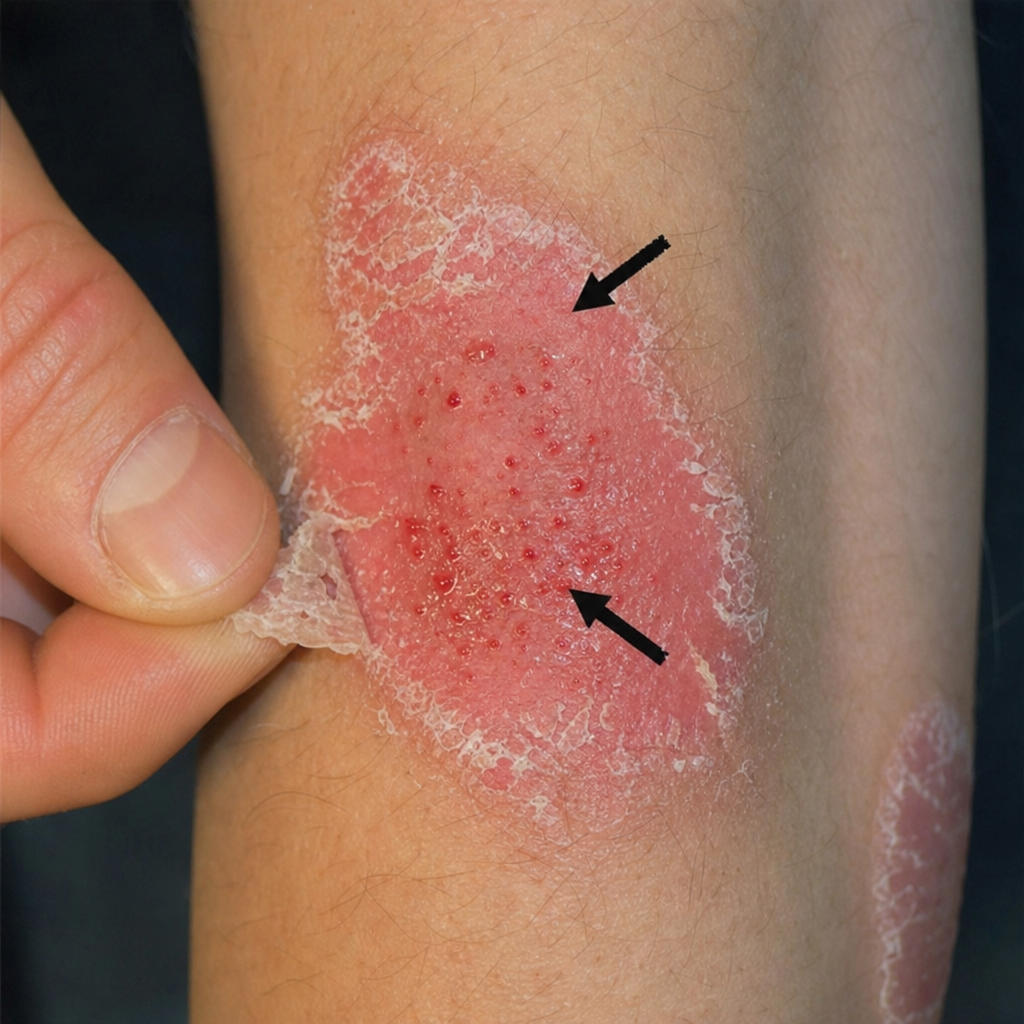
Explanation: **Explanation:** **Auspitz sign** is a classic clinical diagnostic feature of **Psoriasis**. It refers to the appearance of **pinpoint bleeding points** when the silvery-white scales of a psoriatic plaque are forcibly removed. **Pathophysiology:** The underlying mechanism is related to the histopathological changes in psoriasis: 1. **Thinning of the Suprapapillary Plate:** The epidermis overlying the dermal papillae becomes significantly thinned. 2. **Dilated Capillaries:** The blood vessels within the dermal papillae become elongated, tortuous, and dilated. When scales are scraped off (Grattage test), these superficial, fragile capillaries are ruptured, leading to the characteristic pinpoint bleeding. **Why other options are incorrect:** * **Fungal infections (Tinea):** Characterized by centrifugal spread with central clearing and peripheral scaling; Auspitz sign is absent. * **Vitiligo:** An autoimmune condition causing depigmentation due to loss of melanocytes; the skin surface remains smooth without scaling. * **Melasma:** A hyperpigmentation disorder (mask of pregnancy) involving increased melanin; it does not involve epidermal thickening or scaling. **High-Yield Clinical Pearls for NEET-PG:** * **Grattage Test:** The clinical procedure used to elicit the Auspitz sign. * **Candle Grease Sign:** During the Grattage test, as scales are scraped, they become more white and opaque, resembling scrapings from a wax candle. * **Woronoff’s Ring:** A pale halo of blanched skin surrounding a healing psoriatic plaque. * **Koebner’s Phenomenon:** Development of new psoriatic lesions at sites of local trauma (also seen in Lichen Planus and Vitiligo). * **Munro’s Microabscess:** Collection of neutrophils in the stratum corneum (hallmark histopathology).
Explanation: **Explanation:** The clinical presentation of **silvery, scaling plaques** on extensor surfaces (**elbows and knees**) in a young adult with a positive family history is the classic hallmark of **Psoriasis vulgaris**. **Why Psoriasis vulgaris is correct:** Psoriasis is a chronic, T-cell-mediated inflammatory dermatosis characterized by epidermal hyperproliferation. The "silvery-white" scale (micaceous scale) results from parakeratosis (retention of nuclei in the stratum corneum). Its predilection for extensor surfaces and strong genetic association (linked to HLA-Cw6) confirms the diagnosis in this patient. **Why the other options are incorrect:** * **Acne rosacea:** Typically presents with facial flushing, telangiectasia, and papulopustules. It lacks the thick silvery scales and extensor distribution seen here. * **Acne vulgaris:** Characterized by comedones (blackheads/whiteheads), papules, and pustules, primarily on the face, back, and chest; not scaling plaques on limbs. * **Pemphigus vulgaris:** An autoimmune blistering disease characterized by fragile, intraepidermal bullae and painful oral erosions. It involves a positive Nikolsky sign, not scaling plaques. **NEET-PG High-Yield Pearls:** * **Auspitz Sign:** Pinpoint bleeding occurs when scales are forcibly removed (due to thinning of the suprapapillary epidermis). * **Koebner Phenomenon:** Development of psoriatic lesions at sites of local trauma (also seen in Vitiligo and Lichen Planus). * **Histopathology:** Look for **Munro’s microabscesses** (neutrophils in the stratum corneum) and **Kogoj’s pustules** (neutrophils in the stratum spinosum). * **Guttate Psoriasis:** Often triggered by a Streptococcal sore throat.
Explanation: **Explanation:** The correct answer is **Pityriasis rosea** (Note: The option provided as "Psoriasis rosea" is a common nomenclature error in some question banks; the medical term is Pityriasis rosea). **1. Why Pityriasis Rosea is Correct:** The **"Collarette of scales"** is the pathognomonic clinical feature of Pityriasis Rosea (PR). It refers to a thin, fine rim of scales attached at the periphery with a free central edge, typically seen within the oval, salmon-colored erythematous plaques. This occurs because the scale peels outward from the center. PR often begins with a single, large **"Herald Patch"** followed by a generalized eruption in a **"Christmas Tree"** or "Fir Tree" distribution along the skin tension lines (Langer’s lines). **2. Why Other Options are Incorrect:** * **Pityriasis versicolor:** Characterized by "furfuraceous" (fine, powdery) scales that become prominent upon scratching (**Besnier’s sign** or the Stroke sign). * **Lichen planus:** Characterized by the 6 P's (Planar, Purple, Polygonal, Pruritic, Papules, and Plaques) and **Wickham striae** (whitish reticular lines), not peripheral scaling. * **Pityriasis rubra pilaris (PRP):** Known for follicular papules on an erythematous base, "islands of sparing," and orange-red palmoplantar keratoderma. **High-Yield Clinical Pearls for NEET-PG:** * **Etiology:** Associated with Human Herpesvirus 6 and 7 (**HHV-6/7**). * **Herald Patch:** The initial lesion, usually 2–10 cm, appearing days to weeks before the secondary eruption. * **Distribution:** Follows Langer’s lines on the trunk. * **Treatment:** Self-limiting (6–8 weeks); symptomatic relief with antihistamines or topical steroids. Narrowband UVB can be used in severe cases.
Explanation: **Explanation:** **Pityriasis Rosea (PR)** is a self-limiting, inflammatory skin disorder characterized by the **Herald Patch**. This is the initial lesion, appearing in about 50–90% of cases. It is typically a single, oval, salmon-colored or erythematous plaque (2–10 cm) with a peripheral "collarette" of scale. Following this, a generalized eruption occurs in a "Christmas tree" distribution along the cleavage lines (Langer’s lines) of the trunk. **Analysis of Incorrect Options:** * **Psoriasis:** Characterized by well-demarcated, silvery-white micaceous scales on an erythematous base, typically on extensors. It lacks a single precursor herald patch and often shows the Auspitz sign. * **Lichen Planus:** Presents as the "6 Ps": Planar, Purple, Polygonal, Pruritic, Papules, and Plaques. It is associated with Wickham striae and Koebner phenomenon, not a herald patch. * **Pityriasis Rubra Pilaris (PRP):** Characterized by follicular papules on an erythematous base, "islands of sparing," and orange-red palmoplantar keratoderma. **High-Yield Clinical Pearls for NEET-PG:** * **Etiology:** Likely associated with Human Herpesvirus 6 and 7 (HHV-6/7). * **Collarette Scale:** The scale is attached peripherally with the free edge pointing inwards. * **Distribution:** "Christmas tree" or "Fir tree" pattern on the back. * **Treatment:** Usually self-limiting (6–8 weeks); symptomatic relief with antihistamines or topical steroids. * **Differential Diagnosis:** Secondary syphilis (always rule out if lesions involve palms/soles).
Explanation: **Explanation:** **Auspitz sign** is a classic clinical diagnostic feature of **Psoriasis**. It refers to the appearance of **pinpoint bleeding points** when the silvery scales of a psoriatic plaque are forcibly removed. **Pathophysiology:** The underlying mechanism is related to the histopathological changes in psoriasis: 1. **Thinning of the suprapapillary plate:** The epidermis overlying the dermal papillae is significantly thinned. 2. **Dilated and tortuous capillaries:** The blood vessels within the dermal papillae are elongated and congested. When the scale is removed (Grattage test), these fragile, superficial capillaries are ruptured, leading to the characteristic pinpoint bleeding. **Why other options are incorrect:** * **Lichen Planus:** Characterized by **Wickham striae** (whitish reticular lines) and the Koebner phenomenon, but it does not exhibit Auspitz sign as there is no significant suprapapillary thinning. * **Pityriasis Alba:** A form of low-grade eczema common in children, presenting as hypopigmented scaly patches. It lacks the vascular changes seen in psoriasis. **NEET-PG High-Yield Pearls:** * **Grattage Test:** The clinical procedure used to elicit the Auspitz sign. * **Munro’s Microabscesses:** Collections of neutrophils in the stratum corneum (hallmark of psoriasis). * **Kogoj’s Pustule:** Neutrophils in the stratum spinosum. * **Woronoff’s Ring:** A pale halo around a healing psoriatic plaque. * **Note:** Auspitz sign may be absent in inverse psoriasis, pustular psoriasis, or erythrodermic psoriasis.
Pathophysiology of Psoriasis
Practice Questions
Psoriasis Vulgaris
Practice Questions
Guttate Psoriasis
Practice Questions
Erythrodermic Psoriasis
Practice Questions
Pustular Psoriasis
Practice Questions
Palmoplantar Psoriasis
Practice Questions
Nail Psoriasis
Practice Questions
Scalp Psoriasis
Practice Questions
Psoriatic Arthritis
Practice Questions
Topical Therapy for Psoriasis
Practice Questions
Systemic Therapy for Psoriasis
Practice Questions
Phototherapy and Biologics for Psoriasis
Practice Questions
Get full access to all questions, explanations, and performance tracking.
Start For Free