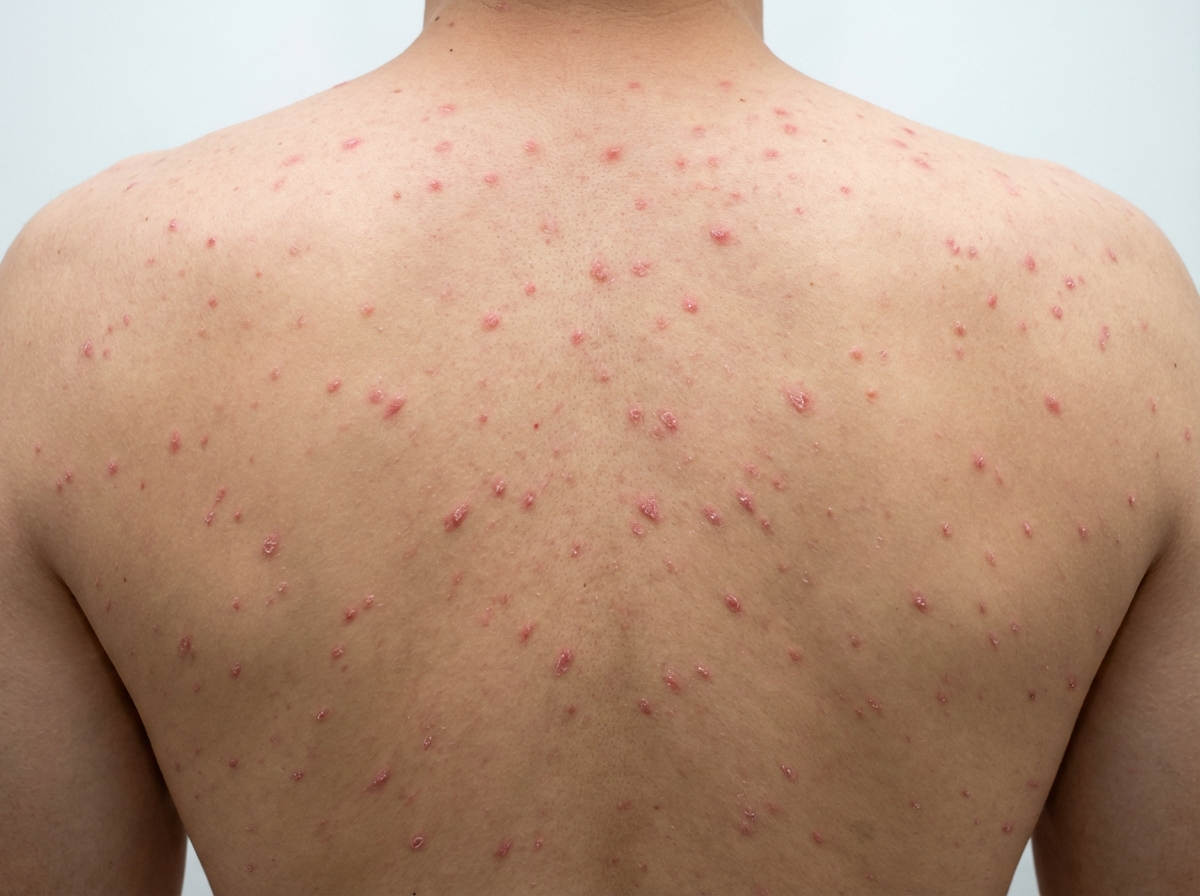
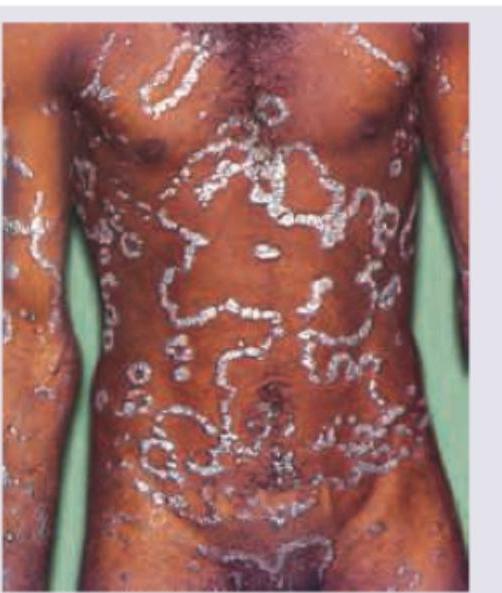
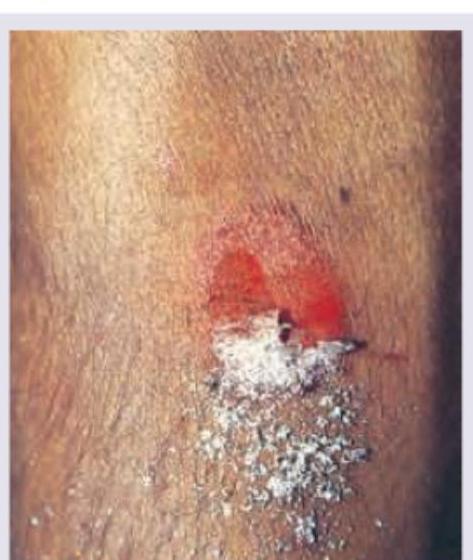
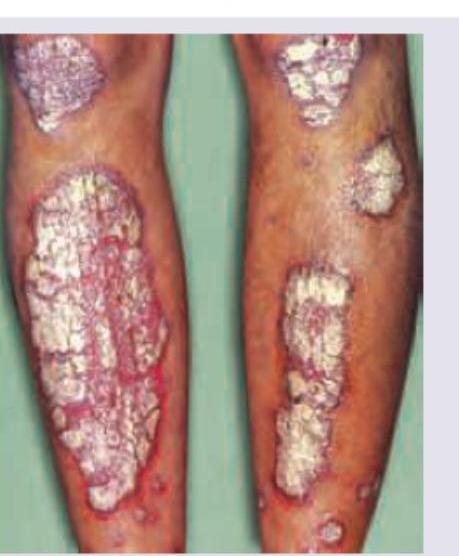
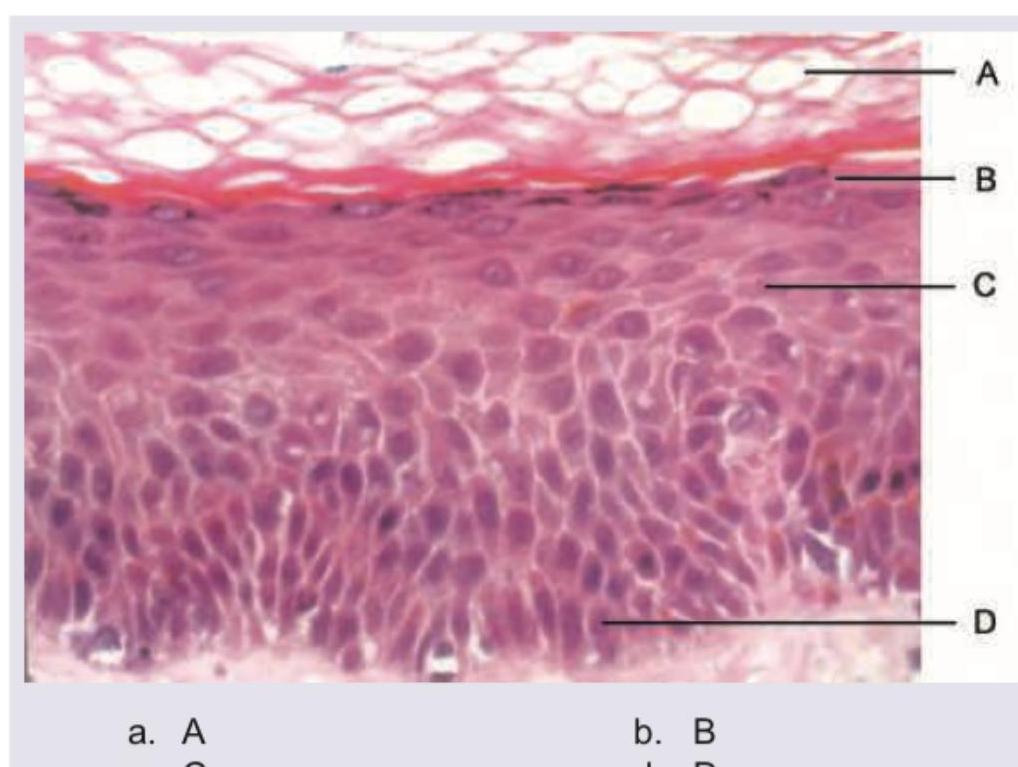
Munro microabscesses are seen in which of the following conditions?
Which of the following is NOT true regarding Munro's microabscess?
Which of the following is NOT true about psoriatic arthritis?
Which sign is observed on membrane removal of a psoriatic lesion?
Which of the following biologic agents approved for the treatment of psoriasis or psoriatic arthritis is not anti-TNF-alpha?
All of the following nail changes are associated with psoriasis, EXCEPT:
What is the topical treatment for Lichen planus?
True isomorphic phenomenon is not seen in which of the following conditions?
What is the only definite indication for giving systemic corticosteroids in pustular psoriasis?
All of the following are used in the management of Psoriasis except?
Explanation: **Explanation:** **Psoriasis** is the correct answer because **Munro microabscesses** are a pathognomonic histopathological feature of this condition. They represent collections of **neutrophils** within the **stratum corneum** (parakeratotic layer). This occurs due to the rapid migration of neutrophils from the papillary dermis through the epidermis (Kogoj’s sponges) into the horny layer, driven by chemotactic factors like IL-8 and LTB4. **Analysis of Incorrect Options:** * **Lichen Planus:** Characterized by a "saw-tooth" appearance of rete ridges, Civatte bodies (apoptotic keratinocytes), and a band-like lymphocytic infiltrate at the dermo-epidermal junction. * **Mycosis Fungoides:** A cutaneous T-cell lymphoma characterized by **Pautrier’s microabscesses**, which are clusters of atypical T-lymphocytes (not neutrophils) within the epidermis. * **Eczema:** Histologically defined by **spongiosis** (intercellular edema) and intraepidermal vesicles. While neutrophils may be present if secondarily infected, they do not form classic Munro microabscesses. **NEET-PG High-Yield Pearls:** * **Kogoj’s Macropustule:** Neutrophilic collections in the **stratum spinosum** (seen in Pustular Psoriasis). * **Auspitz Sign:** Pinpoint bleeding when psoriasis scales are removed, due to thinning of the suprapapillary plate and dilated capillaries. * **Other Histology:** Regular elongation of rete ridges ("camel foot" appearance), absent stratum granulosum, and parakeratosis. * **Key Distinction:** Remember **M**unro = **M**any Neutrophils (Psoriasis) vs. **P**autrier = **P**roliferating T-cells (Mycosis Fungoides).
Explanation: **Explanation:** The correct answer is **B (Debris consists of eosinophils)** because Munro’s microabscesses are characterized by the accumulation of **neutrophils**, not eosinophils. In the pathogenesis of Psoriasis, there is a marked chemotactic migration of neutrophils from the papillary capillaries into the epidermis. When these neutrophils aggregate within the parakeratotic layers of the **stratum corneum**, they form **Munro’s microabscesses**. If these neutrophils aggregate within the stratum spinosum (forming multilocular pustules), they are referred to as **Kogoj’s spongiform pustules**. **Analysis of other options:** * **Option A:** True. Munro’s microabscesses are specifically located in the **stratum corneum** (horny layer). * **Option C:** True. These microabscesses represent the microscopic equivalent of the clinical pustules seen in variants like pustular psoriasis. * **Option D:** True. Munro’s microabscess is a **pathognomonic** histological feature of Psoriasis. **High-Yield Clinical Pearls for NEET-PG:** * **Kogoj’s Spongiform Pustule:** Neutrophils in the stratum spinosum (seen in Psoriasis and Reiter’s syndrome). * **Psoriasis Histology Mnemonic:** "A-P-A-C-H-E" * **A**canthosis (regular) * **P**arakeratosis (nuclei in stratum corneum) * **A**bsent granular layer (Hypogranulosis) * **C**lubbing of dermal papillae * **H**orny layer microabscess (Munro’s) * **E**longated Rete ridges (Camel-foot appearance) * **Auspitz Sign:** Pinpoint bleeding on peeling a scale, due to thinning of the suprapapillary plate and dilated capillaries.
Explanation: ### Explanation Psoriatic arthritis (PsA) is a chronic inflammatory spondyloarthropathy occurring in approximately 30% of patients with psoriasis. **Why Option C is the correct answer:** The statement that PsA is "more common in males" is **incorrect**. Unlike many other spondyloarthropathies (like Ankylosing Spondylitis), psoriatic arthritis affects **males and females equally (1:1 ratio)**. While certain subtypes may show slight predilection (e.g., the spondylitis form is slightly more common in males), the overall prevalence is gender-neutral. **Analysis of other options:** * **A. Association with HLA-Cw6:** This is the strongest genetic risk factor for Psoriasis (Type 1). While HLA-B27 is linked to the axial/spondylitis subtype of PsA, HLA-Cw6 remains the primary genetic marker for the underlying cutaneous disease. * **B. Involvement of the DIP joint:** This is a **hallmark feature** of PsA. Involvement of the Distal Interphalangeal (DIP) joints helps clinically distinguish PsA from Rheumatoid Arthritis (which typically spares the DIP joints). * **D. Drug of choice is Methotrexate:** Methotrexate is the first-line Disease-Modifying Anti-Rheumatic Drug (DMARD) for PsA, as it effectively treats both the skin lesions and the peripheral joint inflammation. **High-Yield Clinical Pearls for NEET-PG:** 1. **Moll and Wright Criteria:** The most common clinical pattern is **Asymmetric Oligoarthritis**. 2. **Arthritis Mutilans:** The most severe form, characterized by "telescoping fingers" and "pencil-in-cup" appearance on X-ray. 3. **Dactylitis:** "Sausage digits" (diffuse swelling of a finger/toe) is a highly characteristic finding. 4. **Nail Changes:** Pitting and onycholysis are strong predictors of future joint involvement.
Explanation: **Explanation:** **Auspitz sign** is the hallmark clinical sign of Psoriasis. It refers to the appearance of **pinpoint bleeding** when the silvery-white scales (micaceous scales) are scraped off. * **Mechanism:** In psoriasis, there is significant epidermal hyperplasia (acanthosis) and thinning of the epidermis over the dermal papillae (suprapapillary thinning). Additionally, the dermal capillaries are dilated and tortuous. When the "bulk" of the scale (the **Bulkley membrane**) is removed, these fragile, superficial capillaries are ruptured, resulting in pinpoint bleeding. **Analysis of Incorrect Options:** * **A. Gottron’s sign:** Characterized by symmetric, violaceous papules over the dorsal aspect of interphalangeal joints; it is a pathognomonic feature of **Dermatomyositis**. * **B. Darier’s sign:** Refers to the formation of a wheal and flare after stroking a lesion; it is seen in **Mastocytosis** (Urticaria Pigmentosa) due to mast cell degranulation. * **D. Crowe’s sign:** Refers to axillary or inguinal freckling; it is a diagnostic criterion for **Neurofibromatosis Type 1 (NF-1)**. **High-Yield Clinical Pearls for NEET-PG:** * **Grattage Test:** The process of scraping psoriatic scales to demonstrate the "candle grease sign" (scales becoming more white/opaque) followed by the Auspitz sign. * **Koebner Phenomenon:** Appearance of new psoriatic lesions at sites of local trauma (also seen in Vitiligo and Lichen Planus). * **Woronoff Ring:** A pale halo of blanched skin surrounding a healing psoriatic plaque. * **Histopathology:** Look for Munro’s microabscesses (neutrophils in the stratum corneum) and Kogoj’s pustules (neutrophils in the stratum spinosum).
Explanation: ### Explanation The correct answer is **Alefacept**. **1. Why Alefacept is the correct answer:** Alefacept is a recombinant fusion protein (LFA-3-IgG1) that works by a different mechanism than TNF inhibitors. It binds to **CD2** on memory-effector T cells, inhibiting their interaction with LFA-3 on antigen-presenting cells. This leads to the apoptosis of pathogenic T cells, which are central to the development of psoriasis. Note: Alefacept was the first biologic approved for psoriasis but has since been discontinued in many markets due to the emergence of more effective agents. **2. Why the other options are incorrect:** * **Etanercept:** A soluble fusion protein that acts as a decoy receptor, binding to both TNF-α and TNF-β. * **Infliximab:** A chimeric monoclonal antibody (mouse/human) that binds specifically to soluble and transmembrane TNF-α. * **Adalimumab:** A fully human monoclonal antibody directed against TNF-α. **3. High-Yield Clinical Pearls for NEET-PG:** * **TNF-α Inhibitors:** These are the "first-generation" biologics. Before starting these, always screen for **Latent Tuberculosis** (via Mantoux or IGRA) and Hepatitis B/C, as they can cause reactivation. * **IL-17 Inhibitors:** (e.g., **Secukinumab**, Ixekizumab) – Highly effective for psoriasis; watch out for worsening of Inflammatory Bowel Disease (IBD). * **IL-23 Inhibitors:** (e.g., **Guselkumab**, Risankizumab) – Target the p19 subunit. * **IL-12/23 Inhibitor:** **Ustekinumab** (targets the common p40 subunit). * **Apremilast:** An oral **PDE-4 inhibitor** used in psoriasis; common side effects include diarrhea and weight loss.
Explanation: **Explanation:** Psoriasis is a chronic inflammatory dermatosis that affects the nails in approximately 50% of patients. The correct answer is **Pterygium formation**, as this is a classic feature of **Lichen Planus**, not psoriasis. Pterygium occurs due to scarring of the nail matrix, leading to the fusion of the proximal nail fold to the nail bed. **Analysis of Options:** * **Pitting (Option A):** The most common nail finding in psoriasis. It results from focal areas of parakeratosis in the **proximal nail matrix**, which leave depressions as the nail grows out. * **Onycholysis (Option B):** This refers to the separation of the nail plate from the nail bed. In psoriasis, it often starts distally and may be surrounded by a yellowish margin (the "oil drop" or "salmon patch" sign). * **Subungual hyperkeratosis (Option D):** Caused by parakeratosis of the **nail bed**, leading to an accumulation of scales under the distal nail plate. **Clinical Pearls for NEET-PG:** * **Oil drop sign/Salmon patch:** Pathognomonic for psoriasis; represents localized nail bed involvement. * **Nail Psoriasis & Arthritis:** Nail involvement is a strong predictor of **Psoriatic Arthritis**, specifically involving the Distal Interphalangeal (DIP) joints. * **Pitting Comparison:** Psoriatic pits are typically deep, large, and irregularly scattered. In contrast, Alopecia Areata presents with fine, shallow, "geometric" pits. * **Differential:** Pterygium is seen in Lichen Planus (Dorsal pterygium) and Systemic Sclerosis/Raynaud's (Ventral pterygium/Hyponychium fusion).
Explanation: **Explanation:** Lichen Planus (LP) is a chronic inflammatory, T-cell mediated autoimmune condition affecting the skin and mucous membranes. While the question asks for "topical treatment" but marks **Systemic Steroids** as the correct answer, this reflects a common pattern in competitive exams where the most effective "first-line" or "definitive" management for generalized/severe cases is prioritized. 1. **Why Systemic Steroids are correct:** Corticosteroids are the mainstay of treatment due to their potent anti-inflammatory and immunosuppressive properties. While topical steroids (e.g., Clobetasol) are used for localized LP, **Systemic Steroids** (Oral Prednisolone) are indicated for widespread (generalized) LP, rapidly progressive disease, or severe mucosal involvement to induce remission and prevent scarring (especially in Lichen Planopilaris). 2. **Why other options are incorrect:** * **Topical Salicylic acid:** This is a keratolytic agent used in psoriasis or ichthyosis to remove scales; it does not address the underlying lymphocytic inflammation of LP. * **UV ray (Phototherapy):** While Narrowband UVB (NBUVB) or PUVA can be used for generalized LP, they are typically second-line options if steroids are contraindicated or ineffective. * **Erythromycin:** This is an antibiotic with no role in the standard management of Lichen Planus. **High-Yield Clinical Pearls for NEET-PG:** * **The 6 P’s of LP:** Planar (flat-topped), Purple (violaceous), Polygonal, Pruritic, Papules, and Plaques. * **Wickham Striae:** Fine white reticular patterns on the surface of lesions (best seen with oil). * **Koebner Phenomenon:** Development of lesions at sites of trauma (also seen in Psoriasis and Vitiligo). * **Histopathology:** Characterized by "saw-tooth" rete ridges, Civatte bodies (apoptotic keratinocytes), and a band-like lymphocytic infiltrate at the dermo-epidermal junction. * **Association:** Chronic Hepatitis C infection is frequently associated with oral Lichen Planus.
Explanation: **Explanation:** The **Isomorphic Phenomenon (Koebner Phenomenon)** refers to the development of characteristic skin lesions of an existing dermatosis at the site of trauma (e.g., scratching, surgical scars, or pressure) on previously uninvolved skin. **Why Lichen Sclerosus is the correct answer:** While Lichen Sclerosus can sometimes show a "Pseudo-Koebner" effect (where lesions spread due to irritation), it is **not** classically associated with the **True Isomorphic Phenomenon**. True Koebnerization is a hallmark of specific inflammatory and autoimmune conditions where the trauma triggers the exact pathophysiological process of the primary disease. **Analysis of Incorrect Options:** * **Lichen Planus (B):** One of the most common conditions to exhibit the Koebner phenomenon. Linear lesions often form along scratch marks. * **Vitiligo (C):** Depigmented patches frequently appear at sites of friction or injury (e.g., elbows, knees, or waistbands), indicating disease activity. * **Psoriasis (D):** The classic example of Koebnerization. It occurs in roughly 25% of patients, typically appearing 7–14 days after injury. **High-Yield Clinical Pearls for NEET-PG:** * **True Koebner Phenomenon:** Seen in Psoriasis, Lichen Planus, and Vitiligo. * **Pseudo-Koebner Phenomenon:** Seen in infectious conditions like **Molluscum Contagiosum** and **Verruca (Warts)**, where trauma causes local inoculation/seeding of the virus. * **Reverse Koebner Phenomenon:** The disappearance of an existing lesion following trauma to the area (seen in Psoriasis). * **Wolf’s Isotopic Response:** Appearance of a new skin disease at the exact site of a previously healed, unrelated skin disease (e.g., Granuloma annulare appearing at the site of healed Herpes Zoster).
Explanation: **Explanation:** The use of systemic corticosteroids in psoriasis is generally avoided because their withdrawal can trigger a life-threatening flare-up of **Von Zumbusch (Generalized Pustular Psoriasis)**. However, in cases of severe, extensive pustular psoriasis where the patient is toxic and other systemic agents (like Methotrexate or Cyclosporine) are contraindicated or failing, systemic steroids may be used as a "rescue" therapy to control inflammation rapidly. **Analysis of Options:** * **Extensive lesions (Correct):** In generalized pustular psoriasis with widespread involvement, systemic steroids are indicated to stabilize the patient and prevent complications like high-output heart failure or sepsis, despite the risk of rebound. * **Pustular psoriasis with pregnancy:** This is known as **Impetigo Herpetiformis**. The first-line treatment is typically systemic corticosteroids or Cyclosporine, but the "definite indication" in general dermatology literature for pustular psoriasis specifically emphasizes the severity/extensiveness of the disease. * **Alcoholic cirrhosis:** This is a contraindication for Methotrexate, but not a primary indication for steroids. Acitretin or Cyclosporine would be considered based on the clinical picture. * **Moderate arthritis:** Psoriatic arthritis is primarily managed with NSAIDs, DMARDs (Methotrexate, Sulfasalazine), or Biologics (TNF-alpha inhibitors). Steroids are not the standard for moderate involvement. **High-Yield Clinical Pearls for NEET-PG:** * **The "Rebound" Phenomenon:** Sudden withdrawal of oral steroids is the most common trigger for converting stable plaque psoriasis into pustular psoriasis. * **Drug of Choice (DOC):** For Generalized Pustular Psoriasis, **Acitretin** is the first-line treatment (except in pregnancy). * **Impetigo Herpetiformis:** A variant of pustular psoriasis occurring in the 3rd trimester of pregnancy; **Cyclosporine** or steroids are preferred as Acitretin is highly teratogenic. * **Auspitz Sign:** Usually negative in pustular psoriasis (positive in plaque psoriasis).
Explanation: ### Explanation **Correct Answer: C. Reslizumab** **1. Why Reslizumab is the Correct Answer:** Reslizumab is a humanized monoclonal antibody that binds to **Interleukin-5 (IL-5)**. IL-5 is the primary cytokine responsible for the growth, activation, and survival of **eosinophils**. Therefore, Reslizumab is indicated for the add-on maintenance treatment of **severe eosinophilic asthma**, not psoriasis. Psoriasis is primarily a Th1/Th17 mediated disease, whereas IL-5 is associated with Th2-mediated eosinophilic inflammation. **2. Analysis of Incorrect Options (Used in Psoriasis):** * **Secukinumab (Option A):** A fully human monoclonal antibody that inhibits **IL-17A**. It is highly effective and FDA-approved for moderate-to-severe plaque psoriasis and psoriatic arthritis. * **Ixekizumab (Option B):** Another potent **IL-17A inhibitor**. Like Secukinumab, it is a mainstay in the biological management of recalcitrant psoriasis. * **Guselkumab (Option D):** A monoclonal antibody that targets the **p19 subunit of IL-23**. By inhibiting IL-23, it prevents the maintenance of Th17 cells, making it a first-line biological agent for chronic plaque psoriasis. **3. NEET-PG Clinical Pearls:** * **IL-17 Inhibitors:** Secukinumab, Ixekizumab, Brodalumab (targets IL-17 receptor). *Caution: Can exacerbate Inflammatory Bowel Disease (IBD).* * **IL-23 Inhibitors:** Guselkumab, Tildrakizumab, Risankizumab. * **IL-12/23 Inhibitor:** Ustekinumab (targets the p40 subunit). * **TNF-α Inhibitors:** Infliximab, Adalimumab, Etanercept. * **Apremilast:** An oral **PDE-4 inhibitor** used in psoriasis management. * **First-line systemic drug (Non-biological):** Methotrexate remains the most commonly used systemic agent for extensive psoriasis in the Indian context.
Pathophysiology of Psoriasis
Practice Questions
Psoriasis Vulgaris
Practice Questions
Guttate Psoriasis
Practice Questions
Erythrodermic Psoriasis
Practice Questions
Pustular Psoriasis
Practice Questions
Palmoplantar Psoriasis
Practice Questions
Nail Psoriasis
Practice Questions
Scalp Psoriasis
Practice Questions
Psoriatic Arthritis
Practice Questions
Topical Therapy for Psoriasis
Practice Questions
Systemic Therapy for Psoriasis
Practice Questions
Phototherapy and Biologics for Psoriasis
Practice Questions
Get full access to all questions, explanations, and performance tracking.
Start For Free