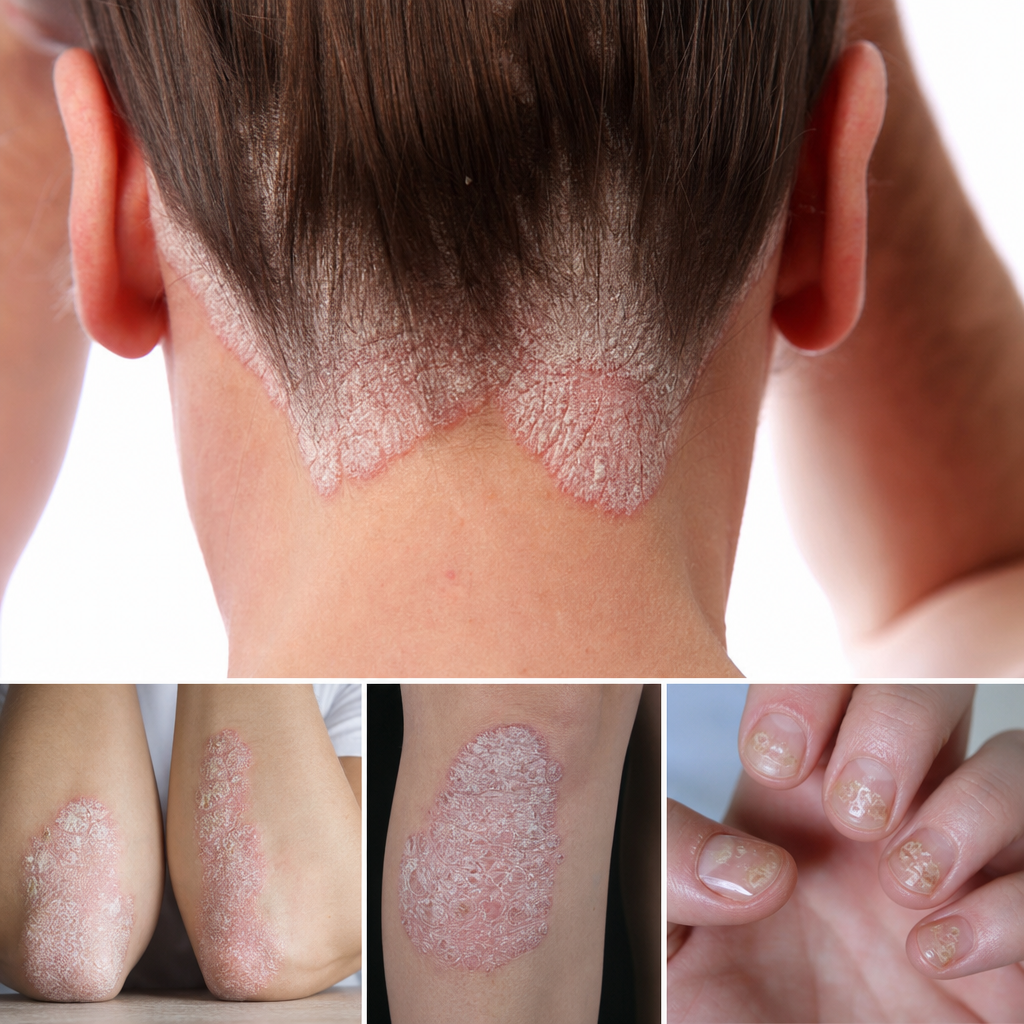
What is the best treatment option for psoriasis during pregnancy?
Which of the following histological features are associated with psoriasis?
Von Zumbusch disease is characterized by which of the following manifestations?
Oral lesions are not seen in which of the following conditions?
What is the primary indication for corticosteroid use in pustular psoriasis?
Monro's abscesses are seen in which of the following conditions?
What is the primary treatment for pustular psoriasis?
Which of the following conditions is characterized by "sausage digits"?
Bleeding spots are seen on removal of of plaques in which of the following conditions?
Psoriasis is characterized by which sign?
Explanation: **Explanation:** The management of psoriasis in pregnancy follows a "step-up" approach, prioritizing fetal safety while maintaining maternal skin health. **Why Topical Steroids are the Correct Answer:** Topical corticosteroids (low to moderate potency) are considered the **first-line treatment** for psoriasis in pregnancy. They have a well-established safety profile with minimal systemic absorption when used appropriately. If topical steroids alone are insufficient, narrowband UVB (NBUVB) phototherapy is the preferred second-line intervention. **Analysis of Incorrect Options:** * **Systemic Cyclosporine:** While it can be used in severe, refractory cases under strict supervision, it is not the first-line choice due to risks of maternal hypertension, renal toxicity, and potential low birth weight. * **PUVA Therapy:** Psoralen is **contraindicated** in pregnancy because it is mutagenic and teratogenic. While UVA itself is less concerning, the systemic psoralen makes this modality unsafe. * **Infliximab:** Although some biologics are used in pregnancy (especially in the first two trimesters), they are generally reserved for severe cases where first-line therapies fail. They are not the "best" or initial option. **High-Yield Clinical Pearls for NEET-PG:** * **Teratogenic Alert:** **Methotrexate** and **Oral Retinoids (Acitretin)** are strictly contraindicated. Acitretin requires a washout period of 3 years before conception. * **Disease Course:** Approximately 40-60% of patients see improvement in psoriasis during pregnancy due to high progesterone levels, though postpartum flares are common. * **Safe Systemic Option:** If a systemic agent is absolutely necessary, **Cyclosporine** is generally preferred over others, but only after topical and NBUVB options are exhausted.
Explanation: Psoriasis is a chronic inflammatory dermatosis characterized by accelerated keratinocyte turnover. The histological hallmark of psoriasis is the "psoriatic triad": **epidermal hyperplasia** (regular elongation of rete ridges), **parakeratosis** (retention of nuclei in the stratum corneum), and neutrophilic infiltration. **Why Option B is Correct:** * **Munro’s micro-abscesses:** These are collections of neutrophils within the parakeratotic stratum corneum. (Note: Neutrophils in the stratum spinosum are called *Kogoj’s spongiform pustules*). * **Parakeratosis:** Due to rapid cell division, keratinocytes do not have time to lose their nuclei before reaching the surface. * **Epidermal Hyperplasia:** Specifically "regular" acanthosis, often described as a "test-tube in a rack" appearance. **Analysis of Incorrect Options:** * **Option A:** "Fir tree appearance" is the clinical distribution pattern of **Pityriasis Rosea**, not a histological feature of psoriasis. * **Option C:** "Satellite pustules" are a clinical hallmark of **Candidiasis**, typically found in intertriginous areas. * **Option D:** "Wickham’s striae" are the white, reticulate lines seen clinically in **Lichen Planus**. **High-Yield NEET-PG Pearls:** * **Auspitz Sign:** Pinpoint bleeding when a scale is removed, caused by thinning of the suprapapillary epidermis over dilated capillaries. * **Grattage Test:** Scraping the lesion increases the silvery-white scale (candle grease sign). * **Koebner Phenomenon:** Development of lesions at sites of trauma (also seen in Lichen Planus and Vitiligo). * **Key Histology Mnemonic:** "PMN" – **P**arakeratosis, **M**unro’s micro-abscesses, **N**eutrophils (Kogoj).
Explanation: **Explanation:** **Von Zumbusch disease** is the acute, generalized form of **Pustular Psoriasis**. It is a severe, potentially life-threatening variant characterized by the sudden onset of widespread erythema followed by the eruption of numerous sterile, pin-head-sized pustules. These pustules often coalesce to form "lakes of pus." **Why the correct answer is right:** The underlying pathophysiology involves an intense inflammatory response, often triggered by the withdrawal of systemic steroids, infections, or pregnancy (Impetigo Herpetiformis). Clinically, patients present with systemic symptoms like high-grade fever, malaise, and leukocytosis, alongside the characteristic pustular rash. **Analysis of incorrect options:** * **Plaque Psoriasis (Psoriasis Vulgaris):** This is the most common form, characterized by well-demarcated erythematous plaques with silvery-white scaling (Auspitz sign positive), but it does not feature primary pustulation. * **Psoriatic Erythroderma:** This involves >90% of the body surface area becoming red and scaly. While Von Zumbusch can progress to erythroderma, the specific eponym refers to the pustular phase. * **Psoriatic Arthritis:** This is an inflammatory joint disease associated with psoriasis (found in ~30% of patients), typically involving the distal interphalangeal joints and presenting with "pencil-in-cup" deformity on X-ray. **High-Yield Clinical Pearls for NEET-PG:** * **Histopathology:** Look for **Kogoj’s spongiform pustules** (neutrophils in the stratum spinosum) and **Munro’s microabscesses** (neutrophils in the stratum corneum). * **Triggers:** Rapid tapering of systemic corticosteroids is the classic "textbook" trigger for a Von Zumbusch flare. * **Treatment:** Oral Retinoids (Acitretin) are considered the first-line systemic treatment for pustular psoriasis, unlike plaque psoriasis where they are second-line.
Explanation: **Explanation:** The correct answer is **Psoriasis**. While psoriasis is a chronic inflammatory dermatosis that can affect the skin, nails, and joints, **oral involvement is extremely rare** and clinically insignificant. When oral lesions are reported (such as "geographic tongue"), they are often considered associated conditions rather than direct psoriatic manifestations. **Analysis of Options:** * **Pemphigoid (Bullous Pemphigoid):** While primarily a subepidermal blistering disease of the skin, oral mucosal involvement occurs in approximately 10–20% of cases (though less frequent than in Pemphigus Vulgaris). Cicatricial pemphigoid specifically targets mucous membranes. * **Stevens-Johnson Syndrome (SJS):** This is a hypersensitivity reaction characterized by extensive mucosal involvement. Hemorrhagic crusting of the lips and painful oral erosions are hallmark features. * **Candidiasis:** This is a fungal infection caused by *Candida albicans*. Oral candidiasis (thrush) is one of the most common clinical presentations, manifesting as white, curd-like plaques. **High-Yield Clinical Pearls for Psoriasis:** * **Auspitz Sign:** Pinpoint bleeding on peeling a scale (due to thinning of the suprapapillary epidermis). * **Koebner Phenomenon:** Development of lesions at sites of trauma (also seen in Vitiligo and Lichen Planus). * **Histology:** Look for **Munro’s microabscesses** (neutrophils in the stratum corneum) and **Kogoj’s pustules** (neutrophils in the stratum spinosum). * **Nail Changes:** Pitting (most common), Oil drop sign (pathognomonic), and subungual hyperkeratosis.
Explanation: ### Explanation **Correct Option: A. Psoriatic erythroderma during pregnancy** The primary indication for systemic corticosteroids in psoriasis is extremely limited due to the risk of triggering a life-threatening rebound flare of **Generalized Pustular Psoriasis (von Zumbusch)** upon withdrawal. However, **Impetigo Herpetiformis** (a variant of pustular psoriasis occurring in pregnancy) and associated psoriatic erythroderma represent a critical exception. In pregnancy, first-line systemic retinoids (Acitretin) and Methotrexate are strictly **teratogenic** and contraindicated. Therefore, systemic steroids are used as a rescue therapy to manage severe systemic inflammation and protect both maternal and fetal well-being. **Why the other options are incorrect:** * **B. Alcoholic Cirrhosis:** While Methotrexate is contraindicated in cirrhosis, the preferred alternative is usually **Acitretin** or biologics. Steroids are avoided to prevent pustular flares. * **C. Moderate Arthritis:** The standard of care for psoriatic arthritis includes NSAIDs and DMARDs (Methotrexate, Leflunomide, or TNF-alpha inhibitors). Systemic steroids are not a primary treatment for joint involvement in psoriasis. * **D. Extensive Lesions:** For extensive plaque psoriasis, the treatment of choice is **Phototherapy (NBUVB)** or systemic agents like Methotrexate/Cyclosporine. Using steroids here is a classic "contraindication" because it leads to unstable disease. **High-Yield Clinical Pearls for NEET-PG:** * **The "Steroid Rule":** Never use systemic steroids for routine plaque psoriasis. It is the most common trigger for **Generalized Pustular Psoriasis**. * **Impetigo Herpetiformis:** Usually occurs in the 3rd trimester; associated with hypocalcemia. Treatment: Systemic steroids + Cyclosporine (if refractory). * **Drug of Choice (DOC):** For Generalized Pustular Psoriasis (non-pregnant), the DOC is **Acitretin**. For Psoriatic Arthritis, the DOC is **Methotrexate**.
Explanation: **Explanation:** **Monro’s microabscesses** are a hallmark histopathological feature of **Psoriasis**. They consist of small collections of **neutrophils** within the **stratum corneum** (horny layer). This occurs due to the rapid migration of neutrophils from the papillary dermis through the epidermis, driven by chemotactic factors like IL-8 and LTB4. **Analysis of Options:** * **Psoriasis (Correct):** Along with Monro’s microabscesses, psoriasis is characterized by **Kogoj’s pustules** (neutrophils in the stratum spinosum), parakeratosis (nuclei in the stratum corneum), and regular elongation of rete ridges. * **Pemphigus:** This is an autoimmune blistering disorder characterized by **acantholysis** (loss of cell-to-cell adhesion) and intraepidermal blisters. * **Lichen Planus:** Histology shows a "saw-tooth" appearance of rete ridges, **Wickham striae**, and a band-like lymphocytic infiltrate at the dermo-epidermal junction (Civatte bodies). * **Leukoplakia:** This is a clinical term for a white patch; histologically, it shows hyperkeratosis and varying degrees of epithelial dysplasia, but not neutrophilic abscesses. **High-Yield Clinical Pearls for NEET-PG:** * **Auspitz Sign:** Pinpoint bleeding on scraping a psoriatic plaque due to thinning of the suprapapillary plate. * **Grattage Test:** Scraping the lesion increases the silvery-white scale (candle grease sign). * **Koebner Phenomenon:** Development of new lesions at sites of trauma (also seen in Lichen Planus and Vitiligo). * **Histology Mnemonic:** "Munro is on top (Corneum), Kogoj is below (Spinosum)."
Explanation: **Explanation:** **Pustular Psoriasis** (von Zumbusch type) is a severe, systemic form of psoriasis characterized by widespread sterile pustules on an erythematous base. The primary goal of treatment is rapid control of inflammation and stabilization of the skin barrier. **Why Retinoids are the Correct Answer:** Oral retinoids, specifically **Acitretin**, are considered the first-line treatment (drug of choice) for generalized pustular psoriasis. Retinoids work by modulating keratinocyte proliferation and differentiation and, crucially, exert a potent **anti-inflammatory effect** by inhibiting neutrophil chemotaxis into the epidermis (which forms the pustules). Their rapid onset of action in controlling pustulation makes them superior in this clinical subtype. **Analysis of Incorrect Options:** * **Thalidomide (A):** While it has anti-TNF properties, it is not a standard or first-line treatment for psoriasis due to its severe teratogenicity and peripheral neuropathy risks. * **Hydroxyurea (C):** This is a second or third-line cytotoxic agent used only when other systemic therapies (like Methotrexate or Cyclosporine) are contraindicated or ineffective. * **Methotrexate (D):** While Methotrexate is the drug of choice for **Chronic Plaque Psoriasis**, it is generally considered second-line for the acute phase of Pustular Psoriasis, as it acts slower than retinoids or cyclosporine. **High-Yield Clinical Pearls for NEET-PG:** * **Histopathology:** Look for the **Kogoj’s spongiform pustule** (neutrophils in the stratum spinosum). * **Triggers:** Sudden withdrawal of systemic steroids is the most common trigger for pustular psoriasis. * **Contraindication:** Avoid Acitretin in females of childbearing age unless strict contraception is used, as it is highly teratogenic (pregnancy must be avoided for 3 years after stopping). * **Alternative:** If a rapid response is needed and retinoids are contraindicated, **Cyclosporine** is the preferred alternative.
Explanation: ### Explanation **Correct Answer: C. Psoriatic arthritis** **1. Why Psoriatic Arthritis is Correct:** The term **"sausage digit"** refers to **Dactylitis**, which is the uniform, generalized swelling of an entire finger or toe. In Psoriatic Arthritis (PsA), this occurs due to a combination of inflammation in the small joints (synovitis) and the surrounding tendons and ligaments (enthesitis/tenosynovitis). Dactylitis is a hallmark feature of Seronegative Spondyloarthropathies (like PsA) and is seen in approximately 30-50% of patients with PsA. It typically affects the digits asymmetrically. **2. Why Other Options are Incorrect:** * **A. Lyme Disease:** Typically presents with a "bull’s eye" rash (Erythema chronicum migrans) and large joint oligoarthritis (most commonly the knee). It does not typically cause diffuse digital swelling (dactylitis). * **B. Osteoarthritis:** Characterized by bony enlargements at specific joints, such as **Heberden’s nodes** (DIP joints) and **Bouchard’s nodes** (PIP joints). The swelling is localized to the joint itself, not the entire digit. **3. NEET-PG High-Yield Clinical Pearls:** * **Pencil-in-cup deformity:** The classic radiographic finding in PsA due to periarticular erosions and bone resorption. * **Nail changes:** Pitting, onycholysis, and subungual hyperkeratosis are strong predictors of joint involvement in psoriasis. * **Auspitz Sign:** Pinpoint bleeding upon removal of a psoriasis scale (due to thinning of the suprapapillary plate). * **Woronoff’s Ring:** A pale halo of blanched skin surrounding a healing psoriatic plaque. * **Other causes of Dactylitis:** Sickle cell disease (Hand-foot syndrome), Sarcoidosis, and Reactive Arthritis.
Explanation: The correct answer is **Psoriasis**. ### **Explanation** The phenomenon described is the **Auspitz sign**, a hallmark clinical feature of Psoriasis. **Why it occurs:** In Psoriasis, there is significant epidermal hyperplasia (acanthosis) and thinning of the epidermis overlying the dermal papillae (suprapapillary thinning). Additionally, the blood vessels within the dermal papillae become dilated and tortuous. When a psoriatic plaque is forcibly removed or scraped, these fragile, superficial capillaries are ruptured, resulting in **pinpoint bleeding spots**. ### **Analysis of Incorrect Options** * **Lichen planus:** Characterized by the **6 Ps** (Planar, Purple, Polygonal, Pruritic, Papules, and Plaques) and **Wickham striae** (whitish reticular lines). It does not show Auspitz sign. * **Lichen striatus:** A self-limiting linear dermatosis following **Blaschko’s lines**, typically seen in children. It lacks the vascular changes seen in psoriasis. * **Systemic Lupus Erythematosus (SLE):** Cutaneous SLE (like DLE) is characterized by **carpet tacking sign** (follicular plugging seen when a scale is removed), not pinpoint bleeding. ### **NEET-PG High-Yield Pearls** * **Grattage Test:** The clinical procedure of scraping a lesion with a glass slide to elicit the Auspitz sign. * **Koebner Phenomenon:** Development of new psoriatic lesions at sites of trauma (also seen in Lichen Planus and Vitiligo). * **Woronoff Ring:** A pale halo of blanched skin surrounding a healing psoriatic plaque. * **Munro’s Microabscesses:** Collections of neutrophils in the stratum corneum (histopathological hallmark).
Explanation: **Explanation:** **Auspitz sign** is a classic clinical hallmark of **Psoriasis**. It refers to the appearance of pinpoint bleeding points when psoriatic scales are forcibly removed. This occurs due to the underlying histopathology of psoriasis: **elongated dermal papillae** (papillomatosis) and the thinning of the suprapapillary epidermis. When the scale is lifted, the dilated and tortuous capillaries within these prominent dermal papillae are ruptured, leading to focal bleeding. **Analysis of Incorrect Options:** * **Darier's sign:** Seen in **Mastocytosis** (specifically Urticaria Pigmentosa). It involves the formation of a wheal and flare after firm stroking of a lesion due to mast cell degranulation and histamine release. * **Nikolsky's sign:** A characteristic of **Pemphigus Vulgaris** and SJS/TEN. It is positive when the top layer of skin slips away from the lower layers when rubbed, indicating acantholysis (loss of intercellular adhesion). * **Gottron’s sign:** (Corrected spelling of "Gottoson's") These are erythematous, scaly papules found over the bony prominences of the knuckles, pathognomonic for **Dermatomyositis**. **High-Yield Clinical Pearls for NEET-PG:** * **Grattage Test:** The procedure of scraping psoriatic lesions with a glass slide to elicit the Auspitz sign. * **Koebner Phenomenon:** Development of new psoriatic lesions at sites of local trauma (also seen in Lichen Planus and Vitiligo). * **Woronoff’s Ring:** A pale halo of blanched skin surrounding a healing psoriatic plaque. * **Histology Mnemonic:** "MUNRO’S microabscesses" (Neutrophils in the stratum corneum) and "KOGOJ’S pustules" (Neutrophils in the stratum spinosum).
Pathophysiology of Psoriasis
Practice Questions
Psoriasis Vulgaris
Practice Questions
Guttate Psoriasis
Practice Questions
Erythrodermic Psoriasis
Practice Questions
Pustular Psoriasis
Practice Questions
Palmoplantar Psoriasis
Practice Questions
Nail Psoriasis
Practice Questions
Scalp Psoriasis
Practice Questions
Psoriatic Arthritis
Practice Questions
Topical Therapy for Psoriasis
Practice Questions
Systemic Therapy for Psoriasis
Practice Questions
Phototherapy and Biologics for Psoriasis
Practice Questions
Get full access to all questions, explanations, and performance tracking.
Start For Free