What is the primary condition for which calcitriol is used as a treatment?
All are nail changes seen in cases of psoriasis except:
Treatment of choice for Pustular psoriasis is:
All are true about psoriasis except –
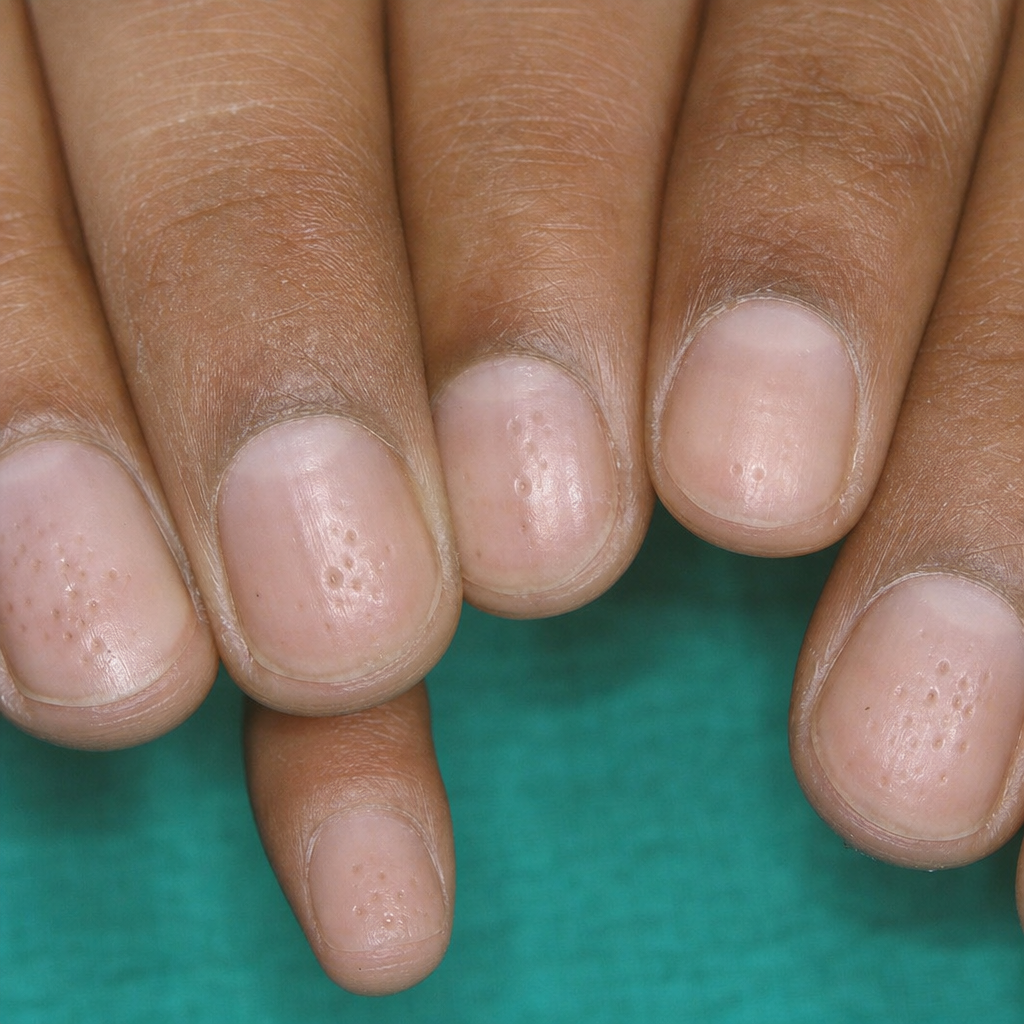
Which of the following nail findings is seen in the condition shown below?
A 54-year-old man presents with well-demarcated scaly plaques on the extensor surfaces of elbows and knees. The scales are silvery-white in appearance. What is the most likely diagnosis?
All are true about psoriasis except:
A 25-year-old patient presents with well-demarcated plaques with silvery scales on the elbows and knees. What is the most likely diagnosis?
A 54-year-old man presents with scaly plaques on extensor surfaces. What is the most likely diagnosis?
A 25-year-old presents with silvery scales on elbows and knees. Likely diagnosis?
Explanation: Secondary hyperparathyroidism - Calcitriol is the active form of vitamin D (1,25-dihydroxyvitamin D₃), and it is crucial for regulating calcium and phosphate levels in the body [1]. - In secondary hyperparathyroidism, often seen in chronic kidney disease (CKD), the kidneys cannot convert vitamin D to its active form, leading to hypocalcemia and increased PTH secretion [1], [2]. - Calcitriol supplementation helps to increase calcium absorption from the gut and suppress the release of parathyroid hormone (PTH), thereby treating the underlying cause of secondary hyperparathyroidism [1], [2]. - This is the primary therapeutic indication for calcitriol in clinical practice. Lichen planus - This is a chronic inflammatory condition affecting the skin, hair, nails, and mucous membranes - Typically treated with corticosteroids or other immunosuppressants - Calcitriol has no primary role in the treatment of lichen planus; its therapeutic applications are predominantly related to calcium and bone metabolism Pemphigus - Pemphigus is a group of rare autoimmune blistering diseases that affect the skin and mucous membranes - Primary treatment involves immunosuppressants like corticosteroids, often in high doses - Calcitriol is not indicated for the treatment of pemphigus, as its mechanism of action is unrelated to the autoimmune processes characteristic of this disease Leprosy - Leprosy is a chronic infectious disease caused by the bacterium Mycobacterium leprae - Treated with multi-drug therapy (MDT), which includes antibiotics like rifampicin, dapsone, and clofazimine - Calcitriol is not an antibiotic and therefore has no role in treating the bacterial infection responsible for leprosy
Explanation: ***Mees lines*** - **Mees lines** (or Aldrich-Mees lines) are **transverse white bands** that appear in the nail plate. - They are typically associated with **heavy metal poisoning** (e.g., arsenic), chemotherapy, or systemic illnesses, not psoriasis. *Subungual hyperkeratosis* - This is a common finding in **psoriasis**, characterized by the **thickening of the nail bed** due to excessive keratin production. - It leads to lifting of the nail plate from the nail bed. *Oil drop sign* - The **oil drop sign** (or salmon patch) is a classic psoriatic nail change, presenting as a **translucent, yellowish-red discoloration** under the nail plate. - It is due to psoriasis of the nail bed. *Pitting* - **Nail pitting** refers to the presence of **small depressions or pits** on the nail surface. - It results from defective keratinization of the nail matrix and is a characteristic sign of nail psoriasis.
Explanation: ***Methotrexate*** - **Methotrexate** is a systemic immunosuppressant often considered the first-line treatment for severe forms of **pustular psoriasis** due to its efficacy in reducing inflammation and hyperproliferation of skin cells. - It works by inhibiting **dihydrofolate reductase**, thereby interfering with DNA synthesis and cell division, which is crucial in rapidly dividing cells like those found in psoriasis. *Psoralen - UV therapy* - **Psoralen and ultraviolet A (PUVA)** therapy can be used for chronic plaque psoriasis, but it is generally **contraindicated or used with extreme caution** in pustular psoriasis due to the risk of exacerbating the disease or causing irritation. - **UV light therapy** can sometimes trigger or worsen pustular flares, especially in acute generalized pustular psoriasis. *Systemic steroid* - While systemic steroids can provide temporary relief by addressing inflammation, their use in pustular psoriasis is generally **not recommended for long-term management** due to the high risk of severe rebound flares upon withdrawal. - Withdrawal of **systemic corticosteroids** can precipitate or worsen generalized pustular psoriasis, making them a less desirable long-term treatment option. *Estrogen* - **Estrogen** has no direct role in the treatment of psoriasis. Psoriasis is an inflammatory skin condition, and its pathophysiology is not directly influenced by estrogen levels. - Hormonal therapies are not indicated for the management of psoriasis, including its pustular forms.
Explanation: ***Joint involvement in 5–10%*** - While **psoriasis** is a skin condition, it can involve the joints in about **30% of patients**, leading to **psoriatic arthritis**. - Therefore, stating that joint involvement occurs in only **5-10%** is incorrect, as the percentage is significantly higher. - This is the **FALSE statement** in this EXCEPT question. *Auspitz sign positive* - The **Auspitz sign** (pinpoint bleeding when scales are removed) is a classic feature of psoriasis. - It occurs due to the proximity of dilated capillaries to the thinned suprapapillary epidermis. - This is a **TRUE statement**. *Parakeratosis & acanthosis* - **Parakeratosis** (retention of nuclei in the stratum corneum) and **acanthosis** (epidermal hyperplasia) are classic histopathological features of psoriasis. - These features reflect the **rapid cell turnover** and **thickening of the epidermis** characteristic of psoriatic plaques. - This is a **TRUE statement**. *Pitting of nails* - **Nail pitting** is a common manifestation of psoriasis, affecting up to **50% of patients** with chronic plaque psoriasis and **80% of patients with psoriatic arthritis**. - Other nail changes include **onycholysis**, **subungual hyperkeratosis**, and discoloration. - This is a **TRUE statement**. *Koebner phenomenon* - **Koebner phenomenon** (isomorphic response) is the development of psoriatic lesions at sites of trauma or injury. - This is seen in approximately **25% of patients** with psoriasis and is a well-recognized clinical feature. - This is a **TRUE statement**.
Explanation: ***Pitting*** - The image displays multiple small, **punctate depressions** on the nail plate, which are characteristic features of nail pitting. - Nail pitting is a common finding in conditions affecting the **nail matrix**, such as psoriasis. *Pterygium* - **Pterygium** refers to the forward growth of the proximal nail fold onto the nail plate, or the lateral nail folds onto the nail plate, often leading to nail loss. - This is not observed in the image, which primarily shows depressions rather than overgrowth of skin onto the nail. *Pigmentation* - **Nail pigmentation** involves discoloration of the nail plate, appearing as streaks, spots, or diffuse changes in color (e.g., brown, black, blue). - The nail in the image does not show abnormal discoloration but rather surface irregularities. *Ridges* - **Ridges** in nails (longitudinal or transverse) are linear elevations or grooves on the nail surface. - While some linear texture is present, the predominant feature in the image is distinct, small, and scattered depressions, which are consistent with pitting rather than continuous ridges.
Explanation: ***Psoriasis*** - **Psoriasis** classically presents with **scaly plaques** that often appear on the **extensor surfaces** like elbows and knees. - The scales are typically **silvery-white** and can be associated with itching or discomfort. *Eczema* - **Eczema** (atopic dermatitis) typically presents with **pruritic (itchy)**, **erythematous (red)**, and sometimes **weeping lesions**, often in flexural areas like the antecubital and popliteal fossae. - While it can be scaly, the scales are usually finer and less prominent than those seen in psoriasis, and it often presents on **flexor surfaces**. *Lichen planus* - **Lichen planus** is characterized by **pruritic, purple, polygonal, planar papules and plaques** (the "6 Ps"), often found on flexural surfaces, wrists, and ankles. - It does not typically present with the thick, silvery scales on extensor surfaces seen in this case. *Pityriasis rosea* - **Pityriasis rosea** typically begins with a **herald patch**, followed by an eruption of smaller, oval, scaly patches that follow the skin Langer's lines, often described as a "Christmas tree" pattern on the trunk. - It is usually self-limiting and rarely involves the thick, scaly plaques on extensor surfaces seen in psoriasis.
Explanation: ***Very pruritic*** - While psoriasis can be itchy, it is generally not characterized as "very pruritic" compared to other dermatological conditions like **eczema** or **scabies**. - **Pruritus** in psoriasis tends to be mild to moderate, and it is not a defining characteristic that differentiates it from other skin disorders. *Parakeratosis & acanthosis* - **Parakeratosis** (retention of nuclei in the stratum corneum) and **acanthosis** (epidermal hyperplasia) are classic histopathological hallmarks of psoriasis. - These features reflect the rapid epidermal turnover characteristic of the condition. *Pitting of nails* - **Nail pitting**, onycholysis, and subungual hyperkeratosis are common and characteristic manifestations of psoriasis, affecting up to 50% of patients. - These nail changes are highly indicative of **psoriatic involvement**. *Joint involvement in 5–10%* - **Psoriatic arthritis**, involving inflammation of the joints, affects approximately 5-30% of individuals with psoriasis. - This statistic makes joint involvement a significant comorbidity of psoriasis.
Explanation: ***Psoriasis*** - **Psoriasis** is characterized by well-demarcated erythematous plaques with characteristic silvery scales, commonly found on extensor surfaces like the **elbows and knees**. - This chronic inflammatory skin condition results from an accelerated epidermal turnover rate. *Lichen planus* - **Lichen planus** typically presents with pruritic, polygonal, purple, planar papules and plaques, often with **Wickham's striae**, which are absent here. - It commonly affects the wrists, ankles, and oral mucosa, not primarily the elbows and knees with silvery scales. *Pityriasis rosea* - **Pityriasis rosea** usually starts with a single **"herald patch"** followed by smaller, oval, salmon-colored patches in a "Christmas tree" distribution on the trunk. - It does not present with thick silvery scales on the elbows and knees. *Eczema* - **Eczema** (atopic dermatitis) typically presents with intensely itchy, erythematous, oozing, and crusted lesions in acute flares, or dry, thickened, and lichenified skin in chronic cases. - While it can affect the extremities, the presence of distinct **silvery scales** is more characteristic of psoriasis.
Explanation: ***Psoriasis*** - **Psoriasis** is characterized by the presence of **scaly plaques** on extensor surfaces. - The scales are typically silvery and can be associated with *pruritus* (itching). *Lichen planus* - **Lichen planus** presents as **pruritic, purple, polygonal papules and plaques** (the "6 P's") - It usually affects the flexor surfaces and mucous membranes, not primarily extensor surfaces with scaly plaques. *Eczema* - **Eczema** (dermatitis) often manifests as **erythematous, intensely itchy patches** and plaques, which can be dry or oozing. - While it can occur on extensor surfaces, the classic description of "scaly plaques" on extensor surfaces points more strongly to psoriasis. *Pityriasis rosea* - **Pityriasis rosea** typically begins with a single **"herald patch"** followed by smaller, oval, salmon-colored patches in a **"Christmas tree" pattern** on the trunk. - It does not primarily present as thick scaly plaques on extensor surfaces.
Explanation: ***Psoriasis*** - **Silvery scales** on **extensor surfaces** like elbows and knees are classic presentations of plaque psoriasis. - This chronic inflammatory skin condition is characterized by **accelerated epidermal turnover**. *Atopic dermatitis* - Typically presents as **eczematous lesions** characterized by **red, itchy, and often oozing or crusted patches**, mainly on flexural surfaces in adults. - It is strongly associated with a history of **allergies, asthma, or hay fever**. *Pityriasis rosea* - Usually starts with a **herald patch** followed by smaller, oval, pinkish-orange macules and patches with fine scales in a **Christmas tree pattern** on the trunk. - It is distinguished from psoriasis by its distribution and appearance of scales. *Lichen planus* - Characterized by **pruritic, purple, polygonal, planar papules and plaques** (the "6 P's") often with fine, white lacy streaks called **Wickham's striae**, typically affecting flexor surfaces, wrists, and oral mucosa. - It does not present with silvery scales on extensor surfaces.
Get full access to all questions, explanations, and performance tracking.
Start For Free