Koebner's phenomenon is seen in all of the following except:
Which one of these should not be used in severe widespread psoriasis?
The following is an important feature of psoriasis:
Antibiotics are indicated in which type of psoriasis?
A 30-year-old male presented with silvery scales on elbow and knee, that bleed on removal. The probable diagnosis is:
Psoriasis typically seen after β-hemolytic streptococcal infection is
Vitamin D analogues (such as calcitriol and calcipotriol) are useful in the treatment of:
Match the following scale types with their lesions. | Scales | Lesions | | :-- | :-- | | 1. Collarette scales | a. Pityriasis versicolour | | 2. Silvery scales | b. Pityriasis rosea | | 3. Mica-like scales | c. Psoriasis | | 4. Branny scales | d. Pityriasis lichenoides |
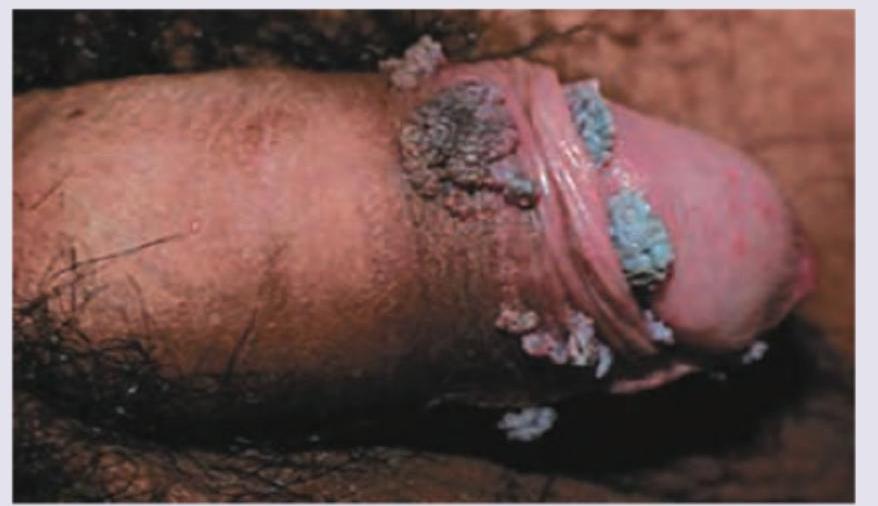
What is the causative agent for the lesion on penis shown below?
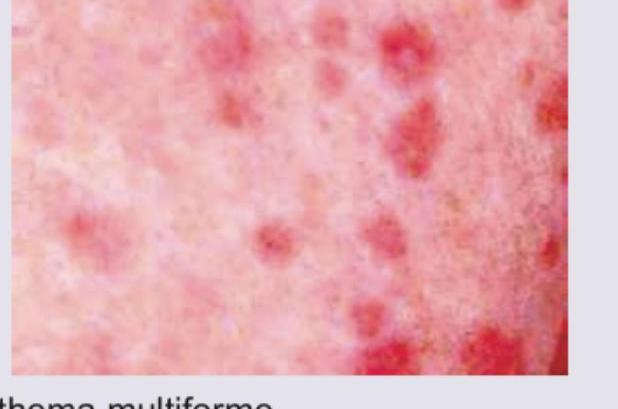
Identify the lesion: (Recent NEET Pattern 2016-17)
Explanation: ***Erythema multiforme*** - **Erythema multiforme** is an acute hypersensitivity reaction that does **NOT** typically demonstrate the Koebner phenomenon. - Unlike chronic papulosquamous disorders, EM lesions arise from immunologic triggers (infections, drugs) rather than trauma-induced spread. - The characteristic **target lesions** develop in response to antigenic stimuli, not mechanical trauma. *Darier's disease* - **Darier's disease** (keratosis follicularis) is an autosomal dominant disorder that exhibits the Koebner phenomenon. - New keratotic papules develop at sites of trauma, scratching, or friction. - This trauma-induced lesion development is a **key clinical feature** of the disease. *Molluscum contagiosum* - **Molluscum contagiosum** demonstrates the Koebner phenomenon through **autoinoculation**. - Scratching can cause viral spread, resulting in **linear arrangements of lesions** along scratch marks. - This is a classic example of trauma-induced spread in viral skin infections. *Scleromyxedema* - **Scleromyxedema** (generalized lichen myxedematosus) can exhibit the Koebner phenomenon. - New papules may develop at sites of trauma in some cases. - While less commonly emphasized than in psoriasis or lichen planus, Koebnerization has been reported in this condition.
Explanation: ***Oral glucocorticoids*** - While they may provide temporary relief, **oral glucocorticoids** can exacerbate psoriasis upon withdrawal, leading to a severe flare-up or **pustular psoriasis**. - Their long-term use is associated with numerous side effects, making them unsuitable for widespread, chronic conditions like severe psoriasis. *Methotrexate* - **Methotrexate** is a systemic agent commonly used for severe psoriasis due to its immune-modulating and anti-proliferative effects. - It is effective in reducing inflammation and slowing down epidermal cell turnover. *Oral retinoids* - **Oral retinoids** like acitretin are effective systemic treatments for severe widespread psoriasis, especially **pustular** and **erythrodermic** forms. - They work by normalizing keratinocyte proliferation and differentiation. *Cyclosporin* - **Cyclosporin** is a potent immunosuppressant widely used for severe psoriasis, particularly when rapid disease control is needed. - It works by inhibiting T-cell activation and is highly effective in clearing psoriatic lesions.
Explanation: ***Silvery Scaling*** - **Silvery scaling** is a hallmark clinical feature of **psoriasis**, resulting from the rapid turnover of skin cells. - These scales often appear on **erythematous plaques** and can be easily scraped off, sometimes revealing pinpoint bleeding underneath (**Auspitz sign**). *Erythematous macules* - While psoriasis does involve **erythema** (redness), the primary lesions are typically **plaques**, not macules (flat, discolored spots). - Macules are seen in other dermatological conditions such as drug eruptions or early viral exanthems, but not as the definitive feature of psoriasis. *Crusting* - **Crusting** is a feature of conditions involving exudation and drying of serum, blood, or pus, such as **impetigo** or **eczema** with secondary infection. - It is not a characteristic primary lesion of psoriasis, although secondary infection of psoriatic plaques could theoretically lead to crusting. *Coarse bleeding* - **Coarse bleeding** is not a primary feature of psoriasis; however, when psoriatic scales are removed, pinpoint bleeding known as the **Auspitz sign** can occur. - This is distinct from frank, coarse bleeding and is a diagnostic clue rather than a characteristic lesion in itself.
Explanation: ***Guttate*** - **Guttate psoriasis** is frequently triggered by a preceding **streptococcal infection**, such as streptococcal pharyngitis (strep throat). - Treatment with **antibiotics** (e.g., penicillin) is indicated to eradicate the streptococcal infection, which can help in resolving the psoriatic lesions and preventing future flares. *Chronic plaque psoriasis* - This is the most common form of psoriasis, characterized by **well-demarcated, erythematous plaques with silvery scales**. - Its etiology is primarily **autoimmune**, and while infections can sometimes exacerbate it, antibiotics are not a standard part of its treatment. *Erythrodermic psoriasis* - This is a severe, generalized form of psoriasis affecting nearly the **entire skin surface**, leading to significant inflammation and desquamation. - While patients with erythrodermic psoriasis are at higher risk for **secondary infections** due to skin barrier disruption, antibiotics are only indicated for treating these secondary bacterial infections, not for the psoriasis itself. *Pustular* - **Pustular psoriasis** is characterized by the presence of sterile pustules on an erythematous base. - Though severe, it is primarily an **inflammatory condition**, and antibiotics are not used in its primary management unless a secondary bacterial infection is suspected and confirmed.
Explanation: ***Psoriasis*** - The presence of **silvery scales** on the elbows and knees, which **bleed upon removal** (Auspitz sign), is a classic presentation of **plaque psoriasis**. - Psoriasis is a chronic inflammatory skin condition characterized by **accelerated epidermal turnover**. *Secondary syphilis* - Secondary syphilis typically presents with a **generalized maculopapular rash**, which can affect the palms and soles, but it does not usually feature silvery scales or the Auspitz sign. - Other common symptoms of secondary syphilis include **fever, lymphadenopathy, and condyloma lata**. *Pityriasis* - **Pityriasis rosea** is characterized by an oval, fawn-colored, scaly rash, often preceded by a **herald patch**, and usually resolves spontaneously. It does not typically present with silvery scales or bleeding on removal. - **Pityriasis versicolor** is caused by yeast and presents as hypopigmented or hyperpigmented macules with fine scales, commonly on the trunk, not silvery scales on elbows and knees. *Seborrhoeic dermatitis* - Seborrhoeic dermatitis involves greasy, yellowish scales on red skin, typically affecting areas rich in sebaceous glands like the scalp, face (nasolabial folds, eyebrows), and chest. - It does not present with silvery scales or the Auspitz sign, which are specific to psoriasis.
Explanation: ***Guttate psoriasis*** - This form of psoriasis is classically triggered by an antecedent **streptococcal pharyngitis** (often β-hemolytic streptococcal infection), presenting as small, **tear-drop shaped lesions** scattered over the trunk and proximal extremities. - The onset is typically **acute**, occurring a few weeks after the infection. *Psoriasis vulgaris* - This is the **most common form** of psoriasis, characterized by well-demarcated, erythematous plaques with silvery scales. - While infections can exacerbate psoriasis vulgaris, it is **not typically triggered de novo** by streptococcal infections in the same way guttate psoriasis is. *Erythrodermic psoriasis* - This is a **severe and rare form** of psoriasis where nearly the entire skin surface becomes red and scaly, often accompanied by systemic symptoms like fever and malaise. - It represents a generalized inflammatory response and is usually a **flare of existing psoriasis** rather than an initial presentation following bacterial infection. *Pustular psoriasis* - This presentation involves widespread or localized pustules, often on a red, tender skin base, and can be associated with systemic symptoms. - While infections can be a trigger, **streptococcal infections** are not the classic trigger for pustular psoriasis outbreaks as they are for guttate psoriasis.
Explanation: ***Psoriasis*** - **Vitamin D analogues** such as calcipotriol and calcitriol help treat psoriasis by **inhibiting keratinocyte proliferation** and promoting their differentiation, reducing scale and plaque formation. - They also have **anti-inflammatory properties** that help alleviate the characteristic redness and inflammation seen in psoriatic plaques. - These are commonly used as **topical treatments** for mild to moderate plaque psoriasis. *Pemphigus* - This is an **autoimmune blistering disease** characterized by **antibodies against desmoglein**, leading to loss of cell-cell adhesion in the epidermis. - Treatment primarily involves **systemic corticosteroids** and immunosuppressants, not vitamin D analogues. *Leprosy* - **Leprosy** is a chronic infectious disease caused by **Mycobacterium leprae**, primarily affecting the skin, nerves, upper respiratory tract, eyes, and testes. - Treatment involves **multi-drug therapy (MDT)** with antibiotics like dapsone, rifampicin, and clofazimine, and vitamin D analogues are not indicated. *Lichen planus* - **Lichen planus** is a chronic inflammatory condition affecting the skin, hair, nails, and mucous membranes, characterized by **pruritic, polygonal, purple, planar papules and plaques**. - Treatment typically involves **topical or systemic corticosteroids**, retinoids, or phototherapy, not vitamin D analogues.
Explanation: ***1-b, 2-c, 3-d, 4-a*** - **Collarette scales** are pathognomonic of **Pityriasis rosea**, appearing as fine, trailing scales around the periphery of oval lesions in a "Christmas tree" distribution. - **Silvery scales** are the classic hallmark of **Psoriasis**, presenting as thick, adherent, silvery-white scales overlying well-demarcated erythematous plaques. - **Mica-like scales** are characteristic of **Pityriasis lichenoides**, appearing as thick, shiny, adherent scales that can be peeled off like mica sheets. - **Branny scales** are typical of **Pityriasis versicolor**, presenting as fine, powdery scales caused by **Malassezia** yeast overgrowth. *1-d, 2-c, 3-a, 4-b* - Incorrectly matches **collarette scales with Pityriasis lichenoides**, which typically presents with mica-like scales, not collarette scales. - Misassociates **mica-like scales with Pityriasis versicolor**, which characteristically has branny (fine, powdery) scales. *1-c, 2-b, 3-d, 4-a* - Wrongly pairs **collarette scales with Psoriasis**, which is known for thick silvery scales, not peripheral collarette scales. - Incorrectly matches **silvery scales with Pityriasis rosea**, which has collarette scales at lesion periphery, not silvery scales. *1-a, 2-b, 3-d, 4-c* - Falsely associates **collarette scales with Pityriasis versicolor**, which has branny scales from yeast infection, not collarette scales. - Mismatches **branny scales with Psoriasis**, which has characteristic thick silvery scales, not fine powdery scales.
Explanation: ***Treponema pallidum*** * The image displays **condylomata lata**, which are moist, flat-topped, wart-like lesions that occur in secondary syphilis. * These lesions are highly infectious and contain a high concentration of **_Treponema pallidum_**. * _HPV_ * **Human Papillomavirus** causes **condylomata acuminata** (genital warts), which are typically exophytic, raised, and cauliflower-like or filiform, not the flat, broad lesions seen in the image. * While some HPV types are oncogenic, the morphology presented is not characteristic of typical HPV-induced warts. * _EBV_ * **Epstein-Barr virus** is associated with infectious mononucleosis and certain malignancies like nasopharyngeal carcinoma and Burkitt lymphoma, but not with penile lesions of this nature. * There is no direct causal link between typical EBV infection and genital warts or similar proliferative lesions. * _KSHV_ * **Kaposi's Sarcoma-associated Herpesvirus** (KSHV), also known as Human Herpesvirus 8 (HHV-8), causes Kaposi's sarcoma, a vascular tumor. * Kaposi's sarcoma lesions typically appear as **purple, red, or brown macules, plaques, or nodules**, which are distinct from the white/grey, moist, flat lesions shown.
Explanation: ***Erythema multiforme*** - The image displays characteristic **targetoid lesions** with multiple concentric rings of color (erythema, edema, pallor), typical of **erythema multiforme**. - These lesions often appear suddenly, symmetrically, and commonly on the extremities, often triggered by infections (e.g., **herpes simplex virus**) or medications. *Gianotti-Crosti syndrome* - Characterized by **monomorphic, flesh-colored to erythematous papules** and papulovesicles, often on the cheeks, buttocks, and extensor surfaces of the limbs. - This condition is typically observed in **children** after viral infections and does not usually present with target lesions. *Pityriasis rosea* - Starts with a single **"herald patch,"** followed by smaller, oval, pinkish-red patches with fine scales, often arranged in a **"Christmas tree pattern"** on the trunk. - The morphology of the lesions in the image, specifically the targetoid appearance, is not consistent with pityriasis rosea. *Acne rosacea* - Marked by **facial erythema**, papules, pustules, and telangiectasias, primarily affecting the central face. - It does not present with the widespread, distinct target lesions seen in the image.
Get full access to all questions, explanations, and performance tracking.
Start For Free