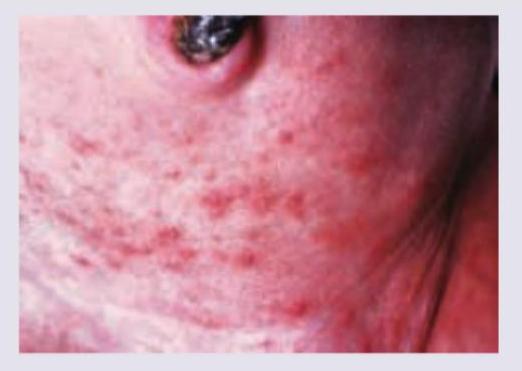
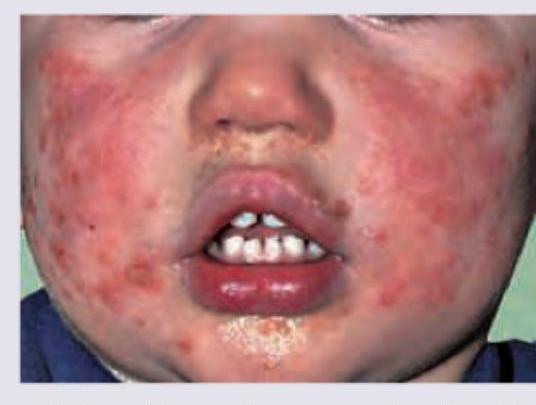
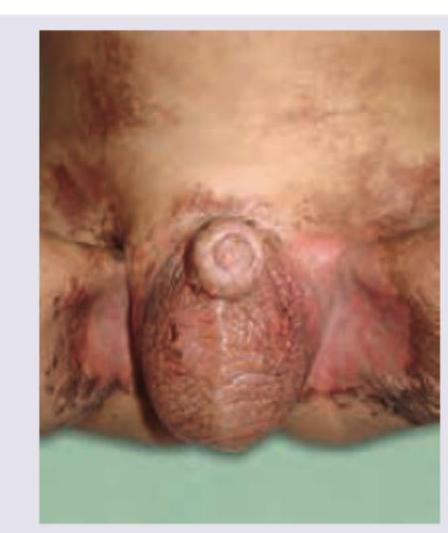
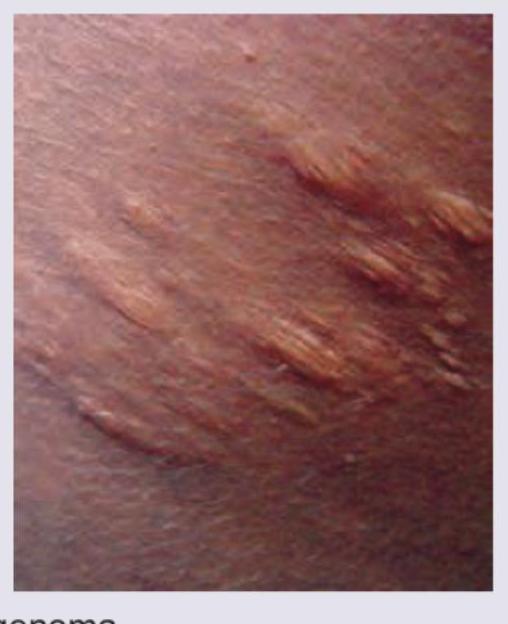
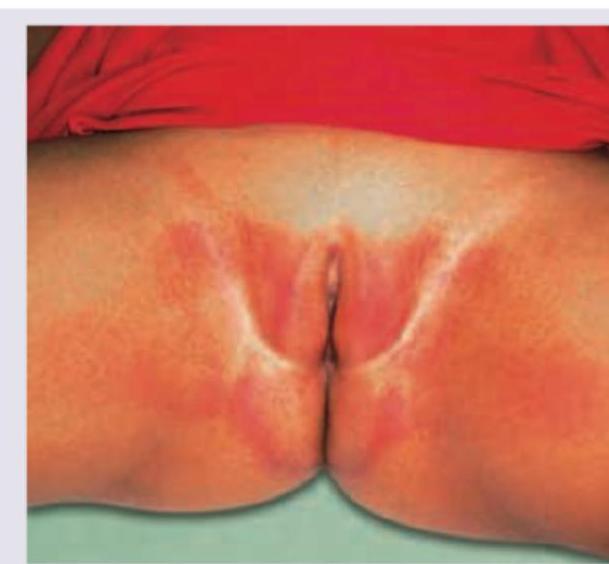
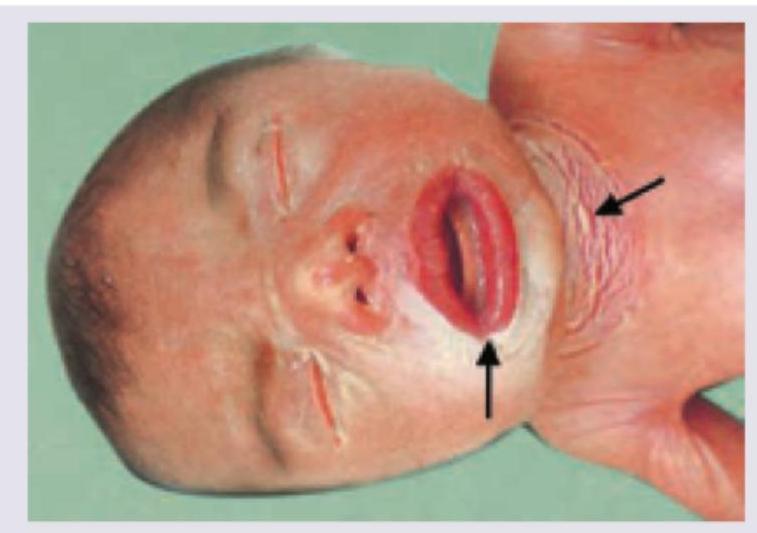
Rhagades are found in which of the following conditions?
A 5-year-old boy presents with a small hypopigmented scaly macule on his cheek. Some of his classmates also have similar lesions. What is the most probable diagnosis?
What is the most common clinical sign or symptom for the diagnosis of PHACE syndrome?
A male child with cryptorchidism presents with large black scales on body flexures. Skin biopsy showed hypergranulosis and steroid sulfatase deficiency. What is the probable diagnosis?
Mongolian spots are usually seen in which region?
What is the mode of inheritance of incontinentia pigmenti?
Combination of retinitis pigmentosa and ichthyosis is seen in which syndrome?
What is the most common clinical sign or symptom for the diagnosis of Tuberous sclerosis?
What is another name for encephalotrigeminal angiomatosis?
A 27-year-old G1P0 female at 36 weeks gestation presents with a 3-day history of abrupt onset of extremely pruritic and urticarial papules and blisters on the abdomen and trunk, which has worsened to interfere with her everyday life. What is the most likely diagnosis?
Explanation: **Explanation:** **Rhagades** (also known as Parrot’s lines) are linear scars or fissures that radiate from the angles of the mouth, nose, or anus. They result from the healing of linear ulcerations and macerated skin lesions (mucous patches) that occur during the **early stage of congenital syphilis**. 1. **Why Option C is Correct:** In early congenital syphilis (occurring within the first 2 years of life), the infant develops a diffuse maculopapular rash and moist, infectious lesions around mucosal orifices. When these inflamed areas heal, they form permanent, radiating cicatricial scars known as Rhagades. These are considered a classic "stigmata" of the infection. 2. **Why Other Options are Incorrect:** * **Primary Syphilis (A):** Characterized by a painless chancre at the site of inoculation; it does not present with radiating perioral scars. * **Secondary Syphilis (B):** Presents with a generalized maculopapular rash, condylomata lata, and mucous patches, but these typically heal without the specific scarring pattern of Rhagades. * **Postnatal (Acquired) Syphilis (D):** This follows the standard primary-secondary-tertiary progression and lacks the developmental stigmata associated with *in utero* transmission. **High-Yield Clinical Pearls for NEET-PG:** * **Early Congenital Syphilis (<2 years):** Presents with Snuffles (hemorrhagic rhinitis), Pemphigus syphiliticus (bullous lesions), and Rhagades. * **Late Congenital Syphilis (>2 years):** Characterized by **Hutchinson’s Triad** (Interstitial keratitis, Sensorineural deafness, and Hutchinson’s teeth). * **Other Stigmata:** Mulberry molars, Saddle nose deformity, and Sabre shins. * **Diagnosis:** VDRL/RPR are used for screening; FTA-ABS or TP-PA for confirmation.
Explanation: **Explanation:** The correct diagnosis is **Pityriasis alba**. This is a common, benign condition primarily seen in children (3–16 years). It is considered a manifestation of **atopic dermatitis**. The classic presentation involves ill-defined, hypopigmented, slightly scaly macules or patches, most commonly located on the face (cheeks). The "epidemic" mention of classmates having similar lesions often points to shared environmental triggers like sun exposure or dry skin, rather than contagion. **Distinguishing the Options:** * **Pityriasis rosea:** Characterized by a "Herald patch" followed by a "Christmas tree" distribution of erythematous, scaly plaques on the trunk. It is not typically localized to a single facial macule. * **Pityriasis versicolor:** Caused by *Malassezia furfur*. While it causes hypopigmented scaly macules, it predominantly affects the chest and back (seborrheic areas) and is rare in young children. Diagnosis is confirmed by a "spaghetti and meatballs" appearance on KOH mount. * **Indeterminate leprosy:** Presents as a solitary, hypopigmented, non-scaly macule with **loss of sensation** and/or loss of hair. The presence of scales in the question points away from leprosy. **NEET-PG High-Yield Pearls:** * **Etiology:** Low-grade eczematous dermatitis; often associated with xerosis and sun exposure. * **Clinical Stages:** Starts as pink erythema $\rightarrow$ progresses to hypopigmented scaly patches $\rightarrow$ ends as smooth hypopigmented macules. * **Treatment:** Reassurance, emollients, and sun protection. * **Key Differentiator:** Unlike Vitiligo, Pityriasis alba has **ill-defined borders** and **fine scaling**.
Explanation: **Explanation:** **PHACE Syndrome** is a neurocutaneous syndrome characterized by the association of a large segmental **infantile hemangioma** (usually >5 cm) on the face or scalp with multiple structural anomalies. The acronym stands for: * **P:** Posterior fossa malformations (e.g., Dandy-Walker) * **H:** Hemangioma (segmental, facial) * **A:** Arterial anomalies (cerebrovascular) * **C:** Cardiac defects (Coarctation of aorta) * **E:** Eye anomalies (Microphthalmia, cataracts, or optic nerve atrophy leading to **blindness**) **Option A** is correct because it describes a large facial lesion (hemangioma) associated with ipsilateral ocular complications (blindness), which is a hallmark diagnostic feature of PHACE syndrome. **Analysis of Incorrect Options:** * **Option B:** Describes **Tuberous Sclerosis Complex (TSC)**. The triad of infantile spasms (West syndrome), hypsarrhythmia, and ash-leaf spots is classic for TSC, not PHACE. * **Option C:** Describes **Neurofibromatosis Type 1 (NF1)**. Optic gliomas and the transformation of neurofibromas into Malignant Peripheral Nerve Sheath Tumors (schwannomas) are characteristic of NF1. * **Option D:** Suggests an immunodeficiency or chronic systemic illness (like Job syndrome or SCID), which does not align with the vascular and structural malformations of PHACE. **High-Yield Clinical Pearls for NEET-PG:** * **Gender Predilection:** PHACE syndrome shows a strong female predominance (9:1). * **S is for Sternal:** Sometimes called **PHACES** syndrome, where 'S' stands for Sternal cleft or supraumbilical raphe. * **Investigation of Choice:** MRI/MRA of the head and neck and Echocardiography are mandatory for any infant with a large segmental facial hemangioma to rule out internal anomalies. * **Treatment:** Propranolol is the first-line treatment for the hemangioma, but must be used with caution if cerebrovascular anomalies are present due to stroke risk.
Explanation: ### Explanation The correct diagnosis is **X-linked Recessive Ichthyosis (XLRI)**, also known as Ichthyosis Nigra. **Why it is correct:** XLRI is caused by a deficiency of the enzyme **steroid sulfatase**, leading to an accumulation of cholesterol sulfate in the epidermis. This disrupts lipid metabolism and prevents normal desquamation. * **Clinical Presentation:** It typically presents with large, dark/brown "dirty" scales that characteristically **involve the neck and flexures** (unlike Ichthyosis Vulgaris). * **Systemic Associations:** It is frequently associated with **cryptorchidism** (undescended testes) and corneal opacities. * **Histopathology:** Unlike Ichthyosis Vulgaris, XLRI shows **hypergranulosis** (increased granular layer) or a normal granular layer. **Why the other options are incorrect:** * **Ichthyosis Vulgaris:** The most common type; it **spares the flexures** and histologically shows an **absent or diminished granular layer** (hypogranulosis). It is not associated with steroid sulfatase deficiency. * **Lamellar Ichthyosis:** Presents at birth as a **collodion membrane**. Scales are large and plate-like, often associated with ectropion and eclabium. It is autosomal recessive. * **Nonbullous Ichthyosiform Erythroderma (NBIE):** Presents with generalized erythroderma and fine white scales. It does not show the specific steroid sulfatase deficiency or the "nigra" (dark) scale pattern. **NEET-PG High-Yield Pearls:** 1. **Placental Sulfatase Deficiency:** Mothers carrying a fetus with XLRI often have **delayed labor** due to low estrogen levels (steroid sulfatase is needed to produce estriol). 2. **Mnemonic:** XLRI = **D**ark scales, **D**irty neck, **D**escend (Cryptorchidism), **D**elayed labor. 3. **Inheritance:** As the name suggests, it is X-linked recessive, affecting males almost exclusively.
Explanation: **Explanation:** **Mongolian Spots** (Dermal Melanocytosis) are the most common birthmarks in neonates, particularly in those of Asian, African, and Hispanic descent. 1. **Why Lumbosacral is Correct:** The condition results from the **failure of melanocytes to migrate** completely from the neural crest to the epidermis during embryonic development. These melanocytes remain trapped in the deeper **dermis**. The characteristic blue-gray appearance is due to the **Tyndall effect**, where shorter wavelengths of light (blue) are scattered by dermal melanin. The **lumbosacral and gluteal regions** are the most common anatomical sites for these lesions. 2. **Analysis of Incorrect Options:** * **Cervicofacial:** While dermal melanocytosis can occur here, it is then specifically termed **Nevus of Ota** (involving the distribution of the trigeminal nerve). * **Deltoid:** Dermal melanocytosis in the deltoid or acromioclavicular region is known as **Nevus of Ito**. * **Thoracolumbar:** While spots can occasionally extend upward, the primary and most frequent site remains the localized lumbosacral area. **NEET-PG High-Yield Clinical Pearls:** * **Prognosis:** Most Mongolian spots are benign and typically **disappear or fade** by age 2–6 years; no treatment is required. * **Histology:** Shows spindle-shaped melanocytes interspersed between collagen bundles in the lower two-thirds of the dermis. * **Differential Diagnosis:** Must be distinguished from physical child abuse (bruises). Unlike bruises, Mongolian spots do not change color over days and are not tender. * **Association:** Extensive or persistent Mongolian spots may rarely be associated with inborn errors of metabolism, such as **GM1 gangliosidosis** or **Hurler syndrome**.
Explanation: **Explanation:** **Incontinentia Pigmenti (Bloch-Sulzberger syndrome)** is a rare multisystem neurocutaneous disorder caused by a mutation in the **IKBKG gene** (formerly NEMO). 1. **Why X-linked Dominant is correct:** The inheritance is **X-linked dominant**. The mutation is typically **lethal in males** in utero, which explains why the clinical phenotype is seen almost exclusively in females. Affected females survive due to functional mosaicism resulting from X-chromosome inactivation (Lyonization). 2. **Why other options are incorrect:** * **Autosomal Dominant/Recessive:** The gene is located on the X chromosome (Xq28), ruling out autosomal patterns. * **X-linked Recessive:** In recessive conditions, heterozygous females are usually asymptomatic carriers. In IP, a single mutated allele is sufficient to cause the disease in females and cause lethality in males. **Clinical Pearls for NEET-PG:** * **Four Stages of Skin Lesions:** 1. **Vesicular:** Linear vesicles (present at birth/infancy). 2. **Verrucous:** Hyperkeratotic linear plaques. 3. **Hyperpigmented:** "Swirl-like" or **"Marble cake"** pigmentation along **Blaschko’s lines**. 4. **Hypopigmented:** Atrophic, hairless patches. * **Associated Findings:** "Peg-shaped" or conical teeth (hypodontia), cicatricial alopecia, and CNS involvement (seizures/intellectual disability). * **Histopathology:** Characteristic **eosinophilic spongiosis** is seen in the vesicular stage.
Explanation: **Explanation:** **Refsum’s Syndrome** (Heredopathia Atactica Polyneuritiformis) is an autosomal recessive metabolic disorder caused by a deficiency in the enzyme **phytanoyl-CoA hydroxylase**. This leads to the systemic accumulation of **phytanic acid**. The classic clinical tetrad includes: 1. **Ichthyosis:** Usually presents as mild, generalized scaling. 2. **Retinitis Pigmentosa:** Leading to night blindness and constricted visual fields. 3. **Peripheral Neuropathy:** Chronic, progressive motor and sensory loss. 4. **Cerebellar Ataxia.** Other features include sensorineural deafness and cardiomyopathy. **Analysis of Incorrect Options:** * **A. Netherton Syndrome:** Characterized by the triad of **Ichthyosis linearis circumflexa**, **Bamboo hair** (Trichorrhexis invaginata), and **Atopy**. It does not involve retinitis pigmentosa. * **C. Down’s Syndrome:** A chromosomal disorder (Trisomy 21) associated with intellectual disability, characteristic facies, and dermatological findings like xerosis, syringomas, and alopecia areata, but not ichthyosis with retinitis pigmentosa. * **D. Sjögren-Larsson Syndrome (likely intended by "Mob's"):** This syndrome presents with the triad of **Ichthyosis**, **Spastic diplegia/quadriplegia**, and **Intellectual disability**. It features "glistening white dots" in the retina, not retinitis pigmentosa. **NEET-PG High-Yield Pearls:** * **Dietary Management:** The primary treatment for Refsum’s is a diet low in phytanic acid (avoiding green leafy vegetables, dairy, and ruminant fats). * **Differential Diagnosis:** If you see Ichthyosis + Neurological symptoms, think Refsum’s (Ataxia/Retinitis) or Sjögren-Larsson (Spasticity). * **Ichthyosis Linearis Circumflexa** is the pathognomonic skin finding for Netherton Syndrome.
Explanation: ### Explanation **Tuberous Sclerosis Complex (TSC)** is an autosomal dominant neurocutaneous syndrome (phakomatosis) caused by mutations in the **TSC1 (Hamartin)** or **TSC2 (Tuberin)** genes. **Why Option B is Correct:** The triad of **infantile spasms** (West Syndrome), **hypsarrhythmia** on EEG, and **ash-leaf spots** (hypopigmented macules) is a classic presentation. Ash-leaf spots are often the **earliest cutaneous sign** of TSC, visible under Wood’s lamp even in neonates. Infantile spasms in the presence of these macules are highly suggestive of cortical tubers, a hallmark of TSC. **Analysis of Incorrect Options:** * **Option A:** Describes **Sturge-Weber Syndrome**, characterized by a Port-wine stain (Nevus Flammeus) in the V1/V2 distribution, glaucoma (leading to blindness), and leptomeningeal angiomas. * **Option C:** Describes **Neurofibromatosis Type 1 (NF1)**. Optic gliomas and malignant peripheral nerve sheath tumors (schwannomas) are characteristic of NF1, not TSC. * **Option D:** Suggests an immunodeficiency or systemic metabolic disorder, which is not a primary feature of Tuberous Sclerosis. **High-Yield Clinical Pearls for NEET-PG:** * **Vogt’s Triad:** Adenoma sebaceum (facial angiofibromas), mental retardation, and seizures (present in only ~30% of cases). * **Cutaneous Signs:** Ash-leaf spots (earliest), Shagreen patches (connective tissue nevi on the lower back), Periungual fibromas (**Koenen tumors**), and Confetti skin lesions. * **Systemic Involvement:** Cardiac rhabdomyomas (often regress spontaneously), Renal Angiomyolipomas (AML), and Subependymal Giant Cell Astrocytomas (SEGA). * **Drug of Choice for Infantile Spasms in TSC:** Vigabatrin.
Explanation: **Explanation:** **Sturge-Weber Syndrome (SWS)**, also known as **Encephalotrigeminal Angiomatosis**, is a rare neurocutaneous disorder (phakomatosis). The name "encephalotrigeminal" describes its hallmark pathology: vascular malformations involving the **leptomeninges** (encephalo-) and the skin supplied by the **trigeminal nerve** (-trigeminal). It is caused by a somatic mutation in the **GNAQ gene**. The classic clinical triad includes: 1. **Port-wine stain (Nevus Flammeus):** Usually in the V1/V2 distribution of the trigeminal nerve. 2. **Leptomeningeal Angioma:** Typically ipsilateral to the skin lesion, often leading to seizures and hemiparesis. 3. **Glaucoma:** Increased intraocular pressure, often presenting as buphthalmos in infants. **Analysis of Incorrect Options:** * **A. Rendu-Osler-Weber syndrome:** Also known as Hereditary Hemorrhagic Telangiectasia (HHT). It presents with multiple telangiectasias on the skin/mucosa and visceral arteriovenous malformations (AVMs), leading to recurrent epistaxis. * **C. Beckwith-Wiedemann syndrome:** An overgrowth disorder characterized by macrosomia, macroglossia, omphalocele, and an increased risk of Wilms tumor. * **D. Cushing syndrome:** A metabolic disorder caused by prolonged exposure to excess cortisol, presenting with "moon facies," truncal obesity, and purple striae. **High-Yield Clinical Pearls for NEET-PG:** * **Radiology:** Skull X-ray or CT shows characteristic **"Tram-track" calcifications** (gyriform calcifications) in the cerebral cortex. * **Inheritance:** Unlike many other phakomatoses (like NF-1 or TSC), SWS is **sporadic** and not inherited. * **Management:** Focuses on seizure control and treating glaucoma to prevent blindness.
Explanation: **Explanation:** **1. Why Option D is Correct:** **Herpes gestationis** (also known as Pemphigoid Gestationis) is a rare, autoimmune bullous dermatosis of pregnancy. It typically presents in the 2nd or 3rd trimester with the abrupt onset of **intense pruritus** followed by **urticarial plaques and vesicles/bullae**. A hallmark feature is the involvement of the **umbilicus** (periumbilical area), which helps distinguish it from other pregnancy dermatoses. Pathologically, it is caused by IgG antibodies against the BP180 protein, leading to subepidermal blisters. **2. Why Other Options are Incorrect:** * **Option A (Herpes zoster):** This presents as painful, unilateral vesicles in a dermatomal distribution. It is not specifically associated with pregnancy or generalized abdominal pruritus. * **Option B (PUPPP):** Pruritic Urticarial Papules and Plaques of Pregnancy is the most common pregnancy dermatosis. While it presents with pruritic papules, it **spares the umbilicus** and, crucially, **does not form blisters**. * **Option C (Intrahepatic cholestasis of pregnancy):** This presents with severe pruritus (typically starting on palms and soles) but **lacks a primary skin rash** or blisters. Diagnosis is confirmed by elevated serum bile acids. **3. NEET-PG High-Yield Pearls:** * **Immunofluorescence:** Direct Immunofluorescence (DIF) shows **linear C3 deposition** along the basement membrane zone (BMZ). * **Fetal Risk:** Unlike PUPPP, Herpes gestationis is associated with risks of **preterm delivery** and **fetal growth restriction**. 10% of neonates may have transient skin lesions due to passive transfer of antibodies. * **Recurrence:** It often recurs in subsequent pregnancies and may flare during delivery or with oral contraceptive use. * **Treatment:** Systemic corticosteroids are the mainstay of treatment.
Neonatal Dermatology
Practice Questions
Infantile Hemangiomas and Vascular Malformations
Practice Questions
Atopic Dermatitis in Children
Practice Questions
Acne in Childhood and Adolescence
Practice Questions
Childhood Exanthems
Practice Questions
Genetic Skin Disorders in Children
Practice Questions
Genodermatoses
Practice Questions
Nutritional Dermatoses in Children
Practice Questions
Pigmentary Disorders in Children
Practice Questions
Hair Disorders in Children
Practice Questions
Child Abuse: Cutaneous Manifestations
Practice Questions
Therapeutic Considerations in Pediatric Dermatology
Practice Questions
Get full access to all questions, explanations, and performance tracking.
Start For Free