A 2-year-old child presents with a 4-day history of a rash limited to the feet and ankles. The papular rash is both pruritic and erythematous. The 3-month-old sibling of this patient has similar lesions also involving the head and neck. What is the most appropriate treatment for this condition?
A 17-year-old pregnant woman presents with scattered small, raised lesions on her trunk and axillary freckles. What is the most likely mode of inheritance for this condition?
A child is diagnosed to have tuberous sclerosis. Which of the following skin lesions is not associated?
Ichthyosis linearis circumflexa is the characteristic skin lesion seen in which of the following conditions?
Which of the following is not associated with cafe-au-lait spots?
A 10-year-old child has violaceous papules and pterygium of the nails. What is the most likely diagnosis?
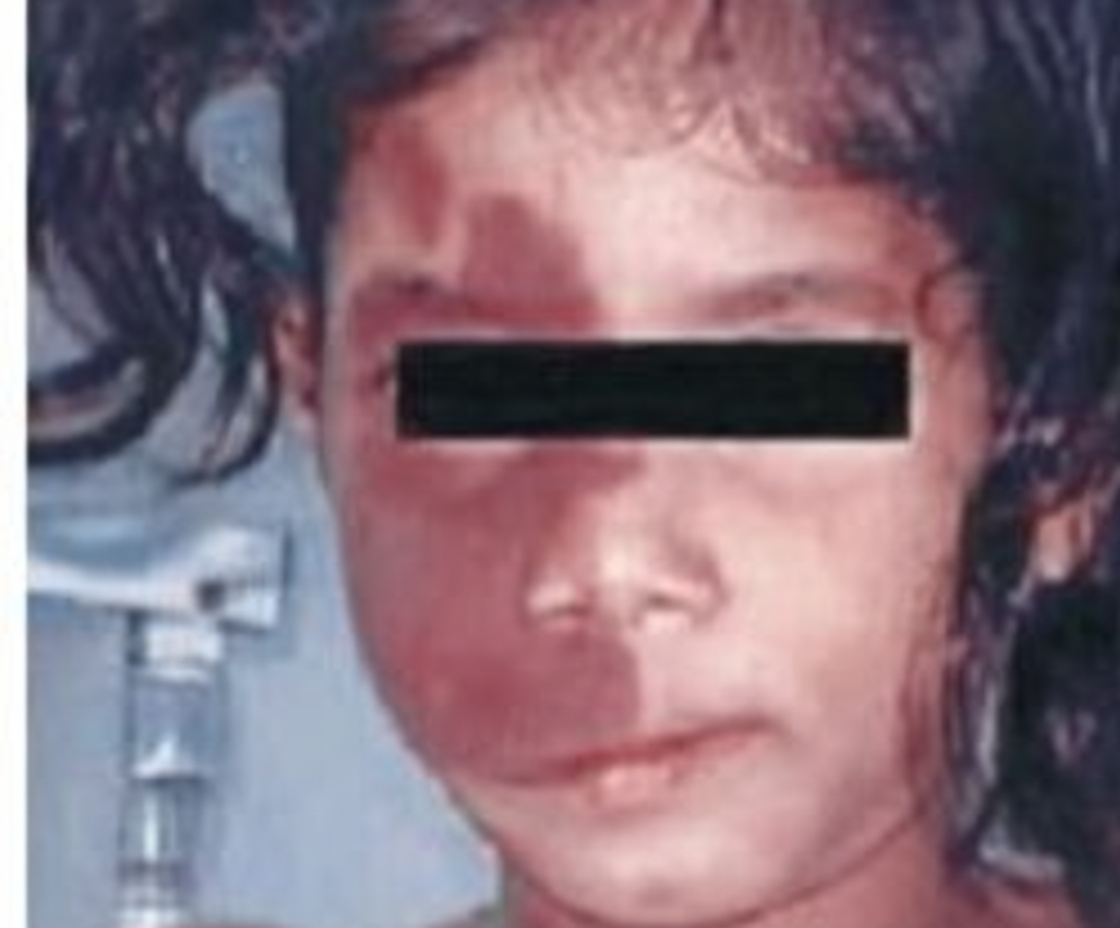
Sturge Weber syndrome is associated with which of the following conditions?
Papillomatous tongue is observed in which of the following conditions?
Neonatal fat necrosis (subcutaneous fat necrosis of the newborn) resembles which of the following conditions?
What are the common sites for a Mongolian spot?
Explanation: **Explanation:** The clinical presentation is classic for **Scabies**, a contagious infestation caused by the mite *Sarcoptes scabiei*. In children, the presentation is often characterized by intensely pruritic, erythematous papules. A key diagnostic clue in this scenario is the involvement of the **head and neck in the 3-month-old sibling**; while adults typically spare the head, in infants and young children, the rash frequently involves the face, scalp, palms, and soles. **1. Why Permethrin is correct:** **5% Permethrin cream** is the first-line treatment (Gold Standard) for scabies. It acts by disrupting the sodium channel currents in the neurons of the parasites, leading to paralysis and death. It is preferred due to its high efficacy and low mammalian toxicity. It should be applied from the neck down in adults, but **from head to toe** in infants and young children. **2. Why other options are incorrect:** * **Coal-tar soap:** Used primarily in chronic plaque psoriasis or seborrheic dermatitis; it has no role in treating parasitic infestations. * **Hydrocortisone cream:** A low-potency steroid that might temporarily reduce itching but will not treat the underlying infestation. In fact, using steroids alone can lead to *Scabies Incognito*, masking the classic symptoms while the infestation worsens. * **Emollients:** These are moisturizing agents used for barrier repair in atopic dermatitis or xerosis; they are ineffective against mites. **Clinical Pearls for NEET-PG:** * **Pathognomonic sign:** The **Burrow** (a short, wavy, grayish line). * **Treatment Protocol:** Apply at night, leave for 8–12 hours, and repeat after 7–14 days to kill newly hatched nymphs. * **Family Treatment:** All close contacts must be treated simultaneously, even if asymptomatic, to prevent re-infestation. * **Nodular Scabies:** Persistent itchy nodules in the axilla or genitalia, common in children even after successful treatment.
Explanation: **Explanation:** The clinical presentation of **scattered small, raised lesions** (Neurofibromas) and **axillary freckling** (Crowe’s sign) is pathognomonic for **Neurofibromatosis Type 1 (NF1)**, also known as von Recklinghausen disease. **Why Autosomal Dominant is correct:** NF1 is an **Autosomal Dominant (AD)** disorder caused by a mutation in the *NF1* gene located on **chromosome 17q11.2**. This gene encodes **neurofibromin**, a tumor suppressor that regulates the Ras pathway. It exhibits 100% penetrance but highly variable expressivity. Notably, about 50% of cases arise from *de novo* mutations. **Why other options are incorrect:** * **Autosomal Recessive:** Very few neurocutaneous syndromes follow this pattern (e.g., Xeroderma Pigmentosum). NF1 requires only one mutated allele to manifest the phenotype. * **X-linked Dominant/Recessive:** NF1 affects males and females equally and shows male-to-male transmission, which rules out X-linked inheritance. **High-Yield Clinical Pearls for NEET-PG:** * **Diagnostic Criteria (NIH):** Requires 2 or more of: 1. ≥6 **Café-au-lait macules** (>5mm prepubertal, >15mm postpubertal). 2. ≥2 Neurofibromas or 1 Plexiform neurofibroma. 3. **Axillary or inguinal freckling** (Crowe’s sign). 4. **Lisch nodules** (iris hamartomas seen on slit-lamp exam). 5. Optic pathway glioma. 6. Distinctive osseous lesions (e.g., sphenoid dysplasia). 7. A first-degree relative with NF1. * **Pregnancy Connection:** Neurofibromas often increase in size or number during pregnancy due to hormonal changes. * **Chromosome 17:** Remember "Neurofibromatosis 17 letters = Chromosome 17."
Explanation: **Explanation:** **Tuberous Sclerosis Complex (TSC)**, also known as Bourneville’s disease, is an autosomal dominant neurocutaneous syndrome caused by mutations in the **TSC1 (Hamartin)** or **TSC2 (Tuberin)** genes. It is characterized by the development of benign tumors (hamartomas) in multiple organs. **Why Xanthoderma is the correct answer:** **Xanthoderma** refers to a yellowish discoloration of the skin, most commonly caused by carotenemia (excessive intake of Vitamin A precursors) or jaundice. It has no pathogenic association with Tuberous Sclerosis. **Analysis of Incorrect Options (Associated Lesions):** * **Ash leaf spots (Hypomelanotic macules):** These are typically the **earliest** cutaneous sign of TSC. They appear as lanceolate, hypopigmented patches and are best visualized using a **Wood’s lamp**. * **Shagreen patches (Connective tissue nevi):** These are leathery, "orange-peel" textured plaques usually found on the lumbosacral region. They represent collagenomas. * **Adenoma sebaceum (Facial Angiofibromas):** Despite the historical name, these are not disorders of sebaceous glands but are **angiofibromas**. They typically appear in late childhood as malar, reddish papules in a butterfly distribution. **NEET-PG High-Yield Pearls:** 1. **Vogt’s Triad:** Epilepsy, Mental Retardation, and Adenoma Sebaceum (seen in only ~30% of cases). 2. **Koenen’s Tumor:** Periungual or subungual fibromas (usually appear after puberty). 3. **Confetti lesions:** Multiple tiny hypopigmented macules on the extremities; highly specific for TSC. 4. **Systemic findings:** Cardiac rhabdomyomas (often regress), Renal Angiomyolipomas (AML), and Cortical tubers/Subependymal nodules in the brain.
Explanation: **Explanation:** **Ichthyosis linearis circumflexa (ILC)** is the pathognomonic cutaneous manifestation of **Netherton Syndrome**. It is characterized by migratory, erythematous, polycyclic, or serpiginous plaques with a distinctive "double-edged" scale at the periphery. **1. Why Netherton Syndrome is correct:** Netherton Syndrome is an autosomal recessive neurocutaneous disorder caused by a mutation in the **SPINK5 gene**, which encodes the serine protease inhibitor **LEKTI**. The absence of LEKTI leads to unchecked protease activity in the epidermis, resulting in premature desquamation and a defective skin barrier. The classic clinical triad includes: * **Ichthyosis linearis circumflexa** (or congenital ichthyosiform erythroderma). * **Hair shaft defects:** Specifically **Trichorrhexis invaginata** (Bamboo hair), which is pathognomonic. * **Atopic features:** Elevated IgE levels, asthma, and food allergies. **2. Why other options are incorrect:** * **Progeria (Hutchinson-Gilford Syndrome):** A premature aging syndrome characterized by scleroderma-like skin changes, alopecia, and "plucked-bird" appearance, but not ichthyosis. * **Lamellar Ichthyosis:** Presents with large, dark, plate-like scales over the entire body and is often associated with a **collodion membrane** at birth and ectropion. * **Harlequin Ichthyosis:** The most severe form of congenital ichthyosis, characterized by thick, diamond-shaped armor-like plates of scale with deep fissures, severe eclabium, and ectropion. **Clinical Pearls for NEET-PG:** * **Pathognomonic Hair:** Trichorrhexis invaginata (Bamboo hair). * **Gene Mutation:** SPINK5 (Chromosome 5q). * **Diagnostic Test:** Skin biopsy showing absence of LEKTI or hair bulb microscopy. * **Differential:** Often misdiagnosed as Atopic Dermatitis or Psoriasis in early childhood.
Explanation: **Explanation:** Café-au-lait macules (CALMs) are flat, pigmented skin lesions caused by increased melanin content in the epidermis. While isolated spots are common in the general population, multiple CALMs are hallmark features of several neurocutaneous and genetic syndromes. **Why Von Hippel-Lindau (VHL) Syndrome is the correct answer:** VHL syndrome is a phakomatosis characterized by visceral cysts and benign/malignant tumors, most notably **hemangioblastomas** (cerebellum, retina, spinal cord), pheochromocytomas, and renal cell carcinomas. Unlike other neurocutaneous syndromes, VHL is **not** typically associated with café-au-lait spots. Its primary cutaneous manifestations, if present, are rare and usually involve port-wine stains. **Analysis of Incorrect Options:** * **Neurofibromatosis Type 1 (NF1):** CALMs are the earliest clinical sign. The diagnostic criteria require $\geq$ 6 spots ($>$5mm in prepubertal and $>$15mm in postpubertal individuals). * **Tuberous Sclerosis (TSC):** While the classic skin findings are ash-leaf spots and angiofibromas, CALMs occur in approximately 15-28% of TSC patients, making it a recognized association. * **Russell-Silver Syndrome:** This is a growth retardation syndrome characterized by triangular facies and limb asymmetry; CALMs are a frequently documented cutaneous finding in these patients. **High-Yield Clinical Pearls for NEET-PG:** * **McCune-Albright Syndrome:** Features large, unilateral CALMs with irregular "Coast of Maine" borders, associated with polyostotic fibrous dysplasia and precocious puberty. * **NF1 CALMs:** Typically have smooth "Coast of California" borders. * **Fanconi Anemia:** A high-yield hematological association where CALMs are seen alongside thumb/radius defects and pancytopenia. * **Legius Syndrome:** A "NF1-like" syndrome presenting with multiple CALMs but lacking Lisch nodules or neurofibromas.
Explanation: ### **Explanation** The correct answer is **Lichen Planus (LP)**. **1. Why Lichen Planus is correct:** Lichen Planus is a chronic inflammatory condition characterized by the "6 Ps": **P**lanar (flat-topped), **P**urple (violaceous), **P**olygonal, **P**ruritic, **P**apules, and **P**laques. Nail involvement occurs in about 10% of cases. The most characteristic (pathognomonic) nail finding in LP is **Dorsal Pterygium** (V-shaped extension of the proximal nail fold onto the nail bed), which occurs due to scarring of the nail matrix. **2. Why other options are incorrect:** * **Psoriasis:** While it commonly affects nails, the classic findings are **pitting** (deep and irregular), **oil spots** (salmon patches), and subungual hyperkeratosis. It does not cause pterygium. * **Pemphigus/Pemphigoid:** These are autoimmune blistering (bullous) disorders. While they can occasionally cause nail dystrophy due to periungual inflammation, they present primarily with blisters/erosions and do not typically manifest with violaceous papules or pterygium. **3. NEET-PG High-Yield Pearls:** * **Wickham Striae:** Fine white reticular lines seen on the surface of LP papules (best seen with oil immersion). * **Koebner Phenomenon:** Development of lesions at sites of trauma (also seen in Psoriasis and Vitiligo). * **Civatte Bodies:** Histopathological hallmark representing apoptotic keratinocytes in the basal layer. * **Nail LP:** Can lead to "Twenty-nail dystrophy" (trachyonychia) in children. * **Treatment:** Topical or systemic corticosteroids are the first-line management.
Explanation: **Explanation:** **Sturge-Weber Syndrome (SWS)**, also known as encephalotrigeminal angiomatosis, is a neurocutaneous disorder characterized by the primary clinical feature of a **Port-wine stain (PWS)**. 1. **Why Port-wine stain is correct:** PWS (Nevus Flammeus) is a congenital capillary malformation. In SWS, it typically occurs in the distribution of the **trigeminal nerve** (most commonly the $V_1$ and $V_2$ ophthalmic and maxillary divisions). The underlying pathology involves a somatic mutation in the **GNAQ gene**, leading to malformed, dilated permanent capillaries in the skin, brain (leptomeningeal angiomas), and eyes (glaucoma). 2. **Why other options are incorrect:** * **Cavernous hemangioma:** These are deep vascular malformations (now often termed venous malformations) that are not a diagnostic component of SWS. * **Lymphangioma:** This is a malformation of the lymphatic system (e.g., cystic hygroma), unrelated to the capillary pathology of SWS. * **Hemangiosarcoma:** This is a rare, highly malignant neoplasm of the vascular endothelium, whereas SWS involves benign congenital malformations. **High-Yield Clinical Pearls for NEET-PG:** * **The Triad of SWS:** 1. Facial Port-wine stain, 2. Leptomeningeal angiomatosis (ipsilateral), 3. Glaucoma/Ocular vascular abnormalities. * **Radiology:** Skull X-ray or CT shows characteristic **"Tram-track" calcifications** (gyriform calcifications) due to underlying leptomeningeal angiomas. * **Clinical Presentation:** Patients often present with refractory seizures, hemiparesis, and intellectual disability. * **Note:** Not every child with a facial PWS has SWS; the risk is highest if the PWS involves the **upper eyelid ($V_1$ distribution)**.
Explanation: **Explanation:** **Lymphangioma circumscriptum** is a benign malformation of the lymphatic vessels. When it involves the tongue (Macroglossia), it typically presents as a cluster of clear, fluid-filled vesicles that resemble "frog spawn." Over time, these vesicles can become hyperkeratotic and verrucous, leading to a characteristic **papillomatous or pebbly appearance** of the tongue surface. This is the most common cause of macroglossia in children. **Analysis of Incorrect Options:** * **Systemic hyalinosis (Infantile Systemic Hyalinosis):** This is characterized by the deposition of hyaline material in the skin and internal organs. While it causes thickened skin and gingival hyperplasia, it does not typically present with a papillomatous tongue. * **Foetal face syndrome (Robinow Syndrome):** This genetic disorder is characterized by short-limbed dwarfism and facial dysmorphism (resembling a 8-week-old fetus). Oral findings usually include gingival hypertrophy and a wide mouth, but not papillomatous lesions. * **Tuberous sclerosis:** While this neurocutaneous syndrome presents with oral manifestations like **gingival fibromas** and **dental enamel pitting**, it is not associated with a papillomatous tongue. **High-Yield Clinical Pearls for NEET-PG:** * **Lymphangioma circumscriptum:** Often described as "frog-spawn" appearance; histologically shows dilated lymphatic channels in the papillary dermis. * **Macroglossia Differential:** Common causes include Down syndrome, Hemangioma, Lymphangioma, and Hypothyroidism (Cretinism). * **Cobblestone Tongue:** Seen in Crohn’s disease and Amyloidosis. * **Strawberry Tongue:** White strawberry tongue (early) and Red strawberry tongue (late) are classic signs of **Scarlet Fever** and **Kawasaki Disease**.
Explanation: **Explanation:** **Subcutaneous Fat Necrosis of the Newborn (SCFN)** is a transient form of panniculitis occurring in full-term or post-term neonates, often following birth asphyxia, hypothermia, or trauma. **Why Post-steroidal Panniculitis is the correct answer:** Both SCFN and post-steroidal panniculitis share identical histopathological features. They are characterized by a **lobular panniculitis** with a pathognomonic finding: **needle-shaped clefts** arranged in a **radial (sunburst) pattern** within adipocytes. These clefts represent dissolved triglyceride crystals. Clinically, post-steroidal panniculitis occurs in children after the rapid withdrawal of high-dose systemic corticosteroids, mirroring the firm, erythematous nodules seen in SCFN. **Analysis of Incorrect Options:** * **A. Erythema Induratum (Bazin Disease):** This is a chronic lobular panniculitis associated with tuberculosis, typically presenting as nodules on the posterior calves of adult women. It shows granulomatous inflammation and vasculitis, unlike SCFN. * **C. Lupus Panniculitis:** This presents as deep-seated nodules (Lupus profundus) in adults with SLE or DLE. Histology shows hyaline sclerosis of fat and lymphoid follicles, which is distinct from the crystal formation in SCFN. * **D. Lipodermatosclerosis:** This is a localized chronic fibrosing panniculitis of the lower legs resulting from venous insufficiency ("inverted champagne bottle" appearance). It is not seen in neonates. **High-Yield Clinical Pearls for NEET-PG:** * **Most serious complication of SCFN:** **Hypercalcemia** (occurs 1–6 months after skin lesions appear; monitor serum calcium levels). * **Histology Keyword:** "Radial arrangement of needle-shaped clefts." * **Risk Factors:** Meconium aspiration, therapeutic hypothermia, and obstetric trauma. * **Prognosis:** Usually self-limiting, but requires monitoring for hypercalcemia to prevent nephrocalcinosis.
Explanation: **Explanation:** **Mongolian Spot** (Dermal Melanocytosis) is a common, benign, congenital birthmark. It occurs due to the **arrest of melanocytes** during their migration from the neural crest to the epidermis. These melanocytes remain trapped in the deeper **dermis**, and their blue-gray appearance is a result of the **Tyndall effect** (shorter wavelengths of light are scattered by dermal melanin). * **Why C is correct:** The **lumbo-sacral area** and buttocks are the most common sites, occurring in over 90% of affected infants, particularly those of Asian, African, and Hispanic descent. * **Why A, B, and D are incorrect:** While "Extrasacral Mongolian spots" can occur on the face, neck, or extremities, these are significantly less common. The lumbo-sacral region remains the classic and most frequent anatomical site. **High-Yield Clinical Pearls for NEET-PG:** * **Clinical Appearance:** Flat, non-blanchable, blue-gray or slate-colored macules/patches with indefinite borders. * **Prognosis:** Most spots fade spontaneously by age 2–6 years and usually disappear by puberty. No treatment is required. * **Differential Diagnosis:** It is crucial to document these at birth to avoid confusion with **child abuse (bruising)**. Unlike bruises, Mongolian spots do not change color over days or show tenderness. * **Associations:** Extensive or persistent Mongolian spots may rarely be associated with inborn errors of metabolism, such as **GM1 gangliosidosis** or **Hurler syndrome**.
Neonatal Dermatology
Practice Questions
Infantile Hemangiomas and Vascular Malformations
Practice Questions
Atopic Dermatitis in Children
Practice Questions
Acne in Childhood and Adolescence
Practice Questions
Childhood Exanthems
Practice Questions
Genetic Skin Disorders in Children
Practice Questions
Genodermatoses
Practice Questions
Nutritional Dermatoses in Children
Practice Questions
Pigmentary Disorders in Children
Practice Questions
Hair Disorders in Children
Practice Questions
Child Abuse: Cutaneous Manifestations
Practice Questions
Therapeutic Considerations in Pediatric Dermatology
Practice Questions
Get full access to all questions, explanations, and performance tracking.
Start For Free