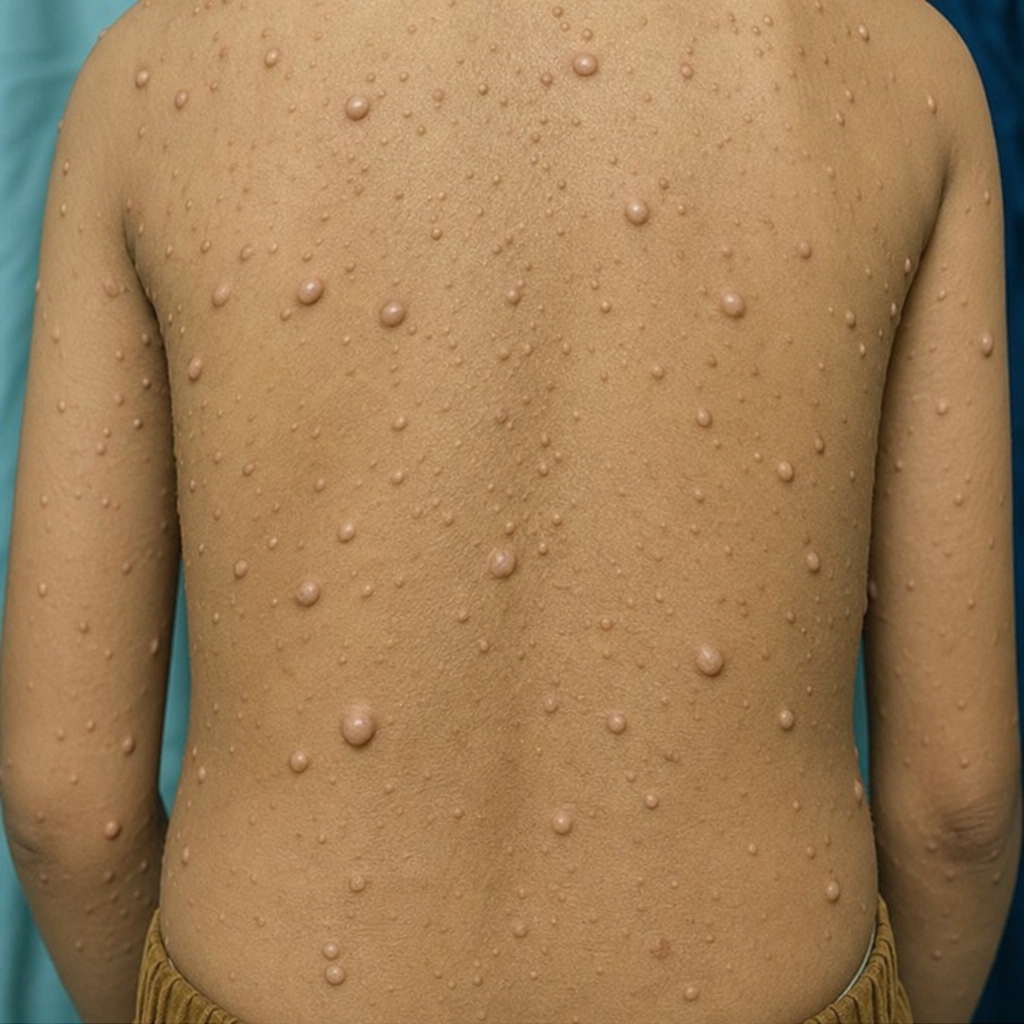
A 5-year-old male child presents with multiple hyperpigmented macules over the trunk. Upon rubbing the lesions with the rounded end of a pen, urticarial wheals develop, confined to the border of the lesion. What is the most likely diagnosis?
Hutchinson's triad is seen in which of the following conditions?
An 8-year-old boy presents with a 6-month history of an ill-defined, hypopigmented, slightly atrophic macule on the face. What is the most likely diagnosis?
A 20-year-old male with Acute Myeloid Leukemia (AML) is undergoing chemotherapy and has a neutrophil count of 400/mm 3, for which he was started on prophylactic antibiotics. The patient developed a sudden spike of fever and is complaining of severe myalgias, joint pains, and painful, widespread skin lesions. Biopsy of a skin lesion will most likely show what?
A child presents with a hyperpigmented patch over the back since birth. The level of melanin in this patch on biopsy is likely to be?
What is the commonest skin infection in children?
All of the following neurocutaneous signs are seen in Neurofibromatosis Type 2, EXCEPT:
Which of the following is NOT true of Sturge Weber syndrome?
Which of the following conditions produces seborrheic dermatitis-like lesions in an infant?
What is true about pityriasis alba?
Explanation: **Explanation:** The clinical presentation describes a classic case of **Urticaria Pigmentosa (UP)**, the most common form of cutaneous mastocytosis in children. **1. Why Urticaria Pigmentosa is correct:** The key to this diagnosis is the positive **Darier’s sign**. When the hyperpigmented macules (caused by an accumulation of mast cells in the dermis) are stroked or rubbed, it triggers mast cell degranulation. This releases inflammatory mediators like histamine, leading to localized edema and erythema (wheal formation) confined strictly to the lesion. In children, these lesions typically appear as reddish-brown macules or papules on the trunk. **2. Why other options are incorrect:** * **Fixed Drug Eruption (FDE):** Presents as a solitary (usually), dusky red/violaceous plaque that recurs at the same site upon drug re-exposure. It does not exhibit Darier’s sign. * **Lichen Planus:** Characterized by the "6 Ps" (Planar, Purple, Polygonal, Pruritic, Papules, and Plaques) and Wickham striae. It shows the **Koebner phenomenon** (lesions at sites of trauma), not Darier’s sign. * **Urticarial Vasculitis:** Presents as wheals that persist for >24 hours and often leave behind post-inflammatory hyperpigmentation. However, these wheals are not triggered by rubbing a pre-existing macule. **Clinical Pearls for NEET-PG:** * **Darier’s Sign:** Pathognomonic for Mastocytosis. * **Pseudo-Darier Sign:** Seen in **Smooth Muscle Hamartoma** (temporary induration/piloerection on rubbing). * **Systemic Mastocytosis:** Suspect if there is hepatosplenomegaly, lymphadenopathy, or systemic symptoms (flushing, diarrhea). * **Treatment:** Primarily symptomatic (H1/H2 blockers); avoid mast cell triggers (NSAIDs, morphine, heat).
Explanation: **Explanation:** **Hutchinson’s Triad** is a classic clinical diagnostic marker for **Late Congenital Syphilis** (presenting after 2 years of age). It occurs due to the systemic inflammatory response to *Treponema pallidum* during fetal development and early childhood. The triad consists of: 1. **Hutchinson’s Teeth:** Notched, peg-shaped permanent upper central incisors. 2. **Interstitial Keratitis:** Chronic inflammation of the corneal stroma leading to corneal scarring and potential blindness (usually appears between ages 5–15). 3. **Sensorineural Hearing Loss:** Caused by eighth cranial nerve (vestibulocochlear) involvement. **Analysis of Options:** * **Option B (Correct):** Congenital syphilis is the only condition where this developmental triad occurs. It is divided into Early (birth to 2 years) and Late (>2 years) stages. * **Option A, C, & D (Incorrect):** Acquired syphilis (Primary, Secondary, and Tertiary) occurs after birth via sexual contact or inoculation. While these stages can involve the eyes (uveitis) or ears (otosyphilis), they do not cause the specific developmental dental deformities or the classic triad seen in the congenital form. **High-Yield Clinical Pearls for NEET-PG:** * **Mulberry Molars:** Another dental sign of congenital syphilis characterized by multiple rudimentary cusps on the first permanent molars. * **Other Late Signs:** Saddle nose deformity, Sabre shins (anterior bowing of the tibia), and Clutton’s joints (painless symmetrical knee swelling). * **Early Signs:** Snuffles (syphilitic rhinitis), pemphigus syphiliticus (bullous lesions), and hepatosplenomegaly. * **Screening:** VDRL/RPR are used for screening; FTA-ABS is the confirmatory treponemal test.
Explanation: ### Explanation The correct diagnosis is **Indeterminate Leprosy**. In the context of the NEET-PG exam, a solitary, ill-defined, hypopigmented macule in a child—especially when associated with **atrophy** or **sensory loss**—should be considered leprosy until proven otherwise. **Why Indeterminate Leprosy is correct:** Indeterminate leprosy is the earliest clinical stage of leprosy. It typically presents as a single, vaguely defined, hypopigmented macule. While sensory loss may be subtle or absent in early stages, the presence of **atrophy** (thinning of the skin) is a strong clinical pointer toward leprosy rather than simple inflammatory conditions. In endemic regions like India, any persistent hypopigmented patch in a child warrants a high index of suspicion for leprosy. **Why other options are incorrect:** * **Pityriasis alba:** This is a very common cause of hypopigmentation in children (often associated with atopy). However, the patches are usually multiple, have fine scaling (furfuraceous), and **never show atrophy** or sensory loss. * **Morphoea (Localized Scleroderma):** While morphoea can cause atrophy, it typically presents with an initial inflammatory "lilac border" followed by **induration (hardening)** of the skin, rather than just a simple hypopigmented macule. * **Calcium deficiency:** This is a common **myth**. Nutritional deficiencies do not cause localized, well-demarcated hypopigmented patches on the face. **Clinical Pearls for NEET-PG:** * **Earliest sign of Leprosy:** Indeterminate leprosy (often self-healing or progresses to other poles). * **Most common site for Indeterminate Leprosy:** Face in children; outer aspect of thighs/arms in adults. * **Histopathology:** Shows non-specific perineural lymphocytic infiltration (AFB is usually negative). * **Differential Diagnosis Tip:** If the patch is anesthetic, it’s Leprosy; if it scales, it’s likely Pityriasis alba or Tinea versicolor.
Explanation: ### **Explanation** The patient is a classic case of **Febrile Neutropenia** (Neutrophil count <500/mm³) in the setting of hematologic malignancy (AML). Despite prophylactic antibiotics, the sudden onset of fever, severe myalgias, and painful skin lesions is highly suggestive of **Disseminated Candidiasis** (Systemic Candidiasis). **1. Why Option A is Correct:** In immunocompromised patients, *Candida* species can disseminate hematogenously. The "classic triad" includes fever, generalized papulonodular skin lesions (often with a pale center), and severe muscle tenderness (myositis). A skin biopsy in these cases typically reveals **fungal hyphae, pseudohyphae, and yeast cells** invading the dermis and blood vessel walls. **2. Why Incorrect Options are Wrong:** * **Option B (Intravascular thrombi with necrosis):** This is characteristic of **Ecthyma Gangrenosum** (caused by *Pseudomonas aeruginosa*) or **Angioinvasive Fungal Infections** (like *Mucor* or *Aspergillus*). While possible in neutropenia, the severe myalgia and diffuse nature of the lesions more specifically point toward *Candida*. * **Option C (Intracytoplasmic viral inclusions):** This would suggest a viral etiology like Poxvirus (Molluscum) or CMV. Viral infections usually present with different morphology and lack the systemic "muscle pain" profile seen here. * **Option D (Eosinophilic microabscesses):** These are seen in **Sweet Syndrome** (Acute Febrile Neutrophilic Dermatosis). While Sweet Syndrome is associated with AML, the biopsy would show a dense *neutrophilic* (not eosinophilic) infiltrate, and it would not explain the systemic fungal symptoms. ### **Clinical Pearls for NEET-PG:** * **Neutropenic Triad for Candidiasis:** Fever + Erythematous Papules + Myalgia. * **Ecthyma Gangrenosum:** Look for a central black eschar with a surrounding erythematous halo in a neutropenic patient (*Pseudomonas*). * **Sweet Syndrome:** Often called "Neutrophilic Dermatosis"; presents with succulent, juicy plaques and is a common paraneoplastic manifestation of AML. * **Diagnosis:** Skin biopsy is the gold standard for differentiating these life-threatening infections in neutropenic patients.
Explanation: ### Explanation The clinical presentation describes a **Mongolian spot** (Congenital Dermal Melanocytosis), which is the most common hyperpigmented patch present at birth, typically located over the lumbosacral area or back. **1. Why the Correct Answer is Right:** The underlying mechanism is the **arrest of melanocyte migration**. During embryogenesis, melanocytes migrate from the neural crest to the epidermis. In certain conditions, these melanocytes fail to reach the epidermis and remain trapped in the **deep dermis**. Because these melanocytes are located deep within the skin, the light reflecting off them undergoes the **Tyndall effect**, giving the lesion its characteristic slate-gray or blue-black appearance. **2. Why Other Options are Wrong:** * **Epidermal:** Melanin in the epidermis (e.g., freckles, lentigines) appears brown. If the pigment were here, the lesion would not have the characteristic bluish hue of a congenital dermal melanocytosis. * **Dermoepidermal Junction:** This is the site of melanocyte activity in junctional nevi. Pigment here typically appears dark brown to black. * **Superficial Dermis:** While some dermal melanocytoses (like Nevus of Ito or Ota) involve the upper and mid-dermis, the classic "Mongolian spot" and deep blue nevi are characterized by melanocytes residing specifically in the **deep reticular dermis**. **3. High-Yield Clinical Pearls for NEET-PG:** * **Mongolian Spot:** Most common in Asians; usually fades by age 2–5 years; no treatment required. * **Nevus of Ota:** Dermal melanocytosis along the ophthalmic and maxillary branches of the **Trigeminal nerve** (unilateral facial pigmentation). * **Nevus of Ito:** Similar to Ota but involves the **posterior shoulder** (acromioclavicular area). * **Tyndall Effect:** Shorter wavelengths (blue) are scattered more by dermal melanin, while longer wavelengths (red) are absorbed, explaining why deep pigment looks blue.
Explanation: **Explanation:** **Impetigo contagiosa** is the commonest bacterial skin infection in children worldwide. It is a highly contagious superficial pyoderma caused primarily by *Staphylococcus aureus* and, less frequently, *Streptococcus pyogenes*. Children are more susceptible due to their developing immune systems and frequent close contact in schools or daycare settings. The infection typically presents in two forms: non-bullous (honey-colored crusts) and bullous (thin-walled blisters). **Analysis of Options:** * **Scabies (Option A):** While a very common parasitic infestation caused by *Sarcoptes scabiei*, it is generally less prevalent than bacterial pyodermas in the overall pediatric population. * **Molluscum contagiosum (Option C):** This is a common viral infection caused by the Poxvirus, characterized by umbilicated papules. While frequent in children, its incidence is lower than that of impetigo. * **Warts (Option D):** Caused by Human Papillomavirus (HPV), these are common viral infections, but they typically have a lower point prevalence compared to the rapid spread of impetigo. **Clinical Pearls for NEET-PG:** * **Non-bullous Impetigo:** The most common type; characterized by the classic **"honey-colored crusts"** over an erythematous base. * **Bullous Impetigo:** Always caused by *S. aureus* producing exfoliative toxins; it is the localized form of Staphylococcal Scalded Skin Syndrome (SSSS). * **Treatment:** Topical **Mupirocin** or Retapamulin is the first-line treatment for localized lesions. Systemic antibiotics (e.g., Amoxicillin-Clavulanate) are used for extensive cases. * **Complication:** Post-streptococcal glomerulonephritis (PSGN) can follow impetigo, but notably, Rheumatic Fever does **not** follow skin infections.
Explanation: This question tests the ability to differentiate between the two major neurocutaneous syndromes: **Neurofibromatosis (NF)** and **Tuberous Sclerosis Complex (TSC)**. ### **Explanation of the Correct Answer** **D. Shagreen patch** is the correct answer because it is a pathognomonic feature of **Tuberous Sclerosis**, not Neurofibromatosis. It is a connective tissue nevus, typically appearing as a "leathery" or "orange-peel" textured plaque on the lower back. ### **Analysis of Other Options** * **A. Meningioma:** This is a classic feature of **NF-2**. While NF-1 is characterized by peripheral nerve tumors, NF-2 is characterized by central nervous system tumors, remembered by the mnemonic **MISME** (Multiple Inherited Schwannomas, Meningiomas, and Ependymomas). * **B. Lisch nodule:** These are iris hamartomas. While they are a hallmark diagnostic criterion for **NF-1**, they can occasionally be seen in NF-2 (though much less frequently). In the context of this "Except" question, the Shagreen patch is the most definitive outlier as it belongs to a completely different disease spectrum (TSC). * **C. Axillary freckling (Crowe’s sign):** Similar to Lisch nodules, this is a classic feature of **NF-1**. However, in NEET-PG questions, features of NF-1 and NF-2 are often grouped under the broad umbrella of "Neurofibromatosis" to contrast them against Tuberous Sclerosis. ### **High-Yield Clinical Pearls for NEET-PG** * **NF-2 (Chromosome 22):** Key feature is **Bilateral Acoustic Neuromas** (Vestibular Schwannomas). * **NF-1 (Chromosome 17):** Characterized by Café-au-lait spots, Neurofibromas, and Lisch nodules. * **Tuberous Sclerosis (TSC1/TSC2):** Look for the triad of **Vogt’s (Epiloia)**: Adenoma sebaceum (Angiofibromas), Mental retardation, and Epilepsy. Other signs include Ash-leaf spots and Koenen’s tumors (periungual fibromas).
Explanation: **Sturge-Weber Syndrome (SWS)**, also known as encephalotrigeminal angiomatosis, is a rare neurocutaneous disorder characterized by vascular malformations. ### **Explanation of Options:** * **Why Option B is the correct answer (False statement):** Sturge-Weber Syndrome is **sporadic** and **predominantly unilateral**. While bilateral involvement can occur (approximately 15% of cases), it is not the "most common" presentation. The condition is caused by a somatic mutation in the **GNAQ gene**, which occurs after fertilization, leading to localized rather than systemic distribution. * **Option A (True):** It involves a cutaneous capillary malformation (hemangiomatous involvement) typically in the distribution of the trigeminal nerve (V1 and V2 branches). * **Option C (True):** The hallmark cutaneous finding is the **Port-wine stain (Nevus Flammeus)**, which is present at birth and, unlike strawberry hemangiomas, does not regress but darkens and thickens over time. * **Option D (True):** Vascular gingival hyperplasia is a recognized oral manifestation of SWS, occurring due to underlying hemangiomatous changes in the gingival tissues. ### **High-Yield Clinical Pearls for NEET-PG:** 1. **Classic Triad:** * **Cutaneous:** Port-wine stain (V1/V2 distribution). * **Neurologic:** Leptomeningeal angiomas (leading to seizures, hemiparesis, and intellectual disability). * **Ocular:** Glaucoma (most common ocular finding) and choroidal hemangiomas. 2. **Radiology:** Skull X-ray or CT shows characteristic **"Tram-track" calcifications** (cortical calcifications). 3. **Genetics:** Somatic mutation in the **GNAQ gene** on chromosome 9q21. 4. **Management:** Port-wine stains are treated with **Pulsed Dye Laser (PDL)**, the gold standard.
Explanation: **Explanation:** **Langerhans Cell Histiocytosis (LCH)** is the correct answer because it frequently presents in infants as a "cradle cap" mimic. The underlying pathology involves the neoplastic proliferation of Langerhans cells. Clinically, it manifests as scaly, erythematous, or purpuric papules and plaques, primarily affecting the scalp, retroauricular areas, and intertriginous folds. Unlike simple seborrheic dermatitis, LCH lesions are often **hemorrhagic (petechial)**, may show ulceration, and are typically refractory to standard antifungal or steroid treatments. **Analysis of Incorrect Options:** * **Juvenile Xanthogranuloma (JXG):** This is the most common form of non-Langerhans cell histiocytosis. It typically presents as solitary, firm, yellowish-orange "dome-shaped" nodules, not as a diffuse seborrheic-like rash. * **Multicentric Histiocytosis:** A rare systemic disease characterized by destructive arthritis and skin nodules (papulonodular eruption), usually seen in adults rather than infants. * **Erdheim-Chester Disease:** A rare non-Langerhans cell histiocytosis that primarily affects adults. It is characterized by xanthomatous infiltration of internal organs and long bone osteosclerosis, not pediatric dermatitis. **High-Yield Clinical Pearls for NEET-PG:** * **Diagnostic Hallmark:** On Electron Microscopy, LCH shows **Birbeck granules** (tennis-racket shaped). * **Immunohistochemistry (IHC):** LCH cells are positive for **CD1a, S100, and CD207 (Langerin)**. * **Red Flag:** If an infant has "seborrheic dermatitis" that is **petechial/purpuric** or associated with **atrophy/ulceration**, always rule out LCH with a skin biopsy. * **Letterer-Siwe Disease:** The specific clinical subtype of LCH in infants that presents with this multisystem, seborrheic-like distribution.
Explanation: **Explanation:** **Pityriasis alba** is a common, benign skin condition primarily seen in children and adolescents (ages 3–16). It is considered a mild manifestation of **atopic dermatitis**. **1. Why Option A is correct:** The condition is **self-limiting** and typically resolves spontaneously after puberty. Because it is asymptomatic (non-itchy) and poses no systemic risk, **no active medical treatment is required**. Management usually focuses on reassurance, the use of emollients to reduce scaling, and sun protection to minimize the contrast between the patches and surrounding tanned skin. **2. Why the other options are incorrect:** * **Option B:** It is most common in **children**, not the elderly. It often presents after sun exposure, which makes the hypopigmented patches more prominent. * **Option C:** It is **not** a variant of vitiligo. While both present with light patches, pityriasis alba shows **hypopigmentation** (reduced melanin) with ill-defined borders and fine scaling. Vitiligo presents as **depigmentation** (total loss of melanin) with chalky white, well-demarcated patches and no scaling. **Clinical Pearls for NEET-PG:** * **Clinical Presentation:** Characterized by "powdery" fine scales on ill-defined hypopigmented patches, most commonly on the **face** (cheeks). * **Histopathology:** Shows hyperkeratosis, parakeratosis, and decreased number of active melanocytes/melanosomes. * **Differential Diagnosis:** Must be distinguished from **Tinea versicolor** (KOH mount positive) and **Vitiligo** (Wood’s lamp shows bright blue-white fluorescence). * **Association:** Strongly associated with the **Atopic Diathesis** (asthma, allergic rhinitis, eczema).
Neonatal Dermatology
Practice Questions
Infantile Hemangiomas and Vascular Malformations
Practice Questions
Atopic Dermatitis in Children
Practice Questions
Acne in Childhood and Adolescence
Practice Questions
Childhood Exanthems
Practice Questions
Genetic Skin Disorders in Children
Practice Questions
Genodermatoses
Practice Questions
Nutritional Dermatoses in Children
Practice Questions
Pigmentary Disorders in Children
Practice Questions
Hair Disorders in Children
Practice Questions
Child Abuse: Cutaneous Manifestations
Practice Questions
Therapeutic Considerations in Pediatric Dermatology
Practice Questions
Get full access to all questions, explanations, and performance tracking.
Start For Free