What is the Drug of Choice (DOC) for Onychomycosis?
Which of the following is not a part of P. versicolor treatment -
Which of the following drugs are used topically for dermatophytes?
All the following drugs are effective in the treatment of Pityriasis Versicolor except:
Agents most effective and best tolerated in the management of onychomycosis?
Treatment of partner is required in all infections except -
What is the correct term for candidiasis of the penis?
A 70 year old farmer, presented to you with complaints of yellowish discolouration of his finger nails for the past 6 months, he also gives history of recurrent episodes of itching in the groin for which he used to take local home made herbal remedy. On examination 3 of his toe nails also show similar change with tunneling. Which among the following is the best test for rapid confirmation of your diagnosis?
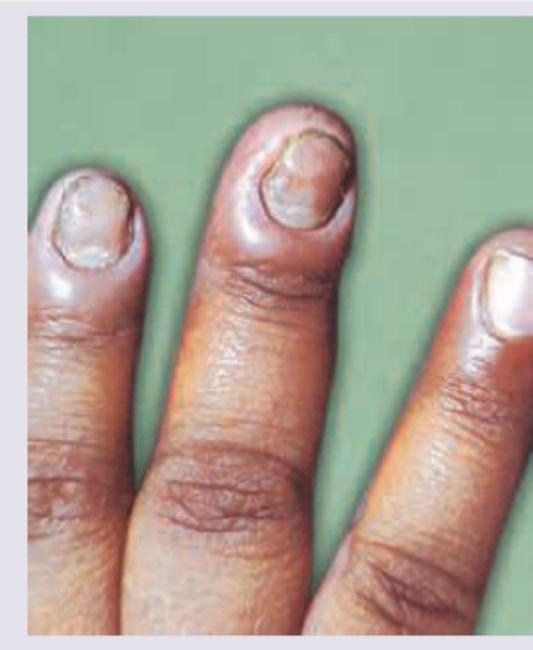
A 30-year-old washerwoman presents with the following lesion. All are correct except:
Skin scraping and KOH mounting is done for what condition?
Explanation: ***Terbinafine*** - **Terbinafine** is considered the **drug of choice** for **onychomycosis** due to its potent fungicidal activity against **dermatophytes**, which are the most common cause of nail infections [1]. - It accumulates in the nail plate at therapeutic levels, leading to high cure rates and a relatively good safety profile [2]. *Fluconazole* - While effective against some fungi, **fluconazole** is primarily fungistatic and generally less effective against dermatophytes compared to terbinafine for onychomycosis, resulting in lower cure rates [1]. - It is often preferred for **mucocutaneous candidiasis** and other systemic fungal infections [1]. *Itraconazole* - **Itraconazole** is an alternative for onychomycosis, often administered in pulse doses, but it can have more significant drug interactions and a higher risk of hepatic toxicity compared to terbinafine [1]. - Its efficacy against dermatophytes is comparable to terbinafine, but its side effect profile makes it a second-line option [1]. *Nystatin* - **Nystatin** is a topical antifungal effective primarily against **Candida species**, and is not effective against **dermatophytes**, which are the main pathogens in onychomycosis. - It is typically used for mucocutaneous candidiasis, such as oral thrush or vaginal yeast infections, and is not absorbed systemically.
Explanation: **Griseofulvin (Correct - NOT used for P. versicolor)** - **Griseofulvin** interferes with fungal cell division and is primarily used for dermatophyte infections of the skin, hair, and nails, not superficial yeast infections like *P. versicolor*. - It is systemically absorbed and incorporated into **keratin precursor cells**, offering protection against dermatophytes in newly formed tissue. - *Malassezia* species (causing P. versicolor) are **yeasts**, not dermatophytes, making griseofulvin ineffective. *Selenium sulfide (Incorrect - IS used)* - **Selenium sulfide** is an effective topical antifungal agent commonly used in shampoos and lotions to treat *P. versicolor* by inhibiting the growth of *Malassezia* species. - It works by reducing **sebum production** and having a direct fungistatic effect on the yeast. *Clotrimazole (Incorrect - IS used)* - **Clotrimazole** is a broad-spectrum azole antifungal that is very effective as a topical treatment for *P. versicolor* by inhibiting ergosterol synthesis in the fungal cell membrane. - It works well for localized patches of the infection. *Ketoconazole (Incorrect - IS used)* - **Ketoconazole**, another azole antifungal, is highly effective for *P. versicolor* and can be used topically (shampoos, creams) or orally in more extensive or recalcitrant cases. - It disrupts the fungal cell membrane by inhibiting the synthesis of **ergosterol**.
Explanation: ***All of the options*** - **Terbinafine**, **Ciclopirox olamine**, and **Econazole** are all commonly used as topical antifungal agents for the treatment of dermatophyte infections. - These drugs target different aspects of fungal cell metabolism or structure to inhibit growth or kill the fungus. *Terbinafine* - It is an **allylamine antifungal** that inhibits **squalene epoxidase**, an enzyme involved in fungal ergosterol synthesis. - While effective topically, terbinafine can also be used orally for more extensive or recalcitrant infections, but the question specifically asks for topical use. *Cyclopirox olamine* - This is a **hydroxypyridone antifungal** that acts by chelating polyvalent metal cations, inhibiting essential enzymes in fungal cells. - It is often used for topical treatment of dermatophyte infections, including **tinea pedis** and **tinea corporis**, and is also used for onychomycosis. *Econazole* - It is an **imidazole antifungal** that inhibits the fungal cytochrome P450 enzyme 14α-demethylase, which is crucial for **ergosterol biosynthesis**. - Commonly available as a cream or solution, econazole is effective against a broad spectrum of fungi, including dermatophytes, and is used for various superficial fungal infections.
Explanation: ***Griseofulvin*** - **Griseofulvin** is an oral antifungal agent primarily effective against **dermatophytes** (tinea infections) by interfering with microtubule assembly and fungal cell division. - It is **ineffective against *Malassezia furfur***, the yeast responsible for Pityriasis Versicolor, as this organism is not a dermatophyte. *Clotrimazole* - **Clotrimazole** is a topical azole antifungal that inhibits **lanosterol 14-alpha-demethylase**, a crucial enzyme in fungal ergosterol synthesis, making it effective against *Malassezia furfur*. - It works by disrupting the **fungal cell membrane**, leading to its fungistatic and fungicidal properties. *Selenium Sulphide* - **Selenium Sulphide** is a topical antifungal agent that acts as a **cytostatic agent**, reducing the growth rate of epidermal cells and inhibiting the growth of *Malassezia furfur*. - It is commonly used in **shampoos and lotions** for treating Pityriasis Versicolor, often applied as a lather and left on the skin. *Ketoconazole* - **Ketoconazole** is another azole antifungal, available in both topical and oral forms, effective against *Malassezia furfur* by inhibiting **ergosterol synthesis**. - Its broad-spectrum antifungal activity makes it a common and effective treatment for **Pityriasis Versicolor**.
Explanation: ***Itraconazole and terbinafine*** - **Terbinafine** is a highly effective **allylamine antifungal** for onychomycosis, achieving high cure rates with good tolerability due to its fungicidal action and accumulation in the nail plate. - **Itraconazole** is a **triazole antifungal** that is also effective for onychomycosis, particularly for both dermatophyte and non-dermatophyte infections, and can be given in pulse doses which may improve patient compliance and reduce side effects. *Ciclopirox and griseofulvin* - **Ciclopirox** is a topical agent, generally less effective for moderate to severe onychomycosis, and requires prolonged daily application. - **Griseofulvin** has a lower cure rate for onychomycosis compared to newer antifungals like terbinafine and itraconazole, and requires longer treatment durations with potential for more drug interactions. *Griseofulvin and ketoconazole* - **Griseofulvin** has been largely supplanted by newer antifungals due to its lower efficacy and longer treatment courses for onychomycosis. - **Ketoconazole** has a less favorable safety profile (e.g., hepatotoxicity) for systemic use in onychomycosis and is generally not recommended as a first-line treatment. *Griseofulvin and caspofungin* - **Griseofulvin** is an older oral antifungal with limited efficacy and prolonged treatment duration for onychomycosis. - **Caspofungin** is an **echinocandin** antifungal primarily used for systemic candidiasis and aspergillosis, and is not indicated for the treatment of onychomycosis.
Explanation: ***Candida*** - **Candidiasis** is primarily caused by an overgrowth of fungi that are part of the normal vaginal flora, not typically considered a sexually transmitted infection (STI), therefore **partner treatment is generally not required**. - While it can be transmitted sexually, it is often due to **other predisposing factors** like antibiotic use, hormonal changes, or immunosuppression. *Trichomonas* - **Trichomonas vaginalis** is a sexually transmitted parasite that causes **trichomoniasis**, which can lead to recurrent infections if the partner is not treated. - **Simultaneous treatment of all sexual partners** is crucial to prevent re-infection and reduce transmission rates. *Herpes* - **Genital herpes** is caused by the **herpes simplex virus (HSV)**, a highly contagious sexually transmitted infection. - While treatment of the partner does not cure the infection, it is essential for partners to be aware of the diagnosis, receive **counseling on safe sex practices**, and consider suppressive therapy to reduce transmission risk. *All of the options* - This option is incorrect because partner treatment is typically required for **Trichomonas** and counseling/awareness for **Herpes** to prevent re-infection and transmission, whereas it is generally not essential for **Candida**. - Partner treatment strategies vary significantly based on the **specific characteristics of each infection** and its mode of transmission.
Explanation: ***Balanitis*** - **Candidiasis of the penis** is specifically referred to as Candidal balanitis, an inflammatory condition affecting the **glans penis**. - This term accurately describes the location and cause of the infection. *Oral thrush* - **Oral thrush** is candidiasis of the mouth, characterized by **white patches** on the tongue and oral mucosa. - This term refers to a different anatomical location and is not applicable to penile infection. *No candidiasis present* - This option is incorrect because candidiasis can indeed affect the penis, leading to a recognized clinical condition. - Symptoms like **redness, itching, and discharge** would indicate the presence of candidiasis. *Leukoplakia* - **Leukoplakia** is a condition characterized by **white patches** that develop on the mucous membranes of the mouth, tongue, or sometimes the genitals. - It is a **precancerous lesion** that is not caused by Candida infection, distinguishing it from balanitis.
Explanation: ***KOH mount*** - A **KOH mount** (potassium hydroxide) dissolves keratinocytes, allowing for direct visualization of fungal elements such as **hyphae** and **spores** under a microscope. This is the **most rapid and cost-effective test** for confirming fungal infections like **onychomycosis**. - The patient's presentation with **yellowish discoloration** and **"tunneling"** of nails (suggesting onycholysis and subungual hyperkeratosis), along with a history of recurrent groin itching (potentially **tinea cruris**), strongly points to a fungal infection. *Tzanck smear* - A **Tzanck smear** is primarily used to detect multinucleated giant cells in **herpesvirus infections** (e.g., herpes simplex, varicella-zoster). - It is not useful for identifying fungal elements responsible for nail discoloration or suspected onychomycosis. *Woods lamp* - A **Woods lamp** uses ultraviolet light to detect specific fluorescent substances, particularly useful for diagnosing certain **bacterial infections** (e.g., *Corynebacterium minutissimum* in erythrasma) or some **tinea capitis** species (*Microsporum*). - Most common dermatophytes causing onychomycosis **do not fluoresce** under a Wood's lamp, making it an unreliable diagnostic tool in this scenario. *Biopsy* - A **nail biopsy** (with histology and special stains like PAS) is a highly accurate diagnostic method for onychomycosis, especially when other tests are inconclusive. - However, it is an **invasive procedure**, takes more time for results, and is generally not the **most rapid** initial test compared to a KOH mount.
Explanation: ***Tinea unguium*** - **Tinea unguium** (onychomycosis) is a **dermatophyte infection** of the nail plate, typically caused by *Trichophyton* species, not *Candida*. - The image shows **chronic paronychia** caused by *Candida* affecting the nail fold, which is a completely different condition from tinea unguium. *Caused by normal commensal of GIT* - *Candida albicans* is indeed a **normal commensal** of the gastrointestinal tract and can cause chronic paronychia in washerwomen. - Constant **water exposure** allows this opportunistic organism to colonize and infect the periungual tissues. *Rule out diabetes mellitus in recurrent episodes* - **Recurrent candidal infections** warrant screening for **diabetes mellitus** due to impaired immune function and elevated glucose levels. - Diabetic patients have increased susceptibility to **opportunistic fungal infections** including chronic paronychia. *Deformed nail plate* - The image clearly shows **nail dystrophy** with irregular, discolored, and thickened nail plate secondary to chronic inflammation. - **Chronic paronychia** affects the nail matrix, leading to **abnormal nail growth** and permanent deformation.
Explanation: **Explanation:** **1. Why Fungal Infections is Correct:** Potassium Hydroxide (KOH) mounting is the **gold standard bedside diagnostic test** for superficial fungal infections (Dermatophytosis, Candidiasis, and Tinea versicolor). The medical principle relies on the fact that KOH is a strong alkali that digests keratin, epithelial cells, and debris in skin scrapings, hair, or nails. Since fungal cell walls contain **chitin**, they remain resistant to KOH. This allows the clinician to clearly visualize fungal elements like hyphae, spores, or budding yeast under a microscope. **2. Why Other Options are Incorrect:** * **Leprosy (A):** Diagnosis is primarily clinical, supported by **Slit Skin Smear (SSS)** using Modified Ziehl-Neelsen staining to identify *Mycobacterium leprae* (acid-fast bacilli). * **Varicella (B) & HSV (D):** These are viral infections. The classic bedside test for these is the **Tzanck Smear**, where a scraping from the base of a vesicle is stained (Giemsa/Wright) to look for **multinucleated giant cells** (Acantholytic cells). **3. High-Yield Clinical Pearls for NEET-PG:** * **Concentration:** 10% KOH is used for skin/hair; 20% KOH is used for thicker nail clippings. * **Classic Morphologies:** * **Dermatophytes:** Translucent, branching, septate hyphae. * **Tinea Versicolor:** "Spaghetti and meatballs" appearance (short hyphae and spores). * **Candidiasis:** Pseudohyphae and budding yeast cells. * **Modification:** **DMSO (Dimethyl sulfoxide)** can be added to KOH to speed up the clearing of keratin without requiring heat.
Get full access to all questions, explanations, and performance tracking.
Start For Free