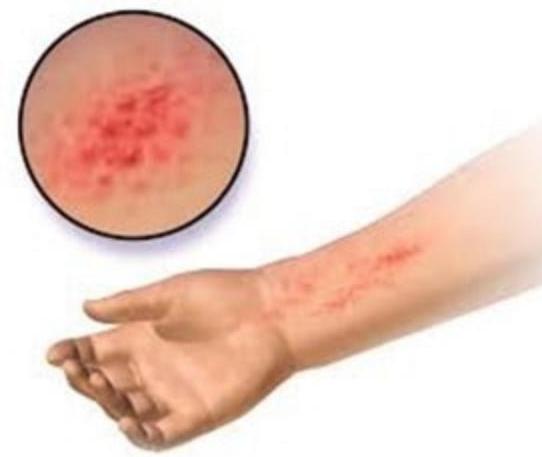
The image shows presence of:

All are causes of the skin lesion shown except:

The image shows:

The clinical sign shown in the image is:

This patient was cleaning the basement, following which he developed the lesions as shown on his back for the last 6 hours. The image shows presence of:

The following strip is used for testing of:

A child has a pruritic rash as shown below. His mother is an asthmatic. Comment on the diagnosis:

A child presented with itchy plaques over the neck, the bilateral popliteal and cubital fossa. What could be the diagnosis?
Dennie-Morgan fold is indicative of:
A patient comes to you with skin reactions after visiting the hair dresser. What will you do to confirm the diagnosis of contact dermatitis?
Explanation: ***Onychogryphosis*** - The image clearly shows a thickened, **curved**, and discolored nail, often described as resembling a **ram's horn**, which is characteristic of onychogryphosis. - This condition results from an imbalance in nail growth, leading to hypertrophy and abnormal curvature, often seen in the elderly or due to trauma. *Onycholysis* - Onycholysis is the **separation of the nail plate from the nail bed**, typically starting at the distal end. - The image does not show a clear separation of the nail from its bed, but rather a deformed, thickened nail plate. *Trachyonychia* - Trachyonychia is characterized by **rough**, opaque, and sometimes vertically ridged nails, often described as having a "sandpapered" appearance. - While there is some discoloration, the predominant feature in the image is the extreme thickening and curvature, not uniform roughness. *Onychocryptosis* - Onychocryptosis, commonly known as an **ingrown nail**, occurs when the edge of the nail grows into the surrounding skin. - The image does not depict an ingrown nail; instead, it shows a nail with significant hypertrophy and deformation of the nail plate itself.
Explanation: ***Chronic renal failure*** - The image depicts **erythema multiforme**, a hypersensitivity reaction characterized by **target lesions**. - **Chronic renal failure** is not a known direct cause of erythema multiforme. *Infectious mononucleosis* - **Viral infections**, including **Epstein-Barr virus** (which causes infectious mononucleosis), are common triggers for erythema multiforme. - The immune response to the viral infection can lead to the characteristic skin lesions. *Mycoplasma* - **Mycoplasma pneumoniae infection** is a well-established cause of erythema multiforme, particularly in children and young adults. - Mycoplasma is one of the most common infectious triggers and can also cause other severe mucocutaneous reactions. *Collagen vascular disease* - Certain **collagen vascular diseases**, such as **systemic lupus erythematosus**, can be associated with erythema multiforme. - The underlying autoimmune dysregulation can trigger generalized hypersensitivity reactions.
Explanation: ***Atopic dermatitis*** - The image displays characteristic features of **atopic dermatitis**, including **erythema**, **scaling**, and **lichenification**, particularly visible on the foot. - The skin appears dry, thickened, and inflamed, consistent with chronic eczema often associated with atopic dermatitis. *Allergic shiners* - **Allergic shiners** are dark circles under the eyes caused by venous congestion due to allergies, which are not depicted in this image of a foot. - This condition is a facial sign and unrelated to the skin findings shown. *Allergic line* - The term "allergic line" or **Dennie-Morgan folds** refers to extra folds of skin under the lower eyelids, also a facial sign of allergies, not seen here. - The image presents a skin condition on the foot, not a facial feature. *Acute urticaria* - **Acute urticaria** (hives) presents as transient, raised, itchy **wheals** with well-demarcated borders, which are not consistent with the chronic, scaly, and thickened appearance of the skin in the image. - The lesions in the image show thickening and inflammation, typical of a more chronic dermatological condition rather than the transient nature of acute urticaria.
Explanation: ***Dennie-Morgan fold (infraorbital fold)*** - The image clearly shows a prominent **infraorbital fold** or crease below the lower eyelid. - This crease is known as **Dennie-Morgan fold** (also called Dennie-Morgan lines) and is a common finding in individuals with atopic dermatitis or chronic allergic conditions. - It represents an accentuated line or fold in the skin of the lower eyelid and is considered a minor diagnostic criterion for atopic dermatitis. *Allergic salute* - An **allergic salute** refers to the characteristic gesture where a child repeatedly pushes the tip of the nose upward with the palm of the hand to relieve nasal itching and obstruction. - This action often leads to a transverse crease across the bridge of the nose, but it is not depicted in the image. *Allergic line* - The term **allergic line** (or allergic crease) is synonymous with the transverse nasal crease resulting from the allergic salute. - While it's a sign associated with chronic allergic rhinitis, it does not describe the infraorbital fold seen in the image. *Allergic shiners* - **Allergic shiners** are dark, discolored areas under the eyes, resembling bruises, caused by venous congestion secondary to chronic allergic rhinitis or nasal obstruction. - While allergic shiners may coexist with Dennie-Morgan folds, the prominent feature indicated in the image is the infraorbital fold itself, not periorbital darkening.
Explanation: ***Acute urticaria*** - The image shows widespread, erythematous, edematous, and **pruritic wheals** (hives) on the back, consistent with **acute urticaria**. - The sudden onset after cleaning the basement suggests an acute allergic reaction or contact with an irritant, leading to mast cell degranulation and histamine release. *Atopic dermatitis* - This condition typically presents with **eczematous lesions**, characterized by dry, itchy, inflamed skin, often with lichenification in chronic cases. - The lesions in the image are distinct wheals, not the typical presentation of atopic dermatitis. *Cholinergic urticaria* - This form of urticaria is triggered by **increases in body temperature**, such as exercise, hot baths, or emotional stress, rarely by cleaning a basement. - It usually manifests as small, pinpoint wheals surrounded by a flare, which is different from the large, confluent wheals shown. *Dermographism* - **Dermographism** is a physical urticaria where wheals appear along lines of pressure or scratching on the skin, literally "writing on the skin." - While it involves wheals, the distribution in the image is generalized and not confined to areas of pressure or linear scratching, making it inconsistent with dermographism.
Explanation: ***Contact dermatitis (Allergic)*** - The image depicts a **patch test** strip, characterized by multiple small chambers containing various allergens, which are applied to the skin. - This method is the **gold standard** for identifying specific substances that cause **allergic contact dermatitis** by observing localized inflammatory reactions after 48-72 hours. - Patch testing detects **Type IV delayed hypersensitivity** reactions to specific allergens. *Atopic dermatitis* - While atopic dermatitis is a type of eczema, it is primarily diagnosed based on **clinical criteria** (e.g., pruritus, typical morphology and distribution), family history, and elevated IgE levels. - Patch testing is generally not the primary diagnostic tool for atopic dermatitis, as it is primarily a **Type I hypersensitivity** reaction, whereas patch tests detect Type IV reactions. *Seborrheic dermatitis* - Seborrheic dermatitis is a chronic inflammatory condition affecting sebum-rich areas (scalp, face, chest). - Diagnosis is made **clinically** based on characteristic greasy, yellowish scales in typical distributions. - Patch testing is not used for diagnosis of seborrheic dermatitis. *Irritant contact dermatitis* - Irritant contact dermatitis results from **direct chemical damage** to the skin rather than an allergic immune response. - It is diagnosed primarily through **clinical history** and distribution pattern of lesions. - Patch testing is specifically designed to identify **allergic** (not irritant) contact dermatitis, as irritant reactions are non-immunological.
Explanation: ***Atopic dermatitis*** - The image shows a classic presentation of **eczematous rash** in the **flexural areas** (knees), which is characteristic of atopic dermatitis. - The history of a **mother with asthma** suggests an **atopic diathesis**, increasing the likelihood of atopic dermatitis in the child due to its strong genetic component and association with other atopic conditions (asthma, allergic rhinitis). *Seborrheic dermatitis* - Typically presents as **greasy, yellowish scales** on an erythematous base, commonly affecting the scalp, face (eyebrows, nasolabial folds), and chest. - While it can occur in infants ("cradle cap"), its morphology and locations are distinct from the rash seen in the image. *Allergic contact dermatitis* - This rash would typically be localized to areas of direct contact with an **allergen** and would not necessarily show the typical flexural distribution seen in the image. - It often presents with more acute **vesicles, bullae, and intense pruritus** strictly limited to the exposure site. *Erysipelas* - Erysipelas is a **superficial bacterial skin infection** characterized by a **well-demarcated, erythematous, raised, and warm plaque**, often with systemic symptoms like fever and chills. - The rash in the image does not present with the characteristic features of an acute bacterial infection.
Explanation: **Atopic dermatitis** - The presentation of **itchy plaques** in the anatomical locations described (neck, bilateral popliteal fossa, and cubital fossa) is highly characteristic of **atopic dermatitis** in children. - Atopic dermatitis typically involves **flexural surfaces** in older children and adults, and is characterized by **intense pruritus**. *Dermatitis herpetiformis* - This condition presents with **extremely itchy, grouped vesicles and papules**, primarily on extensor surfaces, buttocks, and scalp. - It is strongly associated with **celiac disease** and is unlikely to present as plaques in flexural areas. *Psoriasis* - Psoriasis typically presents with **well-demarcated, erythematous plaques** covered with **silvery scales**, often on extensor surfaces (knees, elbows) and the scalp. - While it can occur in flexural areas (inverse psoriasis), **itching is usually less prominent** than in atopic dermatitis, and the characteristic scaling is usually present. *Pemphigus vegetans* - Pemphigus vegetans is a rare variant of pemphigus, characterized by **verrucous, vegetative lesions** and **bullae**, often in intertriginous areas. - This condition is a chronic autoimmune blistering disease and does not typically present as simple itchy plaques in a child.
Explanation: ***Atopic dermatitis*** - A **Dennie-Morgan fold** is an extra crease or fold in the skin below the lower eyelid, which is a common but not exclusive indicator for **atopic dermatitis**, also known as **eczema**. - Its presence suggests chronic inflammation and edema around the eyes, characteristic of this allergic skin condition. *Leprosy* - **Leprosy** primarily affects nerves, skin, eyes, and the upper respiratory tract but does not typically cause **Dennie-Morgan folds**. - Its characteristic skin lesions involve nodules, macules, and loss of sensation. *Dermatitis herpetiformis* - **Dermatitis herpetiformis** is an intensely itchy, chronic blistering skin condition associated with **celiac disease**. - It presents with symmetrical papules and vesicles, predominantly on extensor surfaces, and is not linked to periorbital folds. *TB* - **Tuberculosis (TB)** is a bacterial infection primarily affecting the lungs but can manifest in other organs. - Skin manifestations of TB, like lupus vulgaris or scrofuloderma, are rare and do not include the **Dennie-Morgan fold**.
Explanation: ***Patch Test*** - A **patch test** is the gold standard for diagnosing **allergic contact dermatitis** by directly applying suspected allergens to the skin. - This test identifies specific substances that cause a delayed hypersensitivity reaction, which is characteristic of contact dermatitis. *S IgE* - **Serum IgE** levels are primarily indicative of **Type I hypersensitivity** reactions, such as allergic rhinitis or asthma. - Contact dermatitis is a **Type IV delayed hypersensitivity reaction**, not mediated by IgE antibodies. *Allergy Test* - The term "allergy test" is broad and can refer to various methods including skin prick tests, IgE blood tests, or patch tests. - Without specifying **patch testing**, other forms of allergy tests are less appropriate for diagnosing contact dermatitis, as they target different immune mechanisms. *VDRL* - **VDRL (Venereal Disease Research Laboratory)** test is used to screen for **syphilis**, a sexually transmitted infection. - It has no relevance to the diagnosis of contact dermatitis, which is an inflammatory skin condition caused by contact with an allergen or irritant.
Atopic Dermatitis
Practice Questions
Seborrheic Dermatitis
Practice Questions
Contact Dermatitis: Irritant
Practice Questions
Contact Dermatitis: Allergic
Practice Questions
Nummular Eczema
Practice Questions
Dyshidrotic Eczema
Practice Questions
Stasis Dermatitis
Practice Questions
Asteatotic Eczema
Practice Questions
Lichen Simplex Chronicus
Practice Questions
Autoeczematization (Id Reaction)
Practice Questions
Photosensitive Eczemas
Practice Questions
Treatment Strategies for Eczematous Disorders
Practice Questions
Get full access to all questions, explanations, and performance tracking.
Start For Free