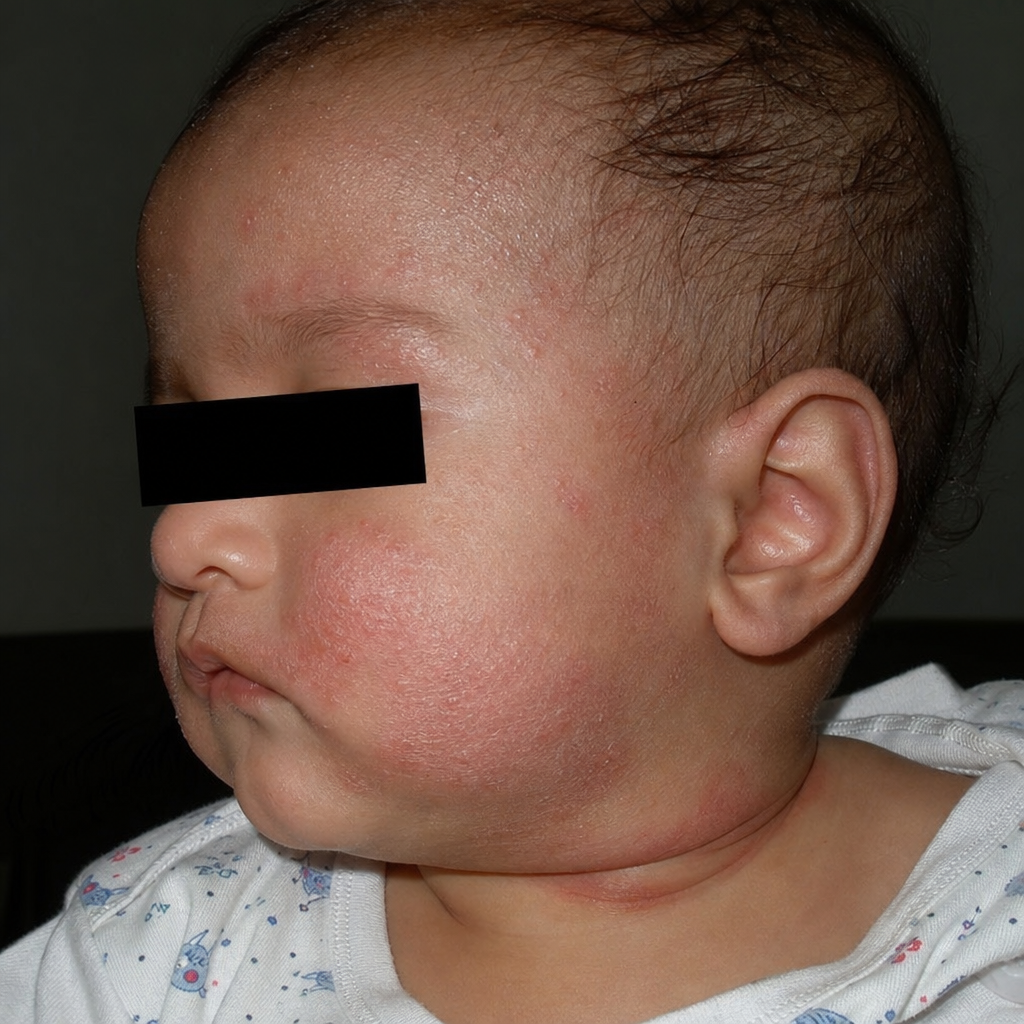
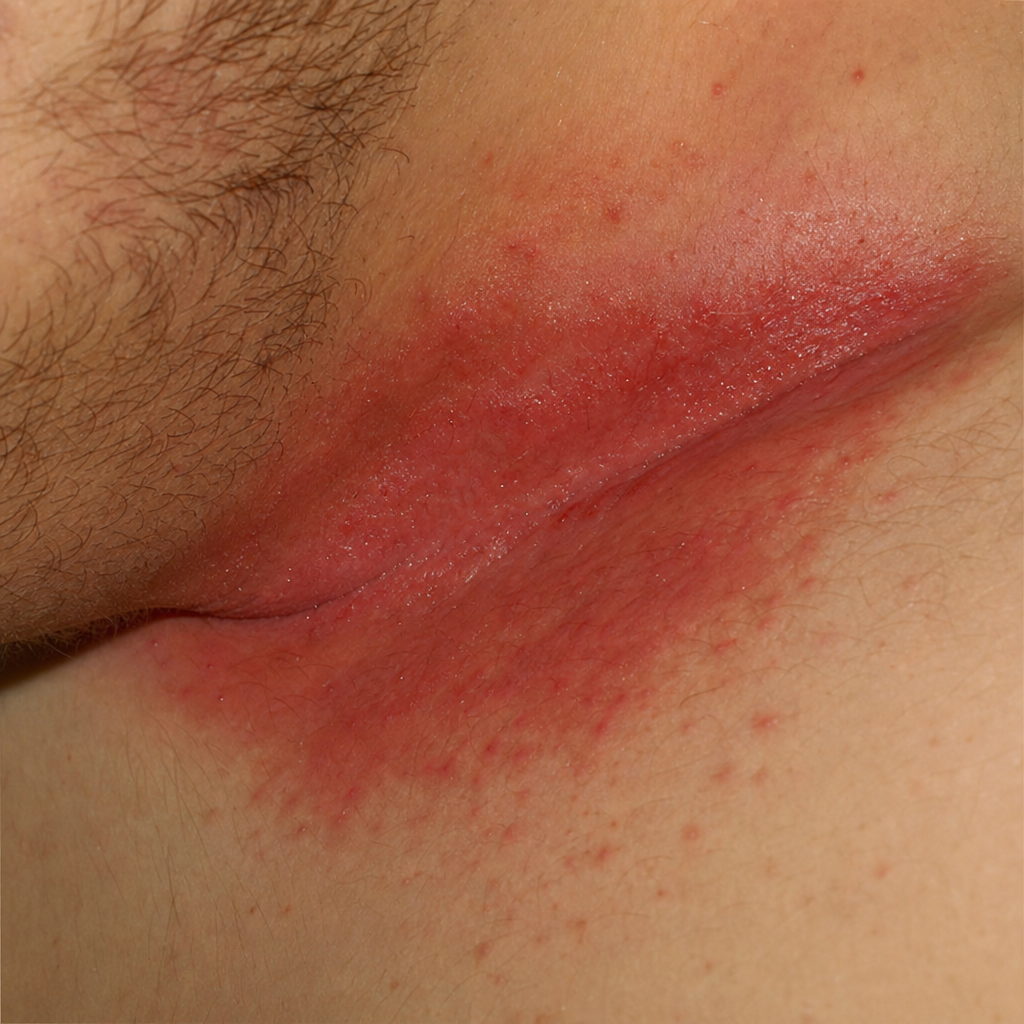
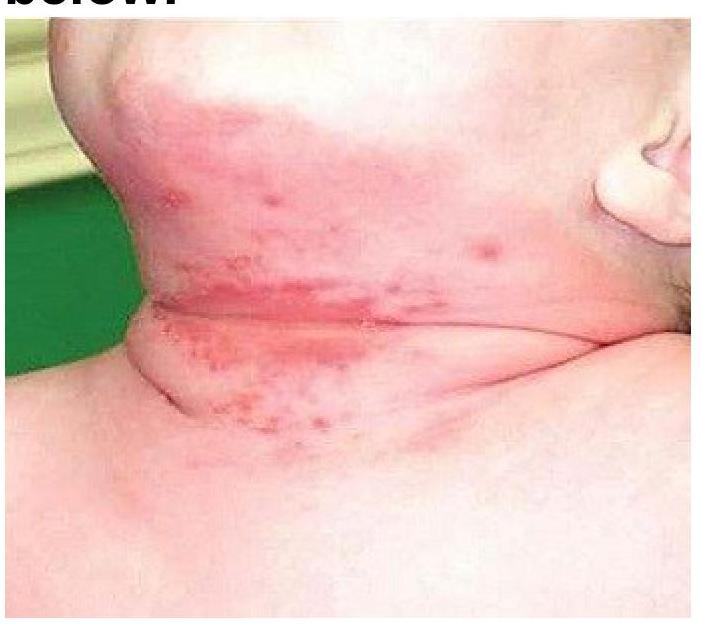
The Hanifin & Rajka diagnostic criteria are used for which condition?
A 17-year-old female presents with a pruritic rash localized to the wrist. Papules and vesicles are noted in a bandlike pattern, with slight oozing from some lesions. What is the most likely cause of this rash?
A 25-year-old male presents with recurrent episodes of flexural eczema, contact urticaria, recurrent skin infections, and severe abdominal cramps and diarrhea upon consuming seafood. What is the most likely diagnosis?
What is the characteristic presentation of erythematous lesions with collarettes of scales on the trunk?
An infant presented with erythematous lesions on the cheek and extensor aspect of the upper and lower limbs. There is a family history of asthma. What is the probable diagnosis?
Air-borne contact dermatitis can be diagnosed by?
A 35-year-old woman develops an itchy rash over her back, legs, and trunk several hours after swimming in a lake. Erythematous, edematous papules are noted. The wheals vary in size. There are no mucosal lesions and no swelling of the lips. What is the most likely diagnosis?
Multipleround to oval erythematous patches with fine central scale distributed along the skin tension lines on the trunk is highly suggestive of?
A 22-year-old woman developed small itchy wheals after physical exertion, walking in the sun, eating hot spicy food, and when she was angry. What is the most likely diagnosis?
The following are true regarding the picture shown except:

Explanation: **Explanation:** The **Hanifin and Rajka criteria** (established in 1980) are the traditional "gold standard" for diagnosing **Atopic Dermatitis (AD)**. Because there is no specific laboratory biomarker for AD, diagnosis relies on clinical morphology and history. To satisfy the criteria, a patient must meet at least **3 out of 4 Major features** and at least **3 out of 23 Minor features**: * **Major Criteria:** Pruritus (itching), Typical morphology and distribution (e.g., facial/extensor involvement in infants, flexural lichenification in adults), Chronic or chronically relapsing dermatitis, and Personal/family history of atopy (asthma, allergic rhinitis, AD). * **Minor Criteria:** Include xerosis, ichthyosis, elevated serum IgE, early age of onset, Dennie-Morgan infraorbital fold, keratosis pilaris, and white dermographism. **Why other options are incorrect:** * **Contact Dermatitis:** Diagnosed primarily via clinical history and **Patch Testing** (to identify Type IV hypersensitivity allergens). * **Urticaria:** Characterized by transient wheals and angioedema; diagnosis is clinical, often involving the **UAS7 (Urticaria Activity Score)** for severity. * **Erythroderma:** A clinical state (exfoliative dermatitis involving >90% body surface area) caused by various underlying conditions like psoriasis or drugs; it does not use these specific criteria. **High-Yield Clinical Pearls for NEET-PG:** * **UK Working Party Criteria:** A simplified version of Hanifin & Rajka often used in clinical trials (requires Itch + 3 or more minor criteria). * **Dennie-Morgan Fold:** An extra fold of skin under the lower eyelid, a classic minor sign of AD. * **Hertoghe’s Sign:** Thinning of the lateral third of the eyebrows (seen in AD and Hypothyroidism). * **Pathogenesis:** Often involves **Filaggrin (FLG) gene mutations**, leading to skin barrier defects.
Explanation: ### Explanation **Correct Answer: C. Contact Dermatitis** The clinical presentation of a pruritic rash localized to the wrist in a "bandlike pattern" is a classic description of **Allergic Contact Dermatitis (ACD)**. In this case, the pattern strongly suggests an exogenous trigger, most commonly **Nickel**, found in wristwatches, bracelets, or metallic straps. ACD is a **Type IV (Delayed) Hypersensitivity reaction**. The acute phase is characterized by erythematous papules, vesicles, and oozing (as seen here), while the chronic phase presents with lichenification and scaling. The most defining feature for NEET-PG is the **morphology conforming to the shape of the offending agent** (e.g., a band for a watch, a circle for a bindi, or a linear streak for Poison Ivy). **Why the other options are incorrect:** * **A & B (Herpes Simplex & Shingles):** While both can present with vesicles, they are typically painful or burning rather than primarily pruritic. Shingles (Herpes Zoster) follows a **dermatomal distribution**, not a circumferential bandlike pattern around a limb. * **D (Seborrheic Dermatitis):** This typically affects "seborrheic areas" rich in sebaceous glands, such as the scalp, eyebrows, and nasolabial folds. It presents with greasy, yellowish scales rather than oozing vesicles on the wrist. **High-Yield Clinical Pearls for NEET-PG:** * **Gold Standard Diagnosis:** Patch Testing (Readings taken at 48 and 72/96 hours). * **Common Allergens:** Nickel (most common worldwide), Potassium dichromate (cement/leather), Paraphenylenediamine (hair dye), and Neomycin (topical creams). * **Management:** Identification and avoidance of the allergen is the most crucial step. Topical corticosteroids are the first-line medical treatment.
Explanation: ### Explanation The correct diagnosis is **Atopic dermatitis (AD)**. This clinical presentation highlights the "Atopic March" and the systemic nature of the disease. **Why Atopic Dermatitis is correct:** Atopic dermatitis is a chronic, relapsing inflammatory skin condition characterized by a defective skin barrier (often due to **Filaggrin mutations**) and Th2-mediated immune responses. * **Flexural involvement:** This is the hallmark distribution in adults (antecubital and popliteal fossae). * **Atopic Diathesis:** The patient exhibits the classic triad/association of eczema, **contact urticaria**, and **Type I hypersensitivity (Food Allergy)**. The abdominal cramps and diarrhea after seafood consumption indicate a systemic IgE-mediated reaction, which is frequently comorbid with AD. * **Infections:** Patients are prone to recurrent skin infections (Staphylococcal and Viral like Eczema Herpeticum) due to decreased levels of antimicrobial peptides (cathelicidins). **Why other options are incorrect:** * **Seborrheic dermatitis:** Typically involves "greasy" scales in sebum-rich areas (scalp, nasolabial folds, chest) and is not associated with food allergies or systemic IgE symptoms. * **Airborne contact dermatitis:** Usually affects exposed areas (eyelids, face, neck) and follows a pattern related to environmental exposure (e.g., Parthenium), not flexural folds. * **Nummular dermatitis:** Characterized by coin-shaped, well-demarcated itchy plaques, usually on the extensors of limbs, without systemic atopic associations. **High-Yield Clinical Pearls for NEET-PG:** * **Hanifin and Rajka Criteria:** The gold standard for AD diagnosis. * **Dennie-Morgan fold:** An extra fold of skin under the lower eyelid (infraorbital fold) seen in AD. * **Hertoghe’s sign:** Thinning of the lateral third of the eyebrows. * **White Dermographism:** A paradoxical blanching of the skin after stroking (due to capillary vasoconstriction), characteristic of AD.
Explanation: **Explanation:** **Pityriasis rosea (PR)** is a common, self-limiting inflammatory dermatosis. The classic presentation begins with a **"Herald Patch"**—a single, large, oval, erythematous plaque (2–5 cm) usually on the trunk. This is followed 1–2 weeks later by a generalized eruption of smaller, oval, salmon-colored papules and plaques. The hallmark feature is the **"collarette of scales,"** where the scale is attached at the periphery and free in the center. These lesions follow the lines of cleavage (Langer’s lines), creating a characteristic **"Christmas tree" or "Fir tree" appearance** on the back. **Why other options are incorrect:** * **Pityriasis rubra pilaris (PRP):** Characterized by follicular papules on an erythematous base, "islands of sparing" (normal skin within affected areas), and orange-red palmoplantar keratoderma. * **Pityriasis versicolor:** A fungal infection (Malassezia) presenting as hypo- or hyperpigmented macules with fine, "branny" (furfuraceous) scaling, typically showing a "spaghetti and meatballs" appearance on KOH mount. * **Pityriasis alba:** A manifestation of atopic dermatitis seen in children, presenting as ill-defined, hypopigmented patches with fine scaling, most commonly on the face. **High-Yield Clinical Pearls for NEET-PG:** * **Etiology:** Associated with Human Herpesvirus **HHV-6 and HHV-7**. * **Herald Patch:** Often misdiagnosed as Tinea corporis; however, Tinea has central clearing and active borders. * **Inverse Pityriasis Rosea:** A variant where lesions affect flexural areas (axilla, groin) rather than the trunk. * **Treatment:** Reassurance is key as it is self-limiting (6–8 weeks). Severe cases may benefit from acyclovir or UVB therapy.
Explanation: ### Explanation **Correct Answer: B. Atopic Dermatitis** The diagnosis is based on the classic clinical triad of **infantile distribution**, **morphology**, and **personal/family history of atopy**. 1. **Clinical Presentation:** In infants (birth to 2 years), atopic dermatitis typically involves the **face (cheeks)** and **extensor surfaces** of the extremities. The diaper area is usually spared. 2. **Atopic Diathesis:** The mention of a family history of **asthma** is a significant clue. Atopic dermatitis is often the first step of the "Atopic March," followed by asthma and allergic rhinitis. 3. **Pathophysiology:** It is a chronic relapsing inflammatory skin disease characterized by a defective skin barrier (often due to **Filaggrin gene mutations**) and IgE hyper-reactivity. --- ### Why other options are incorrect: * **A. Airborne Contact Dermatitis:** Typically affects adults and presents on exposed areas like eyelids and the "V" of the neck. It is rare in infants. * **C. Seborrheic Dermatitis:** Usually appears earlier (first few weeks of life) and involves the **scalp (Cradle cap)** and **flexural areas** (axilla, groin). It is non-pruritic and lacks a family history of atopy. * **D. Infectious Eczematoid Dermatitis:** This is a secondary eczematous reaction to a primary pyogenic focus (like a discharging ear or wound). --- ### High-Yield Clinical Pearls for NEET-PG: * **Distribution Shift:** Infantile phase = **Extensors** and face; Childhood/Adult phase = **Flexures** (antecubital and popliteal fossae). * **Major Criteria (Hanifin & Rajka):** Pruritus, typical morphology/distribution, chronic relapsing course, and personal/family history of atopy. * **Dennie-Morgan Fold:** An extra fold of skin under the lower eyelid, a classic sign of atopy. * **Hertoghe’s Sign:** Thinning of the lateral third of the eyebrows due to chronic rubbing. * **Treatment of Choice:** Topical corticosteroids or Calcineurin inhibitors (Tacrolimus).
Explanation: ### Explanation **Correct Option: B. Patch Test** Airborne contact dermatitis (ABCD) is a form of **Type IV (Delayed-type) Hypersensitivity** reaction caused by volatile particles, pollens (e.g., *Parthenium hysterophorus*), or dust settling on exposed skin. The gold standard for diagnosing any allergic contact dermatitis, including the airborne variant, is the **Patch Test**. This test identifies the specific allergen by applying suspected substances to the skin under occlusion for 48 hours and observing for an eczematous reaction at 48 and 72/96 hours. **Why other options are incorrect:** * **Skin Biopsy (A):** While a biopsy can confirm the presence of "eczematous tissue changes" (like spongiosis), it is non-specific. It cannot identify the causative allergen or differentiate between types of contact dermatitis. * **Prick Test (C):** This is used to diagnose **Type I (Immediate) Hypersensitivity** reactions, such as urticaria or allergic rhinitis. It is not used for the T-cell mediated delayed response seen in ABCD. * **Serum IgE Levels (D):** Elevated IgE is a marker for **Atopic Dermatitis** or Type I allergies. ABCD is not mediated by IgE antibodies. **High-Yield Clinical Pearls for NEET-PG:** * **Commonest Cause in India:** *Parthenium hysterophorus* (Congress grass). * **Clinical Presentation:** Typically involves "exposed areas" such as the face, eyelids, V-area of the neck, and antecubital fossae. It characteristically **spares** the upper eyelids (due to the deep fold) and the submental area (the "shadow sign"). * **Differential Diagnosis:** Must be distinguished from Photo-allergic dermatitis. ABCD involves the eyelids and skin folds, which are often spared in purely photodermatoses. * **Standard Series:** In India, the **CODSAI** (Contact and Occupational Dermatoses Forum of India) series is commonly used for patch testing.
Explanation: ### Explanation **Correct Answer: A. Urticaria** The clinical presentation of **erythematous, edematous papules (wheals)** that appear rapidly (within hours) and are intensely itchy is classic for **Urticaria**. In this scenario, the trigger is likely **Aquagenic Urticaria** or **Cold Urticaria** (due to lake water temperature). **Medical Concept:** Urticaria is a Type I Hypersensitivity reaction (IgE-mediated) or a physical trigger leading to mast cell degranulation. This releases histamine, causing vasodilation and localized dermal edema (the wheal). The absence of mucosal involvement and lip swelling helps rule out systemic anaphylaxis or angioedema. --- ### Why the other options are incorrect: * **B. Folliculitis:** This presents as small, dome-shaped pustules or erythematous papules centered around hair follicles. It is usually painful or tender rather than intensely pruritic and does not present as transient wheals. * **C. Erythema Multiforme (EM):** EM is characterized by "target" or "iris" lesions (concentric rings). It is often associated with infections (HSV) or drugs and typically involves the acral surfaces (palms/soles) and sometimes mucosa. * **D. Erythema Chronicum Migrans:** This is the hallmark of early **Lyme Disease**. It presents as a single, slowly expanding "bull's-eye" rash (annular erythema) at the site of a tick bite, not as multiple, itchy, edematous wheals. --- ### NEET-PG High-Yield Pearls: * **Definition of a Wheal:** A transient, elevated lesion caused by local dermal edema that typically disappears within 24 hours without leaving a scar. * **Dermographism:** The most common form of physical urticaria, where linear wheals appear after stroking the skin. * **Treatment of Choice:** Second-generation non-sedating H1 antihistamines (e.g., Cetirizine, Loratadine). * **Histopathology:** Shows superficial dermal edema with dilated blood vessels and a perivascular infiltrate of neutrophils and eosinophils.
Explanation: ### Explanation The clinical description provided is a classic presentation of **Pityriasis Rosea (PR)**. **Why Pityriasis Rosea is correct:** Pityriasis rosea is a self-limiting, inflammatory skin condition (likely viral, associated with HHV-6/7). It typically begins with a single, large **"Herald Patch"** followed by a generalized eruption of smaller, oval, erythematous macules and patches. These lesions feature a characteristic **"collarette" of fine scales** (central clearing with peripheral scaling). Crucially, the long axes of these oval lesions follow the **skin tension lines (Langer’s lines)**, creating the pathognomonic **"Christmas Tree" or "Fir Tree" distribution** on the trunk. **Why the other options are incorrect:** * **Tinea versicolor:** Presents as hypo- or hyperpigmented macules with fine "branny" scales (furfuraceous). While it occurs on the trunk, it does not follow Langer’s lines and is caused by *Malassezia* species. * **Lichen planus:** Characterized by the "6 Ps": Pruritic, Purple, Polygonal, Planar, Papules, and Plaques. It typically involves the flexor surfaces of wrists and shins and features **Wickham striae**, not oval patches along tension lines. * **Seborrheic dermatitis:** Presents as greasy, yellowish scales on an erythematous base. It is localized to "seborrheic areas" (scalp, eyebrows, nasolabial folds, and presternal area) rather than a generalized distribution along tension lines. **High-Yield Clinical Pearls for NEET-PG:** * **Herald Patch:** The initial lesion, seen in 80% of cases; larger than subsequent lesions. * **Collarette Scale:** The scale is attached peripherally and free centrally. * **Hanging Curtain Sign:** When the skin is pinched, the scales fold inward (characteristic of PR). * **Treatment:** Usually self-limiting (6–8 weeks). Reassurance is key; antihistamines or topical steroids can be used for pruritus.
Explanation: ### Explanation **Correct Answer: D. Cholinergic Urticaria** **Why it is correct:** Cholinergic urticaria (CU) is a distinct subtype of physical urticaria triggered by an **increase in core body temperature**. The classic triggers include physical exertion (exercise), exposure to heat (sun/hot baths), emotional stress (anger), and consumption of spicy foods. * **Pathophysiology:** It is mediated by **acetylcholine** released from postganglionic sympathetic nerve fibers supplying the eccrine sweat glands. * **Clinical Presentation:** It is characterized by **small (1–3 mm), punctate, highly pruritic wheals** surrounded by a large area of erythema (flare). This "micropapular" appearance is a hallmark of the condition. **Why other options are incorrect:** * **A. Chronic Idiopathic Urticaria:** This refers to hives occurring daily or almost daily for >6 weeks without an identifiable trigger. It does not specifically correlate with core temperature changes. * **B. Heat Urticaria:** A rare form of localized urticaria occurring only at the site of direct contact with a warm object. It is not triggered by generalized exertion or spicy food. * **C. Solar Urticaria:** This is triggered specifically by exposure to ultraviolet (UV) or visible light, not by exercise or emotional stress. **High-Yield Clinical Pearls for NEET-PG:** * **Diagnostic Test:** The **Provocation Test** (e.g., exercise like running or a hot water bath) is used to confirm the diagnosis. * **Morphology:** Remember the keyword **"Punctate wheals"** or **"Micropapular hives."** * **Treatment:** First-line treatment is **Second-generation H1 antihistamines** (e.g., Cetirizine). In refractory cases, Glycopyrrolate (anticholinergic) or Omalizumab may be used. * **Differential:** Unlike most urticarias, the wheals in CU are much smaller than the surrounding flare.
Explanation: The image displays vesicles on the palms and fingers, characteristic of **dyshidrotic eczema**, also known as **pompholyx**. This condition is primarily characterized by intense itching. ***They are painful but not pruritic*** - Dyshidrotic eczema (pompholyx) is classically described as an intensely **pruritic** condition. - While pain can occur, especially if vesicles rupture or become infected, **pruritus (itching)** is a dominant and defining symptom, making the statement "not pruritic" incorrect. *Topical corticosteroids are usually helpful* - **Topical corticosteroids** are the mainstay of treatment for dyshidrotic eczema and are typically effective in reducing inflammation and itching. - Stronger formulations may be required for severe cases on the palms and soles due to the thick stratum corneum. *Pruritic 'tapioca' vesicles on palms and sides of fingers* - This description perfectly matches the clinical presentation of dyshidrotic eczema, which features deeply-seated, **pruritic vesicles** that resemble **tapioca pudding** on the palms, soles, and sides of the fingers and toes. - The image clearly shows these small, clear vesicles. *50 % of patients have a history of atopy* - Dyshidrotic eczema is frequently associated with **atopy**, with approximately **50% of affected individuals** having a personal or family history of atopic dermatitis, asthma, or allergic rhinitis. - It is considered a variant of eczema, often triggered by internal or external factors in predisposed individuals.
Atopic Dermatitis
Practice Questions
Seborrheic Dermatitis
Practice Questions
Contact Dermatitis: Irritant
Practice Questions
Contact Dermatitis: Allergic
Practice Questions
Nummular Eczema
Practice Questions
Dyshidrotic Eczema
Practice Questions
Stasis Dermatitis
Practice Questions
Asteatotic Eczema
Practice Questions
Lichen Simplex Chronicus
Practice Questions
Autoeczematization (Id Reaction)
Practice Questions
Photosensitive Eczemas
Practice Questions
Treatment Strategies for Eczematous Disorders
Practice Questions
Get full access to all questions, explanations, and performance tracking.
Start For Free