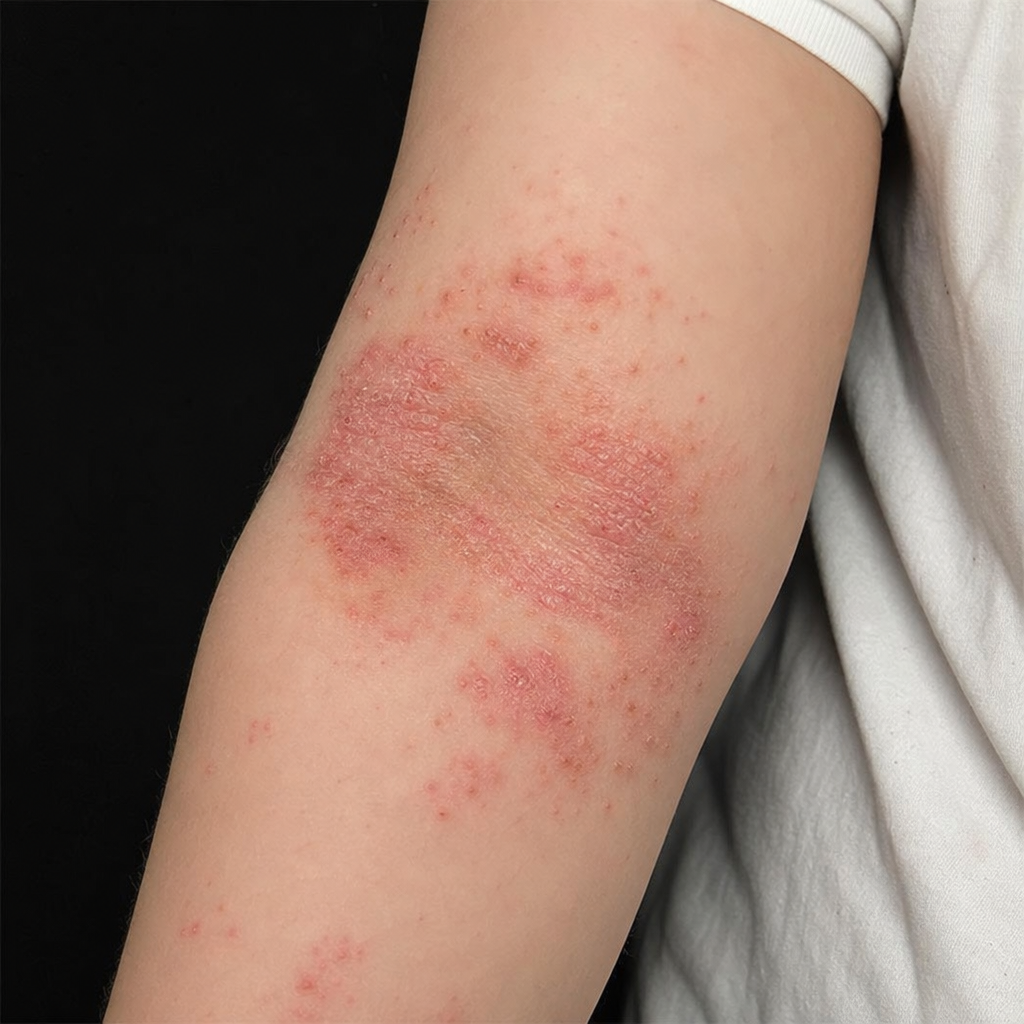
Spongiosis is characteristically seen in which of the following conditions?
What is the characteristic feature of atopic dermatitis?
A patient presents with chronic itchy papulovesicles on the extensor surfaces. Which of the following statements is NOT true regarding this condition?
A 30-year-old man with a large appetite is presented with a situation where all cookies at a meeting contain nuts, which others knew he would avoid due to developing blotchy, erythematous, slightly edematous, pruritic plaques on his skin that form and fade within 2 hours. If the man eats the cookies, which of the following sensitized cells would release a mediator that produces these skin lesions?
'Dennie Morgan' folds are seen in which condition?
What is the diagnostic method for contact dermatitis?
Symptomatic dermographism is commonly seen in which of the following conditions?
Erythroderma is related with all of the following except?
What is the diagnostic method of choice in contact dermatitis?
Which of the following morphologic changes is most consistent with allergic, rather than irritant, contact dermatitis?
Explanation: **Explanation:** **Spongiosis** is the hallmark histological feature of **Eczematous Dermatitis (Eczema)**. It refers to **intercellular edema** within the epidermis. As fluid accumulates between keratinocytes, the desmosomes (intercellular bridges) become stretched and prominent, giving the epidermis a "sponge-like" appearance. In **Acute Eczema**, this process is most intense, often leading to the formation of intraepidermal vesicles. **Analysis of Incorrect Options:** * **Lichen Planus:** Characterized by **interface dermatitis** with a "saw-tooth" appearance of rete ridges, basal cell degeneration (liquefaction necrosis), and Civatte bodies. Spongiosis is typically absent. * **Psoriasis:** Characterized by **Acanthosis** (epidermal thickening), regular elongation of rete ridges, parakeratosis, and Munro’s microabscesses (neutrophils in the stratum corneum). * **Pemphigus:** Characterized by **Acantholysis** (loss of intercellular connections leading to detached, rounded keratinocytes) rather than spongiosis. This results in intraepidermal clefting (e.g., suprabasal in Pemphigus vulgaris). **High-Yield Clinical Pearls for NEET-PG:** * **Stages of Eczema:** Spongiosis is maximal in the **Acute** stage (vesicles/oozing), decreases in the **Subacute** stage, and is minimal to absent in the **Chronic** stage (where Acanthosis and Hyperkeratosis/Lichenification predominate). * **Differential:** While spongiosis is the hallmark of eczema, it can also be seen in Pityriasis Rosea and Miliaria Rubra. * **Key Histology Term:** "Spongiotic Dermatitis" is synonymous with the histological diagnosis of Eczema.
Explanation: **Explanation:** **Pruritus (Option A)** is considered the hallmark and most essential feature of atopic dermatitis (AD). It is often described by the clinical adage: *"The itch that rashes."* According to the **Hanifin and Rajka diagnostic criteria**, pruritus is a mandatory major criterion. Without itching, a diagnosis of atopic dermatitis is highly unlikely. The underlying pathophysiology involves a defective skin barrier (often due to **Filaggrin mutations**) and Th2-mediated inflammation, leading to a vicious "itch-scratch cycle." **Why other options are incorrect:** * **Dennie-Morgan Lines (Option B):** These are infraorbital folds caused by chronic edema. While they are a "minor criterion" and highly suggestive of atopy, they are not present in every patient and are not the defining characteristic. * **Lichenification (Option C):** This refers to thickening of the skin with exaggerated markings due to chronic scratching. While characteristic of the "adult phase" of AD, it is a secondary change and not the primary diagnostic feature. * **Rash (Option D):** While a rash is present, it is non-specific. The morphology and distribution of the rash change with age (e.g., extensor surfaces in infants vs. flexural surfaces in adults), whereas pruritus remains the constant feature across all age groups. **High-Yield Clinical Pearls for NEET-PG:** * **Major Criteria (Hanifin & Rajka):** Pruritus, Typical morphology/distribution, Chronic/relapsing course, and Personal/family history of atopy. * **Filaggrin (FLG) Gene:** Mutation on **Chromosome 1q21** is the most common genetic risk factor. * **Serum Markers:** Elevated **IgE** levels and peripheral blood **eosinophilia** are common. * **Associated signs:** Hertoghe’s sign (thinning of lateral eyebrows), Pityriasis alba, and Keratosis pilaris.
Explanation: ### Explanation The clinical presentation of chronic, itchy papulovesicles on extensor surfaces (elbows, knees, buttocks) is classic for **Dermatitis Herpetiformis (DH)**, a cutaneous manifestation of gluten-sensitive enteropathy (Celiac disease). **1. Why Option D is the Correct Answer (The False Statement):** In Dermatitis Herpetiformis, the characteristic histopathological finding is a **subepidermal split** (not subcorneal). The pathology begins with the formation of microabscesses containing neutrophils and eosinophils at the **tips of dermal papillae**, leading to the separation of the epidermis from the dermis. A subcorneal split is typically seen in conditions like Pemphigus foliaceus or Impetigo. **2. Analysis of Incorrect Options (True Statements):** * **Option A:** DH is strongly associated with gluten sensitivity. Wheat contains gluten, which triggers the immunological response; thus, wheat consumption aggravates the condition. * **Option B:** **Dapsone** is the drug of choice for DH. It provides rapid symptomatic relief (often within 24–48 hours) by inhibiting neutrophil chemotaxis, though it does not treat the underlying enteropathy. * **Option C:** The gold standard for diagnosis is Direct Immunofluorescence (DIF) of perilesional skin, which shows **granular IgA deposits** in the dermal papillae. **Clinical Pearls for NEET-PG:** * **Association:** Almost 90% of DH patients have underlying Celiac disease, though they may be asymptomatic. * **Target Antigen:** The epidermal autoantigen is **Transglutaminase-3 (eTG)**. * **Management:** A lifelong **Gluten-Free Diet (GFD)** is essential to reduce the risk of intestinal lymphoma and eventually decrease the need for Dapsone. * **HLA Association:** Strongly linked with **HLA-DQ2** and **HLA-DQ8**.
Explanation: ### Explanation **Correct Option: B. Mast cell** The clinical presentation describes **Urticaria** (hives). Key diagnostic features include erythematous, edematous, pruritic plaques (wheals) that are transient, typically appearing and resolving within 24 hours (in this case, within 2 hours). Urticaria is a classic example of a **Type I Hypersensitivity reaction** (IgE-mediated). Upon ingestion of an allergen (nuts), IgE antibodies bound to the surface of **sensitized mast cells** cross-link, leading to degranulation. This releases potent inflammatory mediators, primarily **histamine**, which increases vascular permeability and causes vasodilation, resulting in the characteristic dermal edema (wheal) and redness (flare). **Why Incorrect Options are Wrong:** * **A. CD4+ lymphocyte:** These are central to **Type IV (Delayed-type) Hypersensitivity**, such as Allergic Contact Dermatitis. These reactions typically take 48–72 hours to manifest, not 2 hours. * **C. Natural killer cell:** These are part of the innate immune system involved in destroying virally infected or tumor cells; they do not mediate IgE-dependent allergic reactions. * **D. Neutrophil:** While neutrophils may be present in some forms of chronic urticaria or vasculitis, they are not the primary "sensitized" cells responsible for the acute release of mediators in a classic nut allergy. **NEET-PG High-Yield Pearls:** * **Definition of Urticaria:** Transient, itchy, edematous swelling of the dermis that lasts **<24 hours**. If a lesion lasts >24 hours and leaves staining, consider **Urticarial Vasculitis**. * **Dermatographism:** The most common form of physical urticaria, where linear wheals appear after firm stroking of the skin. * **Treatment of Choice:** Second-generation H1 antihistamines (e.g., Cetirizine, Loratadine). * **Angioedema:** Similar mechanism but involves the deeper dermis and subcutaneous tissue; often associated with ACE inhibitors.
Explanation: **Explanation:** **Dennie-Morgan folds** (also known as Dennie-Morgan lines) are infraorbital folds or wrinkles that appear just below the lower eyelid. They are caused by chronic inflammation and edema of the eyelid skin, often exacerbated by repeated rubbing due to pruritus. **1. Why Atopic Dermatitis (AD) is correct:** Dennie-Morgan folds are a classic **minor diagnostic criterion** for Atopic Dermatitis (Hanifin and Rajka criteria). In AD, the skin barrier is defective, leading to chronic inflammation and intense itching. The presence of these folds, along with other stigmata like **Hertoghe’s sign** (thinning of the lateral eyebrows) and **allergic shiners** (infraorbital darkening), strongly suggests an atopic diathesis. **2. Why the other options are incorrect:** * **Dermatitis herpetiformis:** An autoimmune blistering disease associated with Celiac disease. It presents with intensely pruritic vesicles on extensor surfaces, not infraorbital folds. * **Erythema multiforme:** A hypersensitivity reaction (often post-HSV) characterized by "target" or "iris" lesions. * **Measles:** A viral exanthem characterized by **Koplik spots** (buccal mucosa) and a maculopapular rash starting behind the ears. **Clinical Pearls for NEET-PG:** * **Atopic Triad:** Asthma, Allergic Rhinitis, and Atopic Dermatitis. * **Filaggrin Gene Mutation:** The most common genetic defect associated with AD. * **Pityriasis Alba:** Hypopigmented, slightly scaly patches on the face; another minor criterion for AD. * **Hyperlinear palms** and **Ichthyosis vulgaris** are frequently co-associated with Atopic Dermatitis.
Explanation: ### Explanation **Correct Answer: A. Patch Test** **Allergic Contact Dermatitis (ACD)** is a classic example of a **Type IV (Delayed-type) Hypersensitivity reaction**. The diagnostic gold standard is the **Patch Test**. * **Mechanism:** It involves applying suspected allergens (in standardized concentrations) to the patient's back under occlusion for 48 hours. * **Reading:** Results are typically read at **48 hours** (when patches are removed) and again at **72–96 hours** (to identify delayed reactions). A positive result is indicated by erythema, papules, or vesicles at the site of the specific allergen. --- ### Why the other options are incorrect: * **B. Wood’s lamp:** This is a UV light (365 nm) tool used primarily for diagnosing fungal infections (e.g., Tinea capitis - green fluorescence), erythrasma (coral red), and pigmentary disorders like Vitiligo (milky white). * **C. Skin biopsy:** While biopsy can confirm "eczematous" changes (like spongiosis), it cannot differentiate between irritant and allergic contact dermatitis or identify the specific causative allergen. * **D. Darier’s sign:** This refers to the formation of a wheal and flare after stroking a lesion. It is pathognomonic for **Mastocytosis** (Urticaria Pigmentosa). --- ### High-Yield NEET-PG Pearls: * **Standard Series:** The most commonly used series globally is the **European Standard Series**, while in India, the **ISCDR (Indian Standard Series)** is preferred. * **Most common allergen:** Globally, **Nickel** (found in artificial jewelry) is the most common cause of ACD. In India, **Parthenium hysterophorus** (Congress grass) is a frequent cause of airborne contact dermatitis. * **Prick Test vs. Patch Test:** Do not confuse them. The **Skin Prick Test** is used for **Type I Hypersensitivity** (e.g., Asthma, Urticaria, Food allergies).
Explanation: **Explanation:** **Symptomatic dermographism** (also known as "skin writing") is the most common form of physical urticaria. It occurs when mast cells release histamine in response to physical pressure or shearing forces on the skin, resulting in a linear wheal and flare reaction accompanied by itching. 1. **Why Chronic Urticaria is correct:** Symptomatic dermographism is frequently associated with **Chronic Spontaneous Urticaria (CSU)**. In patients with CSU, the mast cells are in a "primed" or hyper-irritable state due to circulating autoantibodies (like anti-FcεRI) or other inflammatory mediators. This lowers the threshold for mast cell degranulation, making the skin highly reactive to minor physical trauma. 2. **Why other options are incorrect:** * **Acute Urticaria:** This is usually a self-limiting reaction to a specific trigger (food, drug, or infection). While dermographism can occur, it is not a hallmark feature as it is in chronic cases. * **Cholinergic Urticaria:** This is triggered by an increase in core body temperature (exercise, hot showers). It presents with characteristic small (1–3 mm) punctate wheals rather than linear dermographic wheals. * **Urticarial Vasculitis:** This is a type III hypersensitivity reaction involving small vessel inflammation. Lesions are painful rather than itchy, last >24 hours, and leave behind post-inflammatory hyperpigmentation—features not seen in dermographism. **High-Yield Clinical Pearls for NEET-PG:** * **Darier’s Sign:** Pathognomonic for **Mastocytosis**. It is a localized form of dermographism where rubbing a macule/papule results in a wheal. * **White Dermographism:** Seen in **Atopic Dermatitis**. Instead of a red wheal, a white line appears due to paradoxical vasoconstriction. * **Diagnosis:** Symptomatic dermographism is confirmed using a **Dermographometer** (applying a specific pressure of 36 g/mm²).
Explanation: **Explanation:** **Erythroderma** (Exfoliative Dermatitis) is a clinical syndrome characterized by universal or near-universal redness (erythema) and scaling involving more than 90% of the body surface area. **Why Lepromatous Leprosy is the correct answer:** Lepromatous leprosy (LL) typically presents with multiple symmetric macules, papules, nodules, or diffuse infiltration of the skin. While it can cause widespread skin involvement, it **does not** manifest as erythroderma. In contrast, the other options are well-documented triggers for exfoliative dermatitis. **Analysis of other options:** * **Psoriasis:** This is the **most common** pre-existing skin disease to progress to erythroderma (Psoriatic Erythroderma), often triggered by the withdrawal of systemic steroids or irritant topical therapy. * **Air-borne Contact Dermatitis (ABCD):** Chronic, severe allergic contact dermatitis (commonly due to *Parthenium*) can generalize and lead to erythroderma, especially in elderly males. * **Sulfonamides:** Drug hypersensitivity reactions are the second most common cause of erythroderma. Sulfonamides, antiepileptics, and allopurinol are frequent culprits. **High-Yield Clinical Pearls for NEET-PG:** * **Causes of Erythroderma (Mnemonic: SCALP):** **S**eborrheic dermatitis, **C**ontact dermatitis, **A**topic dermatitis, **L**ymphoma (Sezary Syndrome), **P**soriasis/Pityriasis Rubra Pilaris. * **Clinical Sign:** "Nose sign" (sparing of the nose and paranasal area) is often seen in erythroderma due to PRP. * **Complications:** High-output cardiac failure, hypothermia, and protein loss (hypoalbuminemia) due to excessive scaling. * **Histopathology:** Often non-specific; multiple biopsies may be required to identify the underlying primary dermatosis.
Explanation: **Explanation:** **Allergic Contact Dermatitis (ACD)** is a classic example of a **Type IV (Delayed-type) Hypersensitivity reaction**. The diagnostic method of choice is the **Patch Test**, as it aims to re-expose the patient’s skin to suspected allergens under controlled conditions to reproduce the inflammatory response. * **Why Patch Test is Correct:** It identifies the specific allergen responsible for the T-cell mediated reaction. Standardized allergens (e.g., Indian Standard Series) are applied to the back using Finn chambers, left for 48 hours, and read at 48 and 72/96 hours. A positive result shows erythema, papules, or vesicles. **Analysis of Incorrect Options:** * **Clinical Examination:** While essential for initial suspicion (noting the morphology and site, like the earlobe for nickel), it cannot definitively identify the specific causative allergen among many possibilities. * **Skin Biopsy:** Histopathology shows spongiosis (intercellular edema), which is characteristic of eczema in general but does not differentiate between types of dermatitis or identify the allergen. * **Tzanck Smear:** This is a rapid bedside test used to identify multinucleated giant cells in **Herpes Simplex or Varicella Zoster** infections, not dermatitis. **High-Yield Clinical Pearls for NEET-PG:** * **Gold Standard:** Patch test is the gold standard for ACD. * **Common Allergens:** **Nickel** (most common worldwide/jewelry), **Potassium Dichromate** (cement/construction workers), **Paraphenylenediamine (PPD)** (hair dye), and **Parthenium** (Airborne Contact Dermatitis). * **Prick Test vs. Patch Test:** Prick tests are for Type I hypersensitivity (e.g., Urticaria, Asthma), whereas Patch tests are for Type IV. * **Reading:** The **International Contact Dermatitis Research Group (ICDRG)** criteria are used to grade patch test reactions.
Explanation: ### Explanation **Correct Option: C. Eosinophilic infiltration** Allergic Contact Dermatitis (ACD) is a **Type IV hypersensitivity reaction** mediated by T-lymphocytes. While both Allergic Contact Dermatitis (ACD) and Irritant Contact Dermatitis (ICD) share many histopathological features of "spongiotic dermatitis," the presence of **eosinophils** within the epidermis and dermis is a hallmark that strongly favors an allergic etiology. In ACD, the immune response involves the recruitment of eosinophils via specific cytokines (like IL-5), whereas ICD is a non-immunologic physical or chemical injury to the skin where eosinophils are typically absent or sparse. **Analysis of Incorrect Options:** * **A. Lymphocytic exocytosis:** This refers to the migration of lymphocytes into the epidermis. While common in ACD, it is a non-specific feature of almost all forms of spongiotic dermatitis, including ICD and nummular eczema. * **B. Papillary dermal edema:** This is a standard feature of acute dermatitis (both allergic and irritant). It represents the vascular response to inflammation but does not differentiate between the two. * **D. Spongiosis:** This is the defining histological feature of "Eczema" (intercellular edema in the epidermis). Both ACD and ICD exhibit spongiosis; therefore, it is not a differentiating factor. **NEET-PG High-Yield Pearls:** 1. **Gold Standard Test:** The **Patch Test** is used to diagnose Allergic Contact Dermatitis (Read at 48 and 72/96 hours). 2. **Most Common Allergen:** Globally, **Nickel** (causing "earring" or "belt-buckle" dermatitis) is the most common. In India, **Parthenium** (Congress grass) is a major cause of airborne contact dermatitis. 3. **ICD vs. ACD:** ICD occurs on the first exposure (no sensitization required) and is limited to the area of contact. ACD requires a prior sensitization phase and can spread beyond the site of contact. 4. **Histology Tip:** If a question mentions "Langerhans cell microvesicles," think ACD. If it mentions "epidermal necrosis/neutrophils," think ICD.
Atopic Dermatitis
Practice Questions
Seborrheic Dermatitis
Practice Questions
Contact Dermatitis: Irritant
Practice Questions
Contact Dermatitis: Allergic
Practice Questions
Nummular Eczema
Practice Questions
Dyshidrotic Eczema
Practice Questions
Stasis Dermatitis
Practice Questions
Asteatotic Eczema
Practice Questions
Lichen Simplex Chronicus
Practice Questions
Autoeczematization (Id Reaction)
Practice Questions
Photosensitive Eczemas
Practice Questions
Treatment Strategies for Eczematous Disorders
Practice Questions
Get full access to all questions, explanations, and performance tracking.
Start For Free