A 5-year-old child presents with intense itching and erythematous papules on the extensor surfaces of the arms and legs. What is the most likely diagnosis?
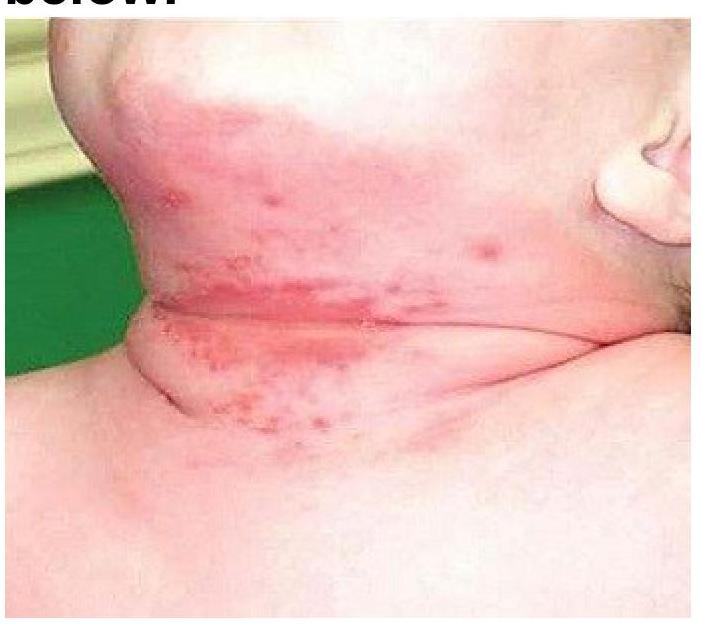
A child presents with a rash in the neck folds as shown in the image. The area appears erythematous with satellite lesions and maceration. What is the most likely diagnosis?
Which of the following organisms has a role to play in Seborrheic dermatitis?
Most common flexural site for atopic dermatitis -
A 25-year-old patient presents with chronic itchy, erythematous skin lesions on the flexural areas that have been recurring since childhood. The patient has a family history of asthma. Which of the following is the most important diagnostic criterion for the most likely diagnosis?
Most common metal in contact allergic dermatitis is?
Characteristic of chronic eczema?
Which of the following is NOT a feature of atopic dermatitis?
A primigravida female presented with erythematous skin changes and lesions consistent with a severe allergic reaction. Which of the following should be the most appropriate treatment?
Most common precipitant of contact dermatitis is?
Explanation: ***Atopic dermatitis*** - **Atopic dermatitis** (eczema) is the most likely diagnosis given the **intense itching** (pruritus is the hallmark feature) and **erythematous papules**. - In children aged **2-5 years**, atopic dermatitis commonly affects **extensor surfaces** of the arms and legs, representing the transition from infantile to childhood patterns. - While flexural involvement becomes more typical in older children (>5 years), extensor distribution at age 5 is still very common and characteristic. - The intense pruritus described is pathognomonic for atopic dermatitis. *Psoriasis* - **Psoriasis** does present on extensor surfaces with well-demarcated **erythematous plaques with silvery scales**, particularly on elbows and knees. - However, **intense itching is NOT a primary feature** of psoriasis; it is typically mildly pruritic or non-pruritic. - The prominent pruritus in this case makes psoriasis unlikely. *Contact dermatitis* - **Contact dermatitis** results from exposure to an **allergen or irritant**, causing a localized rash. - The distribution typically conforms to the contact area and would be less likely to present symmetrically on multiple extensor surfaces without a clear exposure history. - The pattern described is more consistent with an endogenous dermatitis. *Scabies* - **Scabies** causes intense itching (worse at night) with characteristic **burrows, papules, and excoriations**. - Typical sites include **interdigital spaces, wrists, axillae, waistline, and genitalia**, not primarily extensor surfaces of arms and legs. - The distribution pattern does not fit scabies.
Explanation: ***Intertrigo*** - The image shows a reddened, inflamed rash in skin folds (neck creases), which is characteristic of **intertrigo**. This condition results from skin-on-skin friction, moisture, and warmth. - The rash appears to have satellite lesions and a somewhat macerated appearance, which would be consistent with secondary fungal (e.g., Candida) or bacterial infection, common complications of intertrigo. *Heat rash* - **Heat rash (miliaria)** typically presents as small, itchy red bumps or clear blisters, often found in areas prone to sweating. - While it can occur in skin folds, the diffuse, raw-looking erythema and presence of potential satellite lesions shown in the image are less typical for simple heat rash. *Eczema* - **Eczema (atopic dermatitis)** is characterized by dry, itchy, inflamed skin, often with scaling, crusting, or lichenification during chronic stages. - While eczema can affect skin folds, the appearance in the image (intense redness, maceration, potential satellite lesions) is more suggestive of an irritant or infectious process like intertrigo rather than typical eczema. *Impetigo* - **Impetigo** is a bacterial skin infection characterized by honey-colored crusts, vesicles, or bullae, typically appearing anywhere on the body, especially around the nose and mouth. - The rash in the image lacks the characteristic honey-colored crusts or vesiculobullous lesions associated with impetigo.
Explanation: ***Pityrosporum ovale*** - **Pityrosporum ovale**, now known as **Malassezia furfur**, is a lipophilic yeast that colonizes the skin and plays a significant role in the pathogenesis of **seborrheic dermatitis**. - Its presence is commonly associated with the inflammatory response seen in seborrheic dermatitis, though the exact mechanism is not fully understood. *Candida albicans* - **Candida albicans** is a common cause of **mucocutaneous candidiasis** and **intertrigo**, but it is not directly implicated in the etiology of seborrheic dermatitis. - While it can cause skin infections, its typical presentation involves erythematous, macerated rashes with satellite lesions in skin folds. *Propionibacterium* - **Propionibacterium acnes**, now known as **Cutibacterium acnes**, is primarily associated with the pathogenesis of **acne vulgaris**. - It plays a role in the inflammation and comedone formation characteristic of acne, not the scaling and erythema of seborrheic dermatitis. *None of the above* - This option is incorrect because **Pityrosporum ovale (Malassezia furfur)** is a well-recognized organism involved in seborrheic dermatitis. - The other organisms listed are associated with different dermatological conditions.
Explanation: ***Elbow crease*** - The **antecubital fossa** (elbow crease) and **popliteal fossa** (knee crease) are the **two most characteristic flexural sites** for atopic dermatitis in children and adults. - Both sites are **equally common** and represent classic presentations of flexural eczema. - The constant rubbing, friction, and moisture retention in these areas contribute to skin irritation and the characteristic **lichenification** seen in atopic dermatitis. - In the context of this question asking for "most common," both antecubital and popliteal fossae are considered the primary flexural sites. *Popliteal fossa* - The **popliteal fossa** (behind the knee) is equally as common as the antecubital fossa and is a classic flexural site for atopic dermatitis. - It shares the same pathophysiological mechanisms and clinical presentation as the elbow crease. - Both antecubital and popliteal fossae are mentioned together in standard dermatology texts as the hallmark flexural sites. *Scalp* - While the scalp can be affected by atopic dermatitis, especially in **infants** (as **seborrheic dermatitis** or cradle cap), it is **not a flexural site**. - Scalp involvement typically presents as scaling and erythema, rather than the lichenified plaques characteristic of flexural eczema. *Trunk* - The trunk can be affected by atopic dermatitis with diffuse patches or widespread xerosis, but it is **not a flexural site**. - Flexural areas (skin folds) are the characteristic locations for atopic dermatitis in the flexural pattern.
Explanation: ***Chronic pruritic eczema with typical morphology and distribution*** - The patient presents with **chronic**, **itchy**, **erythematous lesions** on the **flexural areas** (e.g., antecubital and popliteal fossae), characteristic of **atopic dermatitis** (eczema). - The **recurrence since childhood** and the typical distribution represent the **major diagnostic criteria** based on clinical morphology and distribution. - **Clinical presentation with typical morphology** is the **primary diagnostic criterion** according to Hanifin and Rajka criteria. *Elevated serum IgE levels* - While **elevated serum IgE** is often associated with atopic dermatitis, it is a **minor criterion** and a **laboratory finding**, not a primary diagnostic feature. - It reflects an **atopic predisposition**, but **clinical morphology and distribution** remain the most important diagnostic factors. *Personal or family history of atopy* - A **family history of asthma** (an atopic condition) is a **minor criterion** that supports the diagnosis of atopic dermatitis. - However, this is a **predisposing/supporting factor**, not as important as the characteristic clinical morphology and distribution. *Early age of onset (before 2 years)* - While atopic dermatitis often begins in **infancy or early childhood**, this is a **minor criterion** in the diagnostic framework. - The question states symptoms **recurring since childhood** but onset timing is less diagnostically important than the characteristic **clinical presentation** with typical morphology and distribution.
Explanation: ***Nickel*** - **Nickel** is the most frequent cause of **metal-induced contact allergic dermatitis**, affecting a significant portion of the population. - It is commonly found in jewelry, belt buckles, buttons, and other everyday metallic objects. *Gold* - **Gold allergy** can occur but is much less common than nickel allergy. - Reactions typically arise from jewelry and may involve **allergic contact dermatitis**. *Silver* - **Silver allergy** is quite rare and often due to impurities or alloys rather than pure silver itself. - Pure silver is generally considered **hypoallergenic**. *Aluminum* - **Aluminum** is generally not a common cause of **allergic contact dermatitis**. - While it can be an irritant in some products (e.g., antiperspirants), true allergic reactions are infrequent.
Explanation: ***Lichenification*** - **Lichenification** is a hallmark of chronic eczema, characterized by thickening of the epidermis with exaggerated skin markings due to persistent rubbing or scratching. - This response reflects the long-term inflammatory and reparative processes in chronically affected skin. *Erythema* - **Erythema**, or redness, is a common finding in both acute and chronic inflammatory skin conditions, including acute eczema, but is not specifically characteristic of chronicity. - While present, it does not distinguish chronic from acute phases as definitively as other features. *Induration* - **Induration** refers to hardening or firmness of the skin, often due to inflammation or infection, and while it can be present in chronic eczema, it's a more general sign and not as specific as lichenification. - It might also suggest other conditions like cellulitis or deep tissue involvement. *Edema* - **Edema**, or swelling, is more prominent in the acute phase of eczema due to vasodilation and increased vascular permeability leading to fluid extravasation. - While some edema can persist, it's a less defining feature of chronic eczema compared to the epidermal changes observed in lichenification.
Explanation: ***Darier's Sign*** - **Darier's sign** is characteristic of **urticaria pigmentosa** (cutaneous mastocytosis), where rubbing a skin lesion causes the formation of an urticarial wheal due to mast cell degranulation - It is **not associated** with the pathogenesis or clinical presentation of **atopic dermatitis** *Dennie-Morgan fold* - **Dennie-Morgan folds** are extra folds or lines in the skin just below the lower eyelids - They are a common clinical sign observed in patients with **atopic dermatitis**, often linked to chronic inflammation and allergic reactions affecting the skin around the eyes *Hertoghe's sign* - **Hertoghe's sign** refers to the thinning or absence of the lateral third of the eyebrows - This sign is often seen in individuals with **atopic dermatitis**, as well as in other conditions like hypothyroidism *Hyperlinearity of palms* - **Hyperlinearity of palms** refers to the exaggerated creases and lines on the palms of the hands - This is a common **stigmata of atopy** and is frequently observed in patients with **atopic dermatitis**, reflecting the underlying predisposition to skin dryness and altered epidermal barrier function
Explanation: ***Corticosteroids*** - **Corticosteroids** are the **first-line therapy** for severe allergic reactions due to their potent **anti-inflammatory** and **immunosuppressive** effects. - They help to stabilize mast cell membranes, reducing the release of inflammatory mediators and suppressing the allergic response. *Acitretin* - **Acitretin** is a **retinoid** primarily used for severe **psoriasis** and is **teratogenic**, making it unsuitable for a primigravida and a severe allergic reaction. - Its mechanism of action involves regulating cell proliferation and differentiation, which is not appropriate for acute allergy management. *Psoralen + PUVA* - **Psoralen** combined with **UVA light (PUVA)** is a **phototherapy** treatment used for severe **psoriasis**, **vitiligo**, and **cutaneous T-cell lymphoma**. - It has a slow onset of action and involves photosensitizers, making it inappropriate for the urgent treatment of a severe allergic reaction. *PUVA* - **PUVA** (Psoralen plus UVA light) is a form of **phototherapy** used for chronic skin conditions, not acute allergic reactions. - The mechanism involves psoralen making the skin more sensitive to UVA light, which then inhibits excessive cell growth and immune activity over time.
Explanation: ***Nickel*** - **Nickel** is the most frequent cause of **allergic contact dermatitis**, commonly found in jewelry, belt buckles, and zippers. - Exposure leads to a **Type IV hypersensitivity reaction**, characterized by erythema, itching, and vesiculation. *Gold* - While gold can cause contact dermatitis, it is **far less common** than nickel allergy. - Reactions to gold are often seen with prolonged skin contact, such as with jewelry. *Silver* - **Silver** is a **rare cause** of allergic contact dermatitis. - Allergic reactions to silver are typically observed in individuals with extensive exposure, such as jewelers. *Iron* - **Iron** is **not a common precipitant** of contact dermatitis. - Allergic reactions to iron are exceedingly rare, as iron is an essential element found naturally in the body.
Atopic Dermatitis
Practice Questions
Seborrheic Dermatitis
Practice Questions
Contact Dermatitis: Irritant
Practice Questions
Contact Dermatitis: Allergic
Practice Questions
Nummular Eczema
Practice Questions
Dyshidrotic Eczema
Practice Questions
Stasis Dermatitis
Practice Questions
Asteatotic Eczema
Practice Questions
Lichen Simplex Chronicus
Practice Questions
Autoeczematization (Id Reaction)
Practice Questions
Photosensitive Eczemas
Practice Questions
Treatment Strategies for Eczematous Disorders
Practice Questions
Get full access to all questions, explanations, and performance tracking.
Start For Free