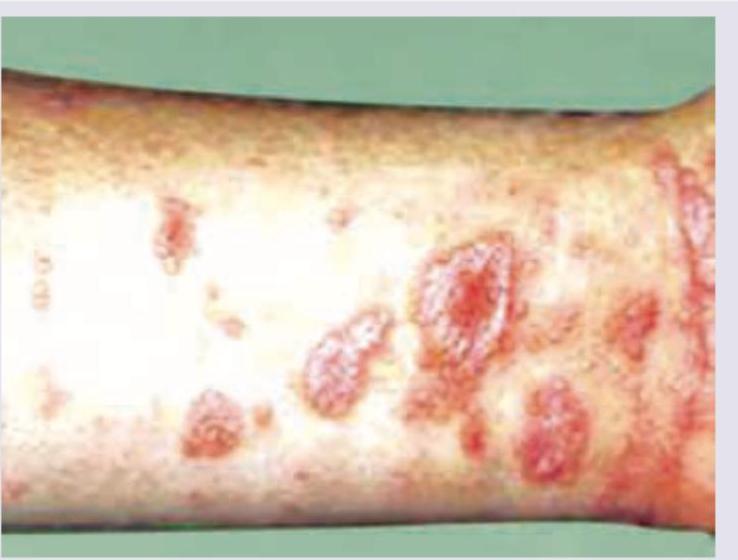
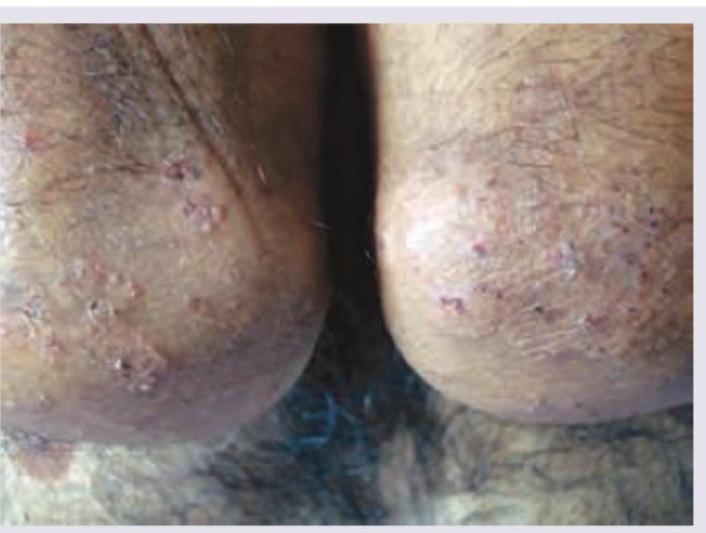
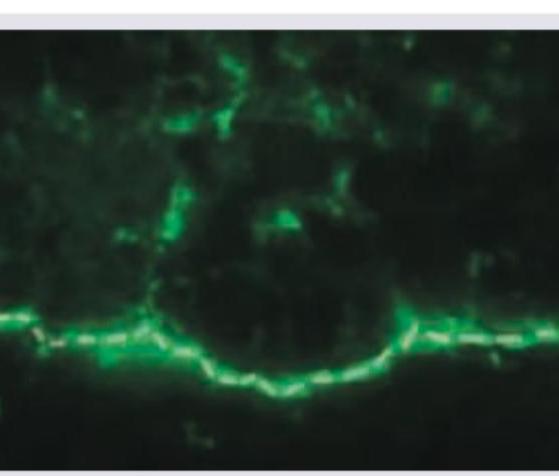
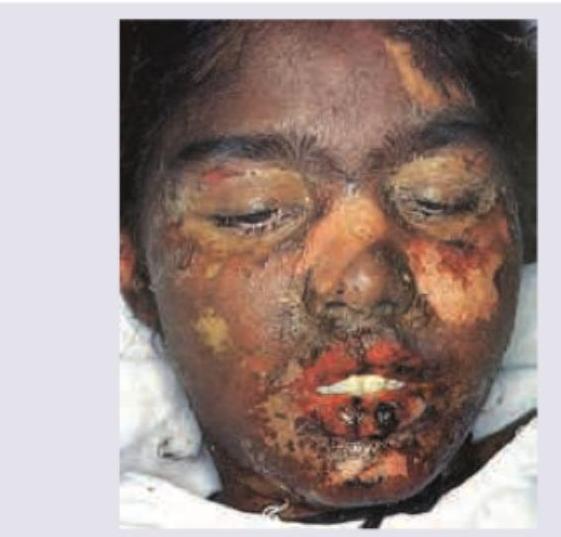
Which of the following is a subepidermal vesiculobuilous disorder?
All of the following are true about dermatitis herpetiformis except:
A 30-year-old male presents with flaccid bullae on an erythematous base and erosions over the oral mucous membrane. The blisters develop painful erosions and rupture. What is the most likely finding on immunofluorescent examination of a skin biopsy from this patient?
A 60-year-old female presents with tense bullae on her lower extremities and subepidermal bullous lesions on microscopy. What is the most likely diagnosis?
Herpes gestationis is:
Nikolsky's sign is positive in each of the following conditions, EXCEPT:
A person presents with hemorrhagic fluid in tense blisters at the dermoepidermal junction. What is the most probable diagnosis?
Which of the following is the histological feature of pemphigus?
Pemphigus is characterized by which of the following histological findings?
A 50-year-old male with a known history of myasthenia gravis presents with erythematous, shallow erosions with a few blisters and scales. The oral mucosa is not involved. Immunopathology demonstrates IgG deposition on keratinocytes and autoantibodies against Dsg-1. What is the most likely diagnosis?
Explanation: **Explanation:** The classification of vesiculobullous disorders is primarily based on the **level of cleavage** within the skin. **1. Why Bullous Pemphigoid is Correct:** Bullous pemphigoid is a classic **subepidermal** blistering disease. It is an autoimmune condition where IgG antibodies target **BP180 (Type XVII collagen)** and **BP230** within the hemidesmosomes. Because the split occurs at the dermo-epidermal junction (below the epidermis), the resulting blisters have a thick roof, making them **tense**, firm, and less likely to rupture easily compared to intraepidermal blisters. **2. Why the Other Options are Incorrect:** * **Pemphigus Vulgaris (A):** This is an **intraepidermal** disorder. Antibodies target Desmoglein 3 (and 1), leading to acantholysis (loss of cell-to-cell adhesion) just above the basal layer (suprabasal split). * **Pemphigus Vegetans (C):** A rare variant of Pemphigus vulgaris characterized by vegetating plaques in intertriginous areas; it is also **intraepidermal**. * **Pemphigus Erythematosus (D):** Also known as Senear-Usher syndrome, this is a localized form of Pemphigus foliaceus. The split is **intraepidermal** (specifically subcorneal, in the granular layer). **Clinical Pearls for NEET-PG:** * **Nikolsky Sign:** Positive in Pemphigus (intraepidermal) and Negative in Bullous Pemphigoid (subepidermal). * **Immunofluorescence (DIF):** Bullous pemphigoid shows **linear** IgG and C3 deposits along the basement membrane zone. Pemphigus shows a **"fish-net"** or reticular pattern. * **Other Subepidermal Blisters:** Dermatitis Herpetiformis, Epidermolysis Bullosa Acquisita, and Cicatricial Pemphigoid.
Explanation: **Explanation:** Dermatitis Herpetiformis (DH) is a chronic, autoimmune blistering disease characterized by intensely pruritic, grouped vesicles (herpetiform) typically located on extensor surfaces. **Why Option C is the correct answer (The Exception):** While DH is indeed an IgA-mediated disease, the deposition does not occur linearly along the dermoepidermal junction. Instead, the hallmark diagnostic feature is the **granular deposition of IgA** specifically at the **tips of the dermal papillae**. Linear IgA deposition is characteristic of Linear IgA Bullous Dermatosis, not DH. **Analysis of Incorrect Options:** * **Option A:** DH typically manifests in **young adults** (20–40 years), though it can occur at any age. It shows a slight male preponderance. * **Option B:** **Intense pruritus** and a burning sensation are the clinical hallmarks. Because the itching is so severe, patients often present with erosions and crusts rather than intact vesicles (due to scratching). * **Option D:** DH is considered the cutaneous manifestation of **Celiac Disease** (Gluten-sensitive enteropathy). Nearly all patients have underlying gluten sensitivity, though many are asymptomatic. **High-Yield Clinical Pearls for NEET-PG:** * **Target Antigen:** Epidermal transglutaminase (eTG/TG3). * **Histopathology:** Neutrophilic microabscesses at the dermal papillary tips. * **HLA Association:** Strongly associated with **HLA-DQ2** and **HLA-DQ8**. * **Treatment of Choice:** **Dapsone** (provides rapid symptomatic relief within 24–48 hours) along with a strict **Gluten-Free Diet** (essential for long-term remission and reducing lymphoma risk).
Explanation: ### Explanation The clinical presentation of **flaccid bullae** and **oral mucosal erosions** in a young adult is characteristic of **Pemphigus Vulgaris (PV)**. In PV, autoantibodies (IgG) target **Desmoglein 3** (and sometimes Desmoglein 1), which are proteins responsible for cell-to-cell adhesion in the epidermis. **1. Why Option C is Correct:** The loss of adhesion (acantholysis) occurs between keratinocytes throughout the epidermis. On Direct Immunofluorescence (DIF), IgG and C3 deposits are found on the surface of these keratinocytes. This creates a characteristic **"fish-net"** or **"chicken-wire"** appearance. Because PV involves the mucous membranes and the epidermis, this pattern is the gold-standard diagnostic finding. **2. Why Other Options are Incorrect:** * **Option A (Linear IgA):** Seen in **Linear IgA Bullous Dermatosis**. It typically presents with "string of beads" vesicles, not flaccid bullae. * **Option B (Linear IgG):** Characteristic of **Bullous Pemphigoid**. These patients present with *tense* bullae (subepidermal) rather than flaccid ones, and mucosal involvement is rare. * **Option D (Granular IgA):** Diagnostic for **Dermatitis Herpetiformis**, which is associated with Celiac disease and presents as extremely itchy, grouped vesicles on extensor surfaces. **3. High-Yield Clinical Pearls for NEET-PG:** * **Nikolsky Sign:** Positive in Pemphigus Vulgaris (extension of a blister or denudation of skin upon lateral pressure). * **Tzanck Smear:** Shows **Acantholytic cells** (Tzanck cells)—large, round keratinocytes with hyperchromatic nuclei. * **Histopathology:** Shows a **"Row of Tombstones"** appearance (basal layer remains attached to the basement membrane while the layers above detach). * **Target Antigens:** PV (Desmoglein 3 > 1); Pemphigus Foliaceus (Desmoglein 1 only; no oral lesions).
Explanation: **Explanation:** The clinical presentation of **tense bullae** in an elderly patient, combined with **subepidermal** cleavage on microscopy, is the classic hallmark of **Bullous Pemphigoid (BP)**. **1. Why Bullous Pemphigoid is correct:** BP is an autoimmune blistering disease caused by IgG autoantibodies against **BP180 (Type XVII collagen)** and **BP230** in the hemidesmosomes. Because the split occurs at the dermo-epidermal junction (below the epidermis), the roof of the blister is thick, resulting in "tense" bullae that do not rupture easily. It typically affects the elderly and involves the limbs and trunk. **2. Why other options are incorrect:** * **Pemphigus Vulgaris:** Characterized by **flaccid** bullae (due to intraepidermal split/acantholysis) and a positive Nikolsky sign. It involves the oral mucosa early and shows "row of tombstones" on histology. * **Erythema Multiforme:** Presents with characteristic **target (iris) lesions**. While it can blister, the clinical morphology and demographic differ from the classic presentation of BP. * **Dermatitis Herpetiformis:** Presents as intensely pruritic, grouped vesicles (herpetiform) on extensor surfaces, associated with Celiac disease. Histology shows **neutrophilic microabscesses** at dermal papillary tips. **High-Yield Clinical Pearls for NEET-PG:** * **Direct Immunofluorescence (DIF):** Shows **linear** IgG and C3 deposits along the basement membrane zone (BMZ). * **Salt-split skin study:** Fluorescence is seen on the **roof** (epidermal side) of the split. * **Nikolsky Sign:** Negative in BP (Positive in Pemphigus). * **Treatment:** Potent topical corticosteroids (e.g., Clobetasol) or systemic steroids.
Explanation: **Explanation:** **Herpes Gestationis** (also known as **Pemphigoid Gestationis**) is a rare, pregnancy-associated autoimmune bullous disease. Despite its name, it has no relation to the herpes virus. 1. **Why Option B is Correct:** The pathogenesis involves the development of IgG antibodies (specifically IgG1) against **BP180 (Bullous Pemphigoid Antigen 2)**, which is **Collagen XVII**. This protein is a transmembrane component of the hemidesmosome in the basement membrane zone (BMZ). The binding of these antibodies triggers a complement-mediated inflammatory response, leading to subepidermal blister formation. 2. **Why other options are incorrect:** * **Option A:** It is an autoimmune disorder, not a viral infection. The name "herpes" refers only to the "creeping" or grouped appearance of the vesicles. * **Option C:** The characteristic histological finding is **eosinophilic** infiltration and degranulation at the dermal-epidermal junction (forming "eosinophilic spongiosis"), not neutrophilic. * **Option D:** The condition typically becomes **more severe** and has an earlier onset in subsequent pregnancies (the "prophit" phenomenon). **High-Yield Clinical Pearls for NEET-PG:** * **Timing:** Usually presents in the 2nd or 3rd trimester; often flares immediately postpartum. * **Presentation:** Intensely pruritic urticarial plaques and vesicles, characteristically **starting in the periumbilical area** (unlike PUPPP, which spares the umbilicus). * **Diagnosis:** Direct Immunofluorescence (DIF) shows **linear C3 deposition** along the basement membrane zone (the "gold standard"). * **Fetal Risk:** Associated with premature delivery and small-for-gestational-age infants. Transient neonatal rashes may occur in 10% of cases due to passive transfer of antibodies.
Explanation: **Explanation:** **Nikolsky’s Sign** is a clinical dermatological sign where slight lateral pressure applied to the skin results in the separation of the superficial layer (epidermis) from the deeper layer, leading to an erosion. It indicates a loss of intercellular cohesion (**acantholysis**) or widespread epidermal necrosis. **Why Psoriasis is the Correct Answer:** Psoriasis is a chronic inflammatory condition characterized by epidermal hyperplasia (acanthosis) and hyperkeratosis, rather than the loss of cell-to-cell adhesion. The skin layers are tightly bound; therefore, Nikolsky’s sign is **negative**. In Psoriasis, the characteristic clinical sign is **Auspitz sign** (pinpoint bleeding upon removal of scales). **Analysis of Other Options:** * **Pemphigus:** This is the classic condition for a positive Nikolsky sign. Autoantibodies against desmogleins cause acantholysis within the epidermis. * **Toxic Epidermal Necrolysis (TEN):** A severe drug reaction causing extensive keratinocyte death and full-thickness epidermal necrosis, leading to a positive Nikolsky sign. * **Staphylococcal Scalded Skin Syndrome (SSSS):** Caused by exfoliative toxins from *S. aureus* that cleavage desmoglein-1 in the upper epidermis (stratum granulosum), resulting in a positive sign. **Clinical Pearls for NEET-PG:** * **Direct Nikolsky:** Elicited on involved/perilesional skin. * **Indirect/Marginal Nikolsky:** Extension of an existing blister by applying pressure to the roof. * **False Nikolsky (Shevelly Sign):** Seen in subepidermal blisters like Bullous Pemphigoid (where the sign is typically negative, but the blister can be moved laterally). * **Key Differentiator:** Nikolsky sign is **Positive** in Pemphigus Vulgaris (Intraepidermal) but **Negative** in Bullous Pemphigoid (Subepidermal).
Explanation: ### Explanation **Correct Option: A. Pemphigoid (Bullous Pemphigoid)** The diagnosis is **Bullous Pemphigoid (BP)** based on two pathognomonic clinical and histological features mentioned in the question: 1. **Tense Blisters:** In BP, the split occurs at the **dermoepidermal junction (subepidermal)**. Because the entire thickness of the epidermis forms the roof of the blister, it is structurally strong and "tense," unlike the flaccid blisters seen in intraepidermal diseases. 2. **Hemorrhagic Fluid:** Subepidermal blisters often involve damage to the papillary dermal vessels, leading to the presence of blood (hemorrhagic fluid) within the bullae. **Why the other options are incorrect:** * **B, C, and D (Pemphigus Group):** All forms of Pemphigus (Vulgaris, Vegetans, and Drug-induced) are **intraepidermal** blistering diseases caused by acantholysis (loss of keratinocyte adhesion). Because the roof of these blisters is very thin (only a portion of the epidermis), they are characteristically **flaccid**, rupture easily, and are rarely hemorrhagic. --- ### NEET-PG High-Yield Pearls * **Target Antigen:** In Bullous Pemphigoid, antibodies (IgG) are directed against **BP180 (BPAG2)** and **BP230 (BPAG1)** in the hemidesmosomes. * **Direct Immunofluorescence (DIF):** Shows **linear** deposition of IgG and C3 along the basement membrane zone (BMZ). * **Nikolsky Sign:** Characteristically **negative** in Pemphigoid (positive in Pemphigus). * **Clinical Clue:** BP often starts with a non-specific "urticarial" or itchy prodromal phase, especially in elderly patients. * **Histology:** Look for a **subepidermal cleft** with an inflammatory infiltrate rich in **eosinophils**.
Explanation: **Explanation:** **Acantholysis** is the hallmark histological feature of the Pemphigus group of diseases. It refers to the loss of intercellular connections (desmosomes) between keratinocytes, leading to the formation of intraepidermal clefts and blisters. In Pemphigus Vulgaris, this occurs due to IgG antibodies against **Desmoglein 3** (and 1), resulting in "row of tombstone" appearance of the basal layer. **Analysis of Incorrect Options:** * **Acanthosis:** Refers to the thickening of the stratum spinosum. It is a characteristic feature of **Psoriasis** and chronic dermatitis, not primary blistering diseases. * **Colloid bodies (Civatte bodies):** These are apoptotic keratinocytes found in the dermo-epidermal junction. They are classically seen in **Lichen Planus** and Lupus Erythematosus. * **Basal cell degeneration:** Also known as vacuolar or liquefactive degeneration, this is the primary pathology in **Lichen Planus** and Erythema Multiforme, where the basal layer is damaged. **High-Yield Clinical Pearls for NEET-PG:** * **Tzanck Smear:** Shows "Acantholytic cells" or **Tzanck cells** (large, round keratinocytes with hyperchromatic nuclei). * **Immunofluorescence:** Direct Immunofluorescence (DIF) shows a characteristic **"Fish-net"** or reticular pattern of IgG/C3 deposits. * **Nikolsky Sign:** Positive in Pemphigus (due to acantholysis) but negative in Bullous Pemphigoid (which is subepidermal). * **Pemphigus Foliaceus:** Acantholysis occurs superficially in the subcorneal layer (Desmoglein 1).
Explanation: **Explanation:** **Pemphigus** is a group of autoimmune blistering diseases characterized by the loss of intercellular adhesion between keratinocytes. **Why Acantholysis is correct:** The hallmark histological feature of Pemphigus is **Acantholysis**. This occurs due to IgG autoantibodies (Type II Hypersensitivity) directed against **Desmogleins** (Dsg1 and Dsg3), which are components of desmosomes. The destruction of these "cellular glues" leads to the separation of keratinocytes, resulting in the formation of intraepidermal blisters. On histology, this appears as rounded, detached keratinocytes (Tzanck cells) floating within the blister fluid. **Why other options are incorrect:** * **Acanthosis:** Refers to the thickening of the stratum spinosum (e.g., seen in Psoriasis or Acanthosis Nigricans), not the separation of cells. * **Hyperorthokeratosis:** Refers to an increased thickness of the stratum corneum without retained nuclei (e.g., seen in Lichen Planus). * **Hyperparakeratosis:** Refers to the thickening of the stratum corneum with retained nuclei, indicating rapid cell turnover (e.g., seen in Psoriasis). **High-Yield Clinical Pearls for NEET-PG:** * **Pemphigus Vulgaris (PV):** Most common type; involves Dsg3 > Dsg1; characterized by **suprabasal** splitting and a **"row of tombstones"** appearance on the basal layer. * **Pemphigus Foliaceus (PF):** Involves Dsg1 only; characterized by **subcorneal** splitting. * **Clinical Signs:** Positive **Nikolsky sign** and **Asboe-Hansen sign** (bulla spread sign). * **Immunofluorescence:** Direct Immunofluorescence (DIF) shows a characteristic **"fishnet"** or "lace-like" pattern of IgG/C3 deposits.
Explanation: ### Explanation **Pemphigus foliaceus (PF)** is the correct diagnosis based on the clinical and immunopathological findings. **1. Why Pemphigus foliaceus is correct:** * **Target Antigen:** The presence of autoantibodies against **Desmoglein-1 (Dsg-1)** is the hallmark of PF. Dsg-1 is primarily expressed in the upper layers of the epidermis (subcorneal). * **Clinical Presentation:** Because Dsg-1 is absent in the oral mucosa (where Dsg-3 compensates), **mucosal involvement is characteristically absent** in PF. The blisters are very superficial and fragile, often presenting as shallow erosions, crusting, and scales rather than intact bullae. * **Association:** There is a known clinical association between Pemphigus and other autoimmune diseases like **Myasthenia Gravis** and Thymoma. **2. Why other options are incorrect:** * **Pemphigus vulgaris (PV):** Involves antibodies against **Dsg-3** (± Dsg-1). It characteristically presents with **painful oral ulcers** and deeper, flaccid blisters. * **Bullous pemphigoid:** This is a subepidermal blistering disease. Immunopathology would show linear IgG/C3 at the **basement membrane zone**, not on keratinocytes. Blisters are typically tense. * **Dermatitis herpetiformis:** Associated with Celiac disease. Immunopathology shows **granular IgA deposits** in the dermal papillae, and it presents as intensely pruritic vesicles on extensor surfaces. **3. High-Yield Clinical Pearls for NEET-PG:** * **Nikolsky Sign:** Positive in all forms of Pemphigus (intraepidermal) but negative in Bullous Pemphigoid (subepidermal). * **Row of Tombstones:** Histopathological appearance of the basal layer in Pemphigus *vulgaris*. * **Senear-Usher Syndrome:** Another name for Pemphigus Erythematosus (a localized variant of PF). * **Key Distinction:** * Dsg-1 only = Pemphigus Foliaceus (Skin only). * Dsg-3 only = Pemphigus Vulgaris (Mucosa only). * Dsg-1 + Dsg-3 = Pemphigus Vulgaris (Skin + Mucosa).
Pemphigus Vulgaris
Practice Questions
Pemphigus Foliaceus
Practice Questions
Bullous Pemphigoid
Practice Questions
Cicatricial Pemphigoid
Practice Questions
Dermatitis Herpetiformis
Practice Questions
Epidermolysis Bullosa
Practice Questions
Linear IgA Bullous Dermatosis
Practice Questions
Pemphigoid Gestationis
Practice Questions
Drug-Induced Bullous Disorders
Practice Questions
Immunofluorescence in Bullous Diseases
Practice Questions
Management of Autoimmune Bullous Diseases
Practice Questions
Genetic Counseling in Inherited Blistering Diseases
Practice Questions
Get full access to all questions, explanations, and performance tracking.
Start For Free