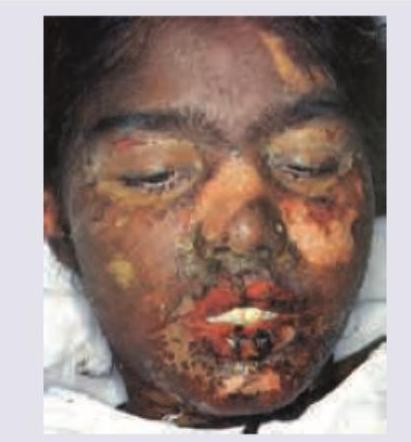
The fishnet pattern is seen in which of the following conditions?
Bullae of bullous pemphigoid are:
A biopsy of affected skin in Pemphigus vulgaris would show which of the following?
Nikolsky's sign is positive in which of the following conditions?
In cicatricial pemphigoid, which antigen is bound by IgG on the epidermal side when using the salt split skin technique?
What is the target antigen in the dermolytic variant of epidermolysis bullosa?
Dermatitis herpetiformis is associated with:
Which of the following statements is FALSE regarding mucous membrane pemphigoid?
A 45-year-old female presents with a history of blisters on her body, which subsequently rupture, leading to severe skin pain. The condition begins in the mouth and involves peeling of the skin upon applying pressure. The dermatologist identified a loss of cellular cohesion, specifically involving desmosomes 3 and 1. What is the most likely diagnosis?
What is the etiology of Epidermolysis bullosa?
Explanation: In **Pemphigus Vulgaris (PV)**, the "fishnet" or "chicken-wire" pattern is a classic finding on **Direct Immunofluorescence (DIF)**. This occurs because IgG antibodies (and sometimes C3) are deposited against **Desmoglein 3** (and 1), which are components of desmosomes. Since desmosomes connect keratinocytes throughout the epidermis, the antibodies outline the entire cell surface, creating a characteristic reticular or lace-like appearance. ### Explanation of Options: * **Pemphigus Vulgaris (Correct):** Characterized by intraepidermal acantholysis. The DIF shows intercellular IgG/C3 deposition in a **fishnet pattern**. * **Bullous Pemphigoid:** This is a subepidermal blistering disease where antibodies target BP180/BP230 at the dermo-epidermal junction. DIF shows a **linear band** of IgG and C3 along the basement membrane zone (BMZ). * **Dermatitis Herpetiformis:** Associated with Celiac disease, DIF reveals **granular IgA deposits** specifically at the tips of the dermal papillae. * **Darier’s Disease:** This is an autosomal dominant genodermatosis caused by a mutation in the ATP2A2 gene. While it involves acantholysis, it is not antibody-mediated; therefore, DIF is typically negative. ### High-Yield Clinical Pearls for NEET-PG: * **Tzanck Smear in PV:** Shows "Tzanck cells" (rounded, acantholytic keratinocytes with hyperchromatic nuclei). * **Histopathology of PV:** "Row of tombstones" appearance (basal layer remains attached to the BMZ). * **Nikolsky Sign:** Positive in Pemphigus Vulgaris; Negative in Bullous Pemphigoid. * **Indirect Immunofluorescence (IIF):** In PV, IIF uses monkey esophagus as a substrate to detect circulating antibodies.
Explanation: **Explanation:** **Bullous Pemphigoid (BP)** is an autoimmune blistering disease characterized by the formation of **subepidermal bullae**. The underlying pathophysiology involves the production of IgG autoantibodies against hemidesmosomal proteins, specifically **BP180 (BPAG2)** and **BP230 (BPAG1)**. These proteins are responsible for anchoring the basal layer of the epidermis to the basement membrane. When these proteins are targeted, the entire epidermis detaches from the dermis, creating a deep-seated, tense blister. **Analysis of Options:** * **Subepidermal (Correct):** Because the split occurs at the level of the basement membrane zone (below the epidermis), the roof of the blister consists of the full thickness of the epidermis. This makes the bullae **tense** and less likely to rupture easily. * **Intraepidermal (Incorrect):** This is characteristic of the **Pemphigus group** (e.g., Pemphigus Vulgaris). In these conditions, antibodies target desmogleins (cell-to-cell adhesion), leading to acantholysis and flaccid blisters that rupture easily. * **Subdermal (Incorrect):** This term refers to the layer below the dermis (subcutaneous fat). Blistering diseases are classified based on their relationship to the epidermis and dermis, not the subcutaneous tissue. **High-Yield Clinical Pearls for NEET-PG:** * **Clinical Feature:** Tense bullae on an erythematous base, often preceded by a pre-eruptive "urticarial" phase. * **Nikolsky Sign:** Negative (unlike Pemphigus). * **Direct Immunofluorescence (DIF):** Shows **linear** deposition of IgG and C3 along the basement membrane zone. * **Salt-split skin study:** Fluorescence is seen on the **roof** (epidermal side) of the split. * **Epidemiology:** Typically affects the elderly (>60 years).
Explanation: **Explanation:** **Pemphigus vulgaris (PV)** is an autoimmune blistering disease characterized by the formation of intraepidermal bullae. The hallmark histological feature is **Acantholysis** (Option A). This occurs due to IgG autoantibodies directed against **Desmoglein 3** (and sometimes Desmoglein 1), which are transmembrane glycoproteins of desmosomes. The loss of intercellular adhesion between keratinocytes causes them to separate and become rounded, leading to the characteristic "row of tombstones" appearance of the basal layer. **Analysis of Incorrect Options:** * **Balloon degeneration (B):** This is a feature of viral infections (e.g., Herpes Simplex or Varicella Zoster), where keratinocytes swell and lose their intercellular bridges. * **Reticular changes (C):** Also known as reticular degeneration, this refers to severe intracellular edema leading to cell bursting and the formation of multilocular vesicles, typically seen in viral infections or acute contact dermatitis. * **Spongiosis (D):** This refers to intercellular edema between keratinocytes, commonly seen in **Eczema/Dermatitis**. While it separates cells, the desmosomes remain intact (appearing as "stretched" bridges), unlike the complete detachment seen in acantholysis. **High-Yield Clinical Pearls for NEET-PG:** * **Nikolsky Sign:** Positive (characteristic of PV). * **Tzanck Smear:** Shows "Tzanck cells" (acantholytic keratinocytes with large hyperchromatic nuclei). * **Direct Immunofluorescence (DIF):** Shows a **"Fish-net"** or "Lace-like" pattern of IgG and C3 deposits in the intercellular spaces. * **Site of cleavage:** Suprabasal (just above the basal layer).
Explanation: **Explanation:** **Nikolsky’s Sign** is a clinical dermatological sign where slight lateral pressure applied to the skin results in the exfoliation of the outermost layer (epidermis), indicating a loss of intercellular cohesion (acantholysis) or dermo-epidermal stability. 1. **Pemphigus (Option A):** This is the classic condition associated with a positive Nikolsky sign. In Pemphigus vulgaris, autoantibodies target Desmoglein 3 (and 1), leading to intraepidermal shearing. 2. **Familial Benign Chronic Pemphigus (Hailey-Hailey Disease) (Option B):** This is a genetic defect in the ATP2C1 gene (calcium pump). It results in widespread acantholysis throughout the epidermis, making the Nikolsky sign positive in active lesions. 3. **Epidermolysis Bullosa (Option C):** Specifically in the **EB Simplex** variant (and sometimes Junctional EB), the skin is extremely fragile due to mutations in keratin or adhesion proteins. Applying lateral pressure easily induces blistering, representing a positive Nikolsky sign. **Why "All of the Above" is correct:** While Pemphigus is the most common association, the sign is positive in any condition where there is significant loss of epidermal or dermo-epidermal cohesion. **High-Yield Clinical Pearls for NEET-PG:** * **False Nikolsky Sign (Modified Nikolsky/Asboe-Hansen Sign):** Pressure on an intact bulla causes it to extend laterally into adjacent uninvolved skin. This is positive in Pemphigus but negative in TEN. * **Other Positive Conditions:** Toxic Epidermal Necrolysis (TEN), Staphylococcal Scalded Skin Syndrome (SSSS). * **Negative Nikolsky Sign:** Bullous Pemphigoid (due to subepidermal pathology and tense blisters). * **Direct Immunofluorescence (DIF):** Pemphigus shows a "fish-net" pattern, while Bullous Pemphigoid shows a "linear" pattern.
Explanation: **Explanation:** **Cicatricial Pemphigoid (Mucous Membrane Pemphigoid)** is a chronic autoimmune subepidermal blistering disease that primarily affects mucous membranes and leads to scarring (cicatrix). 1. **Why Option A is Correct:** The **Salt Split Skin (SSS)** technique involves incubating skin in 1M NaCl to separate the epidermis from the dermis through the *lamina lucida*. In Cicatricial Pemphigoid, the autoantibodies (IgG) can target different antigens. When the target is **Type XVII Collagen (BP180)**, the antigen remains attached to the hemidesmosomes on the **epidermal roof** (base of the basal keratinocytes). Therefore, immunofluorescence shows staining on the epidermal side of the split. 2. **Why Other Options are Incorrect:** * **B & C (Epiligrin/Laminin 5):** These are the same entity. Anti-epiligrin cicatricial pemphigoid is a specific subtype associated with an increased risk of solid organ malignancy. On SSS, these antigens are located in the lower part of the lamina lucida and thus stain the **dermal floor**. * **D (BP Antigen 1 & 2):** While BP180 (BPAG2) is involved, BP230 (BPAG1) is purely intracellular. In classic Bullous Pemphigoid, staining is typically on the epidermal side, but the question specifically asks for the antigen associated with the epidermal side in the context of *Cicatricial Pemphigoid*. **High-Yield Clinical Pearls for NEET-PG:** * **Most common site:** Oral mucosa (Desquamative gingivitis). * **Most serious complication:** Ocular involvement leading to symblepharon, ankyloblepharon, and blindness. * **Salt Split Skin Rule:** * **Epidermal side (Roof):** Bullous Pemphigoid, Cicatricial Pemphigoid (BP180 type). * **Dermal side (Floor):** Epidermolysis Bullosa Acquisita (EBA), Anti-Laminin 332 (Epiligrin) Pemphigoid. * **Mnemonic:** "E" for Epidermal = BP; "D" for Dermal = EBA.
Explanation: **Explanation:** The correct answer is **Collagen 7**. Epidermolysis Bullosa (EB) is a group of genetic mechanobullous disorders characterized by skin fragility and blistering in response to minor trauma. **Why Collagen 7 is correct:** The "dermolytic" variant refers to **Dystrophic Epidermolysis Bullosa (DEB)**. In this condition, the cleavage occurs below the basement membrane within the upper dermis (sub-lamina densa). The target antigen is **Type VII Collagen**, which is the primary constituent of **anchoring fibrils**. These fibrils secure the basement membrane to the underlying dermis; their deficiency or defect leads to deep scarring and milia formation. **Analysis of Incorrect Options:** * **Laminin 5 (Laminin 332):** This is the target in **Junctional EB (Herlitz type)**. The split occurs within the lamina lucida of the basement membrane zone. * **Keratin 5 and 14:** These are the target proteins in **EB Simplex**. Mutations here affect the basal keratinocytes, leading to an intraepidermal split. * **Kindlin-1:** This is the target in **Kindler Syndrome**, a rare subtype of EB characterized by photosensitivity and poikiloderma. **High-Yield Clinical Pearls for NEET-PG:** * **Classification by Level of Split:** 1. **EB Simplex:** Intraepidermal (Keratin 5/14). 2. **Junctional EB:** Intralamina lucida (Laminin 332). 3. **Dystrophic EB:** Sub-lamina densa (Collagen 7). * **Clinical Hallmark of DEB:** Healing with **atrophic scarring** and **milia** (due to the deep, dermal nature of the split). * **Mitten Deformity:** Severe recessive DEB (Hallopeau-Siemens type) often leads to pseudosyndactyly (fusion of fingers).
Explanation: **Explanation:** **Dermatitis Herpetiformis (DH)** is a chronic, intensely pruritic autoimmune blistering disease characterized by symmetric, grouped (herpetiform) vesicles and papules, typically on the extensor surfaces (elbows, knees, buttocks). **Why Celiac Sprue is Correct:** DH is considered the cutaneous manifestation of **gluten-sensitive enteropathy (Celiac sprue)**. The underlying pathophysiology involves IgA antibodies against **tissue transglutaminase (tTG)** in the gut, which cross-react with **epidermal transglutaminase (eTG)** in the skin. While nearly 90% of DH patients have biopsy-proven gluten-sensitive enteropathy, only about 10-20% exhibit clinical gastrointestinal symptoms. A gluten-free diet (GFD) is the definitive long-term treatment for both the skin and gut lesions. **Why Other Options are Incorrect:** * **Glucagonoma:** This pancreatic tumor is associated with **Necrolytic Migratory Erythema (NME)**, not DH. NME presents as painful, pruritic, erythematous plaques with central blistering and crusting, often in the intertriginous areas. * **Gastrinoma:** This is associated with **Zollinger-Ellison Syndrome**, characterized by severe peptic ulcer disease and diarrhea, but it has no specific association with DH. **High-Yield Clinical Pearls for NEET-PG:** * **Direct Immunofluorescence (DIF):** The gold standard for diagnosis; shows **granular IgA deposits** in the dermal papillae. * **Histopathology:** Shows **subepidermal blisters** with **neutrophilic microabscesses** at the tips of dermal papillae. * **HLA Association:** Strongly linked with **HLA-DQ2** and **HLA-DQ8**. * **Treatment:** **Dapsone** is the drug of choice for rapid symptomatic relief of skin lesions, but it does not treat the underlying enteropathy (which requires a GFD).
Explanation: ### Explanation **Mucous Membrane Pemphigoid (MMP)**, also known as Cicatricial Pemphigoid, is a chronic autoimmune subepidermal blistering disease primarily affecting the mucous membranes and resulting in scarring. **Why Option C is the False Statement (The Correct Answer):** In MMP, the autoantibodies are directed against antigens located in the **Lamina Densa** or the **Lower Lamina Lucida**. The most common target antigen is **BP180 (Type XVII Collagen)**, specifically the C-terminus (distal portion), which resides deeper in the basement membrane zone. Another major antigen is **Laminin-332 (Laminin 5)**, which is located in the **Lamina Densa**. In contrast, Bullous Pemphigoid antigens are typically located in the upper lamina lucida. **Analysis of Other Options:** * **Option A:** MMP shows a clear female predilection, typically affecting **females twice as often as males** (2:1 ratio), usually in the 60–80 age group. * **Option B:** It is a **subepidermal** blistering disease where IgG and C3 autoantibodies target proteins within the **basement membrane zone (BMZ)**. * **Option D:** The **oral mucosa** is the most frequently involved site (85-90% of cases), often presenting as "desquamative gingivitis." **High-Yield Clinical Pearls for NEET-PG:** * **Scarring:** Unlike Bullous Pemphigoid, MMP is characterized by significant scarring (cicatrization). * **Ocular Involvement:** Can lead to symblepharon, ankyloblepharon, and eventual blindness. * **Anti-Laminin 332 MMP:** This specific subtype is associated with an **increased risk of internal malignancy** (solid tumors). * **Direct Immunofluorescence (DIF):** Shows linear deposition of IgG, C3, and sometimes IgA along the BMZ.
Explanation: **Explanation:** The clinical presentation and pathophysiology point directly to **Pemphigus Vulgaris (PV)**. **Why Pemphigus Vulgaris is Correct:** 1. **Mucosal Involvement:** PV typically begins in the oral cavity (mouth) before progressing to the skin. 2. **Nikolsky Sign:** The "peeling of skin upon applying pressure" is a positive Nikolsky sign, characteristic of intraepidermal blistering where cell-to-cell adhesion is lost. 3. **Pathophysiology:** The question specifies the loss of cellular cohesion (acantholysis) due to antibodies against **Desmoglein 3 (mucosal-dominant)** and **Desmoglein 1 (mucocutaneous)**. These are components of desmosomes. **Why Other Options are Incorrect:** * **Pemphigus Foliaceus:** This involves antibodies against **Desmoglein 1 only**. It is more superficial, lacks mucosal involvement, and presents with "cornflake" crusts rather than deep erosions. * **Bullous Pemphigoid:** This is a subepidermal blistering disease involving hemidesmosomes (BP180/230). Blisters are **tense**, Nikolsky sign is negative, and mucosal involvement is rare. * **Dermatitis Herpetiformis:** Associated with Celiac disease, it presents as intensely pruritic vesicles on extensor surfaces. Histology shows IgA deposits in dermal papillae, not desmosomal destruction. **High-Yield Clinical Pearls for NEET-PG:** * **Histology:** Look for the **"Row of Tombstones"** appearance (basal layer remains attached to the basement membrane). * **Tzanck Smear:** Shows **Acantholytic cells** (Tzanck cells)—large, round keratinocytes with hyperchromatic nuclei. * **Immunofluorescence:** Direct Immunofluorescence (DIF) shows a **"Fishnet" or "Lace-like"** pattern of IgG/C3 deposits. * **Treatment:** Systemic corticosteroids are the mainstay; Rituximab is now considered first-line therapy.
Explanation: **Explanation:** **Epidermolysis Bullosa (EB)** is a group of rare, non-inflammatory **genetic** disorders characterized by extreme fragility of the skin and mucous membranes. The correct answer is **Genetic** because the condition is caused by inherited mutations in genes encoding structural proteins that anchor the epidermis to the dermis. Depending on the subtype (Simplex, Junctional, or Dystrophic), mutations affect proteins like **Keratin 5/14, Laminin 332, or Type VII Collagen**. Minor mechanical trauma or friction leads to the separation of skin layers, resulting in blister formation. **Analysis of Incorrect Options:** * **Infections:** While blisters can occur in infections (e.g., Bullous Impetigo caused by *S. aureus*), EB is strictly a structural defect, not an infectious process. * **Senile:** This refers to age-related changes. While "Senile Purpura" exists, blistering diseases in the elderly are typically autoimmune (e.g., Bullous Pemphigoid), not "senile" in etiology. * **Malignant:** EB is not a malignancy. However, patients with the Recessive Dystrophic subtype have a significantly high risk of developing aggressive **Squamous Cell Carcinoma (SCC)** in chronic wounds later in life. **High-Yield Clinical Pearls for NEET-PG:** * **EB Simplex:** Most common type; defect in **Keratin 5 and 14** (Basal layer). * **Junctional EB:** Defect in **Laminin 332**; blisters occur within the Lucida layer of the basement membrane. * **Dystrophic EB:** Defect in **Type VII Collagen** (Anchoring fibrils); characterized by scarring and **milia** formation. * **Hallmark Sign:** "Mechanobullous" disease—blisters triggered specifically by friction or rubbing.
Pemphigus Vulgaris
Practice Questions
Pemphigus Foliaceus
Practice Questions
Bullous Pemphigoid
Practice Questions
Cicatricial Pemphigoid
Practice Questions
Dermatitis Herpetiformis
Practice Questions
Epidermolysis Bullosa
Practice Questions
Linear IgA Bullous Dermatosis
Practice Questions
Pemphigoid Gestationis
Practice Questions
Drug-Induced Bullous Disorders
Practice Questions
Immunofluorescence in Bullous Diseases
Practice Questions
Management of Autoimmune Bullous Diseases
Practice Questions
Genetic Counseling in Inherited Blistering Diseases
Practice Questions
Get full access to all questions, explanations, and performance tracking.
Start For Free