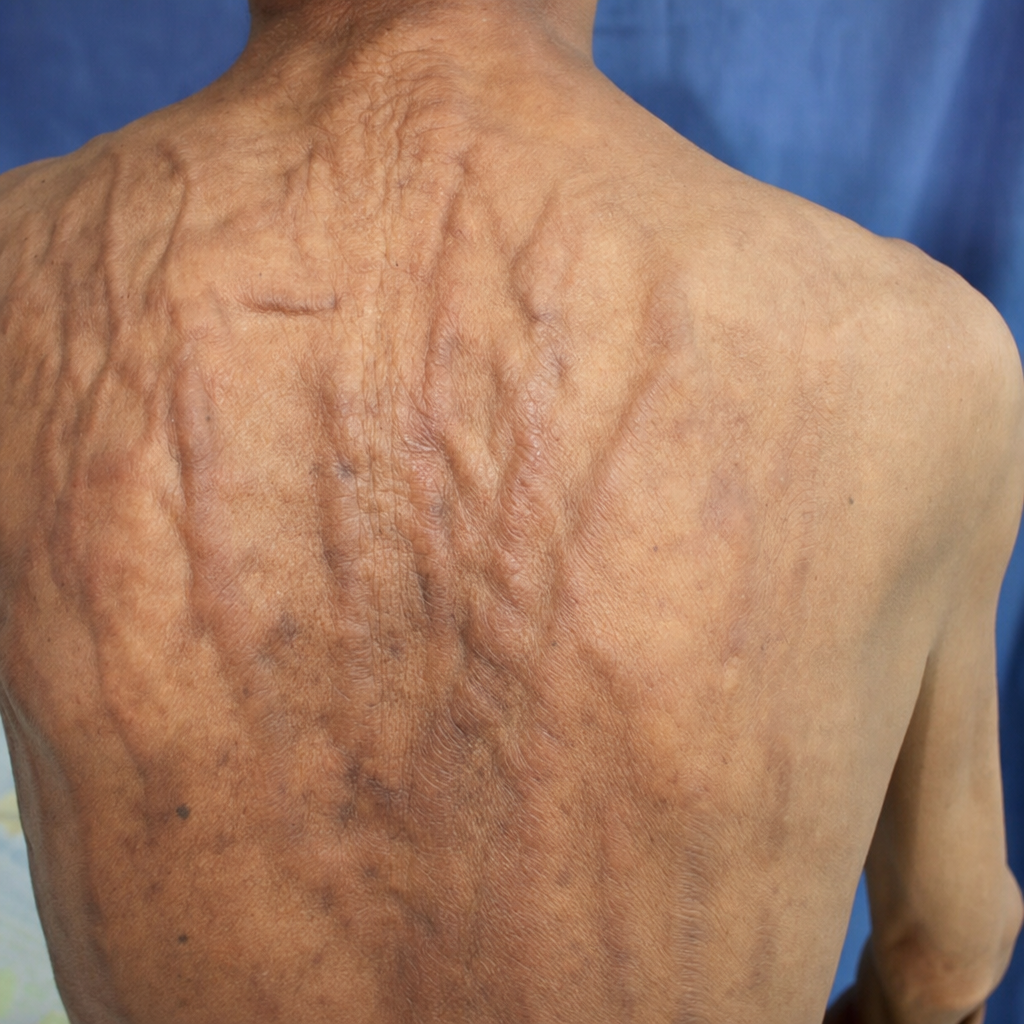
A 5-year-old child presents with itchy, excoriated papules and elevated IgE levels. What is the most probable diagnosis?
Primary prevention of obesity includes:
Helitrope rash is seen in which of the following conditions?
Toxic epidermal necrolysis (TEN) involves what percentage of body surface area?
All of the following cutaneous disorders are associated with a defect in the Nucleotide Excision Repair (NER) pathway, except:
Which of the following conditions is associated with Gottron's sign?
Carpet tacking is characteristically seen in which condition?
A 7-year-old boy presents with abdominal pain, joint aches, and a rash on his legs and feet. He has no history of frequent nosebleeds, easy bruising, or other episodes of abnormal bleeding. What is the most likely diagnosis?
Which of the following is a typical example of an immunologically mediated collagen and connective tissue disorder?
Which of the following autoantibodies is most suggestive of subacute cutaneous lupus erythematosus?
Explanation: ### Explanation **Correct Option: C. Atopic Dermatitis** Atopic dermatitis (AD) is a chronic, relapsing inflammatory skin disease characterized by the "itch that rashes." In children, it typically presents with **intense pruritus** and excoriated papules. The diagnosis is clinical, but a hallmark laboratory finding in approximately 70-80% of patients is **elevated serum IgE levels**. This reflects the Type I hypersensitivity component and the "Atopic March" (association with asthma and allergic rhinitis). **Why other options are incorrect:** * **A. Scabies:** While intensely itchy, it is characterized by **burrows** in web spaces and a history of similar symptoms in family members. It does not typically cause a systemic rise in IgE. * **B. Seborrheic Dermatitis:** Usually presents in infants ("Cradle Cap") or adults as greasy, yellowish scales on erythematous bases in seborrheic areas (scalp, nasolabial folds). It is **not typically associated with elevated IgE** or severe pruritus. * **D. Urticaria:** Presents as transient, evanescent wheals (hives) that resolve within 24 hours. While IgE-mediated, it does not present as persistent excoriated papules. **Clinical Pearls for NEET-PG:** * **Filaggrin (FLG) Mutation:** The most common genetic defect leading to skin barrier dysfunction in AD. * **Infantile AD:** Classically involves the **face (cheeks)** and extensor surfaces, sparing the diaper area. * **Childhood/Adult AD:** Shifts to **flexural surfaces** (antecubital and popliteal fossae) with lichenification. * **Dennie-Morgan Fold:** An extra fold of skin under the lower eyelid, a classic physical sign of atopy. * **Treatment of Choice:** Topical corticosteroids (for flares) and topical calcineurin inhibitors (Tacrolimus) for maintenance.
Explanation: **Explanation:** Primary prevention of obesity aims to prevent the onset of the disease by modifying risk factors, primarily through dietary interventions and lifestyle changes. **Why High Fiber Diet is Correct:** A high-fiber diet is a cornerstone of primary prevention for obesity due to several physiological mechanisms: 1. **Satiety:** Fiber adds bulk to the diet and slows gastric emptying, leading to a prolonged feeling of fullness, which reduces overall caloric intake. 2. **Energy Density:** High-fiber foods (like whole grains, vegetables, and fruits) typically have a lower energy density compared to processed foods. 3. **Insulin Regulation:** Soluble fiber slows the absorption of glucose, preventing rapid insulin spikes that promote fat storage (lipogenesis). **Analysis of Incorrect Options:** * **Low Fiber Diet:** Associated with high energy density and rapid digestion, leading to frequent hunger and overconsumption of calories. * **High Cholesterol Diet:** While primarily linked to dyslipidemia and atherosclerosis, a diet high in cholesterol often mirrors a high-saturated fat intake, which is calorically dense and promotes weight gain. * **High Intake of Protein:** While protein aids in thermogenesis and muscle preservation, an excessively high intake (beyond physiological needs) does not serve as a primary preventive measure for obesity as effectively as fiber-rich dietary patterns. **NEET-PG Clinical Pearls:** * **Definition:** Primary prevention occurs *before* the disease develops (Pre-pathogenesis phase). * **Fiber Recommendations:** The WHO recommends an intake of >25g of dietary fiber per day for adults. * **Obesity Indices:** Remember that for the Indian population, the BMI cutoff for obesity is lower (**>25 kg/m²**) compared to the international WHO cutoff (>30 kg/m²). * **Metabolic Syndrome:** Obesity is a key component of Metabolic Syndrome (ATP III criteria), which also includes hypertension, hyperglycemia, and dyslipidemia.
Explanation: ### Explanation **Correct Answer: B. Dermatomyositis** **Medical Concept:** The **Heliotrope rash** is a pathognomonic cutaneous feature of **Dermatomyositis**, an idiopathic inflammatory myopathy. It is characterized by a symmetrical, violaceous (reddish-purple) eruption involving the upper eyelids, often accompanied by periorbital edema. The name is derived from the *Heliotropium* flower, which shares this distinct purple hue. This rash is photosensitive and results from underlying inflammation of the dermal capillaries. **Analysis of Incorrect Options:** * **A. Psoriasis:** Characterized by well-demarcated erythematous plaques with silvery-white scales, typically on extensors (knees, elbows) and the scalp. It is not associated with periorbital violaceous rashes. * **C. Discoid Lupus Erythematosus (DLE):** Presents with well-defined, coin-shaped erythematous plaques with follicular plugging and scarring (atrophy). While it affects sun-exposed areas, it does not present as a heliotrope rash. * **D. Pemphigus:** An autoimmune blistering disease characterized by flaccid bullae and erosions due to acantholysis (loss of keratinocyte adhesion). It does not feature the specific violaceous eyelid discoloration seen in dermatomyositis. **High-Yield Clinical Pearls for NEET-PG:** * **Gottron’s Papules:** Violaceous papules over the dorsal aspect of interphalangeal and metacarpophalangeal joints (also pathognomonic for Dermatomyositis). * **Shawl Sign:** Erythema over the upper back and shoulders. * **V-Sign:** Erythema over the anterior neck and upper chest. * **Mechanic’s Hands:** Hyperkeratosis and fissuring of the palms and lateral fingers (associated with Anti-Jo-1 antibodies). * **Malignancy Link:** Dermatomyositis in adults is frequently associated with internal malignancies (paraneoplastic syndrome), most commonly ovarian, lung, and gastric cancers.
Explanation: Stevens-Johnson Syndrome (SJS) and Toxic Epidermal Necrolysis (TEN) are severe mucocutaneous adverse drug reactions characterized by extensive keratinocyte apoptosis and epidermal detachment. They are classified as a spectrum of the same disease, differentiated solely by the **percentage of total body surface area (TBSA)** involved with skin detachment. ### **Explanation of Options:** * **Option D (> 30%) is Correct:** By clinical definition, TEN is diagnosed when the epidermal detachment involves **more than 30%** of the body surface area. This represents the most severe end of the spectrum, often associated with high mortality and requiring management in a burn unit. * **Option A (< 10%):** This defines **Stevens-Johnson Syndrome (SJS)**, the less extensive form of the disease. * **Options B & C (10-30%):** This range is classified as **SJS/TEN Overlap**. It serves as a transitional category for patients whose disease is progressing from SJS toward full-blown TEN. ### **High-Yield Clinical Pearls for NEET-PG:** 1. **Pathogenesis:** Mediated by cytotoxic T-cells and the **Fas-Fas ligand** pathway, leading to massive apoptosis. **Granulysin** is the key cytolytic protein found in the blisters. 2. **Clinical Sign:** **Nikolsky Sign** is positive (perifocal extension of a blister or denudation of skin upon applying lateral pressure). 3. **Common Triggers:** Sulfonamides, Anticonvulsants (Phenytoin, Carbamazepine), Allopurinol, and NSAIDs. 4. **Prognosis:** Calculated using the **SCORTEN** scale, which assesses variables like age (>40), heart rate (>120), malignancy, and serum urea/glucose/bicarbonate levels. 5. **Histology:** Shows **subepidermal bullae** with full-thickness epidermal necrosis and a sparse inflammatory infiltrate.
Explanation: **Explanation:** The **Nucleotide Excision Repair (NER)** pathway is the primary mechanism for repairing DNA damage caused by ultraviolet (UV) radiation, specifically bulky adducts like pyrimidine dimers. Defects in this pathway lead to photosensitivity and genomic instability. **Why Muir-Torre Syndrome is the Correct Answer:** Muir-Torre syndrome is a clinical variant of **Lynch syndrome (HNPCC)**. It is caused by mutations in **Mismatch Repair (MMR) genes** (most commonly *MSH2* and *MLH1*), not the NER pathway. It is characterized by at least one sebaceous gland tumor (e.g., sebaceous adenoma or carcinoma) and at least one internal malignancy (most commonly colorectal cancer). **Why the Other Options are Incorrect:** * **Xeroderma pigmentosum (XP):** The classic NER defect. It involves mutations in *XPA* through *XPG* genes, leading to extreme photosensitivity and a 10,000-fold increased risk of skin cancers. * **Cockayne syndrome:** Caused by defects in **Transcription-Coupled Repair (TCR)**, a sub-pathway of NER. Clinical features include "cachectic dwarfism," bird-like facies, and photosensitivity, but notably *no* increased risk of skin cancer. * **Trichothiodystrophy (TTD):** Characterized by sulfur-deficient brittle hair (tiger-tail banding under polarized light). Many cases are caused by mutations in *ERCC2/XPD* or *ERCC3/XPB* genes, which are components of the TFIIH complex involved in NER. **High-Yield Clinical Pearls for NEET-PG:** * **Muir-Torre:** Think **MMR genes** + Sebaceous tumors + GI malignancy. * **Tiger-tail hair:** Pathognomonic for **Trichothiodystrophy**. * **XP vs. Cockayne:** Both have NER defects, but XP has high skin cancer risk, while Cockayne has neurodegeneration and premature aging without increased cancer risk.
Explanation: **Explanation:** **Dermatomyositis (Option A)** is the correct answer. **Gottron’s sign** is a pathognomonic cutaneous feature of this inflammatory myopathy. It is characterized by symmetric, erythematous to violaceous, somewhat scaly macules or patches found over the dorsal aspects of the interphalangeal (IP) and metacarpophalangeal (MCP) joints. It is often confused with **Gottron’s papules**, which are similar but present as raised, palpable lesions. These findings reflect the underlying systemic inflammation targeting the skin and skeletal muscles. **Incorrect Options:** * **Systemic Lupus Erythematosus (B):** While SLE presents with a malar rash, it typically **spares the IP/MCP joints** (interarticular sparing), whereas dermatomyositis specifically involves them. * **Scleroderma (C):** This is characterized by skin thickening (sclerodactyly), Raynaud’s phenomenon, and "salt and pepper" pigmentation, but not Gottron’s sign. * **Mixed Connective Tissue Disease (D):** MCTD features an overlap of SLE, Scleroderma, and Polymyositis (high anti-U1 RNP titers). While it can show features of dermatomyositis, Gottron’s sign is specifically the hallmark of classic Dermatomyositis. **High-Yield Clinical Pearls for NEET-PG:** * **Heliotrope Rash:** Violaceous edema of the upper eyelids (another pathognomonic sign). * **Shawl Sign:** Erythema over the upper back and shoulders. * **Mechanic’s Hands:** Hyperkeratotic, fissured skin on the lateral and palmar aspects of fingers (associated with Anti-Jo-1 antibodies). * **Malignancy:** Dermatomyositis in adults is strongly associated with internal malignancies (paraneoplastic syndrome). * **Muscle Enzymes:** Elevated Creatine Kinase (CK) and Aldolase are key diagnostic markers.
Explanation: **Explanation:** **Carpet tacking sign** (also known as the **Besnier’s sign** or **Tinel’s sign**) is a pathognomonic clinical feature of **Discoid Lupus Erythematosus (DLE)**. In DLE, chronic inflammation leads to **follicular plugging**, where keratinous plugs accumulate within the dilated openings of hair follicles. When an adherent scale is forcibly removed from a long-standing DLE plaque, these keratinous plugs are pulled out along with the scale. The underside of the scale then shows small, spike-like projections resembling carpet tacks or upholstery tacks. **Analysis of Incorrect Options:** * **Systemic Lupus Erythematosus (SLE):** While DLE can occur in SLE patients, the classic "carpet tacking" is a feature of the localized, chronic discoid lesions rather than the acute malar rash of SLE, which typically does not show significant follicular plugging. * **Lichen Planus:** Characterized by **Wickham’s striae** (whitish reticular lines) and the Koebner phenomenon, but it lacks the follicular plugging seen in DLE. * **Dermatitis Herpetiformis:** A bullous disorder associated with celiac disease, characterized by intensely pruritic vesicles on extensor surfaces and **subepidermal neutrophils** on histology, not scaling or plugging. **High-Yield Clinical Pearls for NEET-PG:** * **Triad of DLE:** Erythema, Adherent Scaling, and Follicular Plugging (leading to Atrophy/Scarring). * **Histology:** DLE shows vacuolar degeneration of the basal layer and "periadnexal" lymphocytic infiltrate. * **Wolf’s Isotopic Response:** DLE lesions frequently occur at the site of healed Herpes Zoster. * **Scalp Involvement:** DLE is a common cause of **cicatricial (scarring) alopecia**.
Explanation: **Explanation:** The clinical triad of **abdominal pain, arthralgia (joint aches), and a palpable purpuric rash** on the lower extremities in a child is the classic presentation of **Henoch-Schönlein Purpura (HSP)**, now also known as **IgA Vasculitis**. **Why Option D is correct:** HSP is a small-vessel vasculitis characterized by the deposition of **IgA-dominant immune complexes**. It typically follows an upper respiratory tract infection. The rash is characteristically "palpable purpura" (non-blanchable) found on gravity-dependent areas like the legs and buttocks. The absence of bleeding tendencies (normal platelet count) distinguishes it from thrombocytopenic purpuras. **Why other options are incorrect:** * **A. Acute Urticaria:** Presents as transient, itchy wheals (hives) that blanch on pressure. It does not cause purpura or systemic symptoms like joint pain and abdominal distress. * **B. DIC:** A life-threatening consumptive coagulopathy. While it causes purpura (purpura fulminans), patients are critically ill with active bleeding from multiple sites and abnormal coagulation profiles. * **C. Erythema Nodosum:** Presents as painful, erythematous, tender nodules, typically on the shins. It is a form of panniculitis (septal), not a vasculitic purpuric rash. **High-Yield Clinical Pearls for NEET-PG:** * **Most common systemic vasculitis in children.** * **Renal involvement:** IgA nephropathy (Berger’s disease-like) is the most serious long-term complication; monitor with serial urinalysis. * **Gastrointestinal:** Can lead to **intussusception** (usually ileo-ileal). * **Biopsy:** Shows **Leukocytoclastic vasculitis (LCV)** with IgA deposits on immunofluorescence. * **Platelet count:** Always **normal** (Non-thrombocytopenic purpura).
Explanation: **Explanation:** **Lupus Erythematosus (LE)** is the correct answer because it is a classic example of a **Connective Tissue Disorder (CTD)**. These are a group of autoimmune diseases characterized by the body’s immune system attacking its own connective tissues, including collagen and ground substance. In LE, the pathogenesis involves Type III (immune-complex mediated) and Type II hypersensitivity reactions, leading to multi-organ involvement, including the skin, joints, and kidneys. **Analysis of Incorrect Options:** * **Pemphigus (A):** This is an **autoimmune bullous (blistering) disease** caused by IgG antibodies against desmogleins (desmosomes), leading to loss of cell-to-cell adhesion (acantholysis) in the epidermis. It is not a primary connective tissue disorder. * **Bullous Pemphigoid (B):** This is also an **autoimmune blistering disease**, but it targets the hemidesmosomes (BP180/BP230) at the dermo-epidermal junction. It is classified as a subepidermal immunobullous disease. * **Lichen Planus (D):** This is a **chronic inflammatory papulosquamous disorder** mediated by T-cells (Type IV hypersensitivity) targeting basal keratinocytes. While immunologically mediated, it is not classified as a collagen/connective tissue disease. **High-Yield Clinical Pearls for NEET-PG:** * **Connective Tissue Diseases (CTDs):** Include Lupus Erythematosus (SLE/DLE), Scleroderma (Systemic Sclerosis), and Dermatomyositis. * **Hallmark of SLE:** Presence of Anti-nuclear antibodies (ANA) is the best screening test; Anti-dsDNA is highly specific. * **Histopathology of LE:** Characterized by vacuolar degeneration of the basal layer and basement membrane thickening. * **Pemphigus vs. Pemphigoid:** Pemphigus is **intraepidermal** (flaccid bullae, +ve Nikolsky sign), while Pemphigoid is **subepidermal** (tense bullae, -ve Nikolsky sign).
Explanation: **Explanation:** **Subacute Cutaneous Lupus Erythematosus (SCLE)** is a distinct subset of lupus erythematosus characterized by photosensitive, non-scarring annular or psoriasiform skin lesions. **Why Anti-Ro is correct:** The hallmark of SCLE is the presence of **Anti-Ro (SS-A) antibodies**, which are found in approximately **75–90%** of patients. These antibodies are highly specific for this clinical subtype and are also associated with neonatal lupus and Sjögren’s syndrome. Anti-Ro antibodies are thought to play a role in the photosensitivity characteristic of the disease. **Analysis of Incorrect Options:** * **Anti-dsDNA (Option A):** Highly specific for **Systemic Lupus Erythematosus (SLE)** and correlates with disease activity and lupus nephritis. It is rarely the primary marker for isolated cutaneous variants like SCLE. * **Anti-La (SS-B) (Option C):** Often found in conjunction with Anti-Ro (in about 30–40% of SCLE cases), but it is less frequently positive than Anti-Ro alone. Anti-Ro remains the "most suggestive" and primary marker. * **U1 RNP (Option D):** The diagnostic marker for **Mixed Connective Tissue Disease (MCTD)**. While it can be seen in SLE, it is not specifically associated with the SCLE phenotype. **High-Yield Clinical Pearls for NEET-PG:** * **Drug-Induced SCLE:** Often caused by Hydrochlorothiazide, Terbinafine, Calcium channel blockers, and ACE inhibitors. * **Neonatal Lupus:** Strongly associated with maternal Anti-Ro/La antibodies; the most serious complication is **congenital third-degree heart block**. * **Morphology:** SCLE lesions heal **without scarring** (unlike Discoid Lupus/DLE) but may leave behind temporary telangiectasia or hypopigmentation.
Lupus Erythematosus: Cutaneous Forms
Practice Questions
Lupus Erythematosus: Systemic with Skin Manifestations
Practice Questions
Dermatomyositis
Practice Questions
Scleroderma and Morphea
Practice Questions
Mixed Connective Tissue Disease
Practice Questions
Sjögren's Syndrome: Cutaneous Manifestations
Practice Questions
Relapsing Polychondritis
Practice Questions
Autoimmune Thyroid Disease and the Skin
Practice Questions
Immunobullous Disorders
Practice Questions
Vasculitis
Practice Questions
Diagnostic Methods in Autoimmune Dermatoses
Practice Questions
Management of Autoimmune Skin Diseases
Practice Questions
Get full access to all questions, explanations, and performance tracking.
Start For Free