Which skin manifestation is characteristically seen in dermatomyositis?
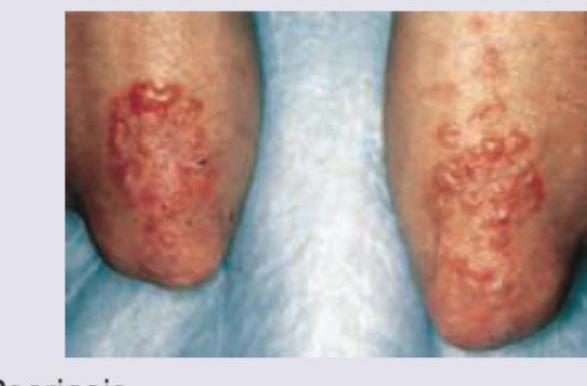
Which skin disorder is associated with gluten sensitivity?
Which of the following is NOT associated with erythema nodosum?
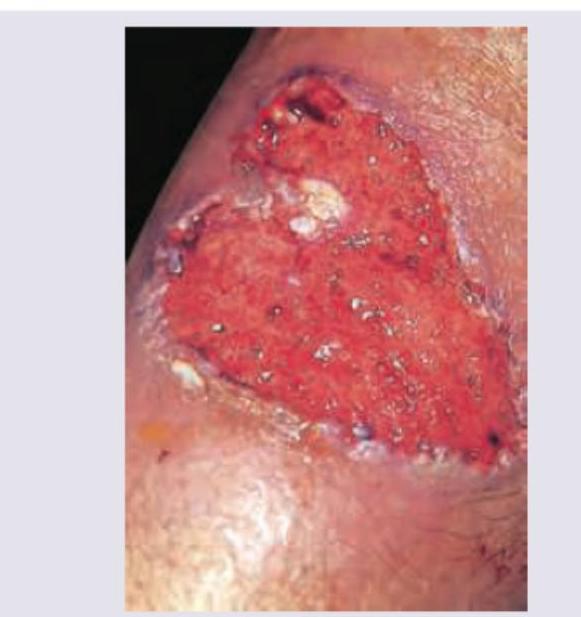
A 50-year-old male presents with a painful ulcer on his leg. The ulcer has an undermined border and purulent discharge, and he has a history of inflammatory bowel disease. What is the most likely diagnosis?
Which autoimmune skin disease is associated with a heliotrope rash?
A 35-year-old woman presents with an erythematous, scaly plaque on her scalp accompanied by hair loss. A biopsy reveals lymphocytic infiltration around the hair follicles. What is the most likely diagnosis?
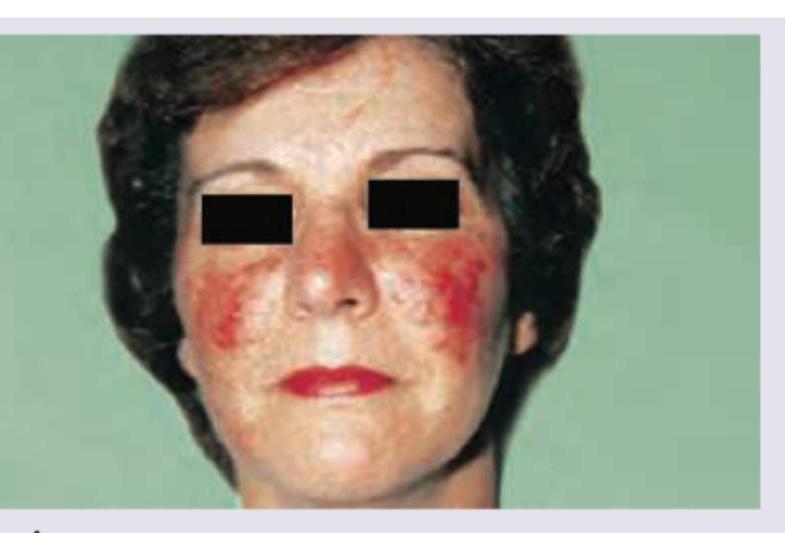
A patient with systemic lupus erythematosus develops a rash after sun exposure. The rash is erythematous with a butterfly distribution. What is the name of this rash?
A 60-year-old woman with a history of systemic lupus erythematosus presents with a persistent rash on her face. Examination reveals well-demarcated, coin-shaped erythematous plaques with scaling and central atrophic areas. What is the most likely diagnosis?
Which of the following is not a feature of dermatomyositis?
Which of the following diseases is closely related to enteropathy?
Explanation: ***Gottron papules*** - **Gottron papules** are raised, erythematous, or violaceous plaques over the **extensor surfaces of the metacarpophalangeal (MCP)** and **interphalangeal (IP)** joints. - They are considered **pathognomonic** (diagnostic) for dermatomyositis and are the most universally accepted characteristic cutaneous marker of the condition. *Heliotrope rash* - The **heliotrope rash** is a characteristic violaceous (purple-red) discoloration on the upper eyelids, often associated with **periorbital edema**. - While highly characteristic of **dermatomyositis**, Gottron papules are more universally accepted as the most pathognomonic feature. *Butterfly rash* - The **butterfly rash** (malar rash) is a classic manifestation of **systemic lupus erythematosus (SLE)**, characterized by redness over the cheeks and nasal bridge, sparing the nasolabial folds. - It is not typically seen in dermatomyositis and suggests a different underlying autoimmune condition. *Shawl sign* - The **shawl sign** refers to a diffuse, flat, erythematous rash over the **shoulders, upper back, and posterior neck**, often exacerbated by sun exposure. - Although seen in dermatomyositis, it is less specific than Gottron papules, which are directly diagnostic of the condition.
Explanation: ***Dermatitis herpetiformis*** - This condition is characterized by **itchy, blistering skin lesions** that typically appear on the elbows, knees, and buttocks. - It is strongly associated with **celiac disease** (gluten-sensitive enteropathy) and improves significantly with a **gluten-free diet**. *Pemphigus vulgaris* - Pemphigus vulgaris is an **autoimmune blistering disease** caused by antibodies against **desmogleins** in the epidermis, leading to intraepidermal blistering. - Its pathogenesis is not related to gluten sensitivity, but rather to a breakdown of **cell adhesion** in the skin. *Psoriasis* - Psoriasis is a **chronic inflammatory skin disease** characterized by red, scaly patches (plaques) due to rapid skin cell turnover. - While it has an autoimmune component, it is not directly linked to **gluten sensitivity**, though some patients report symptom improvement with dietary changes. *Scleroderma* - Scleroderma (systemic sclerosis) is a **chronic autoimmune disease** that causes **fibrosis** (hardening) of the skin and internal organs. - Its pathophysiology involves **collagen overproduction** and vascular dysfunction, with no known association with gluten sensitivity.
Explanation: ***Pemphigus vulgaris*** - **Pemphigus vulgaris** is an **autoimmune blistering disease** that affects the skin and mucous membranes, characterized by flaccid bullae, not subcutaneous nodules. - Its pathophysiology involves **autoantibodies** against **desmoglein 1 and 3**, leading to **acantholysis**, which is distinct from the inflammatory changes seen in erythema nodosum. *Tuberculosis* - **Tuberculosis (TB)** is a common infectious cause of **erythema nodosum**, especially in regions with high TB prevalence. - The development of erythema nodosum in TB is often considered a **hypersensitivity reaction** to mycobacterial antigens. *Sarcoidosis* - **Sarcoidosis** is a systemic granulomatous disease, and **erythema nodosum** can be a prominent cutaneous manifestation, particularly in **Löfgren's syndrome**. - Its presence with **bilateral hilar lymphadenopathy** and **arthralgia** is highly suggestive of acute sarcoidosis. *Leprosy* - **Leprosy**, caused by *Mycobacterium leprae*, can be associated with **erythema nodosum leprosum (ENL)**, which is a type 2 lepra reaction. - **ENL** involves the formation of painful, tender, inflamed nodules that resemble erythema nodosum and is linked to elevated immune complex deposition.
Explanation: ***Pyoderma gangrenosum*** - The classic presentation includes a rapidly progressive, painful ulcer with an **undermined violaceous border** and **purulent exudate**. - A strong association with **inflammatory bowel disease** (e.g., Crohn's disease, ulcerative colitis) is a key diagnostic clue. *Venous ulcer* - Typically found around the **malleoli**, often with a **shallow base**, irregular borders, and associated signs of venous insufficiency like edema and hyperpigmentation. - While they can be painful and purulent if infected, the **undermined border** and strong IBD link point away from this. *Arterial ulcer* - Characteristically located on the **distal extremities** (toes, foot), with a **"punched-out" appearance**, pale base, and often painful, especially at night. - They are associated with **peripheral arterial disease** and cool, pulseless limbs, which are not described here. *Diabetic ulcer* - Usually painless (due to neuropathy), found on **pressure points** of the foot, often with a **calloused rim**. - While they can become secondarily infected and purulent, the defining features like **painful undermined border** and **IBD association** are inconsistent.
Explanation: ***Dermatomyositis (DM)*** - The **heliotrope rash** is a characteristic violaceous (purplish-red) discoloration on the eyelids, often with edema, and is pathognomonic for dermatomyositis. - Other classic cutaneous findings include **Gottron's papules** (violaceous papules over the knuckles) and the **shawl sign** (erythema over the posterior neck and shoulders), along with proximal muscle weakness. *Systemic lupus erythematosus (SLE)* - SLE is known for a **malar rash** (butterfly rash) over the cheeks and nasal bridge, and discoid lupus lesions, but not a heliotrope rash. - It involves multiple organ systems and can present with arthralgia, serositis, and kidney involvement. *Pemphigus vulgaris* - This condition is characterized by **flaccid bullae** and erosions on the skin and mucous membranes due to autoantibodies against desmogleins, leading to intraepidermal blistering. - It typically does not cause the heliotrope rash or muscle weakness associated with dermatomyositis. *Scleroderma (Systemic sclerosis)* - Scleroderma is primarily characterized by **skin thickening** and **fibrosis**, often leading to Raynaud's phenomenon, telangiectasias, and internal organ involvement. - While it can affect the skin, it does not present with a heliotrope rash or the specific inflammatory muscle disease seen in dermatomyositis.
Explanation: ***Discoid lupus erythematosus*** - This condition is characterized by **erythematous, scaly plaques** with associated **permanent hair loss (scarring alopecia)** on the scalp, often forming **atrophic scars**. - Histologically, it presents with a **lymphocytic infiltrate** around hair follicles and the **dermal-epidermal junction**, along with **follicular plugging** and **basal layer degeneration**. *Alopecia areata* - This is a non-scarring form of hair loss, meaning the hair follicles are not permanently destroyed, and hair can regrow. - While it involves lymphocytic infiltration, it typically presents as **smooth, well-demarcated patches of hair loss** without significant erythema or scaling of the skin. *Tinea capitis* - This is a **fungal infection** that causes scaly patches and hair loss, but a biopsy would reveal **fungal elements** within the hair shafts and follicles, not primarily a lymphocytic infiltrate. - Often associated with **broken hairs** and sometimes **pustules**, and can be diagnosed with a **KOH prep** or fungal culture. *Psoriasis* - Scalp psoriasis presents as **thick, silvery scales** on an erythematous base, often with well-demarcated plaques. - While it can cause hair shedding due to inflammation, it does not typically lead to scarring alopecia or the specific perifollicular lymphocytic infiltrate seen in lupus.
Explanation: ***Malar rash*** - This rash is characteristic of **systemic lupus erythematosus (SLE)** and presents as an **erythematous** eruption in a **butterfly distribution** over the cheeks and bridge of the nose. - It is often **photosensitive**, meaning it is triggered or exacerbated by sun exposure, as described in the patient's presentation. *Discoid rash* - While also associated with lupus (particularly discoid lupus erythematosus), a **discoid rash** presents as chronic, scarring lesions with **follicular plugging** and **atrophy**, which is not described as a **butterfly distribution**. - Discoid lesions are typically sharply demarcated and can lead to permanent changes in skin texture and pigmentation. *Photosensitive rash* - This is a general term describing any rash that appears or worsens with **sun exposure**. While the malar rash is photosensitive, this option is too broad and does not specify the characteristic appearance. - Many skin conditions, not just lupus-related rashes, can be photosensitive. *Livedo reticularis* - This is a vascular mottled rash characterized by a **net-like** or **lacy pattern** caused by constriction of small blood vessels, often due to abnormalities in blood flow. - It is not typically described as a **butterfly distribution** and is not the classic rash associated with acute lupus flares after sun exposure.
Explanation: ***Discoid lupus erythematosus*** - This patient's history of **systemic lupus erythematosus (SLE)** and the description of a **discoid rash** with erythematous, scaly, and atrophic areas on the face are classic findings for discoid lupus erythematosus (DLE). - DLE is a **chronic cutaneous form of lupus** that can occur in patients with SLE or as an isolated condition, characterized by scarring and pigmentary changes. *Psoriasis* - Psoriasis typically presents as **well-demarcated, erythematous plaques** with silvery scales, often on extensor surfaces like elbows and knees, distinct from the described rash. - While psoriasis can affect the face, the presence of **atrophy** and history of SLE make DLE a far more likely diagnosis. *Rosacea* - Rosacea often involves **facial erythema, telangiectasias, papules, and pustules**, primarily affecting the central face, but does not present with the same scaly, atrophic, and scarring lesions characteristic of DLE. - It lacks the **discoid morphology** and is not typically associated with SLE. *Seborrheic dermatitis* - Seborrheic dermatitis manifests as **greasy, yellowish scales on an erythematous base**, commonly affecting areas rich in sebaceous glands such as the scalp, eyebrows, and nasolabial folds. - The lesions usually do not lead to **atrophy or scarring**, which are key features of the described rash.
Explanation: ***Groove sign*** - The **Groove sign** (referring to prominent **longitudinal ridging and grooves** in the nails) is NOT a typical feature of dermatomyositis. - This nail manifestation is characteristically seen in **lichen planus** and other conditions, but not in classic dermatomyositis. - In dermatomyositis, nail changes include **periungual telangiectasias**, **ragged cuticles**, and **nail fold capillary changes**, but not prominent nail grooves. *'V' sign* - The **'V' sign** is a characteristic cutaneous finding in dermatomyositis, presenting as **photodistributed erythema** on the anterior neck and upper chest in a 'V' shape. - This distribution corresponds to sun-exposed areas and is a common manifestation of the disease. *Holster sign* - The **Holster sign** refers to **poikilodermatous changes** located on the lateral aspects of the thighs, resembling the area where a holster would be worn. - It is a specific cutaneous manifestation of dermatomyositis, often indicating chronic photodamage in the disease. *Poikiloderma* - **Poikiloderma** is a combination of **atrophy**, **telangiectasias**, and **dyspigmentation** (both hypo- and hyperpigmentation) of the skin. - Poikiloderma is a prominent feature in dermatomyositis, especially in photodistributed areas like the neck (V-sign), upper back (Shawl sign), and lateral thighs (Holster sign).
Explanation: ***Dermatitis herpetiformis*** - This condition is strongly associated with **celiac disease** (gluten-sensitive enteropathy), where **IgA deposits** are found in the skin and small intestine. - Patients typically present with intensely pruritic, polymorphic skin lesions, and often have **villous atrophy** of the small intestine, requiring a **gluten-free diet**. *Linear IgA disease* - Characterized by **linear IgA deposits** along the basement membrane zone, but it is not typically associated with enteropathy. - The disease can be **idiopathic** or **drug-induced**, commonly seen with **vancomycin**. *Pemphigus foliaceus* - An autoimmune blistering disease where **antibodies target desmoglein 1** in the superficial epidermis, leading to superficial blisters and erosions. - It is not associated with **gastrointestinal pathology** or enteropathy. *Erythema multiforme* - This is an acute, self-limited, and often recurrent mucocutaneous syndrome characterized by target lesions, often triggered by **infections (e.g., HSV)** or **drugs**. - It is an immune-mediated reaction and does not have a primary association with **enteropathy**.
Lupus Erythematosus: Cutaneous Forms
Practice Questions
Lupus Erythematosus: Systemic with Skin Manifestations
Practice Questions
Dermatomyositis
Practice Questions
Scleroderma and Morphea
Practice Questions
Mixed Connective Tissue Disease
Practice Questions
Sjögren's Syndrome: Cutaneous Manifestations
Practice Questions
Relapsing Polychondritis
Practice Questions
Autoimmune Thyroid Disease and the Skin
Practice Questions
Immunobullous Disorders
Practice Questions
Vasculitis
Practice Questions
Diagnostic Methods in Autoimmune Dermatoses
Practice Questions
Management of Autoimmune Skin Diseases
Practice Questions
Get full access to all questions, explanations, and performance tracking.
Start For Free