
Dermatomyositis — MCQs

A 10-year-old boy presents with fever, joint pain, and a lesion over his hand, as seen in the image below. Which of the following is the clinical finding, and what is the likely diagnosis?
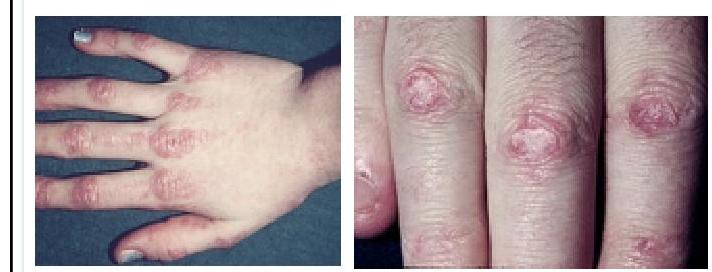
A 50-year-old male patient presented with weakness of bilateral lower limbs which was symmetrical (distal weakness >> proximal muscle weakness) for 1 month. On examination, certain skin and nail changes were noted. Patient also complained of myalgia and arthralgia. Lab findings: Raised creatinine kinase levels, Raised ANA antibody titre. Muscle biopsy was done from the quadriceps femoris muscle. CD4+ cells were found in the cellular infiltrate. IHC study of which protein is a very sensitive diagnostic test for the above condition?
Which of the following is not a feature of dermatomyositis?
A 64-year-old man presents to the clinic with generalized weakness, difficulty getting out of a chair and lifting objects above his head, and a 15-pound weight loss. He has a blue-purple rash on his eyelids and knuckles, and his proximal muscle strength is rated 4 out of 5. Laboratory investigations reveal an elevated creatinine kinase (CK) level. He is started on prednisone therapy. Which of the following is the most important in monitoring response to therapy?
Treatment of myositis ossificans includes all except -
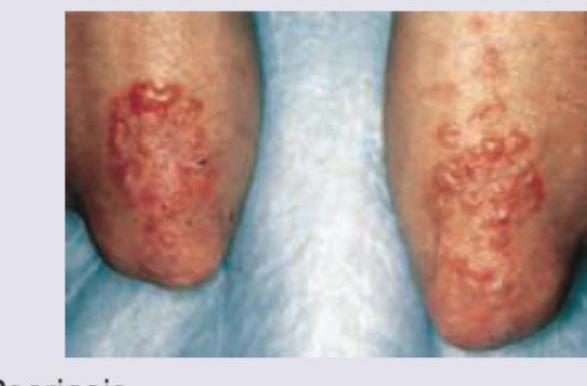
Identify the lesion:
A 26-year-old female patient presented with oral ulcers, sensitivity to light and rash over the malar area of the face sparing the nasolabial folds of both sides. Which of the following is most characteristic of this condition?
Cutis marmorata occurs due to exposure to –
A 28-year-old female presents with a 3-month history of violaceous, flat-topped papules on her wrists and lower back associated with intense pruritus. Examination reveals white lacy streaks on the buccal mucosa bilaterally. She was recently started on antihypertensive medication 4 months ago. Histopathology shows hyperkeratosis, irregular acanthosis, and band-like lymphocytic infiltrate at the dermoepidermal junction. What is the most appropriate next step in management?
A study of persons developing skin lesions following sun exposure is conducted. The lesions are not found on skin protected from ultraviolet light. Biopsies of involved skin show immunoglobulin G deposition along the dermal-epidermal junction, along with vacuolization of the basal layer and a perivascular lymphocytic infiltrate. No other organ involvement is present. Which of the following diseases do these patients most likely have?
Want unlimited practice?
Get full access to all questions, explanations, and performance tracking.
Scan to download app