Which of the following statements regarding Physical Quality of Life Index (PQLI) are correct? 1. It consolidates infant mortality, life expectancy at age one, and literacy 2. It does not measure economic growth but measures the result of economic policies 3. For each component, the performance of individual countries is placed on a scale of 0-100 Select the correct answer using the code given below:
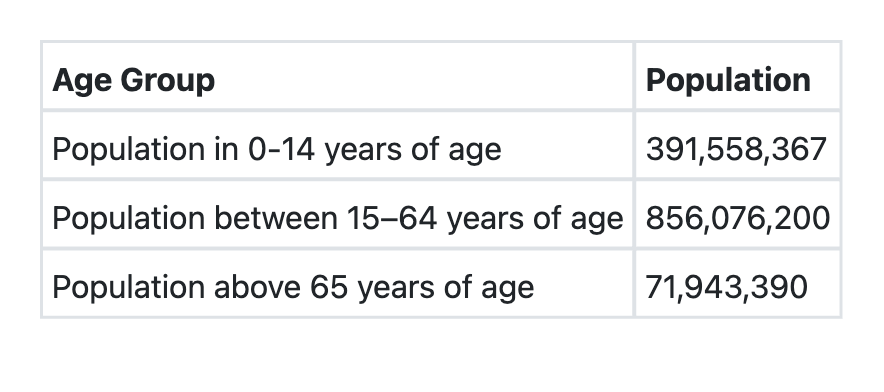
Consider the following data for a country: What shall be the dependency ratio of this country?
A pharmaceutical company sponsors a clinical trial of their new drug. The company employs the lead investigator as a consultant. What ethical concern does this raise?
Blood spill in the operation theater is cleaned with _____?
In Ayushman Bharat under School Health Services, which of the following is not included?
At which level is the School Health Service typically provided?
Mobile Medical Units (MMUs) under government health programs can operate through different models. Which of the following statements about MMU operations are correct? 1. MMUs are run by the government 2. MMUs are run by external agencies with medical supplies given by the government 3. MMUs are run by the government and medical supplies are also given by the government 4. MMUs are run by external agencies and medical supplies are also given by the external agency
What is the most cost-effective screening strategy for STIs in resource-limited settings according to WHO guidelines?
In a clinical laboratory, when is sample registration typically performed?
While launching a community programme, the best method of action is:
Explanation: ***1, 2 and 3*** - The **Physical Quality of Life Index (PQLI)** indeed consolidates **infant mortality**, **life expectancy at age one**, and **literacy rate** as its three core components, reflecting key aspects of well-being. - PQLI specifically aims to measure the **outcomes of economic policies** on human well-being rather than economic growth itself, making it a valuable tool for assessing social progress. The PQLI scales each component from **0 to 100**, where 0 represents the worst performance (e.g., highest infant mortality) and 100 represents the best (e.g., lowest infant mortality), allowing for standardized comparison across countries. *1 and 2 only* - This option incorrectly omits the third correct statement regarding the **0-100 scaling** of individual components, which is a fundamental aspect of how the PQLI is calculated and interpreted. - While statements 1 and 2 are accurate individually, they do not encompass all the correct information provided in the question's premise. *1 and 3 only* - This option omits the correct statement that PQLI measures the **results of economic policies** rather than economic growth, which is a crucial distinguishing characteristic of the index. - While statements 1 and 3 are correct, they do not fully capture all the accurate descriptions of the PQLI. *2 and 3 only* - This option incorrectly excludes the first statement, which correctly identifies the three core components of the PQLI: **infant mortality**, **life expectancy at age one**, and **literacy**. - Without including the components, the understanding of PQLI is incomplete, despite accurately describing other features.
Explanation: ***54.1 %*** - The **dependency ratio** measures the proportion of dependents (children 0-14 and elderly 65+) to the working-age population (15-64). - Calculation: ((391,558,367 + 71,943,390) / 856,076,200) × 100 = (463,501,757 / 856,076,200) × 100 = **54.14%**. *42.4 %* - This value is significantly **lower** than the calculated dependency ratio of 54.1%. - Would indicate a much smaller **dependent population** relative to the working-age group. *66.2 %* - This percentage is **higher** than the mathematically correct dependency ratio calculation. - Would suggest a larger proportion of **dependents** than actually exists in the given data. *78.6 %* - This value is significantly **overestimated** compared to the calculated dependency ratio. - Such a high ratio would indicate an unrealistic proportion of **non-working population** to working-age adults.
Explanation: ***There is a potential conflict of interest*** - A **conflict of interest** arises when the lead investigator's financial relationship with the pharmaceutical company could improperly influence the conduct of the research or the reporting of its results. - This situation can compromise the **objectivity** and **integrity** of the study, as the investigator may feel pressure to produce favorable outcomes for the sponsor. *The study violates research ethics principles* - While a conflict of interest is indeed an ethical concern, this option is too broad; the mere existence of a conflict of interest doesn't automatically mean the entire study *violates* all research ethics principles, especially if it was disclosed and managed appropriately. - Ethical violations usually refer to issues like lack of informed consent, inadequate patient protection, or fabrication of data, which are not explicitly stated here. *The study design will be inherently flawed* - A **conflict of interest** can influence the study design, but it doesn't guarantee that the design will be *inherently flawed* from a scientific methodology perspective (e.g., in terms of blinding or randomization). - The flaw would primarily be in the **objectivity** and **bias**, not necessarily the structural integrity of the design itself. *Patients cannot provide informed consent* - The lead investigator's consultant role does not directly prevent patients from providing **informed consent** regarding their participation in the trial. - Informed consent focuses on patients understanding the risks, benefits, and alternatives of the study, which is a separate process.
Explanation: ***Chlorine compound*** - **Chlorine-releasing agents** like 1% sodium hypochlorite (bleach) are highly effective against a broad spectrum of microorganisms, including **blood-borne pathogens** such as HIV and Hepatitis B. - Their rapid action and strong oxidizing properties make them the preferred choice for disinfecting surfaces contaminated with blood spills in healthcare settings, ensuring efficient **decontamination**. *Phenolic compounds* - Phenolic compounds are generally used for cleaning and disinfecting **hard, non-porous surfaces** but are less preferred for blood spills due to their slower action and potential for leaving residues. - They are effective against some bacteria and fungi but may not be as rapidly virucidal as chlorine compounds, especially against enveloped viruses in organic matter. *Quaternary ammonium compounds* - **Quaternary ammonium compounds** (Quats) are good general disinfectants for routine cleaning and disinfection of environmental surfaces but have a **lower efficacy against non-enveloped viruses** and spores. - They tend to be inactivated by organic matter, making them less suitable for effective decontamination of **blood spills with high protein content**. *Alcoholic compounds* - **Alcoholic compounds** (e.g., 70% ethanol or isopropanol) are effective disinfectants but are often limited to **small surface areas** or for antiseptic use on skin. - They evaporate quickly and are not ideal for cleaning large blood spills as they may not provide sufficient contact time for effective sterilization in the presence of organic material.
Explanation: ***Providing free spectacles*** - Under Ayushman Bharat School Health Services and RBSK (Rashtriya Bal Swasthya Karyakram), while **vision screening** is universally implemented, the provision of **free spectacles** is not uniformly guaranteed across all states and depends on fund availability and state-level implementation. - The primary focus remains on **screening and referral**, with spectacle provision being supplementary rather than a core mandated service compared to the other interventions listed. - Unlike the other three services which are universally delivered, free spectacles provision shows **geographic and implementation variability**. *Health check-up/screening* - **Comprehensive health check-ups** and screenings are a mandatory core component of the Ayushman Bharat School Health Program implemented uniformly across all states. - This includes screening for common conditions like **vision problems**, **hearing impairments**, **dental issues**, and growth monitoring. *Albendazole provision* - The administration of **Albendazole** for biannual deworming is a standard, universally implemented practice under the National Deworming Day initiative integrated with School Health Programs. - This is part of a broader strategy to improve the **nutritional status** and overall health of school-going children. *Monthly Iron Folic Acid Supplementation* - **Iron Folic Acid (IFA) supplementation** through the Weekly Iron Folic Acid Supplementation (WIFS) program is a key mandated intervention to combat **anemia** among adolescents (10-19 years). - This is universally implemented through School Health Services and directly contributes to improving **cognitive function** and physical health of students.
Explanation: ***Correct Option: PHC*** - The **Primary Health Centre (PHC)** is the most common and appropriate level for providing the School Health Service. - PHCs serve as the first point of contact for healthcare in India, making them ideal for reaching a large number of schools within their catchment area for **preventive and basic curative care**. - Under the School Health Program (part of Ayushman Bharat initiative), PHCs are designated to provide comprehensive health services to schools in their catchment areas. *Incorrect Option: Subdistrict* - The subdistrict level, which typically includes Community Health Centers (CHCs) and Taluka hospitals, provides more specialized services than PHCs. - While it can support school health programs, it's not the primary or most frequent point of service delivery for routine school health activities. *Incorrect Option: Subcentre* - Subcentres are the most peripheral health facilities, offering basic care and outreach services, often managed by ANMs and ASHA workers. - While they contribute to community health, their capacity is generally limited for comprehensive School Health Services, which often require a broader range of resources available at a PHC. *Incorrect Option: District* - The district level oversees the entire health system within its jurisdiction and provides tertiary or advanced care through district hospitals. - School Health Services are coordinated at this level, but direct provision of routine health checks and services mainly occurs at the more localized PHC level.
Explanation: ***1, 2, and 3*** - This option correctly identifies the flexible operational models of **Mobile Medical Units (MMUs)** under government health programs. - MMUs can be directly managed by the **government**, managed by **external agencies** with government-provided supplies, or managed by the government with **government-provided supplies**. *1, 2, 3, and 4* - This option incorrectly includes the scenario where MMUs are run by **external agencies** and medical supplies are also provided by the **external agency**. - While external agencies can run MMUs, government health programs typically ensure that essential medical supplies are provided or funded by the **government** to maintain standardization and accessibility. *1 and 2* - This option is incomplete as it misses the model where both the MMU operation and medical supplies are provided by the **government** (statement 3). - Government health programs often have fully integrated models, especially in remote areas. *Only 1* - This option is too restrictive, as it only includes the model where MMUs are run by the **government**. - MMUs often involve partnerships with **external agencies** for operational efficiency or specialized services.
Explanation: ***Syndromic management*** - This approach involves diagnosing and treating STIs based on the **clinical symptoms** presented by the patient, without the need for expensive laboratory tests. - It is highly cost-effective in resource-limited settings as it reduces the need for costly diagnostics while ensuring prompt treatment to prevent complications and onward transmission. *Risk-based screening* - While helpful, identifying high-risk individuals and conducting targeted screening still requires some level of diagnostic testing, which can be **expensive** or **unavailable** in resource-limited settings. - It may miss STIs in individuals who do not fit predefined risk categories but are still infected. *Periodic mass treatment* - This strategy involves treating a large population group for STIs regardless of their symptom status, which can lead to **antimicrobial resistance** and is not specifically recommended by WHO for routine STI control. - It is generally **inefficient** and potentially wasteful of resources, as many individuals treated may not be infected. *Universal screening* - This approach involves comprehensive diagnostic testing for all individuals, which is highly effective but **prohibitively expensive** and logistically challenging for resource-limited settings. - It requires significant infrastructure for laboratory testing and follow-up, which is often lacking where resources are scarce.
Explanation: ***When samples are received at the laboratory*** - **Sample registration** is a critical step performed immediately upon a sample's arrival to ensure proper identification and tracking throughout its lifecycle in the laboratory. - This initial registration helps prevent **errors**, maintains **sample integrity**, and establishes a clear **audit trail**. *At the end of each working day* - Delaying registration until the end of the day introduces a significant risk of **misidentification**, **loss**, or **degradation** of samples. - Urgent or time-sensitive tests would be unduly **delayed**, potentially impacting patient care. *Once per week during batch processing* - Weekly batch processing for registration is entirely unsuitable for a clinical laboratory, where timely processing of individual samples is paramount. - This practice would lead to a massive backlog, compromise **sample stability**, and make it impossible to provide **prompt results** for patient diagnosis and treatment. *Only during quality control audits* - **Quality control audits** periodically review laboratory processes, including registration, but do not replace the need for real-time, continuous sample registration. - Relying solely on audits for registration would mean unregistered samples are processed, leading to **untraceable results** and potential patient harm.
Explanation: ***Talk to community leaders*** - Engaging **community leaders** (e.g., elders, religious figures, formal leaders) is crucial for securing local support and understanding community needs and perspectives. - This step ensures the program is **culturally appropriate** and more likely to be accepted and sustained by the community. *Involvement of voluntary agencies* - While helpful, involving voluntary agencies is typically a **subsequent step** after initial community engagement and needs assessment. - Their involvement is important for implementation, but not the **initial best method** for launching the program effectively. *Publicity drive* - A **publicity drive** is important for awareness but should follow initial community consultation to ensure the message is relevant and well-received. - Launching a publicity drive without prior community engagement risks **miscommunication** or missing the target audience's true needs. *Organize lecture* - Organizing a lecture is a method of information dissemination but may not be the **most effective initial approach** for building trust and gathering diverse community input. - It can be a component of a larger program but doesn't substitute for direct interaction and **negotiation with key stakeholders**.
Health Administration Structures
Practice Questions
National Health Programs
Practice Questions
District Health System
Practice Questions
Community Health Centers
Practice Questions
Primary Health Centers
Practice Questions
Sub-Centers
Practice Questions
Public Health Legislation
Practice Questions
Health Information Systems
Practice Questions
Health Management Information System
Practice Questions
Health Workforce Planning
Practice Questions
Public Health Ethics
Practice Questions
Intersectoral Coordination
Practice Questions
Get full access to all questions, explanations, and performance tracking.
Start For Free