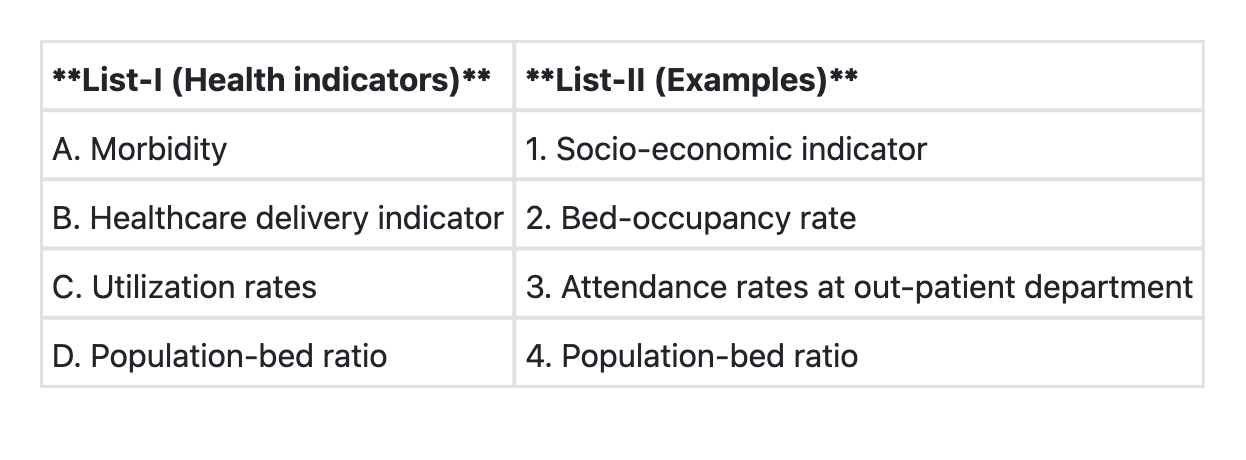
What does "3-0" stand for in hospital waste management?
Which of the following is NOT included under the Swarna Jayanti Shahri Rojgar Yojana?
Who is considered the Father of Medicine?
Which of the following is a function of the female health worker?
Which disease is not typically diagnosed or managed with basic laboratory services available at a Primary Health Centre (PHC)?
Which committee first recommended School Health?
According to national health policy, what is the population a subcentre caters to in hilly and tribal areas?
What does ASHA stand for?
According to biomedical waste management rules, which color-coded bag can be incinerated?
Which of the following is NOT a function of a female health worker?
Explanation: **Explanation:** In the context of hospital waste management and liquid waste treatment, the **"3-D"** (often referred to as 3-0 in some regional administrative contexts) stands for **Disinfection, Disposal, and Drainage**. This principle outlines the systematic approach to handling liquid infectious waste (such as blood, body fluids, and laboratory cultures) before it enters the general sewerage system. 1. **Disinfection:** The primary step involves neutralizing pathogens using chemical disinfectants (typically 1% Hypochlorite solution) to ensure the waste is non-infectious. 2. **Disposal:** This refers to the regulated release of the treated waste into the designated waste stream. 3. **Drainage:** The final stage where the treated liquid is safely channeled into the effluent treatment plant (ETP) or the public sewerage system. **Analysis of Incorrect Options:** * **Option B (Discard):** "Discard" is a general term and not a specific technical step in the standardized liquid waste management protocol. * **Options C & D (Destruction/Deep Burial):** These terms are associated with the management of solid anatomical waste (Yellow Bag) or sharps, rather than the "3-D" protocol for liquid waste. Deep burial is specifically restricted to rural/remote areas where common treatment facilities are unavailable. **High-Yield NEET-PG Pearls:** * **Liquid Waste Treatment:** Always requires chemical disinfection with 1% hypochlorite for at least 30 minutes before disposal. * **BMW Amendment 2016/2018:** Chlorinated plastic bags and gloves are now banned. * **Color Coding:** Remember that liquid waste is generally categorized under the **Yellow** category but follows the 3-D protocol for pretreatment. * **Effluent Treatment Plant (ETP):** Hospitals with more than 10 beds are generally required to have an ETP to manage liquid waste drainage.
Explanation: **Explanation:** The **Swarna Jayanti Shahri Rojgar Yojana (SJSRY)** was launched by the Government of India on December 1, 1997, to address urban poverty by providing gainful employment to the urban unemployed and underemployed poor. The scheme operates through two main channels: encouraging the setting up of self-employment ventures and providing wage employment. **Why the correct answer is "None of the above":** All the options listed (A, B, and C) are integral components of the SJSRY. Since all three are included in the scheme, the statement that any of them is "NOT included" is false, making "None of the above" the correct choice. **Analysis of Options:** * **Option A (Urban Self-Employment Programme - USEP):** This is a core component focusing on individual entrepreneurs among the urban poor for setting up micro-enterprises. * **Option B (Urban Women Self-Help Programme - UWSP):** This component specifically targets groups of urban poor women for setting up self-employment ventures, often accompanied by the revolving fund mechanism. * **Option C (Skill Training for Employment Promotion amongst Urban Poor - STEP-UP):** This component focuses on providing structural and skill-based training to the urban poor to enhance their employability for both self-employment and salaried jobs. **High-Yield Facts for NEET-PG:** * **Evolution:** SJSRY was restructured in 2009 and eventually replaced by the **National Urban Livelihoods Mission (NULM)** in 2013 (later renamed DAY-NULM). * **Funding Pattern:** The funding ratio between the Centre and States was generally **75:25**. * **Target Group:** It specifically targets those living below the poverty line (BPL) in urban areas. * **Community Component:** The scheme relied heavily on community structures like Neighborhood Groups (NHGs) and Neighborhood Committees (NHCs).
Explanation: **Explanation:** **Correct Answer: A. Hippocrates** Hippocrates (460–370 BC) is universally recognized as the **Father of Medicine**. His contribution was revolutionary because he shifted the perception of disease from supernatural or divine causes to rational, natural explanations. He introduced the **Humoral Theory** (imbalance of blood, phlegm, yellow bile, and black bile) and emphasized clinical observation and ethics, embodied today in the **Hippocratic Oath**. **Analysis of Incorrect Options:** * **B. Susrutha:** Known as the **Father of Indian Medicine** and the **Father of Surgery**. He authored the *Susrutha Samhita*, detailing complex surgical procedures like rhinoplasty. * **C. Galen:** A Greek physician whose theories dominated Western medical science for over a millennium. He is often called the **Father of Experimental Physiology** due to his extensive anatomical dissections (mostly on animals). * **D. Panacea:** In Greek mythology, Panacea was the daughter of Asclepius and the **Goddess of Cure/Healing**. The term "panacea" is now used to describe a "universal remedy." **High-Yield NEET-PG Pearls:** * **Father of Public Health:** Cholera (due to its role in the development of modern sanitation). * **Father of Modern Public Health:** John Snow (for his epidemiological work on the Broad Street pump). * **Father of Epidemiology:** John Snow. * **Father of Vaccination:** Edward Jenner. * **Father of Modern Pathology:** Rudolf Virchow. * **First Epidemiologist:** Hippocrates (he distinguished between 'endemic' and 'epidemic' diseases in his treatise *Airs, Waters, and Places*).
Explanation: ### Explanation The **Female Health Worker (FHW)**, commonly known as the **Auxiliary Nurse Midwife (ANM)**, is the key grassroots functionary at the Subcenter level. Her primary roles revolve around Maternal and Child Health (MCH), Family Planning, and Immunization. **Why the correct answer is right:** One of the vital administrative and supervisory functions of the FHW is to **enlist and train Traditional Birth Attendants (Dais)** within her subcenter area. Since many rural deliveries are still attended by Dais, the FHW acts as a bridge, ensuring they are trained in "5 Cleans" and can identify high-risk pregnancies for timely referral. **Analysis of Incorrect Options:** * **A. Visit 4 subcenters per month:** This is a function of the **Health Assistant Female (LHV/Health Supervisor)**. The LHV supervises 6 subcenters and is expected to visit each at least once a month. * **C. Conduct 50% of deliveries:** There is no specific percentage mandate like "50%." While the FHW is trained to conduct normal deliveries, her role is to ensure *all* institutional deliveries or safe supervised births; the specific "50%" figure is not a standard functional definition. * **D. Chlorination of water:** This is primarily the responsibility of the **Male Health Worker (MPW-M)** and the Village Health Sanitation and Nutrition Committee (VHSNC). **High-Yield Pearls for NEET-PG:** * **Population Norms:** One Subcenter covers 5,000 population (3,000 in hilly/tribal areas). * **Staffing:** Under IPHS norms, a Subcenter should have 2 ANMs (one contractual), 1 MPW(M), and 1 Safai Karamchari. * **Key Indicator:** The FHW maintains the **"Eligible Couple Register,"** which is the basic document for family planning programs. * **Supervision:** 1 Female Health Assistant (LHV) supervises 6 Female Health Workers (ANMs).
Explanation: **Explanation:** The diagnosis and management of **Leprosy** (Hansen’s Disease) in the Indian public health system are primarily based on **clinical examination** rather than basic laboratory services at a Primary Health Centre (PHC). According to the National Leprosy Eradication Programme (NLEP) guidelines, a diagnosis is confirmed by the presence of at least one of the three cardinal signs: hypopigmented patches with loss of sensation, thickened peripheral nerves, or a positive skin smear. While Slit Skin Smears (SSS) are used for classification (Paucibacillary vs. Multibacillary), they are usually performed at CHCs or District Hospitals, as most PHCs lack the specialized expertise for high-quality SSS staining and microscopy. **Analysis of Incorrect Options:** * **Tuberculosis (TB):** Under the NTEP, PHCs function as Designated Microscopy Centres (DMCs) equipped with Sputum Smear Microscopy (Sputum AFB) for diagnosis. * **Malaria:** PHCs are the primary units for malaria surveillance. They perform Rapid Diagnostic Tests (RDTs) and prepare peripheral blood smears (thick and thin) for microscopic identification of *Plasmodium* species. * **Syphilis:** Basic screening for syphilis is a standard part of antenatal care at PHCs using the RPR (Rapid Plasma Reagin) or VDRL tests. **High-Yield Clinical Pearls for NEET-PG:** * **PHC Staffing:** A typical PHC (serving 30,000 population) has **one Laboratory Technician** responsible for TB, Malaria, and basic blood/urine tests. * **Leprosy Diagnosis:** It is "Clinico-Epidemiological." The most sensitive tool for diagnosis in the field is a physical examination. * **Indian Public Health Standards (IPHS):** Always remember that Sputum for AFB and Blood for MP (Malarial Parasite) are the "bread and butter" of PHC lab services.
Explanation: **Explanation:** The **Bhore Committee (1946)**, officially known as the Health Survey and Development Committee, is the cornerstone of public health planning in India. It was the first to recommend a comprehensive **School Health Service** to provide integrated preventive, promotive, and curative care for children. The committee emphasized that the school environment is the ideal setting for early detection of defects and health education. **Analysis of Options:** * **Bhore Committee (1946):** Correct. Beyond school health, it recommended the "Integration of Preventive and Curative services" and the concept of the "Primary Health Centre" (PHC). * **Chadah Committee (1963):** Recommended the "Basic Health Worker" (BHW) for every 10,000 population, primarily to look after Malaria vigilance activities. * **Jungalwallah Committee (1967):** Known as the Committee on "Integration of Health Services." It focused on eliminating private practice by government doctors and ensuring a unified cadre for health services. * **Srivastava Committee (1975):** Recommended the creation of "Health Assistants" and "Village Health Guides," leading to the launch of the **ROMP** (Reorientation of Medical Education) scheme. **High-Yield Facts for NEET-PG:** * **School Health Committee (1961):** While Bhore recommended it first, a dedicated committee chaired by **Dr. Vikram Singh** (1961) laid the detailed standards for school health. * **Bhore Committee Goals:** Recommended 1 PHC per 40,000 population and a "3-million plan" for long-term development. * **Kartar Singh Committee (1973):** Introduced the concept of "Multipurpose Workers" (MPW).
Explanation: In India, the public health infrastructure is organized based on population norms to ensure equitable access to healthcare. The **Subcentre (SC)** is the most peripheral point of contact between the Primary Health Care system and the community. ### **Explanation of the Correct Answer** **Option A (3000)** is correct. According to the National Health Policy and IPHS (Indian Public Health Standards) norms, the population coverage for a Subcentre is: * **Plain Areas:** 5,000 population. * **Hilly, Tribal, and Desert Areas:** 3,000 population. The lower threshold for hilly/tribal areas accounts for difficult terrain, low population density, and poor transport facilities, ensuring that healthcare remains accessible to marginalized populations. ### **Analysis of Incorrect Options** * **Option B (5000):** This is the population norm for a Subcentre in **plain areas**. * **Option C (1000):** This is the approximate population covered by an **ASHA** (Accredited Social Health Activist) or a **Village Health Guide**. It is also the population norm for an **Anganwadi worker** in plain areas. * **Option D (2500):** This figure does not correspond to standard population norms for primary health centers or subcentres in the current Indian administrative framework. ### **High-Yield Clinical Pearls for NEET-PG** * **Primary Health Centre (PHC):** Caters to 30,000 (Plains) and 20,000 (Hilly/Tribal). * **Community Health Centre (CHC):** Caters to 1,20,000 (Plains) and 80,000 (Hilly/Tribal). * **Staffing at SC:** Traditionally 3 (Health Worker Female/ANM, Health Worker Male, and a Safai Karamchari). Under the **Ayushman Bharat** scheme, Subcentres are being strengthened into **Health and Wellness Centres (HWCs)** with the addition of a Community Health Officer (CHO). * **Health Unit Ratios:** 1 CHC supervises 4 PHCs; 1 PHC supervises 6 Subcentres.
Explanation: **Explanation:** **ASHA** stands for **Accredited Social Health Activist**. This cadre was introduced in 2005 under the **National Rural Health Mission (NRHM)** to serve as the primary link between the community and the public health system. 1. **Why the correct answer is right:** The term "Accredited" signifies that she is a trained and certified community health volunteer. "Social Health Activist" highlights her role not just as a service provider, but as a community leader who creates awareness and mobilizes the community toward better health practices (e.g., institutional delivery, immunization). 2. **Why the incorrect options are wrong:** * **Auxiliary (Options A & C):** This term is associated with the **ANM** (Auxiliary Nurse Midwife), who is a multipurpose health worker and a regular government employee, unlike the ASHA, who is a volunteer. * **Assistant (Options C & D):** ASHA is an "Activist" (change agent), not an "Assistant." Her role is to demand and facilitate health rights rather than perform clinical assistance. **High-Yield Facts for NEET-PG:** * **Selection Criteria:** One ASHA per **1000 population** (in plain areas) and one per habitation in tribal/hilly areas. * **Eligibility:** Must be a woman, resident of the village, literate (preferably up to **Class 10**), and aged **25–45 years**. * **Remuneration:** She is an **honorary volunteer** and receives performance-based incentives (e.g., JSY incentives for institutional delivery). * **Accountability:** She is accountable to the **Panchayat** (Gram Sabha). * **Key Role:** Acts as a depot holder for essential provisions like ORS, Iron-Folic Acid (IFA) tablets, and oral contraceptives.
Explanation: ### Explanation **Correct Answer: D. Yellow** In India, the **Biomedical Waste (Management and Handling) Rules** categorize waste based on the method of disposal. The **Yellow bag** is designated for highly infectious, non-plastic waste that is primarily disposed of through **incineration** (high-temperature combustion) or plasma pyrolysis. This includes human anatomical waste, animal waste, soiled waste (blood-soaked cotton/dressings), expired medicines, and discarded linen. Incineration is preferred here because it effectively destroys pathogens and reduces the volume of organic matter. **Analysis of Incorrect Options:** * **A. Red:** Red bags are for **recyclable plastic waste** (IV sets, catheters, gloves). These are treated via autoclaving, microwaving, or hydroclaving followed by shredding. They are **never incinerated** because burning plastics releases toxic dioxins and furans. * **B. Blue:** Blue containers (or cardboard boxes with blue markings) are for **glassware** and metallic body implants. These are treated by disinfection (sodium hypochlorite) or autoclaving before recycling. * **C. Green:** Green bags are not part of the core BMW clinical categories; they are used for **general non-hazardous municipal waste** (kitchen waste, paper) and are sent to landfills. **High-Yield Clinical Pearls for NEET-PG:** * **Cytotoxic Drugs:** These must be disposed of in **Yellow bags** marked with a "Cytotoxic" symbol and must be incinerated at temperatures >1200°C. * **Chlorinated Plastics:** The BMW rules strictly prohibit the incineration of chlorinated plastic bags to prevent environmental toxicity. * **White (Translucent) Container:** Used specifically for **sharps** (needles, scalpels). These are puncture-proof and undergo dry heat sterilization or autoclaving followed by shredding. * **Blood Bags:** According to the latest 2016/2018 amendments, discarded blood bags and pre-analytical blood samples are disposed of in **Yellow bags**.
Explanation: In public health administration, the **Female Health Worker (ANM - Auxiliary Nurse Midwife)** and the **Male Health Worker (MPW-M)** have distinct, though overlapping, roles at the Sub-center level. **Why "Conducting malaria surveys" is the correct answer:** Malaria surveillance, including conducting house-to-house surveys for fever cases and collecting blood smears, is primarily the responsibility of the **Male Health Worker**. While the ANM focuses on Maternal and Child Health (MCH), the Male Health Worker is tasked with environmental sanitation and the control of communicable diseases like Malaria, Filaria, and Tuberculosis. **Analysis of incorrect options:** * **Registering births and deaths:** The ANM is responsible for maintaining the vital statistics register in her area. This is a core administrative function to track population dynamics. * **Registering pregnant females:** Early registration of pregnancy (ideally within 12 weeks) is a primary duty of the ANM to ensure the delivery of Antenatal Care (ANC) services. * **Distributing contraceptives:** As a key provider of family planning services, the ANM distributes oral pills and condoms and is trained to insert IUDs. **High-Yield Clinical Pearls for NEET-PG:** * **Population Coverage:** One Sub-center (staffed by 1 ANM and 1 MPW-M) covers 5,000 people in plain areas and 3,000 in hilly/tribal areas. * **Primary Focus:** ANM = Maternal & Child Health + Family Planning; MPW-M = Communicable Disease Control + Environmental Sanitation. * **ASHA vs. ANM:** While both work in the community, the ANM is a formal multipurpose worker, whereas the ASHA is a community volunteer (1 per 1,000 population) acting as a link worker.
Health Administration Structures
Practice Questions
National Health Programs
Practice Questions
District Health System
Practice Questions
Community Health Centers
Practice Questions
Primary Health Centers
Practice Questions
Sub-Centers
Practice Questions
Public Health Legislation
Practice Questions
Health Information Systems
Practice Questions
Health Management Information System
Practice Questions
Health Workforce Planning
Practice Questions
Public Health Ethics
Practice Questions
Intersectoral Coordination
Practice Questions
Get full access to all questions, explanations, and performance tracking.
Start For Free