
Experimental Epidemiology — MCQs

Which of the following is not considered a type of subject bias?
In which phase of clinical trials is drug dosing typically determined?
What is a key benefit of Randomized Controlled Trials (RCTs) in clinical research?
The best indicator for a potential explosiveness of plague outbreak is:
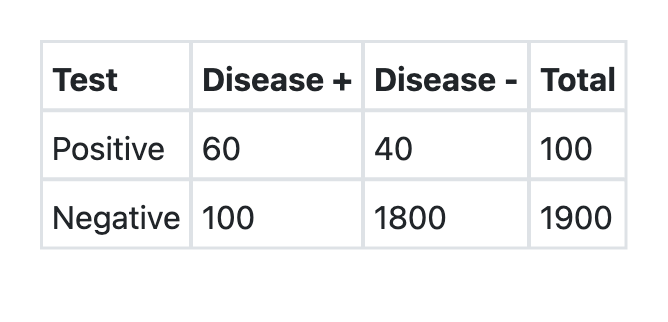
A new test was developed for detection of COVID-19. What is the sensitivity of the test as per the information provided above?
Which of the following Screening methods for Disease is the least useful?
A rheumatologist is interested in studying the association between osteoporosis and the risk of sustaining a distal radius fracture. To explore this association, she develops a retrospective study design in which she identifies patients in a large institutional database over the age of 55 with and without osteoporosis, then follows them over a 10-year period to identify cases of distal radius fracture. She matches patients on age, sex, and body mass index to control for known confounding. After completing the study, she finds that patients with osteoporosis were at an increased risk of developing distal radius fractures. Which of the following study designs did this investigator use in this case?
A researcher is investigating whether there is an association between the use of social media in teenagers and bipolar disorder. In order to study this potential relationship, she collects data from people who have bipolar disorder and matched controls without the disorder. She then asks how much on average these individuals used social media in the 3 years prior to their diagnosis. This continuous data is divided into 2 groups: those who used more than 2 hours per day and those who used less than 2 hours per day. She finds that out of 1000 subjects, 500 had bipolar disorder of which 300 used social media more than 2 hours per day. She also finds that 400 subjects who did not have the disorder also did not use social media more than 2 hours per day. Which of the following is the odds ratio for development of bipolar disorder after being exposed to more social media?
Which of the following is the most important indicator for measuring the communicability of a disease?
What is the death rate among cholera-affected individuals in a population of 5000, where 50 people are affected by cholera, and 10 of these individuals have died?
Want unlimited practice?
Get full access to all questions, explanations, and performance tracking.
Scan to download app